This is topic Shutting down at night in forum Film Handlers' Forum at Film-Tech Forum ARCHIVE.
To visit this topic, use this URL:
https://ft-forum.com/ft/cgi-bin/ubb/ultimatebb.cgi?ubb=get_topic;f=1;t=003593
Posted by Ken Lackner (Member # 1002) on 06-16-2002, 12:28 AM:
Do you turn your amps off before you turn off the breaker to the sound cabinet? What about the monitor? What about the processor? I've never heard of doing that before, but that's what they do at my theater. It certainly could not hurt, but I was just curious as to how necessary it is. Especially turning off the processor. (We have the CP650, and it has a power/bypass button on the front panel rather than behind the panel like previous Dolby processors, but I don't think it's meant to be used as a daily power button.)
Posted by Michael Wohlford (Member # 905) on 06-16-2002, 01:01 AM:
Why do you want to know? We just use the main circuit breaker panel for all things. Platters, sound racks, projectors, wtc.
Posted by Steven Gorsky (Member # 603) on 06-16-2002, 01:06 AM:
I can't think of any problems with doing that, except whoever opens better make sure they turn on everything. I can see it now, on the walkie talkie - projection, there is no dialog in number 5, only the music. Oops. Worse if no one notices something like an amp not turned on, and a tech get called in thinking its a blown speaker or bad amp, only just to turn it on. At the AMC I previously worked at we didn't switch off individual things, but one time someone didn't get all the breakers, and missed the one for the exhaust fan. They swore the got all the breakers, so the taped the failsafe switch up so they could run the projector. They had run several shows that way before I got a chance to come and check it out (two seperate theatres in one mall, I was working the other). Needless to say that was one of the breakers that I put a breaker lock on.
Steven Gorsky
Posted by Paul Mayer (Member # 355) on 06-16-2002, 01:09 AM:
At the places I've seen using the CP-650, they either kill the rack power at the breaker panel or the automation shuts the console and rack down. I don't think there's a need to also switch each item off using its own switch--doing so just puts more wear and tear on said switches IMO.Edit: Who shuts down?  At the Caesars Palace Omnimax our Paramount Sound amps stayed on for the entire 21 years that the place existed (minus the occasional power failure)!
Paul
Lame Mercenary Projectionist
"When the money runs out, so does I."
Posted by Brad Miller (Member # 2) on 06-16-2002, 01:22 AM:
Assuming the installers put thought into how they wired things into the breaker panel, a standard policy of mine is:Power up - hit the top breaker first and work your way down
Power down - hit the bottom breaker first and work your way up
The theory there being that way things are powered on/off in a desired order (like shutting off the amps before the crossover). Not all installations are wired with that mindset though.
I'm with Paul, turning on/off each item using the switch on the unit is just begging for the switch to die prematurely. Bear in mind that any local electrician can change out a breaker in the panel, but only a tech will be able to get inside the piece of equipment and wire around that power button.
Posted by Joe Beres (Member # 678) on 06-16-2002, 01:24 AM:
At my past job, we always left the 650 powered up. As far as the other issues are concerned, turning your amps on last and turning them off first will avoid those loud pops that can, on rare occasions, do some damage to your speakers. I'm sure that's one of the reasons why your co-workers power up and down in the sequence they do.
Posted by Dave Williams (Member # 299) on 06-16-2002, 01:27 AM:
When it comes to really expensive audio equipment, keep this in mind...ALWAYS... power up your amps last...
ALWAYS... power down your amps first...
If you do this, you will avoid costly speaker repair...
Ever hear that loud pop if you dont? Thats the spirit of the speaker letting you know you hurt its feelings, and wont feel much like coming to work tomorrow.
Also, to avoid any potential power spikes, make sure that all of your amps, processors (unless powered directly by the breaker), digital processors, etc, are OFF when you turn on the main breakers, then power them up, then power up your amps.
Dave
Posted by Ken Lackner (Member # 1002) on 06-16-2002, 01:45 AM:
Interesting. I've never heard of turning off the processors before the breakers before. For older processors, would this mean opening up the panel and hitting the bypass switch? Or is it OK to just hit the breaker?
Posted by Brad Miller (Member # 2) on 06-16-2002, 01:57 AM:
I think you are just misunderstanding what everyone is saying.This is the one thing everyone agrees on: Next time you work at the theater, find out which breakers control the amplifiers and mark them (perhaps with a piece of tape). Then just make it a rule that in the morning those breakers are the LAST ones turned on. At night, those marked breakers are the FIRST ones turned off. At night, if you turn off the processor and/or crossover before the amplifiers, you could send a loud BLAM through the speakers and damage them. The reverse can happen in the morning.
The other recommendation is to use only the breakers and not the equipment's power switches. Like I pointed out earlier, my reasoning is that the breakers are cheap and any electrician can change them. That's not the case when the power switch on your equipment dies. Dave is recommending using the power switches on the equipment itself with the reasoning of possible power spikes.
Posted by Ken Lackner (Member # 1002) on 06-16-2002, 02:02 AM:
To my knowledge, the entire sound system is on one breaker. I know that everything in the sound rack is (processor, monitor, crossover, amps). Not sure about the speakers. In that case, it is my understanding that the recommendation is to turn off the power switches on the actual amps before hitting the breakers. Right?
Posted by Brad Miller (Member # 2) on 06-16-2002, 02:06 AM:
One breaker??? ONE??? Unless you're running a low powered system, that's just not enough to wire things to code, as standard 110v outlets are only rated for a maximum of 20A. How many amplifiers do you have in the rack? What brand/model are they?The speakers are connected to the amps. There is no such things as powering down a speaker.
And yes, if everything is really only on one breaker, then you have no other alternative than to power down the amplifiers directly, then power off the breaker. That sounds like a poor installation to me though.
Posted by Ken Lackner (Member # 1002) on 06-16-2002, 02:18 AM:
OK, let me clarify. The breakers that we use on a nightly basis are the ones on the console. We never touch the breaker boxes on the wall. I suppose the box on the wall could have one breaker for each peice of equipment.
Posted by Steven Gorsky (Member # 603) on 06-16-2002, 03:05 AM:
One breaker is enough if it is controlling a contactor. It can also be wired so one breaker will shut down the console and the sound rack.One more thing, don't QSC amps (and some others) have some kind of protection on the speakers when powered down?
Steven Gorsky
Posted by Manny Knowles (Member # 1171) on 06-16-2002, 05:00 AM:
Here in The Bahamas – where power surges and total electrical failures are quite common – we shut EVERYTHING down at night.Shut the actual things off. Then open the breakers.
Turn the sound rack on top-to-bottom (amps last)
Turn the sound rack off in reverse (amps first)
There is no power button on the CP-45 and the one for the CP-500 is inside so nobody shuts them on/off, except with the breaker.
Yes, it's true...this is murder on the actual breaker switches. I guess I replace maybe two switches per year. On the other hand, I've never had to replace an amplifier or a processor. Not a bad trade-off.
Posted by Jamie Sanson (Member # 1161) on 06-16-2002, 07:17 AM:
Most of todays amps have protection for input/output DC offsets at turn-on/turn-off including QSC amps.So it dosen't matter if you don't switch them of at the amp.
Posted by Barry Hans (Member # 477) on 06-16-2002, 08:54 AM:
When I worked at a film society on a university campus the sound system equipment was never shut down. At the Imax I work the sound system is never shut down. I have seen no amp failures or processor failures at either place. I adopted the idea at my theatre and have not had any problems in doing so.
Posted by Manny Knowles (Member # 1171) on 06-16-2002, 10:05 AM:
What does it do to an electricity bill to leave that much equipment running 24/7 ?
Posted by Giorgio Volpi (Member # 1182) on 06-16-2002, 10:53 AM:
First: breakers are not switches; they are a circuit protection.
For this reason it is better to not touch them unless it should be worked on a specific line.
I recommend the following system:
A contactor feeds the entrance of the main circuit breaker panel. The contactor switch is near the projector, and it is a waterproof type, to avoid its involuntary pulse.
The breakers feeds the following minimum lines: threephasic for rectifier, two mono for rack, mono for projector, mono for platter.
All equipments must be turned off with their own switches before turning off the contactor.
Amplifiers must be turned on with an interval of about three seconds between one and another, after turning on the contactor.
Posted by Michael Brown (Member # 890) on 06-16-2002, 11:08 AM:
My rack is connected to just one 'thing on the wall' (Don't know specifically if it is a switch or a breaker)
excluding the cd player and mixer.Power up
Flip the switch on the wall
Switch the amps one one at a time
Power Down
Switch the amps off one at a time
Flip the switch on the wall
Posted by Paul G. Thompson (Member # 655) on 06-16-2002, 12:40 PM:
For years, I have been shutting the booths down from the breaker panels with no ill effects. However, the start-up procedure in many sound systems could be an issue. There are some Cinema Processors that can throw a nasty spike into the power amplifier inputs, so you want to make sure the processor is powered up before the amplifiers are. Many amplifiers are time-delay protected, but some are not.
Posted by Dave Williams (Member # 299) on 06-16-2002, 12:55 PM:
One of the problems with cheap owners is that they will not pay for proper electrical installation. Some of the older buildings would need to be re wired and they just dont want to do it right, so installers are left with having to put entire sound racks on one larger breaker. Hence why having to use the power switches themselves. If this is how it is wired up, you have no alternative but to use the on board device power switch.
Dave
Posted by Ken Lackner (Member # 1002) on 06-16-2002, 02:13 PM:
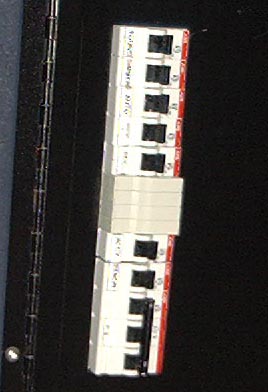
Unless I'm missunderstanding, it seems like some people are recommending shutting off the actual power switches on each item (I'm not talking about older improper instillations that Dave is referring to), and some are recommending just using the breakers. Just so every one knows what I'm using, here is a picture of the switches (are they breakers??) on our consoles: 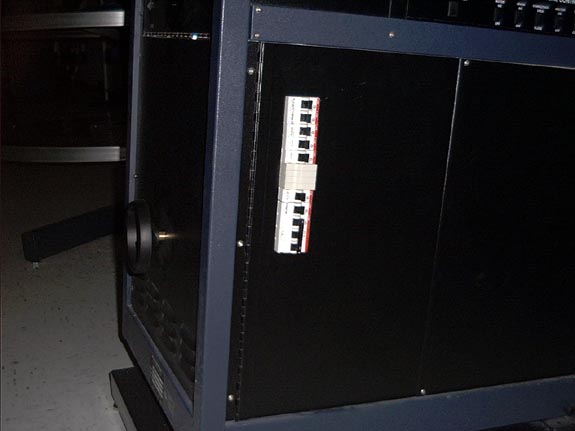
This is our sound rack:
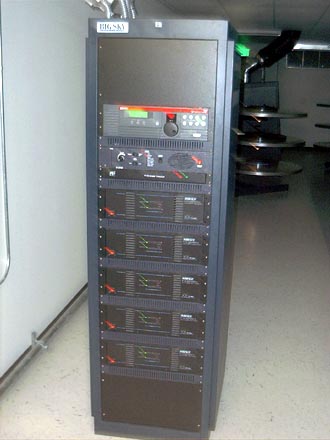
The crossover doesn't have a power switch, but the CP650, the monitor, and the amps all do. And I believe the switch on the console does control a contactor, because you can hear a loud pop (although not as loud as some theaters I've seen) when you turn on the sound rack, whether each piece of equipment was turned of with its power switch or not.
This is a brand new installation, so I can only hope that all the breakers were wired properly. Although we never touch the breaker boxes on the wall, I'll check those out next time I work.
Posted by Manny Knowles (Member # 1171) on 06-16-2002, 02:49 PM:
Ken:If your cinema has prescribed a shut-down procedure you should follow it; I wouldn't advise you to go ahead and develop your own way of doing things on your own. You're going to get a lot of good advice here but just make sure it doesn't put you in harm's way.
Not to be a pessimist or anything, but there's that old adage: "No good deed goes unpunished."
There also tends to be politics in the booths and if it looks like you're making a bid for Booth Lead or Supervisor, your coworkers can start doing stuff to make you look bad. The solution to that is to stay in communication with your superiors regarding what you are doing and why you do things the way you do.
As for tweaking the equipment, just make sure that you don't end up creating extra work for your tech. I've had some booth operators who got ahead of themselves by trying to be "helpful" and they created extra work for me and one of them eventually became an usher as a result.
Just some friendly advice.
Posted by Ken Lackner (Member # 1002) on 06-16-2002, 03:12 PM:
Manny,Thanks for the advice. I'm not tryig to go over anyone's head here. If that's they way they want things done, that's the way I'll do it. I'm just trying to learn what the best way to do things is for the sake of the equipment. This doesn't seem to be too big of an issue, so I'll probablly just drop it. But if there was a policy in place that I felt was harmful for the equipment, I would gather all the facts and tactfully bring it to their attention. As far as tweaking the equipment, I would not do anything without my GM's permission. And I'd show him that I know what I'm doing in. I can admit when I'm in over my head.
Posted by Manny Knowles (Member # 1171) on 06-16-2002, 03:42 PM:
Excellent.I was just having premature pangs of guilt and I wanted to make sure I'd done the whole "disclaimer disclaimer" thing. That's all.
Posted by Thomas Procyk (Member # 1170) on 06-16-2002, 04:49 PM:
When I worked at an older 8-plex built around 1989, we would have to shut off all of the amps one by one before we flipped the switch on the sound rack or it would trip the breaker. I'm not sure what brand/manufacturer these sound racks were as most of the text had rubbed off over the years, but I will try to describe them the best I can:
The entire "sound rack" was a self-contained processor, monitor, and amp unit. They were "christie teal" in color, the larger ones sat on the floor (8 amps in the cabinet) and the smaller ones were wall-mounted (3 to 4 amps in the cabinet). The wall mounted ones would swing open for servicing. I have also seen one of these exact same units in the "cinema" our university was interested in restoring at one point. Ultra Stereo perhaps?
I remember one day one of the amps didn't come on when I flipped its corresponding switch. I went to flip it off, then back on and it shot sparks at me! 
They have since replaced the processors and such with Dolby CP-50s I believe. Perhaps Mr. Donald Dixon who works at the location now (posted here a few months ago) could give more details.
=TMP=
Posted by Steve Kraus (Member # 476) on 06-16-2002, 04:53 PM:
There are power sequencers available which will turn on and off equipment in a specific order with suitable delays between each step.
Posted by Manny Knowles (Member # 1171) on 06-16-2002, 04:58 PM:
Steve: Could you maybe give a manufacturer's name or a specific product? I'd like to look into this as a possibility in the new booths.
Posted by Gordon McLeod (Member # 33) on 06-16-2002, 05:12 PM:
Many crossovers and processors tend to produce a nasty thump on powerup and down so it is best tio power the processor up first and downlast.
Personally I usually insist large systems are left powered up with the fader turned down. Ideling the power drain is very small
Posted by Scott Norwood (Member # 30) on 06-16-2002, 10:23 PM:
I'm actually surprised that more theatres don't have the power sequencers installed. I don't have a brand or model number handy, but I've seen them in "legitimate" theater installations and they work very well.Without a power sequencer, some processors (CP-50 for sure and, I think, CP-200 as well) _will_ damage speakers if you power up the entire rack at once, unless the amps are QSCs or some other type that has a delayed power feature. The CP-500 and CP-65 do not have this "feature," however. I've never seen a CP-650, so I have no idea if this is an issue (probably not, but...). This is the problem that Paul and others have mentioned.
Brad -- I've seen several booths with one breaker for the entire sound rack. Yes, they all have/had low-power sound systems (and weren't digital).
Posted by German Marin (Member # 918) on 06-16-2002, 10:39 PM:
"Do you turn your amps off before you turn off the breaker to the sound cabinet? What about the monitor? What about the processor?"
I do it. I turn the amps, the monitor and the processor off.
I noticed the light in the booth go down for a moment just when I turned the Rack's breakers on, it does mean the the amplifiers needs a lot of current to be turned on. By other hand, my teacher is Mr. Volpi 
Posted by Ken Lackner (Member # 1002) on 06-16-2002, 10:50 PM:
Thomas, I am almost positive you are referring to the RGM CM-4000 processor. There is a manual for it in the Manuals section. Check it out and let us know if that's the one. Did you also have wall-mounted automation of the same greenish color? That's made by RGM as well. (The reason I ask is because all theaters that I've seen that have one also have the other. These are all old Cobb theaters that I speak of.)
Posted by Adam Martin (Member # 641) on 06-16-2002, 11:59 PM:
Our 35mm sound rack power consists of two power strips plugged into what is probably a single circuit. I disclaim any hand in that brainiac move.To answer the question, I have had great success with leaving the sound racks on at night, but muted.
Posted by Thomas Procyk (Member # 1170) on 06-17-2002, 04:46 PM:
Ken -- Yep! The RGM MSS-4000 are the systems which were installed in that theater. Not sure about the automation. Those were also quite worn, but were all black. This was a Cobb theater before Regal acquired it. Even if everything else was off, and the volume turned all the way down, there would be a loud pop from the monitor whenever the system was powered up. They still use the RGM cabinets to house the new Dolby systems!!=TMP=
Posted by Jan Hackett (Member # 1231) on 06-17-2002, 07:36 PM:
In all 35 mm booths I have worked in we powered off the circuit breakers. In my lg forfat booth with 30000 watts of power, I power on processor and IDA then power amps slowly one by one all 12 of them. On shut down I do the reverse. This was dictated to me by Iwerks. I agree with Brad tho that it is easier to replace a breaker than a power switch but I can do both and I have yet had a power switch or breaker fail.------------------
Jan Hackett
Theater Operations Manager
Extreme Screen Dynatheater
NM Museum of Natural History Foundation
Posted by Ken Lackner (Member # 1002) on 06-17-2002, 07:38 PM:
Thomas, since it was a Cobb theater, if the automation was console mounted, it was probablly the console version of the RGM SPATS II.
Posted by David Stambaugh (Member # 1102) on 06-17-2002, 07:46 PM:
An electrician once told me that using circuit breakers as power switches is not recommended because it can cause a breaker's trip rating to gradually rise or fall over a long period of time. In other words a 20A breaker might start functioning as a 22A or 18A breaker (for example).
Posted by Manny Knowles (Member # 1171) on 06-17-2002, 09:35 PM:
Yeah...okay...I'll buy thatHowever, in the five theatres I've worked for and/or serviced over the past, say, ten years...I've only swapped out one three-phase breaker during a "process of elimination" and, as it turned out, that breaker was not the cause of our problem.
So, in fact, I've never actually had a breaker go bad.
My point? I think the electrician has a point, but the odds don't seem to be very high in favor of a premature failure.
Maybe it's a concern if the breakers are just no darn good for starters. I'm using "Square D" and I think that's a well-respected brand. (But I'm sure someone will let me know if it isn't. )
------------------
~Manny.
"The brown acid that is circulating around is not specifically too good."
-- An announcement in the film, "Woodstock: 3 Days of Peace & Music."
Posted by Mike Williams (Member # 1140) on 06-18-2002, 05:51 AM:
How many people leave exhaust fans running after closing? A booth I worked in back in Miami used to have a real humidity problem. It was very difficult to strike any of the bulbs in the morning presumably because of this during the first show. When we started leaving the exhaust fans running at night, the problem went away.
Posted by Steve Guttag (Member # 268) on 06-18-2002, 05:56 AM:
You best have a pretty darn clean booth then or the lamphouses will become the "filter" for the booth.Steve
------------------
"Old projectionists never die, they just changeover!"
Posted by Ken Lackner (Member # 1002) on 06-18-2002, 11:06 AM:
We leave our exhaust fans on all night, too. This is Florida. You pretty much have too.
Posted by Thomas Procyk (Member # 1170) on 06-18-2002, 11:41 AM:
I second that! We had a moisture/condensation problem happen on the reflectors if we didn't leave the exhaust fans on.=TMP=
Posted by Barry Floyd (Member # 385) on 06-18-2002, 12:56 PM:
The church me and my family attend has a sound system that would probably rival many of the theatre systems I've seen. Since I run sound, lighting and media for the church, I work "hands on" with this stuff every week.We have the main console which consist of two 36 channel Mackie boards, a separate rack which holds all of the CD players, tape decks, and the patch bay. Another rack in the booth has all of the wireless mic receivers, effects processors, assisted listening transmitters, etc.. In a room about 20 feet away from the booth we have a "processor rack", which holds all of the cross-overs, digital delays, EQ's, and a bunch of other stuff nobody knows what it does. Then finally in a 8'x10' room behind the choir loft (near the baptistry - approx. 80 feet away from the sound booth), we have the "AMP Room". It has three 8 foot high racks loaded floor to ceiling with Crown Macro-Tech amps and all of the cooling fans for the amps.
To turn this whole system on, you simply insert a key into the main console in the booth, then reach over and press the "START" button. It's one of those "sequencer" type of things, that turns on each set of equipment, in a predetermined order, several seconds apart. If you don't have a key.... you get NO sound - PERIOD. We had a really bad problem with the teenagers trying to figure out the sound system, and finally resulted to "total lock down". To turn the system off - same thing - just in reverse. Turn the key in the opposite direction and hit the "START" button again.
Two weeks ago, someone had a wedding photographer in for a wedding and the remote flash the photographer's assistant used was radio controlled. During the photo session before the wedding... every time the remote flash went off - the video screen started rising out of the back of the choir loft.... it's radio-remote controlled (like a garage door opener).
------------------
Barry Floyd
Floyd Entertainment Group
Nashville, Tennessee
(Drive-In Theatre - Start-Up)
Posted by Dave Williams (Member # 299) on 06-18-2002, 06:26 PM:
SPeaking of radio signals, here in salt lake city, I work part time at a live stage theater called Hale Centre Theatre. We have a million dollar stage system that is truly one of a kind. It is circular, with four quadrants and a center circle. Each of these five sections move up and down either seperate from each other or together, and turn in either direction from a slow crawl to 11 mph to the outside ring, and the center plug can go in the opposite direction of the turn as well, whatever you program. It goes 11 feet into the pit, or five feet up, so we have many amazing things we can do with this stage during the course of a show. Now we have even added a second level to the stage, giving us two stages to play with, so we can do scene changes on the lower level in the pit while the actors play on the upper level. And now back to why the hell you would care, when it was first installed, it used radio signals to control the movements. This resulted in constant shutdowns during productions in front of live audiences. Now we run off of a hardware network with an additional hardwire backup line in case of failure. Now the only thing that stops the stage is if an actor is smart enough to forget to get out of its way and sets off one of its extremely sensitive sensors.
Dave
Posted by Phil Hill (Member # 371) on 06-18-2002, 08:22 PM:
There are "switch duty" rated circuit breakers available.
>>> Phil