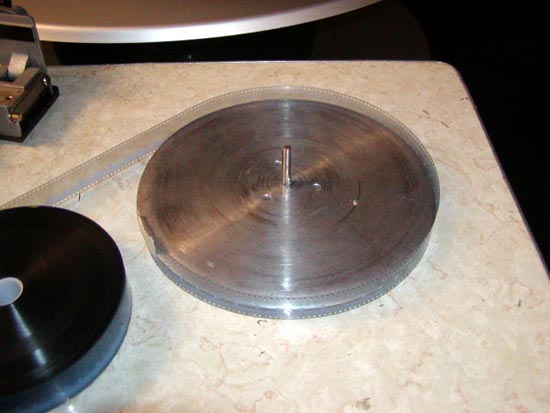
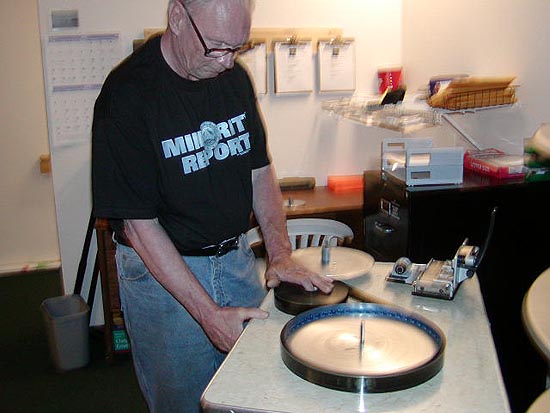
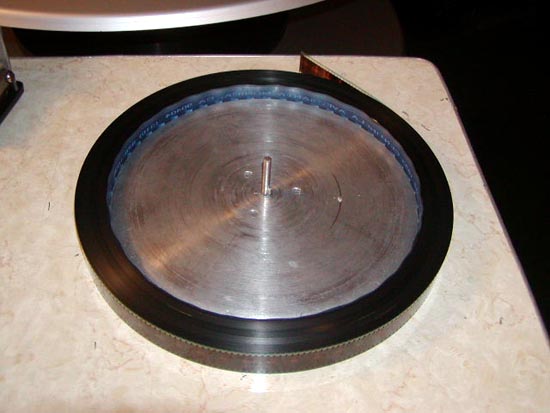
However, there are two issues that the operator should be aware of. One is sometimes the diameter of the new previews may be bigger than what what was removed, but I have found a way to get around that. The other is some of the state-of-the-art platters that are electronically controlled may not like it, and might fall behind in feeding until the previews are expended on that particular showing. It might be necessary to help it along a little.
The other pictures just show how I use a "straight shot" from the MUT to the platter without using any buffer clusters, springs, rollers, etc. One of those pictures has the appearance that the film is dragging on the platter, but that is a camera parallax error.
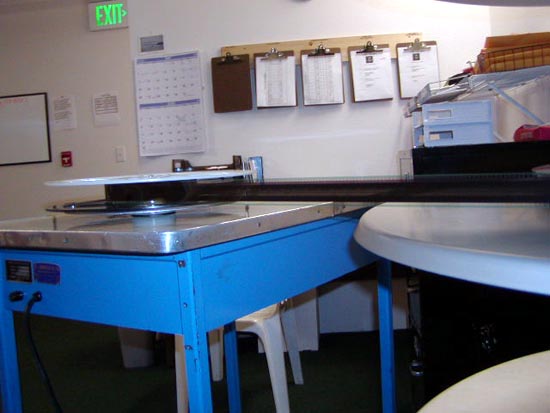
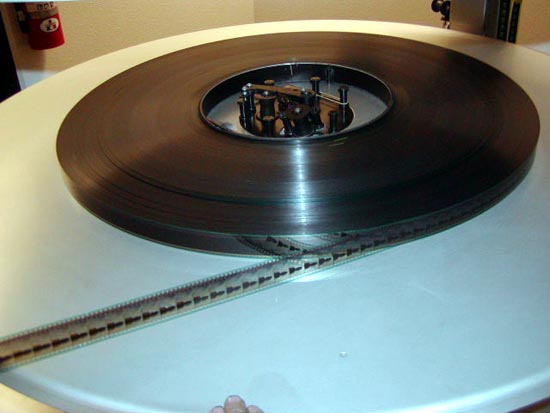
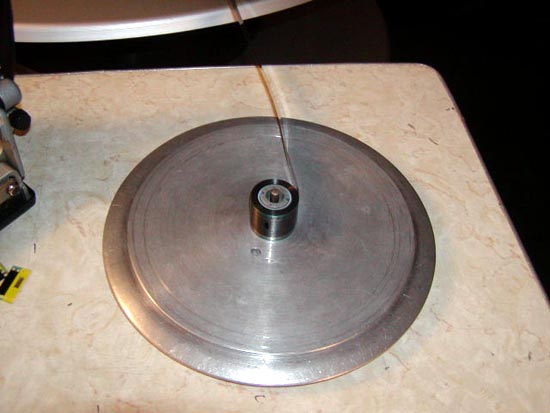
BTW, cool idea for a homemade trailer reel! Could you use a larger trailer flange so the platters do not have to be hand spinned while the trailers play through?

Secondly, if the center platter does break, there are many other center platters to choose from in a multi-plex. Also, if projectionist plans correctly, having a center deck available to do the work with is not an issue.
As a rule, during build-up and tear down nights, I keep the center platter open on as many machines as possible. 
Brad, the trailer reel was manufactured by Neumade. And, the reason why you see no rollers on the MUT is because I took them off and threw them away. 
Actually for the most part, hand spinning may not be necessary for most platters unless they are grossly out of adjustment. Potts, Film Systems, Strong International, Xetron, or Christie AW-3's. seem to handle it very well if they are somewhat in the ballpark as far as timing is concerned.
Actually, the Christie AW-3 will probably handle it the best because the entire operating reference is not set by a variac like the other older style machines mentioned earlier.
Peter, do you still have those "dogs?" I'll come down and pick them up so I can modify them with bigger tops to handle 2 each 6,000 foot reels. Then they are big enough to use as a work table, too. I have done that to two of them, and the projectionists love them.
Except for a blown fuse one day, i've never had a problem with them in the year i've had to use them. As opposed to a particular strong platter system i used this past weekend which tossed the print on me once and had to be helped out the second time! I haven't had the middle-platter-only be much of an issue, to my own suprise.
Paul, how did you plug the Super Platter MUT into the strong platters for build up? Or are you just breaking down that print? I can't tell.
As for the platter tossing the print, I have traced that to excessive vibration. When the P/O head calls for more film, you can hear the vibration of the drive "O" rings shaking loud enough where the platter's disk lets out a growl with the dish beating on the outriggers. A new set of "O" drive rings and some cork spacers to wedge between the outriggers and the bottom of the platter dish should correct that problem.
I like this method because there are no rollers to thread through during build-up to cause any early scratches. The only problem that I had is that there is no back tension, so I would put the movie on 6k reels and use my hand with a rag to provide the tension. In some ways (not all), I prefer the horizontal to the vertical.
Even when I had the option of building/tearing down on any platter (with Christie AW3s) i usually used the middle platter anyway. It was the easiest to work off of. This approach just simplifies the process, imho. Plus, i like the fake-marble laminate top on the CFS tables. It adds a touch of class!
By the way, Strong uses the horizontal MUT with their platters. I don't care for them because the table sits too low. The use of guidance rollers and other crap is necessary no matter what platter you build on. The other thing I don't like about it...It is just simply physically too small. There is hardly enough room to place a splicer on it. If that table is stripped of all the rollers, springs, and extra junk and then raised somehow to the correct height, the exact same things can be done with it as I am doing with the CFS MUT's. However, a special flange would have to be made to do the previews like I do. The the spindle is too high from the table top.
Adam, the answer is yes and no.
Yes to the fact that it is used more to build a show. But the belts only cost about a buck, and they should be changed when they show signs of wear anyway.
No to the fact that the platter drives are mechanically disconnected by the levers while breaking down a print, and the platters are allowed to free wheel. While dis-mounting a print, "One hand on the throttle and one hand on the brake". Darron just mentioned the technique. Of course, some coordination is required.
------------------
Jan Hackett
Theater Operations Manager
Extreme Screen Dynatheater
NM Museum of Natural History Foundation
Having said that, I can't imagine using something like this in place of a standard rewind bench. Rewind benches serve many purposes and rewinding is only one of them--in a booth without a rewind bench, where do you keep stuff like pens, splicers, sync blocks, show schedules, walkie-talkies, spare film cores, split reels, etc? Ordinarily, all of these items can be found on, above, or below the bench. What do you use as a desk when leaving notes for the next day's operator? How do you inspect prints by running them through your fingers on a horizontal MUT, anyway? If I somehow got stuck in a booth without a proper rewind bench, I'd probably go insane. Actually, I'd probably just bring in a pair of handcrank rewinds and clamp them to a table.
Personally, I don't find the CFS to be that bad of a machine. True, if they used the old 1964 Dodge Dart breaker points, well, those were a disaster. But with the new retrofits that were available, they ran great!
The biggest problem with them was not the fault of the machine itself. Projectionists just did not understand how they worked. With any machine that uses the same basic principle, Projectionists might think if there is a pay-out problem, it is a pay-out problem, period. Not so....More often than not, it is a take-up problem that is causing the pay-out problem unless someone had a switch in the wrong position and fried a resistor inside the motor housing. Thus, they never seem to be able to fix the problem.
Paul, I have never seen the trailer flange pictured. Is it part of the table's spindle, or does it fit over the spindle like a regular trailer flange? So you wind trailers onto the flange, which is on the right-hand spindle, and they form a ring, which you can just drop into the print. Is that correct?
Yes, Strong's table is kinda small, and it is hard to work with a splicer, but you can wind 6000-to-6000 without modifying the table.
I like the horizontal design better than the vertical, but maybe that's just because that's what I learned with. And why is it such a problem to thread the film through rollers? I never minded that.
Ken, what you call the trailer flange is the table's spindle.
Yes, the Strong can handle 6,000 foot reels. That's what I like about them, and presently the ONLY thing I like about them.
But soon, my CFS tables will be able to handle them, too.
As far as the roller threading is concerned, too many parts to thread through = possible derailment and film scratches. Seen it happen too many times with too many airheads.
**********************************************************************
Ken also asked:
So you wind trailers onto the flange, which is on the right-hand spindle, and they form a ring, which you can just drop into the print. Is that correct?
Ken, that is correct. But you might have to pull some or all the old trailers off so the new ones will fit. Again, an important note: Wind them sound track down...then flip them so the sound track is up when you drop them in the center and splice them to the head of the movie.
**********************************************************************
Getting back to Adam's comment where he asked:
Paul, how did you plug the Super Platter MUT into the strong platters for build up? Or are you just breaking down that print? I can't tell.
Adam, that answer is this: Any time a film is being built up, the left-hand spindle is used. The right hand spindle is used only during tear-down. Be sure to release the drives on the platter motors. If you don't, you'll overload the MUT motor and blow a fuse. In addition to that, the drive belts on the actual platter motors will quickly fail.
**********************************************************************
I guess most manufacturers assumed a booth comes with a make-up/inspection bench. Unfortunately, this is not true unless it is a hold-over from a manual carbon arc booth. As far as the make-up/inspection bench is concerned, they can be very expensive.
Personally, I prefer the old ones with the hand rewinds on them, along with the old Goldberg electric rewind.
I'll keep the coffee pot on for you.