This is topic Physics example on the booth in forum Film Handlers' Forum at Film-Tech Forum ARCHIVE.
To visit this topic, use this URL:
https://ft-forum.com/ft/cgi-bin/ubb/ultimatebb.cgi?ubb=get_topic;f=1;t=003598
Posted by German Marin (Member # 918) on 06-16-2002, 09:27 PM:
I was checking some items on the booth when I started to see the light on the wall. That light come from inner console of Christie SCL 20. The most peculiar that I saw in this projected light was the red item it has (cathode).
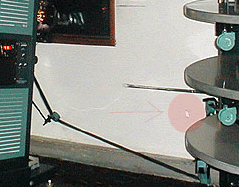
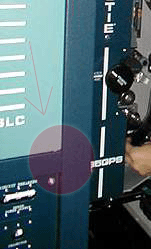
I remember that experiment I did on the school when between a wall and a candle I put an obstacle with a hole. I did can see the candle projected on the wall but head down. Then I put a paper with a hole and I saw the arc, xenon, even the positive wire on the wall, the entire xenon bulb.
Has been It done intentionally? Someone has seen the same I've seen? Or I didn't know about that...
Posted by John Pytlak (Member # 331) on 06-16-2002, 09:57 PM:
A small hole in the lamphouse is probably acting like a "pinhole" lens:
http://www.kodak.com/global/en/consumer/education/lessonPlans/pinholeCamera/
http://www.skypoint.com/members/escargo/ppp.html ------------------
John P. Pytlak, Senior Technical Specialist
Worldwide Technical Services, Entertainment Imaging
Research Labs, Building 69, Room 7525A
Rochester, New York, 14650-1922 USA
Tel: +1 585 477 5325 Cell: +1 585 781 4036 Fax: +1 585 722 7243
e-mail: john.pytlak@kodak.com
Web site: http://www.kodak.com/go/motion
Posted by German Marin (Member # 918) on 06-16-2002, 10:50 PM:
Yes, you are right, John. My question is, Was this "pinhole" made intencionally? The Christie console has not a glass-arc port to see into the lamphouse, I think it's the way that christie's eng. found to see the arc.
Posted by Paul G. Thompson (Member # 655) on 06-17-2002, 12:53 AM:
Probably the question is who made the pinhole, and for what purpose.This reminds me of the carbon arc days when a small hole was drilled into the lamphouse so the arc image could be projected on the wall.
That way, the arc target could be viewed by the projectionist without him or her getting out of the easy chair to check the trim. 
In your case, it could determine a number of abnormal things to a very keen eye at a quick glance while walking past the machine.
Posted by Barry Floyd (Member # 385) on 06-17-2002, 10:52 AM:
I've got several lighting fixtures I use in my mobile DJ setup that when lit up actually project the entire contents of the fixture onto the wall. I don't think it's intentional, but it does happen.It's weird. If the light is stationary... you can clearly see the bulb, filiament, the porcelain socket, the cloth covered wiring leads to the socket, and even the heads of the phillips head screws that hold the socket in place - all projected on the wall. If the motor on the fixture is turning, all you see is just the colored lights moving across the floor and wall.
The fixtures have a focused lens across the front of them, so I guess that's why everything is so clearly defined.
Posted by Manny Knowles (Member # 1171) on 06-17-2002, 11:07 AM:
Each of my Christie reflectors has a pinhole through which the Xenon arc is projected onto a translucent white window on the side panel of the console. It is to reveal if magnet adjustment is required.
Posted by Paul Konen (Member # 41) on 06-17-2002, 01:17 PM:
I did this today and sure enough, you can see the the buld, arc, and the orange glowing piece. The hole is there because they couldn't shape the metal around the x,y and z axis or didn't want to.
Posted by Gerard S. Cohen (Member # 994) on 06-17-2002, 05:44 PM:
Pinhole optics are fascinating things, and in the 19th Century many were built as tourist attractions, usually substituting a lens for the pinhole, to make a real Camera Obscura, with the viewers sitting inside. Often a mirror was used to invert the image right-side-up.
Some, resembling short lighthouses, still exist, especially in the U.K., where they are preserved and maintained by landmark clubs.
The best known one in the USA is in California, where visitors can sit inside and see the seals cavorting on the rocks far in the distance.Several years ago, the Movie Machine Society and the NY Photographic Society held symposia at George Eastman House in Rochester, where a camera obscura was set up in a circular tent, providing bright views
of the Eastman Estate gardens on a table. As the lens rotated 360'
the viewer got a panoramic view.
I used to have my students make pinhole cameras from coffee cans and cereal boxes, and some noteworthy prints resulted.
And I've noticed upside-down images of the street traffic outside theatres on an otherwise blank screen when the auditorium was dark
but a small opening in the rear entry door acted as a pinhole.
Posted by Brian Tristam Williams (Member # 1235) on 06-20-2002, 03:47 AM:
As an 18-year old, I used to work till midnight, then sit up till dawn watching CNN.Because I slept all day, I covered my bedroom windows with aluminium foil. Sure enough, there was a pinhole prick in the foil, and, by golly, I didn't need CCTV - I could see perfectly what was going on outside if I simply looked at the wall. And in full colour and high resolution!
Posted by Paul Turner (Member # 832) on 06-20-2002, 04:14 PM:
Much as Gerard did, my photography student's first project was to make a pinhole camera using a shoebox. We would expose photo paper while could be dropped into the Dektol for immediate results (which made the kids impatient when it came to processing negs and making prints). We could sandwhich the exposed paper with raw paper, hit it with an enlarger lamp or sunlight, and het a positive. Even tho I do most of my "serious" photography with a 4x5 or 120, I still like to come up with fun pinhole cameras and make prints. Making a small camera with a film canister works great and the curve of the paper makes an interesting image. Waiting to have the time to make a pinhole digital . . . .
Posted by Randy Stankey (Member # 64) on 06-20-2002, 04:40 PM:
In my first photography class in High School we made pinhole cameras using an empty Quaker Oats canister.We cut it down until it was about 6" tall, then used an X-Acto Knife to cut a square hole, about 1" square, in the side about 1/2 way up. A pinhole was punched into a square of thin sheet metal, which was cut out of the bottom of an "E-Z Foil" pie pan. That was fixed to the inside of the "camera with a piece of gaffer's tape. The "shutter" was made from a piece of the container, left over from what was cut off the top. It was fixed to the outside of the "camera" with another piece of gaff tape, so as to make a flap.
Our teacher cut us a bunch of squares of photo paper in the darkroom and put them into "paper safes" that we made from more oatmeal boxes. Everybody got about 1/2 dozen pieces of paper and we were turned loose to roam the school. (A camera was considered a hall pass IF you were in photography class.) We'd duck into a closet to load our cameras and emerge with a piece of paper loaded into it.
We would set them up on a window ledge, or some place, open the shutter and count to 50 (or whatever). When we were out of paper we'd go back down to the lab and develop them. We made prints by the contact method the same way you detailed, Paul
One time my friend and I snatched a bunch of paper and took our cameras home with us over the weekend. We drove around town taking pictures. We used the trunk of our parent's car as a mobile darkroom.
We got a lot of cool pictures that day... AND a bunch of funny looks from passers-by as we emerged from the trunk of the car with a sawed-off oatmeal box.