
 You'll probably have to rent some 'porta-potties'.

One of the real problems you may run into will be that the space you envision using will be lacking one essential thing that drive-ins have and that is the raked rows. The rows are raked just like rows in theatres so that each row of cars is higher than the one in front of it. The rows also have "risers" (mounds that create a hump) which are added in the front of each row so that front wheels are raised higher than the rear to avoid having the screen cut off by the top of the windshield. Without these, i.e., if you park cars on a flat surface, each car will see not much more than the rear of the car in front of it. This has become a major problem even for DIs with well-designed raked lots due to the proliferation of today's SUVs and mini-vans. I am afraid the flat surface of the ordinary parking lot will not work, or require the screen to be so high up that without a front wheel riser, it will be cut off by the top of the windshield.
Did you ever consider an outdoor Walk-In theatre as an alternative? I can tell you they are very popular as our operation of the past 4 years has proven. People park their cars, then come with their blankets and folding chairs and sit in the area in front of the screen. This still has the same problem of a flat viewing area -- people not being able to see over the heads of the people in front of them, but as we've found out in our out-door, people are quite good about planting themselves in a way so as to avoid blocking each other. It is still good to have an area that is sloped. We have seats in the front of the screen but the larger area behind the seats is on a gentle hill and this helps with sight lines. Parks are particularly well suited for this type of operation because they usually already have rest room facilities and sometimes even a staging area where placing a screen would be a lot easier than dealing with a space totally foreign to public gatherings. I saw this done on a beach also. The screen was setup on a boardwalk and the projection system in a van that drove on the beach. The local merchants loved it because it kept a large number of people on the beach after dark when the crowds typically would thin out. One of the merchants let the operators tap into their AC supply.
At the park, AC is readily available for us. Here are pictures of our site: http://www.146.245.155.204/cinema/celebrate/moviespark.htm or go to the Pictures section here and go to Movies in the Park.
Of course for an outdoor walk-in you will need to consider a sound system instead of FM transmission. This will be more expensive than a transmitter and will add weight that will have to be moved around....speakers that need to be set up, etc.
Another thought: we learned very quickly that, although the projectors could be mounted on the top "floor" of the scaffold booth, in effect, on its roof (which is what I think you are thinking about on top of the trailer), it became immediately apparent to us with the very first downpour, that the booth needed to be an enclosed room that would be made fairly wind and rain-proof -- or at least could be made rain-proof in short order. The front of our booth is opened, but the tarp is piled on the ground and can be raised in place in a matter of a minute or two with a few good stage hands in case the weather threatens. And I will also ask, why go with a platter? I assume you will only be running one show? You might find a change-over system easier to deal with, time-wise for a single run of your features. Then I have to wonder what kind of trouble a platter might encounter with gusty winds. That's a big surface that might not deal well with wind blowing across it and especially blowing the film in its transverse path.
Very important -- I hope you have a number of good people involved with the project beside yourself. Usually on first blush it may seem like you can get away with two or three people on such a project....that your passion for it be all you need. Then the reality of an actual setup and screening happens with the necessary footwork involved with marketing, getting the local merchants on board, booking the films, dealing with security. etc.,-- you will realize that it all takes lots of time, lots of work and, besides your passion, it takes other reliable people who you can trust. You may want to consider getting committments from good, reliable staff personnel as the FIRST thing to make the project viable; I submit that choosing them will be as important to the success of the project as any equipment you might choose.
I, as I am sure everyone else here, wish you tons of luck with this project; it is very ambitious and has quite a number of obstacles to surmount. Do keep us posted as to your progress, and with PICTURES if you can.
Anyway, I was expecting the typical low-res, washed-out video projection they usually use for outdoor screenings at the school, but they actually brought in a trailer with a 35mm projector, platter system, and the whole nine yards!
They wouldn't let me near the booth because the trailer was being used as a stage for the entire day. The set-up was not very impressive as they had a HUGE and LOUD generator powering the equipment, which made it hard to hear the movie. Mike, with a little "tweaking" maybe you could use a similar concept for your mobile drive-in. Here are some pictures of the set-up:
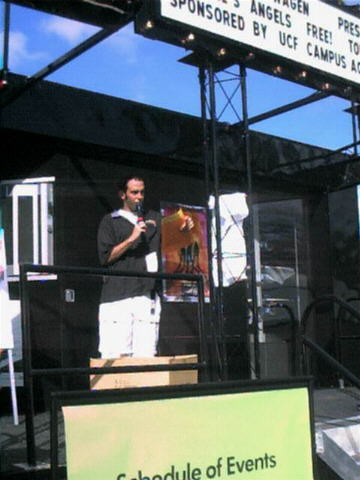
Stage area with the unfunny announcer guy. You can see the Strong platter system through the window on the right. The door to the booth is right behind the guy. (you can see the door handle to the left) Small booth!
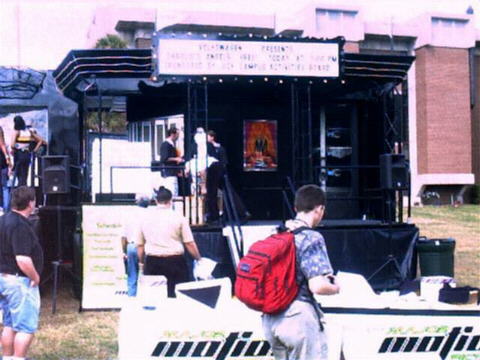
A wider shot of the trailer/stage/booth.
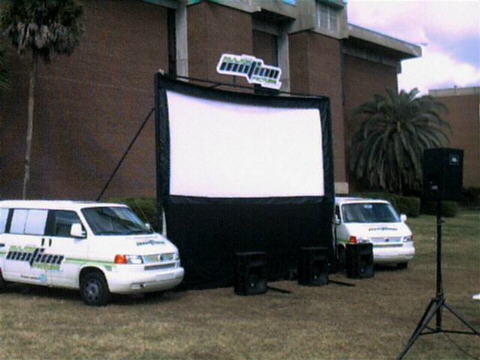
The screen that was erected behind the trailer. Using the vans as comparison, you can see it wasn't very large. Not sure what aspect ratio the masking is set for, but it sure doesn't look like Scope. (Charlie's Angels was a Scope film) Note the speaker stand on the right. That little sliver of white is the start of...
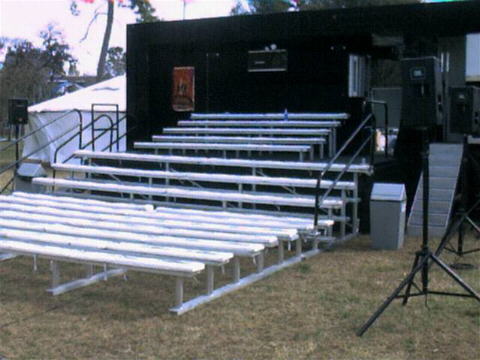
The seating area and booth. Comfortable metal bleachers for about 50 people. The other 250 or so that showed up sat on the grass. Don't know where the generator was, but it sounded like (and smelled like) it was under that top section of bleachers. Comparing this picture with the previous one in regards to the mentioned speaker, you can see how close that first row is to the screen!
=TMP=
Why were they using a platter? That seems like it would be about the worst possible film transport device for outdoor screenings, since it's big and needs to be level in order to work properly (which is probably difficult in a trailer). I would assume that they disassembled the platter (or at least removed the decks) for transport, too.
Trailer-type booths are probably one of the few situations where a large-reel tower system (or Eprad double-MUT) probably makes sense, as it would take up less space than a platter and could be transported intact. Also, unlike a changeover system, there wouldn't be any need for a full rewind bench and it would also avoid needing generator capacity for the second lamphouse.
One of the Kinoton brochures that Brad sent me from Showest has pictures of a projector head sitting on top of a base which holds two 12k' reels of film; it feeds from one side of the machine and takes up on the other. Something like this would probably be ideal for a portable/trailer booth, as it is small and probably doesn't need to be disassembled for travel (aside from probably removing the xenon bulb and storing the reels elsewhere to avoid bending the shafts).
I doubt they are very concerned about the outdoor aspect of using a platter because technically, it is indoors (inside the trailer) behind glass doors. It might have been air conditioned. I also tried to venture close enough to peak inside but I couldn't get close enough.
The picture quality and brightness was ok considering it was a small screen and not throwing very far.
Ken's right... bathroom's are a must. Twice as many for the women as for men.
If your soundhead has a flywheel..... ALWAYS REMOVE IT BEFORE TRANSPORT!! Learned my lesson on that one. The last time I moved the equipment from the house up to the storage building (1/4 mile away) - I left the flywheel on the soundhead. In less than one minute of travel time from one location to the next, I bent the  out of the sound drum shaft on a RCA 9030.
I'd be worried about transporting a 4KW Xenon left mounted in the lamphouse too.
FM Transmitter... If you insist on Ramsey, go with the FM-100 (pre-assembled). Better yet, the Broadcast Warehouse TX-1 transmitter is good too.
If you can keep the rows of parking spaced far enough apart, you "may" be able to do without the ramps, however, the bottom of your screen will have to be at least 10'-12' off the ground.
Always emphasize the speed and quality of the food you are serving. Remember, a drive-in theatre is REALLY a fast-food restaurant with a limited menu, limited operating hours, that also happens to show movies in the parking lot.
------------------
Barry Floyd
Floyd Entertainment Group
Nashville, Tennessee
(Drive-In Theatre - Start-Up)
While your working out the equipment details consider looking for a good lawyer (I know, it's an oxymoron) who will work with you and not just take your money. You'll need to really cover your ass when it comes to liability, local laws and restrictions. They will be different at each stop if this ends up a traveling show.
An arc lamp is the most efficient method of illuminating even a moderate sized screen. Also, standard SMPTE 196M specifies "the light reflected from the screen in theaters shall have a spectral distribution approximating that of a blackbody at a color temperature of 5400 K +600 K -200 K, the use of short-arc xenon light sources being assumed." Tungsten halogen lamps have a much lower (yellower) color temperature.
------------------
John P. Pytlak, Senior Technical Specialist
Worldwide Technical Services, Entertainment Imaging
Research Labs, Building 69, Room 7525A
Rochester, New York, 14650-1922 USA
Tel: +1 585 477 5325 Cell: +1 585 781 4036 Fax: +1 585 722 7243
e-mail: john.pytlak@kodak.com
Web site: http://www.kodak.com/go/motion
The company also sets up in wineries and parks for outdoor walk-ins.
Good luck with your new venture and sorry about the job.
We use a Vic 5 with 4000 lamphouse, 3K lamp. Strong Switch mode
3ph rectifier. Portable single sided tower that splits in two and sits on a simple base. We use an FM transmitter for Drive-In or 4 JBL units 1600w total amp power. At present we broadcast and play in Left & Right only via a simple mixerdesk providing EQ. We will be moving to a Dolby processor in time allowing us to have four track for the non Drive-In shows. Two generators, provided locally, provide power for the projection van and at the screen end.
Depending on the setup we either transmit to the screen and amplify from there or hard wire from the projection van. The screen requires a Bouncy-Castle type fan to be running at all times.
Four water filled ballast tanks are needed to secure the screen. These are normally filled by the local fire department on the morning of the shows.
All in all the equipment and screen can be setup and running in about 90 min. Breaking down takes under an hour. It all fits into a luton van. A minimum of four people are required for the setup/break down of the screen.
The last hire we serviced was for screen only in Trafalgar Square London. Very impressive it looked too.... what a location.

This is a side view taking in one of the fountains....

I have another two hires over the next couple of weeks and will take some pictures of the equipment van. Anyone interested let me know.
Regards Ken
I've emailed and asked them to do someting about it!!