This is topic Shape of intermittent cam. in forum Film Handlers' Forum at Film-Tech Forum ARCHIVE.
To visit this topic, use this URL:
https://ft-forum.com/ft/cgi-bin/ubb/ultimatebb.cgi?ubb=get_topic;f=1;t=003669
Posted by Brian Tristam Williams (Member # 1235) on 07-02-2002, 01:18 PM:
Tim Reed, I tried to e-mail you on this, but your address is not made public.I saw the animation in the 'Videos' section, and I want to build a larger-than-life working model of this. Someone I know, who's a bit of a mechanical engineer, says that this shape will never work. I've researched this, and I see that there are several ways of creating an intermittent motion. Is the animation merely a fanciful example, or is that the shape of most real intermittents?
If this model will work, could you send me a 3D object file of it, Tim? The engineering shop needs it on disk to build me one.
------------------
"One man can make a difference."
Posted by Josh Jones (Member # 447) on 07-02-2002, 01:58 PM:
That is really what they look like. I'll post a pic of what a brenkert movement looks like.*Pic here*
As you can see, the "starwheel" does indeed posses a star shape.
Josh
Posted by Brian Tristam Williams (Member # 1235) on 07-02-2002, 02:26 PM:
Well I didn't see your pic (unless your asterisks represented the starwheel). 
Anyhow, I wasn't questioning the star-wheel, but rather the cam that engages it - I've seen different shapes for this.
Posted by Paul Cassidy (Member # 951) on 07-02-2002, 02:46 PM:
Pehaps the easy way to do this is to get old movement to see how it works , but it has been working for over 100 years so I don't know how your engineer friend can't figure out the workings of it , it is soooo simple but clever with very close working tolerances. 
------------------
A KIWI eats,roots & Leaves.
Posted by Josh Jones (Member # 447) on 07-02-2002, 03:05 PM:
Had to rip a movement apart to show how it works 
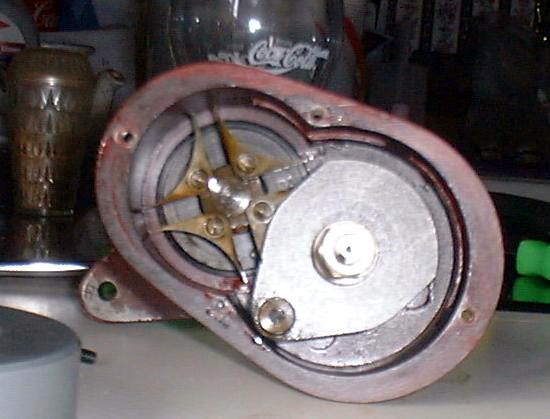
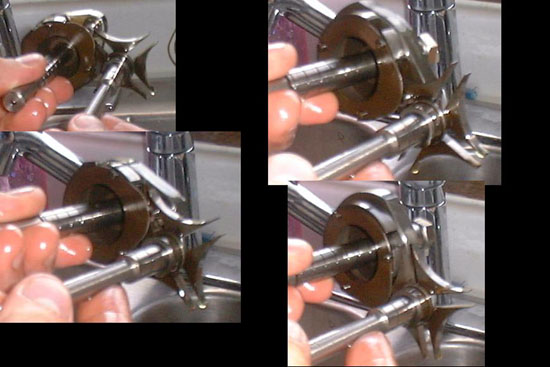
Josh
Posted by Brian Tristam Williams (Member # 1235) on 07-02-2002, 03:28 PM:
You did that just for me, Josh?
Posted by Paul Cassidy (Member # 951) on 07-02-2002, 03:43 PM:
Great work Josh . 
------------------
A KIWI eats,roots & Leaves.
Posted by Gerard S. Cohen (Member # 994) on 07-02-2002, 04:09 PM:
Brian,
You probably know the "star" is also called a "Geneva movement" or "Maltese Cross."
However, an alternative, non-cross intermittant was invented by J. Powers and used on his projectors, although they could be ordered with a conventional cross, pin & cam movement if desired. The Powers
proprietary movement had several pins and cams in place of a cross,
but its use did not become popular. I don't think it was used on non-Powers projectors, but those who used it claimed it worked fine and was smooth and quiet.
Gerard
Posted by Jon Miller (Member # 163) on 07-02-2002, 11:15 PM:
Josh,Thats one impressive intermittent! Is that beast really from a Brenkert? I can't imagine a monster like that being used in an ordinary 35mm machine.
(I've never got up close and personal, so to speak, with a Brenkert.)
Posted by Josh Jones (Member # 447) on 07-02-2002, 11:42 PM:
yes that is really from a brenkert. the star is about 1.5-2.5 inches in diameter, close to the size of a PRO-35 stargear. I was bored today so I took one apart and then put it back together
The second picture shows the cycle the movement goes through during pull-down. all these parts are machined to 1/10,000th of an inch!! Now THAT is precision.Josh
Posted by Josh Jones (Member # 447) on 07-02-2002, 11:48 PM:
John, I see your a simplex man  the simplex machines have smaller stars and cams(xl's), the century's even smaller(at least on the earlier machines, like a C or CC).
Josh
Posted by Paul G. Thompson (Member # 655) on 07-02-2002, 11:53 PM:
John, if you think the star in a Brenkert is big, check out a Ballentyne star! Oops....Josh already said that.
Posted by German Marin (Member # 918) on 07-03-2002, 02:41 AM:
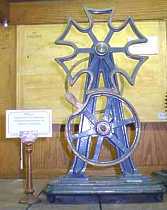
I don't know where is this Maltesse cross and which is its function, but I got this picture from my boss.
Posted by Paul G. Thompson (Member # 655) on 07-03-2002, 04:40 AM:
German, where is the sprocket?
Posted by John Pytlak (Member # 331) on 07-03-2002, 08:52 AM:
Check out the new Kodak "Quickermittent" design, that slightly modifies the 4-slot starwheel and cam to produce a faster pulldown (56 degrees cam rotation instead of 90 degrees), greatly increasing efficiency of illumination: "Design Improvements for Motion Picture Film Projectors"
C.L.DuMont, A.F.Kurtz, B.D.Silverstein, D.H.Kirkpatrick
SMPTE Journal, November 2001, pp 785-791.
The paper is also published in the June 2002 issue of BKSTS Cinema Technology (Volume 15, Number 2).
Prototype starwheels and cams were retrofitted into Century, Simplex and Christie intermittents.
------------------
John P. Pytlak, Senior Technical Specialist
Worldwide Technical Services, Entertainment Imaging
Research Labs, Building 69, Room 7525A
Rochester, New York, 14650-1922 USA
Tel: +1 585 477 5325 Cell: +1 585 781 4036 Fax: +1 585 722 7243
e-mail: john.pytlak@kodak.com
Web site: http://www.kodak.com/go/motion
Posted by Jeff Stricker (Member # 224) on 07-03-2002, 11:57 AM:
John P. any way you could scan and post a sketch of the mods. so we could get an idea of how it works?
Posted by Josh Jones (Member # 447) on 07-03-2002, 12:00 PM:
Sounds like something an old telecine would have.Josh
Posted by John Pytlak (Member # 331) on 07-03-2002, 12:48 PM:
You can see the Kodak patent on line at the US Patent Office website:
http://patft.uspto.gov/netahtml/srchnum.htm Do a search on patent number 6,183,087
Essentially, the Kodak invention uses a unique profile to the starwheel slots to allow the cam pin to provide greater acceleration. Unlike other high speed intermittents, there are no additional linkages or complexity --- just a different shape to the cam and starwheel that can be retrofitted to existing intermittents.
------------------
John P. Pytlak, Senior Technical Specialist
Worldwide Technical Services, Entertainment Imaging
Research Labs, Building 69, Room 7525A
Rochester, New York, 14650-1922 USA
Tel: +1 585 477 5325 Cell: +1 585 781 4036 Fax: +1 585 722 7243
e-mail: john.pytlak@kodak.com
Web site: http://www.kodak.com/go/motion
Posted by Brian Tristam Williams (Member # 1235) on 07-03-2002, 02:43 PM:
German, where did your boss get that picture? Do you have a larger one? Very interesting.
Posted by Paul G. Thompson (Member # 655) on 07-03-2002, 05:55 PM:
I edited my orginal post, but I am curious what it was used in or for. It looks kind of "shipboard-ish" to me....
Posted by Will Kutler (Member # 770) on 07-03-2002, 07:34 PM:
Geneva mechanisms are used for many things. In fact, Berg...a major gear manufacturer out of NY produces some and lists them in their catalog.One very wise and experienced projectionist and tech. once told me that a competitent machinist or toolmaker would have no problem making the parts. Assembling and adjusting an intermittent is another matter...unless you have been properly trained...
As a competitent machinist and die maker, I concour that the parts are straight forward to make...just time consuming!
Posted by German Marin (Member # 918) on 07-03-2002, 10:20 PM:
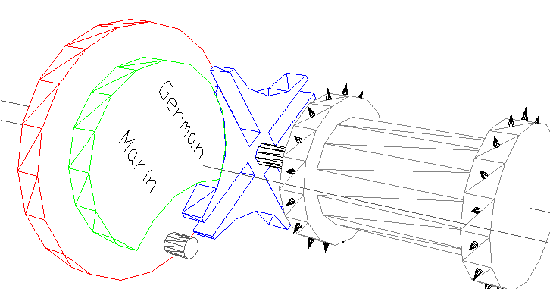
Paul, I think that the Maltese Cross (a six arm star) is a sample just to show how it work but I'm not sure.
Brian, I've not seen the large one but I'll try to find it, that's a very rare maltese cross, the piece look as big as 3' or more.
Posted by Steve Kraus (Member # 476) on 07-04-2002, 02:56 AM:
I rather doubt the average machinist could make the parts in the precision required. There is a reason LaVezzi supplies almost every manufacturer.
Posted by Brian Tristam Williams (Member # 1235) on 07-04-2002, 06:29 PM:
Well, I don't think, for training, you need that precision. Just make a large mock-up of the little thing.
Posted by Will Kutler (Member # 770) on 07-05-2002, 05:52 PM:
Steve K. says that the average machinist could not make these parts?Well, Steve....what do you know about machining?
These parts can either be cast then finish ground, or made entirely from stock...these parts have, I believe, .0002 tolorance, which is the norm w/precision grinding.
Some of the grinding equipment needed for these parts would be common to an injection mold or tool and die shop rather than just a job shop...such a a jig grinder and what not...
Non the less, a competitent machinist should be able to make said parts...I have made complicated precision ground parts with similar tolorances as class projects...
Posted by Steve Kraus (Member # 476) on 07-05-2002, 09:23 PM:
The fact the Charlie Wolk didn't have the boys in the back room make stars and cams tells me something.
Posted by John Hawkinson (Member # 1135) on 07-05-2002, 09:48 PM:
'seems to me it's less about whether your average machinist can machine parts to this tollerance, and more about whether they can do so quickly and cheaply, or whether someone who specializes can do it less expensively and more efficiently.--jhawk
Posted by Gerard S. Cohen (Member # 994) on 07-06-2002, 10:59 AM:
I made my intermittant
It's housing's made of clay
The star is from the deep blue sky,
the c(l)am from Sheepshead Bay.My Pa was not La Vezzi
Nor I, Will Kutler Two
My grinder only sharpens knives,
Micrometer's plastic, (blue.)
My intermittant doesn't pull
Film down like projector claw--
Selective memory is its thing
It skips three of every four.
It shows me highlights of my life
That make me laugh and sing--
If I keep writing crap like this,
I'll earn my straightjacket - Bing!
Gerard
Posted by Will Kutler (Member # 770) on 07-08-2002, 07:50 PM:
Johnyou hit the head on the nail.
It is a matter of specialized set up so that the parts can be made in masse...and cheaply....mass production.
Today, CNC has become a catch phrase that for some reason CNC means quality... This is just not so...in a nutshell, CNC = effeciency for long mass production runs. Lord knows how many messed up CNC parts I have seen because of improper inspection and monitoring of the system...or CNC programmers who have made mistakes...or computers that like to crash
I have personally been witness to the fact that by the time a CNC program has been written and the machine set up, the parts could have been made plentyfold with manual set-ups!
Today, young people are cluelsee to what pentagraphs, tracer mills and lathes, turret lathes, screw machines etc were, and how mass production was efficiently accomplished before the days of computers!
Anyhow, not to crash on CNC, it does have its place...
Love the Dreidel Song Mr. Cohen, Sir!
Posted by Frank Angel (Member # 248) on 07-11-2002, 10:32 PM:
Will said >Today, CNC has become a catch phrase that for some reason CNC means quality... This is just not so...in a nutshell, CNC = effeciency for long mass production runs. Lord knows how many messed up CNC parts I have seen because of improper inspection and monitoring of the system...or CNC programmers who have made mistakes...or computers that like to crash <Gee, seems like they've got those three letter bastards in every industry. You could almost substitute the letters DLP in that paragraph!