This is topic New Technicolor Survey in forum Film Handlers' Forum at Film-Tech Forum ARCHIVE.
To visit this topic, use this URL:
https://ft-forum.com/ft/cgi-bin/ubb/ultimatebb.cgi?ubb=get_topic;f=1;t=003695
Posted by John Scott (Member # 520) on 07-08-2002, 03:33 PM:
We received today in the mail the quarterly newsletter that Technicolor sends out. Inside there is a Business Reply card where they ask for comments and rankings on the website, service overall and what types of split reel fasteners you prefer.
I know many here have stated that they aren't satisfied with the current Technicolor reels so I'd suggest that either you or your manager fill out and mail in the survey to let them know what type of reels you do prefer.
Posted by Steve Kraus (Member # 476) on 07-08-2002, 05:20 PM:
Decisions decisions...i actually kinda liked that shiny black one (Choice D on the card) except for the first batch that were way too tight. Nothing wrong with the 2-prong (Choice C) if they are intact but you could say that about any of them. Which come intact and stay that way?"They're all so beautiful...why don't I have three heads? ahahahahaha "--Amadeus
Posted by Scott Norwood (Member # 30) on 07-08-2002, 05:58 PM:
Technicolor ships reels now? Last I saw, they were just sending out random plastic bits mixed in with film on lab cores. 
Seriously, though, I'd _love_ to see films shipped on those great black plastic solid reels made by "Hollywood Film Company." Since that's probably not going to happen, I'll vote for ETS-style reels as a second choice.
Posted by John Scott (Member # 520) on 07-08-2002, 06:56 PM:
Since I personally don't bother with buildups and tear downs on Thursday (I have enough to do dealing with closing the period and all the weekly period reports that are due friday morning) I asked my projection staff which they prefered for our survey. They chose option c.
Posted by Brad Miller (Member # 2) on 07-08-2002, 07:20 PM:
Will someone who has seen the survey card check the "reviews" section of this website under "TES depot" and explain what A, B, C and D type reels are. There are pictures of them in that review.
Posted by Steve Kraus (Member # 476) on 07-08-2002, 09:46 PM:
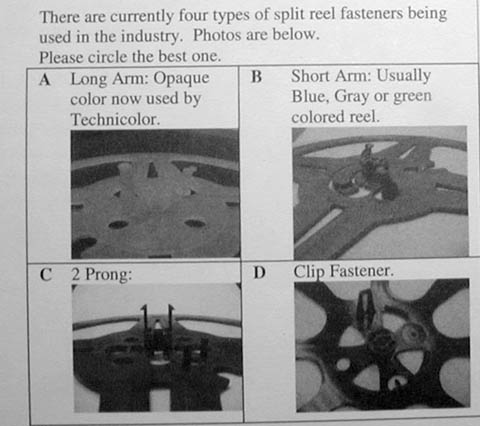
Posted by Brad Miller (Member # 2) on 07-08-2002, 09:54 PM:
Definitely C! The others are a joke and D does not fit properly onto many make up tables (New Line reels).
Posted by John Hawkinson (Member # 1135) on 07-08-2002, 10:38 PM:
What's wrong with A when it has the shaft keyway?I dislike C because it can be extremely difficult to seperate the reels without breaking them, and I suspect that's part of why they come broken.
"Hrmph. I wonder why I didn't get a newsletter in the mail." Perhaps
tomorrow.
--jhawk
Posted by Brad Miller (Member # 2) on 07-08-2002, 11:44 PM:
John, even just any old pair of scissors can separate the ETS-type reels (option C). Just lay the reel flat on a table and squeeze the two latches together. The flange will pop right off, effortlessly. Try it the next time you are in the booth. I've had far too many of the A and B type of reels fall apart while winding the film off. Just check out the "Advanced Booth Training" video for an example.
Posted by Steve Scott (Member # 630) on 07-09-2002, 12:30 AM:
No argument, C.I've noticed some indie films have used these black reels with metal hubs. These things are like tanks! They never fall apart, you could cut the edges jagged and use them as giant throwing stars! 
Posted by John Pytlak (Member # 331) on 07-09-2002, 02:36 PM:
If you have first-hand experience with each of the reels, or were provided samples for evaluation, please be sure to return the survey to TES, attention of Brad Carroll, Manager of Exhibitor Relations:brad_carroll@technicolor.com
Telephone: 818-562-8372
------------------
John P. Pytlak, Senior Technical Specialist
Worldwide Technical Services, Entertainment Imaging
Research Labs, Building 69, Room 7525A
Rochester, New York, 14650-1922 USA
Tel: +1 585 477 5325 Cell: +1 585 781 4036 Fax: +1 585 722 7243
e-mail: john.pytlak@kodak.com
Web site: http://www.kodak.com/go/motion
Posted by Darren Crimmins (Member # 1116) on 07-09-2002, 08:29 PM:
Definately "C" by far. The do not come apart in shipping or handling or break as easily as A and B, and like Brad said, D does not fit onto make-up tables as easily. Also D is to hard to take apart if you do have to try to align the holes (was really pissed off about this when I had to break down 3 prints of Lord of the Rings and barely any of the holes lined up!). Choice "C" comes apart easily to align holes and then stay locked together when put back together properly.
Posted by Bill Hallsworth (Member # 1240) on 07-09-2002, 10:24 PM:
Definitely C. If nobody has thrown away the form, I'll get it in the mail tomorrow. By the way, does anyone really think this survey will make any difference? I seem to remember from the TES review that calling in complaints had no effect. Just a thought.
Posted by John Scott (Member # 520) on 07-09-2002, 11:48 PM:
Bill,I think the fact that Technicolor took between a quarter and a fifth of the survey postcard on the reels leads me to believe that they are seriously looking into our concerns about the reels. Otherwise why would they even bother to waste the space on it when they could ask other questions?
Posted by Mike Schindler (Member # 1309) on 07-10-2002, 01:31 AM:
C!! Yeah!! Definitely not D. Every time I open up a can and find those inside, I cry.
Posted by Joe Redifer (Member # 3) on 07-10-2002, 01:45 AM:
C. That's kind of a no-brainer to me.I really hope TES is serious. Anyone can turn over a new leaf (at least partially in this case). Hell, ANY improvement is welcome!
Posted by Jeff Skallan (Member # 891) on 07-10-2002, 04:59 AM:
C gets my vote! Although I've seen many of these type of reels that are put together wrong with the inner core seated to the wrong hole position, it is quite simple to fix. The type A reels often come without an inner shaft notch and I've encountered many of these that have been hand chiseled to fit the shaft. I've also noticed that Type A reels seem to have more of a tendency to snap apart during transport and often become separated in the film cans.
The type D reels that arrive with New Line prints are my least favorite. For one thing, they have a sharp edge that surely isn't pleasant to handle on a regular basis. These reels have given us problems during breakdown on Christie muts, being that they don't really fit the pin hole position correctly.
Posted by Helmut E. Dorausch (Member # 1356) on 07-15-2002, 12:35 PM:
Good Monday Film handlers:
Having been associated with 35mm, and large scale manufacturing for over a decade, I have had the unfortunate experience of opening a "Goldberg" only to find a pile of spaghetti!!!!!!
Everyone is entitled to their opinions re: "snap-on reels," but I take a PERSONAL interest in your comments, seeing that I am PERSONALLY responsible for the "Transfilm" reel.. (Black, glossy, "Old -Style") aka
selection "D" in the TES survey. For those of you that saw my first "Attempt,"
I apologize!!!!!!!!! You see, I "TRIED" to make them out of recycled movie film!
Obviously, there were problems!!!
We currently manufacture these reels out of a proprietary composite, that I continue to test with. If you require any input re: the "EASY" way to open or assure that they are closed, feel free to E-mail me!!! I want you to be happy with these reels!!!!!!
I must throw in, My 5 year old son had NO problem 'Lining up the holes."
Looking forward to more "constructive " replies!!
Helmut E. Dorausch
Transfilm Inc. Director of National Operations
helmutdorausch@hotmail.com------------------
Posted by Steve Kraus (Member # 476) on 07-15-2002, 12:50 PM:
Welcome Helmut...I actually saw some merit in your reels except for the early ones which had the periphery of the flanges pinching inward leaving substantially less than a 35mm clearance. As a reel to reel operator (I own & operate a private screening room in Chicago) I try as much as possible to take up directly on the shipping reels which not only saves time but also leaves the film tails out (the way **I** prefer to receive them, ready for inspection) and with the preferred emulsion-in wind. Thus your original batch wasn't safe for such use. But the later ones are fine by me. I like the Delrin-like plastic. It seems to stay cleaner.
Posted by Helmut E. Dorausch (Member # 1356) on 07-15-2002, 02:21 PM:
In regards to manufacturing and reel design, I have several specific goals.
#1) The reels DON'T open easily in transit. (Unfortunately this attribute makes the fullfillment job a bit more difficult.)
#2) The compound injects in a fashion that allows for the end product to remain "FLAT." (I've seen my film inspectors with "OTHER" reels, where the edges of the flanges actually touch!!)
#3) UNFORTUNATELY is cost!!!!.
Although MY reels are the same price, if not LESS,than my competitors,(Large volume) to consider making these reels in a manner other than injection molding, would be cost prohibitive.
The film handlers in my employ, have offered their input, and I have had extensive correspondence with TES, inquiring about our reel. Unfortunately again, the investment associated with large volume manufacturing, exceeds hundreds of thousands of$$$$$$.
I value your input in the "evolution of this reel,",,,,,,,,,Or else i'm out more than just a few $$$
Regards
Helmut
Helmut E. Dorausch
Transfilm Inc.
Manager of National Operations
------------------
Posted by Brad Miller (Member # 2) on 07-15-2002, 04:48 PM:
Hi Helmut,You need to do two simple things to improve the product. Go to a theater with Christie platters and mount your reel on their makeup table (not the rewind bench, but the actual rollaround MUT that hooks up to the platter to load and unload film). Then you will see why the general booth population hates those reels. They do not fit. There must be at least one hole in the reel that lines up with the drive hole in the film core, otherwise they are useless. Remember, the vast majority of all theaters run off of platters and almost all of them require that drive pin hole. There's generally lots of cursing to be heard in most booths when it comes time to break down a New Line print that has those reels because of this. This is the main reason why everyone on this thread has pretty much said the same thing "definitely not D".
Also, the edges on the ones I've seen are awful sharp. After seeing some reels that have been "previously enjoyed", the edges are knicked and sharp enough to cut film and flesh. They need to be rounded please.
Fix those two items and I think people won't have any problem other than we need to know the *proper* way to put them together and take them apart. If you will send me documentation, I will post it on the site so your reels do not get broken by projectionists who do not know how to properly take them apart and put them back together.
If you do a re-design, send me a prototype and are there is any problems with the design, trust me, I WILL find them and let you know before you go into mass production.
Posted by Michael Gonzalez (Member # 593) on 07-15-2002, 05:21 PM:
Why do reels have to seperate into two parts in the first place? The best reels that I have ever used are the solid one piece plastic Warner Bros reels. You never had to worry about those falling apart on you. Also I would go for choice E) None of the above. Giving us a choice between four bad reel designs and have us choose the one that going to cause us the least amount of problems, sounds like a parenting trick where instead of giving the kid what he wants you give him/her a choice between two things that you want them to have. This tricks the kid into thinking that he/she actually had a choice when in reality they didn't. Instead of tryingto trick us into choosing a bad product, they should go back to the drawing board and design a reel that works.
Posted by Manny Knowles (Member # 1171) on 07-15-2002, 05:36 PM:
My vote is for C.Think we should send a printout of this forum to TES?
As for the need to separate the flanges...What happens is that the reel is taken apart, then the core is popped out and the film itself is tossed...presumably the polyester base is recycled?
Posted by Scott Norwood (Member # 30) on 07-15-2002, 06:01 PM:
Also, film arrives from the lab on cores. The depot puts it on reels. Sometimes this is done using a rewind bench and proper split reel, but it is more common (now) to just clip the flanges on the core and ship out the print, thus avoiding the time needed to rewind each reel.The concept is basically sound, but the implementation (especially with TES reels) often leaves much to be desired.
Helmut--it's good to see someone involved with the design of these reels here. Hopefully you will be able to use the comments made here to improve upon your existing design and create reels which satisfy the needs of the depots, the accountants, and the theatres.
Posted by Frank Angel (Member # 248) on 07-16-2002, 12:49 AM:
TES sent me four reels to evaluate; they wanted opinions the flanges and the clasp design as two separate items. I will post my response below, but as you can see, the bulk of my response about the flanges was, hire a product engineer -- the material that sustains the least breakage would be the material most suitable. Tinsle strenght and impact testing is not rocket science. The clasps were easy enough to see which had the most holding surface area and, again, given the strength of the material used, which would sustain impact abuse.
Not ever having worked a Christie MUT, I didn't mention Brad's major point -- obviously these things need to work on all existing equipment out there without needing to drill freakin holes in them. Then I added what might seem simplistic, but the idea that if the clasp does break, there should be some down and dirty way to join everything together easily by even the least unhandy of our compadres -- hence the holes that one could either thread string or cable ties through as a quick fix to at least get the film back into the can.
Here's what I sent them:
======================================================
18 May 2002
RE: REEL SURVEY
Dear Brad Carroll:
Received the four break-apart reels for evaluation.
As much as I pondered over these reels, I came back to the same problem. The difficulty is in knowing the tinsel strength of the materials. I just received a print of MGM’s SWEET SMELL OF SUCCESS and one of the flanges of one reel was shattered, a condition that we see too often. As best I can determine, this was a case of the plastic not being able to withstand whatever forces were applied to the can. Plastic seems to be more brittle than some of these other compounds. So the way to prevent this kind of shattering would be to know which material has the best tinsel strength. A chemical engineer would give that information easily and more accurately than my guessing. But I will anyway:
My instincts say the Poly Propylene (A) seems to resist breakage the best because it’s obviously more pliable, less brittle that the other samples. I don’t think I have ever seen these flanges arrive broken. On the other hand, they tend to warp more easily, although warpage in a reel with such pliability is not a major issue as you don’t run the film on these reels, they are merely a means of transporting film.
The second choice would be the High Impact Styrene (B) as it seems to have some of the pliability of the Poly, but a bit more sturdiness. The big question (again for the chemical engineer) is, which of the two is most shatter- proof -- which breaks faster in those compression and impact tests. The choice between these two flange types would be made once you get an answer to that question.
The ABS plastic (C) and the TransFilm blend (D) seem to be as stiff as the common reels that are in use now and that so often arrive broken. But again, if all these flanges were given the same stress testing, THAT would be the way I would choose the one to use. I could be totally wrong about the Poly and Styrene – the ABS or Trans might just stand up better to abuse.
The fasteners are the real issue, it is this that we have the most frustration with. If the fastener breaks, then all is lost.
I would rate the Clip Fastener (D) the best of all four fastening systems. This is because the design allows a sturdier arm that clasps the other flange rather than the hub. But I must say, the others all run a close second – again, everything depends on the physical endurance of the flange. A strong, impact resistant flange will provide a fastener that is more difficult to break. All four seem to hold securely, although the Long Arm (A) and Short Arm (B) both rely on not only the arm to grab the hubs, but on an additional protrusion to hold the arms in place. This provides one more piece that can fail if the reel is damaged. The Prong (C) comes in last because putting the grabbing mechanism at the very center of the reel is where all the forces of a reel being dropped are directed. In the other designs, especially (D), the flanges have a center support that extends into the hub that is separate from the locking mechanism. If this reel is dropped, the forces are directed at the center post holding the hub. Even if that breaks, the fastening mechanism will still function.
Lastly, I would add that whatever the design, it should include a way that if the fastener fails, the film handler would have a way that the flanges could still be easily joined to the hub. The (D) design allows this. Even if one or both of the arms fail, a wire tie or even a length of string could be passed through the flange, through the hub, through the other flange and back again, thus securing the unit well enough to wind or unwind film. It only requires that holes in the hub align with holes in both flanges so that all can be easily tied together by the film handler.
Well, I hope this is helpful. It certainly would go a long way to relieving some of the frustration that is aimed at Technicolor if changing over to a better design stops or reduces those nightmare experiences where a film has to get mounted and the projectionist opens the can only to find one or more broken reels and film spilled all over the can.
Keep me informed on the company’s final decision.
Warm regards,
Frank Angel
Posted by Brad Miller (Member # 2) on 07-16-2002, 12:53 AM:
I'm dying to know, just what does each reel cost on an "average" order? Is an average order 1000 reels, or 10,000 reels? I would think with these reels being injection molded that they could be sold relatively cheap, which may be why the studios don't seem to throw a big fit if they are broken and are thrown out.Maybe our new friend Helmut can give us a rough idea on the costs.
Posted by John Daily (Member # 1362) on 07-16-2002, 08:55 AM:
I would argue that D is the best, for the same reason that Frank brought up. Not only is it durable, but I have actually received a reel that was held together by wire looped through those holes, and I was extremely grateful to the handler who broke the print down. Far too many times have I gone to grab type A or B out of the can only to have the thing fall apart in my hands on the way to the table.
Yes, the edges on D are sharp but, hopefully, this is something that could (and will) be easily taken care of. Until that time, I would gladly use these on all my prints, and just excersize a bit more caution when handling them.
Then again, I don't use a Christie, either! C would be my second choice. I'd rather receive the prints held together with bands of duct tape than use A or B ever again.
Posted by Helmut E. Dorausch (Member # 1356) on 07-16-2002, 12:41 PM:
WOW!!!!
After several years of tests and changes, AND mistakes, I finally found a source for constructive criticism. (Other than my wifes, of course, but I have to be careful how I talk to her)
#1) As far as plastics go, polypro is the most forgiving, breakagewise, but is extremely pliable. This flexural property, is amplified when exposed to heat. Even though you may find that polypro reels don't break, I am CERTAIN you have ALL found them to be open, when you've received a print. This FLEXURAL property is actually working against the intent of the product.(A SECURE means of shipping)
#2) Styrene is CHEAP. Decent impact, BUT they WILL snap if you try to bend them too far.
#3) The proprietary composite that I am currently using to manufacure the Transfilm reel, is an engineered resin, based off of ABS. ABS is a marvelous material to mold with, BUT, WILL SHATTER. (Ever step on a piece of black drain pipe you find @ the Home Depot, and you will see what I mean.)
I would appreciate if you would TRY to break my reel. (Try taking one half, and bending it .) Just don't tell my attorney!!!!
The "U-clip" is also quite resilient!!!
I'm not trying to tell you they CAN'T be broken, but they WILL perform their intended purpose of transportation!
Regarding COST!!!! Plastic IS cheap!!!!!
BUT, What do you think it costs to manufacture an injection mold with the capacity to produce up to2.5 million plus parts per year????
Try several hundred thousand dollars!!!! Anyone that has been associated with injection molding will know that molds CAN be made much cheaper than that, But they WILL not stand up to the demands and stresses of long runs.
All components are made from P-20 Hardened steel or better!!! Some of my tools are actually Stainless steel!!! The Main tool I own, consists of 9 steel plates, hydraulics, electronics, and robotics. The whole unit weighs in at 2200 US pounds, and stands 40 inches tall!
Plastic IS cheap, but the associated costs are NOT!!!!!!
I won't go into TOO much detail, but I can "safely" tell you that as a manufacturer, the reels I make, are under $6.00 (in quantities of 2 or less.)
You might use that number as a starting point to figure out what I would charge for an order of 500000 or more!!!! (Best I can do for now , but I can tell you it's NOT pennies)
I will be following up, by sending out some samples, and making changes that will provide "HOLES, IN ALL THE RIGHT PLACES!!!!!!!"
Regards
Helmut------------------
Posted by Steve Guttag (Member # 268) on 07-16-2002, 01:16 PM:
One thing I wish the reel manufacturers would do is check the applicable ANSI/SMPTE documents on reels before releasing their creations. With 35mm shipping reels, it is ANSI/SMPTE 192. ANSI/SMPTE 192 lists the pertanent dimensions so the reel can actually hold film and line up with other apparatus. In the annex A.2 discusses the need to have holes to allow the use with platter make up tables. It does not specify just where the hole should be and the size of the hole.
Personally, I feel that the drive dog hole for MUT should be standardized such that you don't have to move the dog pin around depending on the reel.
Steve
------------------
"Old projectionists never die, they just changeover!"
Posted by Paul Turner (Member # 832) on 07-17-2002, 12:20 AM:
"C" for me. Aside from the least problematic of the reels I've dealt with (short of metal reels), with just one of the reel sides, it can hold a trailer core to wind trailers off the print/platter, then just pinch the catches and you pull off a perfectly wound used trailer. I'm sure there is a more correct way of doing this . . . .
Posted by Frank Angel (Member # 248) on 07-17-2002, 12:46 AM:
Helmut, this is facinating stuff. Here's a thought -- has there been any experimentation with what actually shatters the these reels? I mean exactly how and when do they break? It's not the guy who puts it in the can at TES -- I am assuming they go out in one piece. It's not the guy in the booth -- he doesn't drop the reels down two flights of stairs. So it has to happen in transit, right? Perhaps once the strongest/cost effective material for the reel flanges is found, further study needs to be made on the cans themselves. Maybe adding some sort of impact absorbing lining on the cans might cut the problem down significantly. I mean, I see prints shipped in cans that look like they have been in WWII. You can't very well expect reels to hold up if they have to be hammered into bent cans. When you have to force a reel into an old can, it seems obvious that if the can is later thrown or dropped, the energy at the point of impact is going to be transfered directly to the reel on the other side of that metal which was already compacted in the can. Perhaps the plastic shipping containers are better than metal. Or perhaps the can design needs a completely new approach. Maybe a different shape or significant amount of padding added as an intergral part of the container.
We run lots of foreign prints, and I must say, their concept of shipping film sans reels but on cores instead and in plastic "cans" that are then shipped in regular cardboard boxes may be a solution. I've hardly ever seen film shipped this spill all over as it does with our conventional way with cans and the broken reels. And for platter makeup and breakdown, it really isn't all that more difficult using a split reel to mount from the core roll and then back again. Dealing with a film roll on a core and a split reel is a lot easier than dealing with a broken reel with half the film slippend off the roll.
Posted by Paul G. Thompson (Member # 655) on 07-17-2002, 12:47 AM:
Bah! They are all junk. Give back the old tin reels. They fit everything. 
Posted by Peter Kerchinsky (Member # 1098) on 07-17-2002, 04:36 AM:
I'm in total agreement with Paul on this one!
I got a print of NEVER AGAIN tonight at my theatre from TES and every, and I mean every, reel came apart as I was lifting it out of the cans. Damn. What a waste of my time trying to fiqure out how to put these crappy things back together. Not sure and really don't care who made them but they are complete shit.
Here's my solution to this guys and gals.
Ship the damn print in cartons on cores. We all buy split reels and go from there.
We do this every year at SIFF and it's no real hassle.
Posted by Paul Konen (Member # 41) on 07-17-2002, 09:27 AM:
I think a combination of materials would be nice.Although the clasp in "D" is secure, it seemed that you had to bend it out a significant distance for it to unlatch. "A" seems like one of the better choices to ensure that reels comes with the pin holes lined up. "B" still has the chance of not having any holes lined up for breakdown. I have seem a few times with "C" that the reel has snapped off at the center leaving just the fastener. Also, fasteners "C" and "D" require that you flip the reel for final separation.
As far as the plastic is concerned, I would vote for either "C" or "D". "A" and "B" are very soft and if they get warped from storage, then more care needs to used during buildup / teardown because you are having to compensate for warpped plastic possibly scraping against film.
"A" Fastener, "C" or "D" plastic
Paul Konen
Cinemark Legacy 24
Posted by Scott Norwood (Member # 30) on 07-17-2002, 10:16 AM:
Has anyone ever seen a split reel that will work on a Christie MUT? Neither the Goldberg nor the Neumade ones have the hole for the "drive-dog" (and only the 4" cores have this hole, anyway). As a result, it takes significantly longer to break a film down onto cores, as one must first break it down onto house reels (6000' or 2000') and then rewind it onto cores on the rewind bench. I suppose one could drill a hole into a normal split reel, but not everyone has a drill in the booth. Even in a reel-to-reel booth, it can be annoying to deal with film shipped on cores, as one must have two good split reels (most places are lucky to have one) to take up on, unless one wants to rewind everything again after the last show.
Why do Christie platter MUTs use "dog drive" anyway? Obviously it's needed for 1/2" shaft reels, but why didn't they use the standard "key"-type drive for the 5/16" reel shaft? (obviously, the shaft would need to be re-designed, as the single screw that holds it in wouldn't work if that shaft were keyed).
Posted by John Pytlak (Member # 331) on 07-17-2002, 12:26 PM:
The physical properties of plastics can also vary with temperature and age. How do the various materials hold up when stored and shipped under very cold (sub-freezing) and very hot conditions? Plastics containing solvents or plasticizers may become brittle with age. Finally, the plastics should not "outgas" chemicals that may harm the film during long term storage (e.g., PVC is a no-no). And in an ideal world, plastic reels should be made of recycleable materials.------------------
John P. Pytlak, Senior Technical Specialist
Worldwide Technical Services, Entertainment Imaging
Research Labs, Building 69, Room 7525A
Rochester, New York, 14650-1922 USA
Tel: +1 585 477 5325 Cell: +1 585 781 4036 Fax: +1 585 722 7243
e-mail: john.pytlak@kodak.com
Web site: http://www.kodak.com/go/motion
Posted by Michael Rourke (Member # 1142) on 07-17-2002, 02:14 PM:
I like reels C and D; however there is nothing wrong with A and B provided they aren't the flexible variety and they have the proper cores, which doesn't happen often.Anytime I get the C or D reels with 3 hole cores in them, I swap them for the two hole cores I have on hand so that I am prepared for the more common A and B type reels with two hole cores leaving no hole for the drive pin on my MUT!
This morning I had to build 8 Legged Freaks and it was on A reels with cores that don't have holes at all, they have 4 wide tapered square openings.......the point is these reels are designed to locked together in a circular hole. This combo I received today fell apart when I picked up the reel.
Some of us projectionists should go get jobs wrapping reels, that's the only solution I see to the problem.
Posted by Steve Guttag (Member # 268) on 07-17-2002, 02:43 PM:
Scott,Just about any well designed make up table will have a drive dog for breaking down film. The key is not designed to take too much torque. From shipping reels this is even more true since their keyways are often just sheet metal or other thin material that can really cut into the key itself.
I believe on the Christie MUT, there are two tapped holes near spindle that will like up with the typical dog pin on a split reel...put the split reel on the MUT...screw the split reel to the dog plate and away you go. One of these days, I'm gonna try it myself!
Steve
------------------
"Old projectionists never die, they just changeover!"
Posted by Helmut E. Dorausch (Member # 1356) on 07-17-2002, 03:59 PM:
At the risk of appearing lazy, would someone please tell me where to contact Christie, re their MUT.
I have phoned several local theaters that are hesitent to allow me to inspect their equipment.
Any help would be appreciated
Helmut E. Dorausch
Transfilm Inc.
Manager of National Operations
Posted by Brad Miller (Member # 2) on 07-17-2002, 04:08 PM:
Bevan Wright is the man you want to talk to at Christie. 714-236-8610If it would help, I can take some pictures for you next week of how the reels fit on a Christie MUT. Please ship me one of yours so I will be able to use that in the pictures as well so you can see why they don't fit.
Posted by Manny Knowles (Member # 1171) on 07-17-2002, 04:53 PM:
My split reels do not have holes in them for the drive dogs. I have considered drilling a hole in one of them for use with the Christie MUT.
Posted by Peter Kerchinsky (Member # 1098) on 07-18-2002, 04:48 AM:
Scott
I agree with your comments on the Christie MUT regarding breaking down films on cores with a split reel.
However when we do get a film on cores I simply tear it down on 6000 foot reels then take those to my trusty Kel-Mar and wind them onto the cores with the split reel. Takes me about as much time as to try to fiqure out how in hell to put those crappy reels back together once they come apart.
After all, I'm paid by the hour!
Posted by John Pytlak (Member # 331) on 07-18-2002, 09:28 AM:
As Steve Guttag noted, shipping reels need to meet the specifications of standard SMPTE 192-1997 to properly interface with rewinds, make-up tables, and projector spindles/magazines. Before any design is finalized, it should be tested on the wide variety of equipment the reels will be used on.Copies of standards may be ordered from the SMPTE:
http://smpte.org/smpte_store/standards/
BTW, the standard for the cores used by the labs is SMPTE 37M-1999. If you are using the cores as the reel hub, you need a copy of this standard as well.
------------------
John P. Pytlak, Senior Technical Specialist
Worldwide Technical Services, Entertainment Imaging
Research Labs, Building 69, Room 7525A
Rochester, New York, 14650-1922 USA
Tel: +1 585 477 5325 Cell: +1 585 781 4036 Fax: +1 585 722 7243
e-mail: john.pytlak@kodak.com
Web site: http://www.kodak.com/go/motion
Posted by Mike Blakesley (Member # 26) on 07-18-2002, 10:47 AM:
I'm a little late on this due to an ISP outage, but ...Most of the problem of broken reels stems from TES shipping them out in cans that are less than full. If they would fill up any empty spaces with empty reels (or better yet, put the proper number of reels in a can...THERE'S a thought!) the problem would go away. It's the reels flopping back and forth during shipment that causes the damage.
The empty-space problem is made worse by the DTS carrier. The carriers should be thinner, that way they could fit into a can filled with reels without jamming. Those carriers could be 1/4" thick and still protect the disks adequately.
We rarely have broken reels in our ETS shipments, because their cans are almost always full, with the DTS carrier crammed in (or the disks in plastic cases slipped between two reels.)
Posted by Helmut E. Dorausch (Member # 1356) on 07-30-2002, 07:27 PM:
Since my last visit, I have done a bit of research.
First off, I WILL be making an adjustment to the "sharp edge" of my reel.
I contacted Christie (Thank you, Brad) and they were kind enough to forward drawings of the drive pin in question. I am currently waiting for a physical sample.
During my correspondence with Christie, we concluded that the "difficulty" of using the Transfilm reel with this MUT, stems from the lack of a "through-hole", when the reel is mounted onto a core with only 2 holes.
(those cores are no longer being manufactured, yet I realize there are plenty in circulation)
Here comes the fun part.
The drive pin on the Christie MUT, is an aluminum shaft with 3/8 in threads, that stands off the plate, 1 3/8 inches. Christie has assured me that the length of the pin, "has no bearing on ANY functional aspect of their equipment, other than to obviously "drive the reel." "
I won't insult you, by suggesting that you merely cut off the additional length,
(in order that the drive pin stays beneath the middle of the core) even though
Christie told me it WON"T affect any other aspect of their machine.
For those of you that may be interested, I am hoping to make available shorter versions of the drive pin, that can be exchanged for the current pin.
(simply unsrcrew the existing, and replace with the new)
Ultimately, in trying to design a reel that is "universal" to existing 2 or 4 hole cores, I did not take into account that drive pins extended all the way through the reel.
Lastly, The suggestions of consulting SMPTE 192-1997 was rather ammusing. Sure looks to me like a "KEY WAY" is called for on 2000ft reels.
They even give dims. Why is there even a need for "drive-pins????
Anyone care to enlighten me???
Regards, and thank you again for your input.Helmut E. Dorausch
Transfilm Inc.
Manager of National Operations
(818) 771-5390
(818) 771-5395
------------------
Posted by Mike Blakesley (Member # 26) on 07-30-2002, 11:04 PM:
quote:
Lastly, The suggestions of consulting SMPTE 192-1997 was rather ammusing. Sure looks to me like a "KEY WAY" is called for on 2000ft reels.
They even give dims. Why is there even a need for "drive-pins????
Anyone care to enlighten me???
Helmut, The Key-way works fine on the projector, but I think a key shaft on a makeup table would wear out, due to the high torque of the motors in most tables.
Posted by Steve Kraus (Member # 476) on 07-31-2002, 12:41 AM:
Eh...where are SMPTE specs when you need them? As applied to MUTs that would include mimimal dimensions for a work area, vertical feed reel orientation (so full ones don't spill all over), some specs about maximum tension & snubbing. Oh, and for 70mm sufficient distances to make those 90 degree twists without stressing the print.
Posted by Helmut E. Dorausch (Member # 1356) on 07-31-2002, 11:38 AM:
I would agree that a shaft key would wear, if you were running metal reels on the MUT.
I currently operate 20 machines @ my Los Angeles facility, that have required shaft replacement on the rare occasion that an operator becomes careless, and bends one.
I DO find ,however, that my reels will get pretty "chewed up" around the key way, after performing high speed operations for app: 100 cycles. I cant comment on the torque, other than to say that if your equipment is transferring enough torque to damage a keyed shaft, I would expect your winds to be "awfully tight!!!"
If anyone has any comments or concerns about acquiring an alternative length drive pin, please let me know.Helmut E. Dorausch
Transfilm Inc.
Manager of National Operations
(818) 771-5390
(818) 771-5395
------------------
Posted by Lewis Bohannon (Member # 1387) on 08-01-2002, 01:30 AM:
Hi all, Just wanted to get a word in on the topic. My personal choice would be D. Second choices would go to A( cause I'm so used to putting them together). I like the way [D] goes together, Just wish I didn't need to rasp the opening a little for each reel for my Christie MUT's. The only reel problem with [A] is they tend to get chewed-up on my Kelmar rewind bench. ------------------
Lewis Bohannon
"The Man Up-Stairs"