
I did something really stupid at work tonight, and the worst part about it is that I can't understand how I possibly could have made this mistake.
Why is it that you can make it through some fairly rigorous, complex stuff just fine, then you have the simplest and most straightforward of tasks which you then proceed to somehow foul up?
What did I do? I threaded the incorrect movie. Yes, it was corrected prior to hitting the feature (the final trailer had just ended!) However, with clearly marked schedules and my (usually) extremely vigilant triple-checking procedure, I cannot for the life of me understand how this one could have slipped by. Worse, this comes less than 24 hours after a satirical posting about the importance of checking things! What egg on my face?
I pride myself on the accuracy and consistency of my work, and errors are few and far between...but this is what makes this one especially annoying: it was so obvious and avoidable.
OK, so I can accept that mistakes will crop up from time to time. But the question is: what about the idea of stupid, inane mistakes cropping up? Shouldn't they be completely absent? What an embarrassment.
 .
. ------------------
currently (relief)chief projectionist
at Luna Leederville cinemas
also cheerleader for john wilson (gooOO JOHN!)
Come on everyone, chime in with your own goofy mistakes (as opposed to that previous "booth disasters" thread). 
Once, and only once, did I manage to build up a print with reels in something other than the correct order. I somehow put on reel 7 where reel 4 should have been, and reel 4 was where reel 7 should have been! (And this print played like this for three days without anyone noticing!) >_<
Lessons learned = mistakes going unrepeated!
Well, I got the hang of the machine in no time and threaded up the projector without a hitch...or so I thought. When the picture hit the screen, something was amiss. Mirrored picture, no sound. D'OH! In my eagerness, I accidentally threaded the print soundtrack in and failed to catch that error . I had to stop the projector and, with the assistance of the theatre's "booth ushers," re-feed the paid-out film back into the center of the platter pack to get it going again. Five minutes and one red face later, we restarted the show, this time threaded as God and Norelco intended.
Sooner or later, a goof catches up with up. As long as no film was damaged, I guess we can live down to our human-ness, pick up the pieces, and get back to doing film right.
 I was expecting something catastrophic like that so I stayed in the booth until it went through. All hell would have broke loose had I not have been there. Five minutes later we were back on screen, and I learned an important lesson.
 Bad thing was, the splice I replaced wasnt the bad one.
Josh
The Ashcraft lamps in our booth can be a little tricky to run these days and I suspect they need a good going over by a tech. If you don't keep a close eye on them, they have been known to lose their arcs when the arc gap gets a little too large. This little problem jumped up and bit us with one machine during this particular show while I was distracted with inspecting film and George was tinkering with the other machine.
As I was on about reel four, with my back to machine one, I suddenly got this funny feeling and thought to myself, "Uh oh, It's been too long since either of us have checked the arc on number one!" I then spun around and discovered that the lamp was indeed dark. I dove for the lamp and re-struck the arc, hoping that we'd been off-screen for only a second or so. Not so, however. Later, floor staff told us the screen was dark for about five minutes. And they never even radioed the booth to tell us!

Everybody makes bone-head mistakes once in a while. It's not so much about whether mistakes are made or not. (Obviously NO mistake is "OK".) What separates the "men from the boys", metaphorically speaking, is the way one conducts him/herself in the face of a problem.
Do you stand there, denying the mistake, making excuses or do you hop on your feet and fix the damned problem?
In my experience, it's an unwritten rule that the audience will give you a Mulligan if the mistake is relatively minor and it happens before the feature actually starts.
Don't worry about it so much... But don't let it happen again!
------------------
So if old projectionists don't die, what happens when new projectionists get old?
"And that's what happens when you try to do two things at once, class!"
~Manny (now in three delicious flavors!)
Back in 1989 I had just been hired at a Cinemark. This particular location was their flagship at the time. My first shift and the first round of movies, the manager comes running up to the booth 5 minutes before #6 was supposed to start. (I have no idea what the movie was, but I remember it was #6.) He says that all of their policy trailers are in terrible condition and that the owners Lee Roy and Tandy Mitchell just walked in the door and were about to watch that movie. He was freaking VERY badly over it and demanded that I unthread it and get a clean copy on there.
To make a long story short, I grabbed a few policies out of the cabinet (all were in bad condition) and found one on a spot check that wasn't too horrible. It was labeled "FRJ head". (FRJ=Front Row Joe) I raced over to #6 with the splicer, got the thing dropped in and the machine rethreaded and hit START right on time. I guess I don't even need to tell you that whoever broke that trailer down should have written "FRJ tail"! If it hadn't been for the numnuts who mislabeled it and wound it emulsion in (and also the fact that I was rushed and had no idea what the beginning and ending of the policy looked like), I would not have screwed that up.
So just like Joe did, the second it hit the screen I saw what had happened. I turned the fader to "0", closed the douser and kept the lights at half and waited there, and waited there, and waited there, and waited there (these policies were in excess of 2 minutes), and then waited there some more until it finally played through. The manager was standing there freaking out even moreso over it (he was acting like he was a mob target) and demanded that I stop the projector and turn it around, but I had to keep explaining to him that such a thing would take a LOT more time. (By the way, he didn't last long.)
Nowadays if the head / tail is not obvious to me, I look at the emulsion in the reflection of the light to determine if it is heads or tails out. I haven't screwed up a trailer change in any fashion since that day (and I've probably done about ten thousand others in the last 13 years).
We're all allowed one mistake, right?
Right...but just that one.
The analog soundtrack is always on the outboard (towards you) side of the projector as you thread.
The emulsion side of a 35mm release print always faces the lamphouse. The base side of the print is always towards the lens.
The image in the gate is always upside down.
The image will always "read" correctly from the emulsion side of the print.
To summarize: As you look at the film coming into the projector head, the analog soundtrack should be outboard, the image on the print should be upside down, and the image (title lettering) should read correctly if you view the print from the lamphouse side.
------------------
John P. Pytlak, Senior Technical Specialist
Worldwide Technical Services, Entertainment Imaging
Research Labs, Building 69, Room 7525A
Rochester, New York, 14650-1922 USA
Tel: +1 585 477 5325 Cell: +1 585 781 4036 Fax: +1 585 722 7243
e-mail: john.pytlak@kodak.com
Web site: http://www.kodak.com/go/motion
Anyone who has worked in a booth for any length of time has gotten bitten by the flipped soundtrack, the wrong lens/aperture, change-over only to find the arc not struck, etc. What is REALLY embarrassing is when you've been in the booth for years and should know better, but because of some small distraction, it comes up and bites you on the butt again. But I've got one better than the soundtrack flip-a-roo. This is very much in line with Manny's, only with a lot more dire consequences.
I was called in for a screening at the museum it so happened at a time that they had just hired a new AV Manager, a young guy just out of college. He was in charge of everything technical in the theatre -- sound mixing for live shows, slide lectures, everything except 35mm projection -- for that he needed to schedule in a licensed operator. So on this his first film screening on his new job, as I am preping this short film, we carry on an animated discussion about the 35mm system, the integration into the house sound system, then moved to museum politics. I start the show; our conversation continues. I make the first two change-overs showing him how it works. He is impressed. But now as we are talking, out of the corner of my eye, I begin to check the third reel playing out thinking I have to bring the lights to "Credit" level soon. Now I begin to shut out his discussion and my mind starts to focus on the film on the screen I and realize something is very wrong. What's wrong is that the there's about 7 minutes on the last reel and nothing on the screen seems to be coming to a conclusion; in fact, what sounds like a new plot twist is beginning.
It would probably be really cool if someone was there with a camera to snap your face at that moment of revelation when it "dawns on you." I stop him in mid-sentence and ask, "Er, do you remember if there are any other film cans downstairs?" "Why?" he asks innocently. "Well, because unless they can get to town, find a lawyer and get some evidence to go to trial in the next 4 minutes, we are missing three, maybe four more reels of this movie." This kid goes white. I mean, he's very white to begin with, but now he looks like he is going to faint right there in front of me. I tell him to sit down and drink some water. He kept repeating over and over, "Oh my God, what are we going to do? "Well, in a situation like this, since we don't have the rest of the film, its simple. We just have to go out and tell the audience that we can't finish the show." I thought a little levity would help, so I add, "And by the way, who's this WE you speak of?" It didn't.
Knowing it was my fault for not realizing that the unfortunate fade-out at the end of R3 was NOT the end of the movie, I said, "Look you just sit here, I'll go out and tell the audience." I went out to the theatre and told the 200 people sitting there in CREDITS lighting that the distributor hadn't send the full feature and we are very sorry but we cannot finish the screening and they could see it next week, pickup passes at the door, blah, blah, blah.
I love museum audiences -- they are so polite. They took it quite well....seemed quite understanding of my explanation. I was actually a little pleased with myself thinking, "Gee, that was easy." And just as I was making my get-away, happy that no one asked the obvious, one feisty old guy down in front was a bit more vocal, a bit more Brooklyn. He yells out in typical Brooklynese, "Hey, the distributor didn't send you all the reels, so how come you didn't figure this out till just now?" "Damn," thinks I, "caught." My voice mumbled, "Yes, that was our error, sorry." while my brain thought, in perfect Brooklynese, "Yah, screw you, pal."
There is a good reason the union has a rule that no one other than the projectionist is allowed in the booth while the film is running. Beware distractions, my brothers!
Frank
Don't feel too bad about it. Just remember you ARE allowed one mistake.
Having said that, I should point out that if you make one more mistake I'm gonna fire your ass!

Mike
Definitely one of the more stupid things I've done. It was a print I hadn't made up and I heard a crunchy splice go through, so I ran my finger along the takeup platter (which happened be on top) to feel the thickness of the splice and got caught in the next layer of film coming on. Luckily, the show wasn't affected, but I was a little ticked at myself for a while.
I was in the Air Force, stationed in Bangkok. Our unit operated super-secret (at the time) electronics for monitoring nuclear weapons testing by other countries (mainly China, but France was still testing at the time too). Our station was next to Bangkok's main airport. Commercial power there was very unreliable, so we had 3 big diesel emergency generators: 1 for utility, 1 for tech equipment, and 1 spare. I think they were 50KW generators. In case of a commercial power failure, one of us would stay inside & shut off all the equipment, while the other would sprint out to the generator shack, fire up 2 of the 3 generators, and get tech power running first, followed by utility power. The person inside would bring all the equipment back online.
We had been on emergency generators for several days, and finally commercial power came back on and seemed stable. Now getting the place switched back to commercial power, without any interruption or downtime, was very tricky. There was a crude monitoring system in the generator shack that displayed if the commercial power & the generator were in sync with each other. The idea was to get commercial & generator power perfectly in phase (by raising or lowering the generator's AC frequency slightly), cut in the commercial breaker, and cut off the generator. So for a couple seconds, our generator would be running in parallel with commercial power.
Did I mention that I was new there?
My shift partner, who was none too swift but still had seniority over me, takes me out to the generator and shows me exactly what to do. "Watch this light. Start adjusting the generator's frequency, and when the light is ON bright & steady, power is synchronized & in phase. That's when you cut in the commercial power, and quickly cut off the generator."
No problemo. He goes back inside to watch over the equipment. I start adjusting the gen. freq. to match commercial. I get the phase light so it's on steady and bright, and cut in the commercial breaker.
Well, before I had a chance to do anything else, this huge generator started bucking and struggling, and smoke started pouring out of the alternator. I was like "Holy crap, what the hell's going on!!??" I at least had the sense to quickly shut the thing down. Smoke was billowing out of the shed now. This was day shift, full office staff there, so of course everyone comes running out of the office building to see what's going on. Our unit commander had an IQ no higher than room temperature on a cool day, and he was in a panic because of all the paperwork he would have to fill out. "I'm personally responsible for this!!!" Then someone reminded him that regulations required the local fire dept. be called in case of ANY fire-related emergency. So they call the airport's Thai fire crew, explaining that this is an electrical fire, and requesting that the fire crew respond accordingly. The fire truck arrives about 10 mins. later with nothing but water.
So we start sorting it out, and find out that my shift partner had a brain fart about that phase light. Commercial & generator power were in phase when the light was completely OFF, not ON. When the light was on, the 2 power sources were 180 degrees out of phase with each other. And believe me, you don't want to parallel your generator with commercial power when they're 180 degrees out of phase with each other.
================
Another story of working in Bangkok, and it's actually film-related. We worked 2-man 12-hour shifts. The graveyard shift would not always have a lot of work to do, so sometimes one of us would grab a few hours of sleep while the other kept an eye on all the equipment. We had a darkroom for developing 500 foot rolls of 35mm b/w film (equipped with a Labmaster automated 35mm film developer). Well, since it was a darkroom and there was a large countertop work surface, we would sleep in there on top of the counter.
Did I mention that power was very unreliable? We were all hyper-sensitive to variations in line frequency, voltage sags, etc. in commercial power and we tended to be paranoid about it, because we were never supposed to have more than 2 minutes of equipment downtime if the power failed. Any more than 2 minutes down and we had a lot of 'splaining to do.
Well, it's my turn to sleep, so I'm in the darkroom, sleeping, shoes off. I'm sound asleep, lulled by the hum of the equipment. All of a sudden commercial power drops. I immediately wake up thinking "Oh shit, I'm the designated generator operator!!" Instinctively, I know I need to get up NOW. Forgetting where I am and being in total darkness, not to mention foggy-headed, my right leg flies up as hard as it will go, and I jam my big toe into the bottom of a cupboard above the counter I'm sleeping on. This pain shoots up my leg, but I manage to drag myself out to the generators and get them going.
When the dust settled, I found out I had jammed my foot into the bottom of the cupboard so hard I broke my big toe. The toe was smashed over sideways, about 45 degrees off from where it should have been pointing. When I went to the doctor, he couldn't really do anything for it. It was about 3 years before I had full flexibility of that toe again, and it's still crooked.
How many people can claim they've broken a limb while sleeping on the job?
I can almost relate that Air Force job to being a projectionist...
The equipment we were running was ancient. It recorded data on successive frames of 35mm b/w film. Most of the electronics were tube, but some of it was solid state and even digital. Back then, a flip-flop circuit was made of discrete components (transistors etc.) on a plug-in circuit board. One board = One flip-flop! No ICs. There were 8 6-foot tall standard 19" racks, filled to capacity with power supplies and other junk.
When a nuclear device is exploded in the atmosphere, it emits a very unique and strong pulse of energy at 10KHz (this is the infamous electromagnetic pulse that's supposed to cause most solid-state devices to be disabled when a big nuke goes off -- Same type of pulse they were creating in Oceans 11 to knock out all the power in Vegas). The signal was picked up on an array of loop antennas, which allowed triangulation of the source. It was amplified, and split into analog and digital components. The analog 10KHz waveform was displayed on an oscillosope-type CRT. The digital data (the signal's amplitude, direction, precise time, etc.) was displayed on a matrix of high-intensity LEDs (actually I think they were some kind of neon tubes), as binary coded decimal data, BCD. These two images were reflected through a series of mirrors and recorded side-by-side on a frame of film.
Unfortunately, there is a LOT of natural atmospheric electrical noise at 10KHz, so we chewed through those 500' rolls of film pretty quickly sometimes. Since they didn't want any gaps in the recorded data, and the rolls of film were limited to 500', we had 2 complete, identical arrays of film recorders. While one was recording, the operator would load up the other one with film. We had to load the magazines in the darkroom, thread the film, record a series of calibration signals on the leader, and ensure that the system clocks were sync'd to UTC. We had an atomic reference clock there for that.
So a good operator would be able to do "changeovers" by himself (while his partner slept - ). The trick was to accurately predict when the operational system would run out of film, based on the rate of film being used, which varied up and down all the time. When you decided the recording system was about to run out of film, you would run the calibration recording sequence on the other system, and start recording data exactly at the top of the minute. The 2 systems would overlap for exactly 1 minute, then you would cut off the one coming down and record another series of calibration images on the tail of the film. Run out the tail, take the magazine into the darkroom, unload and box the exposed film, and load the magazine with a fresh 500' roll.
This one time, I accidentally ruined a roll of freshly-recorded film by exposing it to light. This was very bad. My partner & I talked it over, and decided to load up the spare recorder with fresh film, set the system clock back to the exact start time of the original, ruined run of film, and record a new [bogus] roll as if nothing had happened. We had to make sure the other system didn't run out of film itself during this time, so we tweaked the sensitivity settings on it to minimum, slowing the recording rate to almost nothing (and conceivably filtering out a genuine signal). Yes folks, the security of your country was in our capable hands.
My take on it is, "Hey Paramount, you want a perfect show? Pay for a test run, you cheap &%^$#&s."
Frank
PS -- Dave S., thanks for the great stories.
I had been working as a projectionist in my theater for only a few weeks, when I came into the booth for my shift hearing my GM (at that time) yelling and screaming at the other projectionist. Trying to mind my own buisness, I try to slip by on my way to my desk, noticing a BIG pile of film on the floor. Suddenly, the GM swings around grabbes my by my shirt sleve and drags my to another projector, and orders me to lace it up.
With shaking hands and my life [carrer] flashing before my eyes, I manage to lace it up perfectly. My GM walks over, wearing a smirk only Satin could produce, goes to the take-up platter and reverses the sound-track. He runs about 3-4 of the trailers through, stoppes the projector, tears it at the splice. He then pulls the collar out of this mini-movie and says to me:
"Lew, what would you do if you saw this as you go to thread a projector?"
I told him I'd just twist it the other direction as I thread the first roller on the colum.He smiled, said thank you, and patted me on the back. And as he walked back over to the huge pile of film on the floor he announced that the other guy saw the reversed soundtrack just like the one my GM showed me, and believed the solution was to flip the WHOLE print around... All eight reels, by himself! heance the large pile on the floor. I think it took him ultill 2am to fix that print.
Needless to say the other guy didn't last too much longer. I think what made my GM more upset was the other guy had almost a years more experance than I did. Just goes to show, some people make mistakes, others F***-up!
Running Love Story (1970) in about 1978 in a drive-in. My boss was off the lot for 15-20 minutes. Reel 2 was ending. I loaded up reel 4 and started it. About 2 minutes went by... then the car horns started. I figured out what had happened, stopped the reel 4. The horns stopped, too. Got on the intercom and told the audience what happened, and please give me a couple of minutes. Then turned on the music. I got a round of horn toots, then silence. I quickly loaded reel 3 and resumed the show.
Funny thing though, my boss was the one that set the next reel in front of the projector! When he came back, I told him what happened, and what I did. He was mortified at what he had done, and offered his apologies.
Happily, we had zero complaints that night. Fairly full house, too. I like to think that most of the patrons were actually watching the movie.
My first job in a booth at the brand-new Regal Royal Palm, the only megaplex and stadium seating theater for 50 miles at the time, which would get guests such as Donald Trump and Tommy Lee Jones in the coming years, sell the most tickets in north america for Lethal Weapon 4, the most in Florida for Star Wars Episode 1, yadda yadda yadda.... Anyway, grand opening, me building my first print: "City Of Angels". I wasn't there to witness it run for the first time as I was in school. I come in later that day and see the manager with a disappointed look. He explains that I reversed the soundtrack on one of the reels, so that it was on the screen. They stopped the show, fixed it, and on the very next reel it happened again. First show at a brand new flagship theater.... PASSED HOUSE!  Next print I built: "Deep Impact"... flawless
The other was a year or so later, with "A Night At The Roxbury". It had just been moved to a bigger house because it kept selling out. I just came in for the evening shift on Friday after this new guy, who built the print. He told me that there were bad splices at every trailer, and to stand there and frame it until the feature. This was absurd, so I built a new trailer head, dropped it in, and stood there to watch them play through. Changeover opens, and the words "THIS FALL" are upside down and backwards on the screen!  I shut the douser and hit the sound to Non-Sync. As Brad said, I wait and wait and wait... the trailer was the 5-minute "Pleasantville" crap! But since it was the first trailer, my quick thinking made it look like just an upside-down slide.
  Rest of the trailers were fine, THEN it brainwraps at the feature. Sometimes you just can't win...
=TMP=
Frank
------------------
A KIWI eats,roots & Leaves.
I found this out the hard way showing an archive print of The Wedding March. Big show, 20-piece orchestra. The print didn't arrive until 20 minutes before showtime, so no time to check it properly. The head leaders were Academy ones with a soundtrack, so I assumed that if I laced the track the right way round then the picture would be, too. That was not a safe assumption to make. The reel change came in the middle of a climactic scene: the incoming reel opened with an intertitle, which appeared in mirror-writing. There was nothing for it but to stop and relace.
So, by trial and error, I found out that the way you check is as follows: if the top of the frame points outwards (i.e. away from the rest of the reel) the reel is head out. If it points inwards (i.e. towards the rest of the reel) the reel is tail out. When lacing up the top of the frame should face downwards (i.e. toward the take-up spool): IF the print has been made according to SMPTE specs, the emulsion should face the lamphouse, but don't rely on this, especially with prints produced by Eastern European archives. Look for some writing, e.g. on an intertitle, and ensure that it's the right way round facing the lamphouse, i.e. mirror-writing facing the lens.
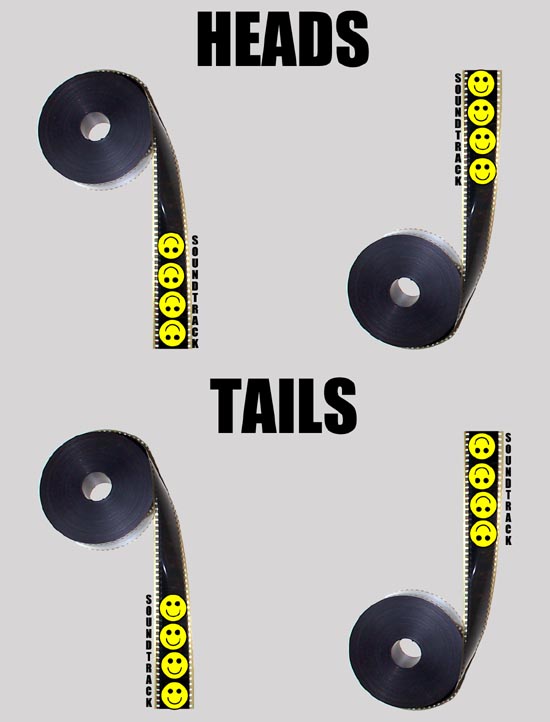
All you have to do is hold your piece of film up to the picture and compare.
Obviously it wouldn't work with film that doesn't have a sound track but for those booths that used this (and other posters I made) their "F-Up ratio" went way down.
on it? ------------------
John P. Pytlak, Senior Technical Specialist
Worldwide Technical Services, Entertainment Imaging
Research Labs, Building 69, Room 7525A
Rochester, New York, 14650-1922 USA
Tel: +1 585 477 5325 Cell: +1 585 781 4036 Fax: +1 585 722 7243
e-mail: john.pytlak@kodak.com
Web site: http://www.kodak.com/go/motion
Anyone ever hear of this? I don;t have a piece of film handy to test it.
Film curl can also be a guide, as in drier conditions, film normally has "positive" curl:
http://www.kodak.com/country/US/en/motion/support/h1/baseP.shtml#other
------------------
John P. Pytlak, Senior Technical Specialist
Worldwide Technical Services, Entertainment Imaging
Research Labs, Building 69, Room 7525A
Rochester, New York, 14650-1922 USA
Tel: +1 585 477 5325 Cell: +1 585 781 4036 Fax: +1 585 722 7243
e-mail: john.pytlak@kodak.com
Web site: http://www.kodak.com/go/motion
Is it really that hard for people to just look at the reflected light off of the film to determine which side is the emulsion and which is the base? I've been to booths where the operators made it a habit to slobber all over the film before and after every splice to make sure it was spliced together properly. What a nasty mess!
The trick is doing it in a darkroom without light.
------------------
John P. Pytlak, Senior Technical Specialist
Worldwide Technical Services, Entertainment Imaging
Research Labs, Building 69, Room 7525A
Rochester, New York, 14650-1922 USA
Tel: +1 585 477 5325 Cell: +1 585 781 4036 Fax: +1 585 722 7243
e-mail: john.pytlak@kodak.com
Web site: http://www.kodak.com/go/motion
![[Wink]](wink.gif)
![[Big Grin]](biggrin.gif)
![[Smile]](smile.gif) (/Edit)
(/Edit)