This is topic Centry Projectors in forum Film Handlers' Forum at Film-Tech Forum ARCHIVE.
To visit this topic, use this URL:
https://ft-forum.com/ft/cgi-bin/ubb/ultimatebb.cgi?ubb=get_topic;f=1;t=003862
Posted by Justin McLeod (Member # 1329) on 08-15-2002, 05:22 PM:
Have a fellow booth projectionist who is working a second theater along with the one I work at.
He said they have all Centry projectors and that they are harder to keep clean. He was needing info on how to best clean these projectors.
I have never seen these types of projectors and all that I know is that they are different than the Christies we have at my theater.
Can anyone help out with this problem.
Pictures would be very helpful also.
Thanks,
Posted by Michael Rourke (Member # 1142) on 08-15-2002, 10:45 PM:
All you need is a clean rag, a toothbrush and a 1 inch paint brush. The Centurys aren't as wide open as the gearless Christies with motorized turrets, but they're not as cluttered as a Simplex. Remove the trap and gate and wipe the tension straps and gate pressure pads with 99% alcohol to remove the emulsion and dirt. Then brush all the film bearing areas with the toothbrush to get off the stubborn dirt. Use the toothbrush to get into all the nooks and crannies like behind the lens turret, under the pad roller arms and behind the upper idler roller on the soundhead. Fold the rag over the toothbrush to wipe up tight areas; wipe the rest of the surfaces with the rag especially under the feeding and holdback sprockets and under the intermittent assembly since they are prone to leaking. Replace the gate then the trap and use the paint brush to sweep away any remaing dirt from the sprockets, pad rollers or painted surfaces. Make sure to wipe the area in front of the projector where the projector and sound head meet because used grease tends to seep out there.
Once in a while it would be beneficial to remove the heat shield from behind the trap and use a CO2 bottle and gun to really clean that area, but don't use the CO2 for everday cleaning beacuse it can break your seals and drive dirt into your bearings.
Posted by Brad Miller (Member # 2) on 08-16-2002, 02:31 AM:
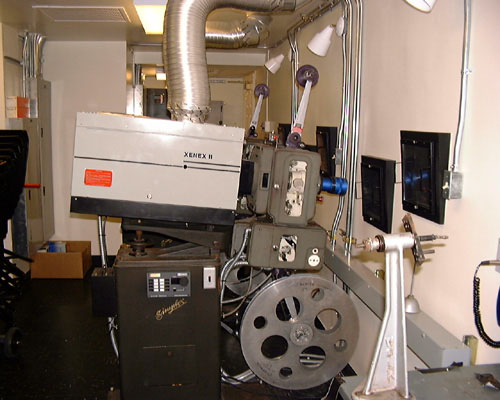
A Century SA projector... 
This picture was taken from the picture page of "Williamsburg Theater" here on the site. Go there for other angles.
Posted by John Pytlak (Member # 331) on 08-16-2002, 07:15 AM:
Here's the manual on Film-Tech: Century SA Manual
Page 9 outlines maintenance. As noted, a stiff toothbrush works fine for cleaning sprockets, pad rollers, gate, trap, and intermittent shoe. The gate and trap are easily removed for cleaning, as is the lens. Wipe-down interior with a clean shop cloth. Don't use harsh solvents, and don't get solvents into bearings. Use a vacuum cleaner and brush to pick up loose dirt. Compressed air will just blow dirt into inaccessable areas. NEVER try to clean a running projector.
------------------
John P. Pytlak, Senior Technical Specialist
Worldwide Technical Services, Entertainment Imaging
Research Labs, Building 69, Room 7525A
Rochester, New York, 14650-1922 USA
Tel: +1 585 477 5325 Cell: +1 585 781 4036 Fax: +1 585 722 7243
e-mail: john.pytlak@kodak.com
Web site: http://www.kodak.com/go/motion
Posted by Gordon McLeod (Member # 33) on 08-16-2002, 10:08 AM:
The Century is a easy machine to keep clean if one makes the effort
If you can't keep a Century clean you shouldn't be working in a booth
Posted by Steve Guttag (Member # 268) on 08-16-2002, 12:53 PM:
A poor example of the Century-SA projector. Though it bears the SA name it has the "H" gates/traps (note the lateral guide rollers). It is an early version. That machine is still in operation though it now has the proper gates and traps.Here is a picture of how that machine currently looks (unfortunetly, the door is closed so you can't see it's brand spankin' new gate/trap.)
Steve
------------------
"Old projectionists never die, they just changeover!"
Posted by Paul G. Thompson (Member # 655) on 08-16-2002, 02:42 PM:
Any machine is fairly easy to keep clean if it is done correctly on a daily basis. I have seen some proud operators keep their old E-7's clean enough to eat out of.
Posted by Scott Norwood (Member # 30) on 08-16-2002, 03:18 PM:
I'm still scratching my head trying to figure out why anyone would think that a Century is hard to keep clean.Since no one else has mentioned this, I will: be sure to leave the gate closed at night to avoid wearing out the spring. This is an annoyingly difficult part to replace if you haven't done it before.
(As a side note, the Centurys at Williamsburg were indeed weird. The model number was/is "MSA/2" and the serials were 150 and 151 [can anyone date them?]. They were originally installed in a drive-in and were bought for the theatre when the DI closed at some point in the 1970s.)
Posted by Dick Prather (Member # 1136) on 08-16-2002, 06:00 PM:
I am sure this might start something. I was taught 40+ years ago when I first and from the union to leave the gates open along with everything else which I still teach. The logic was when you keep the gate closed you are wearing out the pressure springs holding the film in the film trap. These are the springs you want at proper tension for film stability while operating. Stretching bands or their spring pressure would be the same today. I have only had one closing spring break in all the Century's I ran. Replacing the spring wasn't that bad. Maybe different parts of the country do it differently
Posted by Gordon McLeod (Member # 33) on 08-16-2002, 06:15 PM:
What i was always taught was to remove the trap door of the projector and then close the mechanism for it so both are left relaxed
Posted by Brad Miller (Member # 2) on 08-16-2002, 06:26 PM:
I've left the gate closed overnight for years and years and have never had the need to change out the bands. I do like Gordon's idea though. I may start doing that. 
Posted by Dick Prather (Member # 1136) on 08-16-2002, 08:28 PM:
Gordon's idea is indeed the best of both worlds. Just find a safe place to put them and inform all operators working at the theatre. I have seen that in theatres I have visited. Brad, I have never changed any bands either from theatres that did not leave the gates open that. It's just what we were taught when we started.
Posted by Manny Knowles (Member # 1171) on 08-17-2002, 08:08 AM:
If the projector has been retrofitted with Kelmar gates then you won't need to remove the pressure plate at night. The "natural state" for the spring in these gates is the open position. I've never had a spring go bad in these but, if I did, these are very easy to take apart and put back together.If you're applying XeKote II in your film traps at night then you should leave them open overnight anyway.
Posted by Pete Naples (Member # 761) on 08-17-2002, 01:04 PM:
Why fit Kelmar gates? I fit the current Strong curved gate and trap assembly to Westars with little modification. You improve your old machine and get rid of the slight worry about spares availability.I too am with Gordon, I was brought up to do that very thing!
Posted by Jim Alexander (Member # 226) on 08-17-2002, 03:06 PM:
We have been using Century-C Projectors at our theatre for the past five years. They were originally installed in 1947! and work like a dream. The only modifications that were done to them was retrofiting the Arc lamps with Zenon bulb and I just finished upgrading the R3 sound reader to a Component Engineering ASR-40 reader (BTW most excellent upgrade if you are worried about the cyan track change coming!)
Century Projector are quite common in these parts. Most all independant theatres in Atlantic Canada use them and there have been few major failures that couldn't be fixed quickly.
We normally leave the gate open at night and have only had one failure of the gate wheel. Turned out the pin that moved the gate broke off (What do you expect for a 55 year old machine! If only I fair so well.) Cleaning is quite simple as everyone has mentioned above, the only exception is we clean out any excess grease and regrease the drive shafts and gears from the rear (we use Lituium grease) and thats about it. As long as you stay ahead of them, the machines stay quite clean and work FOREVER!Jim Alexander
Zedex Theatre
Greenwood, Nova Scotia
Posted by Jason Black (Member # 684) on 08-17-2002, 03:46 PM:
I recall using Vasoline on the gears on our older Century 'C' models. I believe they were 'C' models anyway. The Century grease that supply houses sold was god awful about slinging loose all inside the rear of the projector. The Vasoline method seemed to have worked just fine as long as I was there (3 years). This is the same theatre that had teh ORC platters. When I was last in it, there was still an OLD tube type amp rack in it. I wish I would have taken it down to keep prior to the place closing up.
Posted by Paul G. Thompson (Member # 655) on 08-17-2002, 04:04 PM:
Century Gear grease looks like industrial strength Vasoline. I never had a problem with it slinging off the gears. However, I do recall that a not-so-cool theatre supply house (now bankrupt) in the midwest was selling tubes of Lubri-Plate with a Century Gear Grease label. I thought it was kind of sleazy, personally.
Jason, I question the the theatre supply house's thoughts. I do not think you were getting official Century Gear grease. You might want to look for another supplier that will sell you the correct stuff.
Vasoline works, but not quite as well. However, I will use it in a pinch if needed. It doesn't adhere to the gears as well as Genuine Century Gear Lube.
Posted by Richard Fowler (Member # 893) on 08-17-2002, 04:15 PM:
Pete,
we have sold and installed over 120 Kelmar turret kits on Century, Monee, Cinemex, Cinecita machines. I do not know who distributes in the U.K. but spares should not be a problem from a well managed company such as Kelmar...I would love to have their balance sheet and profit margin.
Richard Fowler
TVP-Theatre & Video Products Inc. www.tvpmiami.com
Posted by Alan Plester (Member # 852) on 08-17-2002, 05:27 PM:
I agree with Gordon, if you can`t keep that one clean, it beggars the question as why?. Toothbrush and lint free rag every day kept our centurys spotless. We also left the gate open evry night without detrimental effect.
Posted by Manny Knowles (Member # 1171) on 08-17-2002, 05:38 PM:
Thanks for clarifying things, Richard: I started to wonder if Kelmar was shutting down or something when I read Pete's post. I was about to panic!As for the grease (here we go again)...I'm being a good little boy by using the Lubriplate as per the (Westar) manufacturer's instruction. At this point, it is mainly because I have so much of it around.
I have heard that Vaseline® is okay and I've used it in an emergency. The machine survived just fine, but it's no fun cleaning that stuff off the gears.
Whatever I'm using, I remove the gears about every 3-6 months so I can clean away the old grease before adding fresh lube. It's become a very Zen experience for me.
~Manny (Over 1 billion served.)
Posted by Mark Gulbrandsen (Member # 72) on 08-17-2002, 08:01 PM:
Well guys, I was actually taught to put in X-L's anyway. Fewer problems, less repairs, just put a drip pan underneath and recycle the oil! Strong should now include the word "Digital" on every X-L head so everyone knows its the "one to go with".
BTW: What is this new Centry Projector. Does it have a security alarm built in or something theft proof?
Mark
Posted by Pete Naples (Member # 761) on 08-18-2002, 06:19 AM:
Hell no! Don't read anything into posts, which simply isn't there! What I meant was that it's becoming tricky sometimes to obtain parts for old Century and Westrex machines, particularly the Westrex lens holder and trap/gate assembly. Hence I tend to replace it with the current Strong Century item.We carry spares for Westrex and Century gates and traps, so why would we complicate matters by carrying another line for these machines? Not that there's anything wrong with Kelmar stuff, I just don't see the need. Probably in the US there's a cost benefit, but by the time it reaches 'rip off Britain' there's likely little or no difference.
Kelmar stuff is easy enough to get here, we carry some items. We stock a hell of a lot more Strong/Westrex lines though.
Posted by Mark Gulbrandsen (Member # 72) on 08-18-2002, 07:39 AM:
OK Manny,
I'll be the one to jump on you since you gave yourself away.......
Never use Lubriplate on anything, ever. Its pure garbage. Your manual was probably written before the stuff was available. If not then someone at Westar should be shot for writing that. Dries up too fast and leaves a hard to remove residue on the gears when it does.
Vaselene is too thin.....Not temperature resistant and slings rignt off. Use either Century Gear grease(which is Now Superlube with the Century label slapped on the tube), or just buy Superlube itself. I think its about a buck more than a tube of Lubriplate. Available at any Industral or bearing supply outlet. You won't be removing your gear train every 3 to 6 months to clean it off either. It will wipe right off even after 5 years.
Mark
Posted by Richard Fowler (Member # 893) on 08-18-2002, 08:05 AM:
Pete,
sorry the post was misread. I recently returned from a manufacturer and dealer convention where it is obvious that many companies have downsized or are having problems. Kelmar supplies many companies with custom product, such as us, in addition to their own brand.....with all the Century of many types worldwide, there will always be several sources of supply....maybe a four lens turret conversion with a Digital Cinema unit built into the 4th postion 
Richard Fowler
TVP-Theatre & Video Products Inc. www.tvpmiami.com
Posted by Frank Angel (Member # 248) on 08-18-2002, 01:25 PM:
It's funny how certain ideas are passed down from decade to decade and actually become Standard Operating Procedures, many times long after the original reason for them is gone, or maybe never even existed. I was also taught to keep the gate open because doing so would keep the bands in a relaxed state. I was also taught to keep the pressure roller disengaged in the soundhead so that the drum doesn't form a "dent" in the rubber. In reality, I doubt that either of these issues have much basis in fact -- especially the spring thing. Do springs loose their flex tension by being kept in the taut position? Think about it. If they did, it probably isn't enough to be significant. Think of all the springs that remain flexed for years and years -- they don't somehow become less "springy;" it would seem this idea doesn't hold much merit. If it were true, we would be swapping out and replacing springs in everything.....continually. You can think of 100 things that have springs which are almost always in their flexed position -- they don't go bad and become unreliable with time.
As for the rubber "dent" thing, I would assume that if this were really a problem, these rollers would be the most replaced part ever, given how many times projectionists accidentally leave the roller in the closed position, pressing on the drum. I myself have done that and the projectors weren't used in months -- no dents, no thumping sound on the soundtrack as was the supposed result of such a transgression.
Maybe some projectionist decades ago thought up these ideas and they stuck and got propagated over and over until it became these mythical "facts."
I say, keep the gate any way you like, in either position a spring is going to be kept flexed; either the bands or the spring that keeps the gate closed will be taut. According to the theory, one or the other will eventually have no spring left. And keep the pressure roller against the drum -- it's not going to get a dent in it.
But I must say, it's kind of cool when you think about it -- some guy maybe almost a century ago thought up this stuff with nothing much really to test the theories yet they become the way all the projectionists around the world now do it.
Frank
Posted by Pete Naples (Member # 761) on 08-18-2002, 01:30 PM:
Nae bother! With me WYSIWYG!What the heck is Lubriplate? It is not mentioned in any of the three vintages of Westar manual I've got sat in front of me here (admittedly all London Westrex). The Westrex 'bible' only mentions the various Westrex supplied lubricants, all of which have Westrex part Nº's, which of course are obsolete and meaningless now.
Posted by Martin Dean (Member # 1416) on 08-18-2002, 01:47 PM:
I'll back up Peter with everything he has said but will also add the following. On some Century gates the gate assembly is very difficult to slide out, even after suitable lubricant is added. In several cases some extra applied pressure from a suitable tool is required. In these cases I would tend to suggest the projectionist leave the gate open as already suggested. Continually removing / inserting a tight assembly may lead to possible damage due to the force required. Of course the gate closing spring will be under pressure, but should still last a considerable time and then probably be relatively cheap to replace (on a turret fitted version). Keeping the tension of the pressure bands is always preferable. On single lens assemblies the springs tend to deform as a matter of course, sometime breaking with no warning, but are a) cheap and b) easy to replace.As far as cleaning is concerned, n my experience as well as a toothbrush, a small paint brush is useful (i.e ½” size) for those hard to reach spots (if compressed air is not available). A Chief Projectionist in Wales also introduced me to that the best tool for cleaning gate runners/traps, pressure bands etc, which is a glass fiber brush (usually used for the leaning of circuit board tracks).
------------------
Martin Dean
martinidean@charter.net
Posted by Manny Knowles (Member # 1171) on 08-18-2002, 03:20 PM:
Maybe I'm wrong, but wasn't the Westar brand bought out by International Cinema (Miami, FL)?As for Westrex, I don't think that is the same as Westar...or is it?
~Manny (on time, everytime).
Posted by Gordon McLeod (Member # 33) on 08-18-2002, 03:41 PM:
Westrex was originally the export div of western electric. In the agreement with century century got to use there soundheads the R2 and R3 and the patent on the Davis Loop in exchange outside of the US market they built there own century projector called the Westar in most cases
Westrex had facilities in Canada (northern electric) India (Cinecita/monee) Italy Mexico and othersIn the 80's ICECO bought Westrex's UK division and shortly afterwards moved it to the US
Now most of the US built Westar is made from Monee and other parts
Posted by Paul G. Thompson (Member # 655) on 08-18-2002, 03:43 PM:
http://www.lubriplate.com Pete, I don't use that stuff in Century, or Century knock-off's. I only use genuine Century Gear Lube in those machines, or Vasoline in an emergency pinch.
I might add this: If you have been using other crap (including Lubriplate) and you want to change to Century gear lube, you better clean all that old crap off the gears. Some of that stuff will not be happy with other types of lubricants.
The old Century "C" was using Century gear lube for a billion years, and it kept them happy. Need I say more?
Posted by Manny Knowles (Member # 1171) on 08-18-2002, 03:48 PM:
Ah, thanks Gordon.I've heard of the Latham loop, but what is the Davis loop?
I'm also curious...are there essential differences between genuine Century parts and parts from the copycat models? I'm refering to quality as well as interchangeability of the parts.
Posted by Gordon McLeod (Member # 33) on 08-18-2002, 03:53 PM:
The Davis tight loop is the basis of the century soundhead in that a pair of rollers are tensioned against the film that is in contact with a scanner attached to a flywheel
The two rollers are on arms that are spring loaded against each other and the lower one is damped in a fluid to create a kinetic lossAs for interchangablity that is a difficult question
ICECO sells the westar with century pitched gears or the original westar pitch that was actually superior in design
Also some parts are made as assemblies (upper and ower sprocket assemblies) So not all parts are interchangeable
Posted by Wes Hughes (Member # 981) on 08-18-2002, 03:58 PM:
I like CSS (cinema sales and service of Boston) Century Plus Lube. It comes one pound tubs and has teflon mixed in.I cannot use anything else in one of my booths in the summer (no air conditioning). It will not sling off.
MARTIN: If you find a Century with removable traps that is really difficult to remove then the machine is either damaged, or the removable part has been swapped with another machine. The dovetail joint of the removable trap was rumored to have been customized for each machine and hence should not be swapped.
Posted by Pete Naples (Member # 761) on 08-18-2002, 04:10 PM:
If the Century trap assembly is really tight to remove, even with lubricant, I'd suggest that the block assembly which the trap is mounted on needs adjusted (the bottom 'V' block can be adjusted), never found the curved gate assembly to be tight on any of them though.Manny, stick to real Century parts (ie Strong). I've found that some of the knock offs can be real garbage. Also I've found that often the screw threads on the real thing and the knock off either don't match or are drilled in the wrong place.
Posted by Gordon McLeod (Member # 33) on 08-18-2002, 04:21 PM:
I would contact ICECO with the serical numbers to confirm if you can use century parts before purchaseing them as there are many differences in pitch
Posted by Dick Prather (Member # 1136) on 08-18-2002, 04:32 PM:
I have heard all kinds of openions on using lubriplate. In the northwest we have had Century's running using it for over 20 years in 7 day a week service with out any gear problems or dried up grease. I have also heard the dry up problems but mostly from hotter areas of the country. I don't think it is crap but may not be the best gear lube for all settings. I have also used a red lithium grease, AMS synthetic grease, two or three types of Century grease, and had success with all. The object is to keep the fiber gears lubricated. Excess thrown off grease should always be wiped up (NEVER while the machine is running). Vasoline is a last resort and needs to be replaced quickly with a quality lube. Origional Century manuals stated using only Century oil on gear train.When I rebuild a Century I run the gears in dry until a very slight fiber trace shows up on the steel gears. After cleaning the fibre off I use Century oil on thr gears for the rest of the run in which is 10 to 20+ hours with and without film. The machine is shipped to the user so that he/she can use whatever gear grease they want after installation.
Of course my favorite projector the XL doesn't have this grease problem no matter which part of the world you live in.
Posted by Gordon McLeod (Member # 33) on 08-18-2002, 04:41 PM:
I favor the black Molybidinum disulphide greeese myself that was the original spec in many of the Westrex notes
Posted by Pete Naples (Member # 761) on 08-18-2002, 05:07 PM:
In a pub full of projection engineers, you'll spot the Westrex guy a mile off, he's the one with the filthy looking hands!
Posted by Richard Fowler (Member # 893) on 08-18-2002, 07:05 PM:
In Latin America I have seen them use a stiff red axle grease which they put on in such excessive amounts that you could call it a grease filled chamber. One machine that had lost the mounting screw to the shutter gear on the vertical shaft I found embedded in the layer of grease on the inside of the door.
The best source for Century parts in addition to Strong is Lavezzi.
Richard Fowler
TVP-Theatre & Video Products Inc. www.tvpmiami.com
Posted by Justin McLeod (Member # 1329) on 08-19-2002, 12:09 AM:
Thanks for all the very helpful info guys.This should help out the person I mentioned who is in need.
I do have one more question though. Can you manually turn over the motor to clean the sprokets the same as you can with the christies?
Posted by Brad Miller (Member # 2) on 08-19-2002, 12:11 AM:
Advancing the projector mechanism by hand is right on par with other "standard features" such as framing and focusing.