This is topic Changing Dolby/Kelmar Analog LED in forum Film Handlers' Forum at Film-Tech Forum ARCHIVE.
To visit this topic, use this URL:
https://ft-forum.com/ft/cgi-bin/ubb/ultimatebb.cgi?ubb=get_topic;f=1;t=003867
Posted by Manny Knowles (Member # 1171) on 08-16-2002, 07:05 PM:
Since we are on the topic of analog LED kits, I also have a question:How do you replace a dead (or dying) LED in the Kelmar reverse-scan reader?
Maybe a few photos would be best..?
~Manny (I try harder)
Posted by Richard Fowler (Member # 893) on 08-16-2002, 08:14 PM:
manny,
on the Kelmar it is very easy. You will need the white "heat sink" compound available from most electronic stores ( and you should have already for "heat sinking" rectifier diodes also ). The replacement LED-V chip supplied by Dolby will have leads that will need to be trim to match the one that is removed. The chip itself has a reference bump which you must match position when installing the new chip. Remove cover holding chip....pull out old chip, after noting reference bump postion. The chip is plugged into a 3 pin female socket on the supply cable that you can see on the under side of the mount. When pulling out the old chip there are miniture teflon sleeves which reside in the holes of the bracket....if they come out , reseat them into the bracket for the new replacement to pass through. Apply heat sink compound, mount new LED-V chip,square up led array, put on LED clamp, and plug in female socket....5 minutes or less. Component Engineering mounts are almost the same with the female socket part of the flex power ribbon. The hardest one to work on is Cinemeccanica which requires hand soldering, but they where the first company to use basement units...so expect 15 minutes with a magnifier and a clamp to hold the heat sink.
Posted by Manny Knowles (Member # 1171) on 08-16-2002, 10:05 PM:
Richard:Thanks for the reply.
I have a batch of these LEDs to install and I will have help with the first few. I appreciate your instructions - I always like to know a little something before I get a tutorial...it eliminates the whole anxiety issue and it also makes me feel like less of an idiot when I'm being instructed.
The replacement LEDs came with a small amount of heat-sink compound and, yes, I happen to have a tube here from the recent diode swapping.
Where does this heat-sink compound go? I'm just curious.
~Manny (Fast, Fresh & Ready-To-Go.)
Posted by Richard Fowler (Member # 893) on 08-16-2002, 11:33 PM:
Manny,
just a little bit under the diode area...when you take one apart, if the original factory installed LED-V is in use you will see how much.
Richard Fowler
TVP-Theatre & Video Products Inc. www.tvpmiami.com
Posted by Steve Kraus (Member # 476) on 08-17-2002, 12:14 AM:
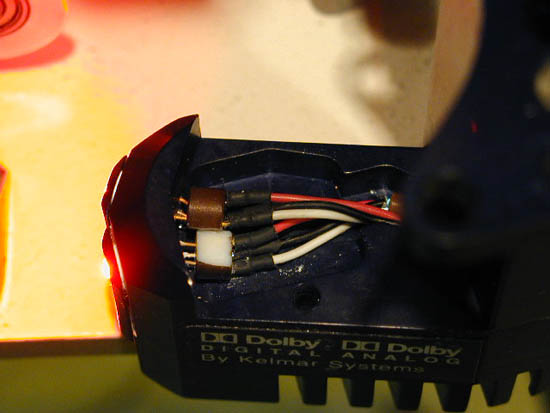
Perhaps the analog only units are different but when I've had to change them on the Kelmar basement reader what I encountered was a socket that was not attached to the heatsink and had to be applied to the LED leads from behind, after it was pushed through the holes. 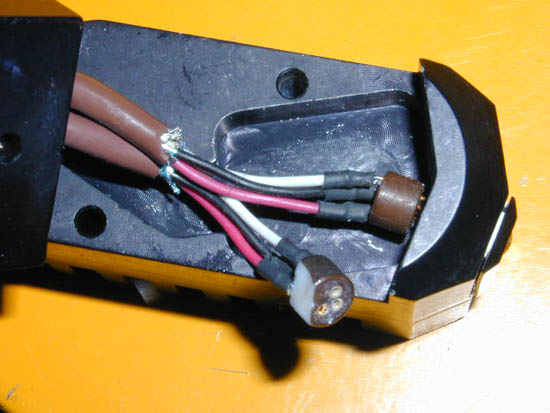
Note also how the flat spots they filed on the 2 sockets to enable their close positioning do not face each other which makes it pointless and very awkward to assemble.
Posted by Manny Knowles (Member # 1171) on 08-17-2002, 12:20 AM:
Richard: Thanks. Why didn't I think of that???Steve: Those are some really great photos. I was hoping I'd get to see stuff like that before "going in."
This already feels like a stupid question, but I will ask it anyway...
...How much of an A-Chain will be required? The whole kit-and-caboodle? Or just a calibration of the LED and a Dolby level set?
~Manny (for whiter teeth and fresh breath.)
Posted by Richard Fowler (Member # 893) on 08-17-2002, 12:35 AM:
Manny,
the LED socket is the same for the analog unit; they do some filing on the dual analog/digital heads due to the close fit. You should only have to do a peak output on the A chain as you move the LED head up and down if your LED array is a square as the previous one.
Richard Fowler
TVP-Theatre & Video Products Inc.
Posted by Steve Kraus (Member # 476) on 08-17-2002, 12:36 AM:
Well, if you're only touching the light source it can't really affect focus, azimuth, or lateral position. Since you don't have digital track illumination to worry about you ought to be able to simply position it for maximum signal. I guess ideally you'd want to check it for uniform illumination across the track but I doubt very many people do. Peak it, tighten it down and then follow the recommended steps for LED current vs. pre-amp gain on the CP.
Posted by Steve Guttag (Member # 268) on 08-17-2002, 08:38 AM:
Actually, it _can_ affect relative azimuth and apparent focus. This has more to due with the style of the light source. It is a slit of light formed by two rows of LEDs. If the height and azimuth of the LED are off, it will show up in the A-Chain. Even the spacing of the LED off of the track can be picked up. It has to do with how the light form the LED cuts through the film and the shadows it creates. However, that said, generally, you can change the LED and just optimize it for maximum output and you will be all set and not have to touch the rest.Steve
------------------
"Old projectionists never die, they just changeover!"
Posted by Gordon McLeod (Member # 33) on 08-17-2002, 09:35 AM:
Like Steve said it does effect the rest
If you are doing it it is worth the effort to redo the A chain at the same time also run the uniformity test film as it is always possible that the bracket was off alignment in the first place
Posted by Steve Kraus (Member # 476) on 08-17-2002, 05:48 PM:
I had a feeling when I posted that that I would be hearing from you two! 
Posted by Alan Gilbertson (Member # 242) on 08-17-2002, 09:34 PM:
Also keep in mind that if you are changing out the old Kelmar LED's that are'nt the Bright red you might find that the polarity is different. Just go to the power supply and switch the NEG. and POS. wires around.
Posted by Gordon McLeod (Member # 33) on 08-17-2002, 10:26 PM:
Didn't want to diappoint you steve
Also remember to turn the LED current back down to the nare min required to get level
Posted by Steve Kraus (Member # 476) on 08-19-2002, 09:29 AM:
There is also the matter of cutting the jumpers on the pre-preamp board (if they are the same as the ones I have and this has not already been done) to up the gain allowing significant reduction in the LED current.
Posted by Martin Dean (Member # 1416) on 08-19-2002, 09:42 AM:
When changing LED's it is almost certain that you will be able to significantly turn down the LED current, not just because they are new, but because Dolby changed the design (or supplier) of the LED's to get a much brighter, more even light. In many cases I have found that you can turn the current down to minimum and still get good Dolby level with plenty of head room left on the adjustments. Of course good line up of the LED to the cell optics is essential.------------------
Martin Dean
martinidean@charter.net
Posted by Manny Knowles (Member # 1171) on 09-14-2002, 04:48 PM:
Well...guess what? I did it! I replaced an LED yesterday. Thanks for all the help.One more question: I applied the heat sink compound to the bracket and then inserted the three electrical contacts and seated the LED onto the compound and then wiped the excess away. Is this how it's supposed to be done or is there an easier, neater way to do it? It kind of got onto those tiny electrical contacts, too (when I pushed them through). I had to scrape the compound off the ends with a tiny little screwdriver to keep things nice n' pretty.
As it turned out this was a particularly nasty machine so I took the time to dismantle the entire unit and I then cleaned each individual piece. As a result, a complete re-do of the A-Chain will be a must. There's no telling when the last one was done anyway.
Plus...I installed a CP-45 at the same time. This was originally a Centre-Surround house (originally with a Smart IIB) and now it has full cinema stereo with all-new JBL speakers.
This is going to be a happy, happy theatre when I'm done with it.
Thanks again for your help...and be sure to let me know if you have an easy way to deal with the heat sink compound.
~Manny.