This is topic The Century (Projectors) Family Reunion in forum Film Handlers' Forum at Film-Tech Forum ARCHIVE.
To visit this topic, use this URL:
https://ft-forum.com/ft/cgi-bin/ubb/ultimatebb.cgi?ubb=get_topic;f=1;t=003879
Posted by Manny Knowles (Member # 1171) on 08-18-2002, 04:08 PM:
I don't want us to go off-topic in the Century Projector (aka "Centry Projector") thread.I posed a question to Gordon about the differences (or similarities) between a geniune Century machine and the various copycat models (Monee, Westar, et al).
Gordon wrote:
quote:
ICECO sells the westar with century pitched gears or the original westar pitch that was actually superior in design
Also some parts are made as assemblies (upper and ower sprocket assemblies) So not all parts are interchangeable
What do you mean by "pitch" in this case?
Also, the upper and lower sprocket assemblies...you mean the gear, the shaft and the sprocket roller? Are you referring to the fact that some of them fasten with screws, whereas others fasten with conical pins?
Posted by Gordon McLeod (Member # 33) on 08-18-2002, 04:24 PM:
On many Westars the upper and lower sprocket assemblies are actually removeable complete in that the bearing assembly bolts into the casting and can be removed with the gear shaft sprocket and pad intact
Century and the older westars were a hole bored through the main casting and a bushing installedOne nice thing about the removable assembly was that the fit to the verticle shaft could be adjusted
THe pitch is the angle of the cut on the gear teeth
Posted by Manny Knowles (Member # 1171) on 08-18-2002, 04:52 PM:
Here are two quick photos from one of our older Westar heads.
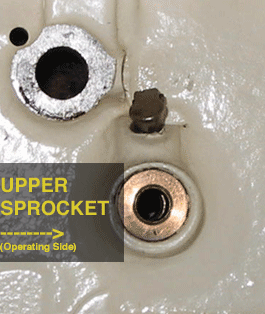

What type of sprocket would this type of opening match?
Posted by Pete Naples (Member # 761) on 08-18-2002, 05:17 PM:
I'd have to check the bible to confirm this, but if I recall rightly, of the London Westrex, anything after model 'B' has removeable sprocket plates.Manny, the sprocket, gear and shaft are the same on the moveable ones.
The other noteable difference is the primary drive assembly, on all but early UK Westars it's removeable and adjustable.
Posted by Mark Gulbrandsen (Member # 72) on 08-18-2002, 07:52 PM:
Manny, that looks like a Century main casting. All Westrex's I've seen have removable upper and lower sprockets. ICECO owns the name Westar(virtually meaningless now) and they usually slap a serial number plate on everything that leaves the shop(for what ever stupid reason).
If thats where these came from that explains it. Seems Century to me though, not Westrex.
Mark
Posted by Dick Prather (Member # 1136) on 08-19-2002, 04:56 AM:
Manny,
I have most of a Westar 2000 and it has removable upper and lower sprocket assemblies just like the Simplex XL. Yours does look like an older model or a Century. In rebuilding these things I found that Century had so many people making gears for them over the years I started to replace them in pairs only. I had very good luck with LaVezzi gears and hightly recommend them.Gordon,
Is Florida the only place to get Westrex parts? Mine is missing the removable outboard main drive shaft bearing holder.
Posted by Bernard Tonks (Member # 809) on 08-19-2002, 07:39 AM:
A Westar 2001-E at the Regal, Cranleigh installed 1970. Details of 2001-E taken from a Westrex manual 1955.
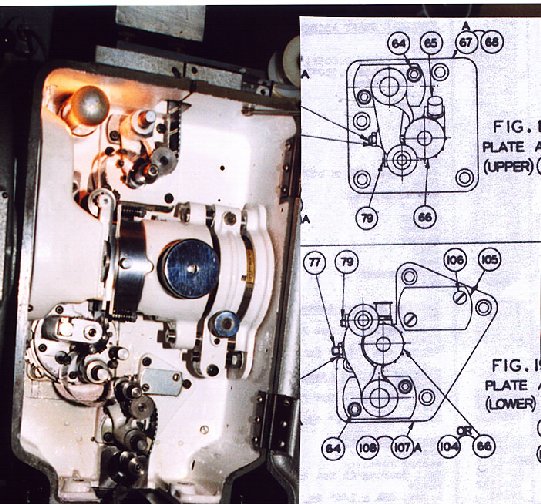
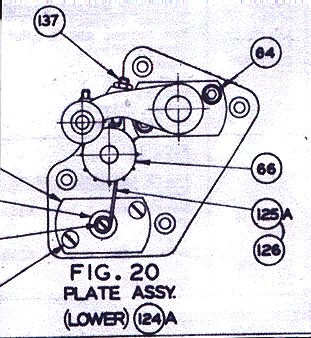
Posted by Richard Fowler (Member # 893) on 08-19-2002, 08:46 AM:
The Westrex 2001 is a fine machine.....I have two running in platter houses for 20 years with two overhauls with no problem. The upper and lower sprocket bearing assembly and outboard main drive removeable bearing support make it easy to tweak for smooth operation. The intermittent drive gear on the vertical shaft and bearing support are slightly different from the Century type, again which allows for final tweak for smoooth operation. A wek spot is the lens mount which is not too forgiving in a tilt situation but works fine level.
Cinecita has been out of production for 15 years and have recently restarted very limited production due to increased building in India. The units sold to ORC where pretty poor and it was obvious that ORC did nothing in quality control since I remember I had to cut a piece of metal off of a soundhead casting so the drive belt could be installed:rolleyses: Cinecita had labor disputes ( which probably contributed to their quality control ) and they shut down their plant.
Monee, the largest supplier of the Indian Centurys is the source of the "Rebadged Westar" units sold by ICECO ( with a Kelmar turret vs the Monee, which the early ones had a problem in indexing accurately ).ICECO will supply either the 14 pitch or Century pitch gears as required by the customer. The intermittents, at least, would have the seals and bearings replaced or at most than intermittent rebuld kit installed to make them more reliable for platter use. Monee has moved to a new plant a couple of years ago and in their latest literature they have a picture of the four unit intermittent test stand to run in the units.
Indian parts are from four sources and vary in quality. We replace the set screws in the gears with stainless allen screws which tend to solve most of the operational problems with the gears.
The V-8 is a tank and the gear train was designed for a 50,000 service life if properly maintained. The weak spot on earlier units was the combination fire shutter picture douser which required constant adjustment which in later model was replace with a "zipper" type changeover. V-4 seem to run forever if you remember to push the oil plunger ( a la E-7 ) prior to each show. I installed a sixplex in Miami 20 years ago ( after removing the equipment from another cinema ) with platters and they are still chugging 12 hours a day.
Cinemeccanica US has, like most suppliers, have downsized, so telephone support is not as great as before but they are trying in addition to our staff in taking care of questions. The parent company has been under the same ownership for 80 years which is extremly rare in this business.
I found PRO-35 easy to keep on the screen has long as you changed out the framing coupler yearly and the oil seal and general recondition on a five year average......and keep it oiled of course.
Richard Fowler
TVP-Theatre & Video Products Inc. www.tvpmiami.com
Posted by Pete Naples (Member # 761) on 08-19-2002, 04:14 PM:
Nice clean Westar there Bernard! It's good to see them being looked after properly. Basically the letter suffix of the later models denotes single or double shutter and the type of drive adaption fitted. Of course that may have changed in the machines lifetime, as rep-sets were often changed. Your set up was quite unusual with the RCA sound heads. Almost all of the Westars I see have the Westrex 2002 (R2) or 2003 (R3) rep-set. On the other hand I've got a picture somewhere of the Cameo, Edinburgh, just after CinemaScope was installed. The booth had Westrex 2002 with Kalee 12 picture heads on. The adaption gearing is quite intricate!
Posted by Bernard Tonks (Member # 809) on 08-20-2002, 03:35 AM:
Pete, The projector heads and soundheads had just been hand painted, with three coats of Hammerite gloss white enamel radiator paint, which never discolours, and is extremely hard wearing! A whole day was spent on each projector head, and same for each soundhead, stripping out all removable parts to make a thorough job. You can also get the radiator paint in satin finish, but the gloss finish is so much smarter. The RCA 9031 soundheads were installed new at Cranleigh in 1954, the projector heads were Ross GC3s, a Pathe Equipment package! So hence the unusual set-up afterwards in 1970 with the Westars 2001s. This was quite common in some ABC cinemas during the late 1950s when Ross or Simplex projectors were replaced retaining the RCA sound system. Following this period Plilips FP20s took the scene.
I’ve worked on the older Westar projector heads without the removable upper & lower sprocket assemblies, also they had the smaller 50mm lens barrel! Claimed to be the first two Westar’s installed in 1947 at the Playhouse, Hampstead (later Classic, then ABC, now closed). These were mounted onto Western Electric Universal Bases.
Posted by William Hooper (Member # 71) on 08-20-2002, 03:42 AM:
Century DBW 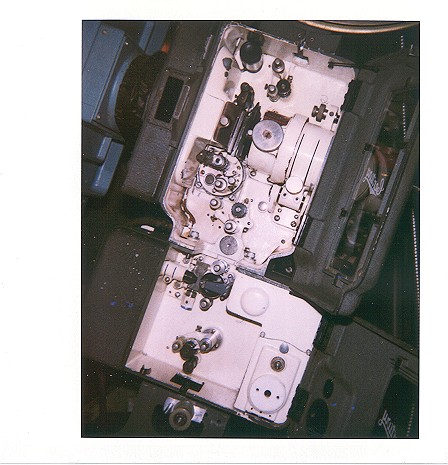
Posted by Pete Naples (Member # 761) on 08-20-2002, 01:05 PM:
A lot of the early Westars like those you mentioned would be pre CinemaScope. Look carefully and you'll often see file marks aruond the lens opening where somebody got the odious task of opening out said hole so the lens could be shifted over. Eccentric and non-eccentric lens sleeves were used for optical and mag CinemaScope foramts.
Posted by Justin McLeod (Member # 1329) on 08-20-2002, 09:05 PM:
I posted one last question on the centry projector thread that I started but for some reason or another the question went unanswered. I will ask it again on this thread. Can you manually turn over the sprokets on a centry projector like you can on a christie?
Posted by Manny Knowles (Member # 1171) on 08-20-2002, 09:22 PM:
When you say "manually turn over sprockets" do you mean......flip them around (so they wear evenly); or
...inch the gears (drivetrain).
Posted by Scott Norwood (Member # 30) on 08-20-2002, 09:24 PM:
Yes, Centurys can be turned over by hand. Assuming that you have Century soundheads, there should be a flywheel on the front of the soundhead (attached to the motor). From the operator side, you can reach in front and spin the flywheel in the "up" (counterclockwise) direction to advance the mechanism. (Simplex X-Ls with 5-star soundheads work the same way, but you spin the flywheel in the opposite direction).
Posted by Manny Knowles (Member # 1171) on 08-20-2002, 09:53 PM:
...or...You can turn the inching knob. There should be a silver knob on the front of the picture head. It should be just behind the lens mount. This knob is actually attached to the shutter shaft.
By the way...The name plate on that Westar in my photo says that the model is SA. I will post a more complete pic of it soon.
Now I have a question: In the interest of avoiding confusion, what should I call my projectors? If they are really Century's should I continue calling them Westars? After all, that is what's printed on the ID plate. I'm trying to avoid using the term "Century" as a generic. Xerox, Aspirin and Band-Aid hate this practice of using a brand-name as a common noun. But I'm also trying to be correct. If -- when all is said and done -- it is revealed to be genuine Century equipment then that's what it should be called, don't you think?
~Manny (don't ask, don't tell.)
Posted by Dick Prather (Member # 1136) on 08-21-2002, 01:04 AM:
Manny,
Is there a serial number on the plate? There should also be the same number on the frame. Century's frame number should be on top of the machine. I can't be sure on the number position of the Westar. If there is no serial number on the attached plate or they don't match it could be a rebuilt Century.
Posted by Gordon McLeod (Member # 33) on 08-21-2002, 09:45 AM:
Depending on the soundhead turning the shutter shaft is not a good idea to inch the machine most gearboxed soundheads don't like being driven from the projectorAlso Westar did not to my knowledge very make a model SA most used the 2000 serries model #'s
In that picture of the DBW projector what make of lamphouse is that behind it
Posted by Manny Knowles (Member # 1171) on 08-21-2002, 08:23 PM:
I think these are R-3 soundheads.
Posted by William Hooper (Member # 71) on 08-22-2002, 02:28 AM:
quote:
In that picture of the DBW projector what make of lamphouse is that behind it
Christie Xenolite Model BSG65 !
Should have made it a trivia question to drive everybody crazy.
Posted by Gordon McLeod (Member # 33) on 08-22-2002, 09:12 AM:
William how much light does that porduce never had much luck with them 
I felt that was it or it was the blue xebex hibeam3
Posted by William Hooper (Member # 71) on 08-23-2002, 12:43 AM:
quote:
how much light
Plenty. We never measured it, & when we saw it we knew we didn't need to. With an ORC XM-4200 bulb it was bright & sharp with little fall off at the corners on flat 23' high & scope 40' wide. One of the best pictures I'd seen. You could sometimes see the arc dance, though, but that was only if there was little picture but clouds, etc.
Great light, great pictures, & I'm way too picky.
The lamphouse was put together with parts from two that were provided, we had no alignment kit & my friend Ed did the initial alignment via his excellent eyeball alone. With an Align-O-Tron we probably would have been showing movies in the park behind the theater. It seems in this lamphouse there were some threads stripped in an adjustment base which made alignment a little annoying & time consuming. Those adjustment pieces down there were soft aluminum gears & worms & one piece of nylon, as I recall. They were damaged in both of the units we had to work from.
Creeped me out due to flaky damaged bulb adjustment, never failed, but sometimes would bzzt twice on strike just to mess with me. Old equipment tends to accumulate individualized collections of characteristics to justify calling it a personality.