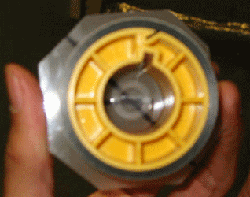
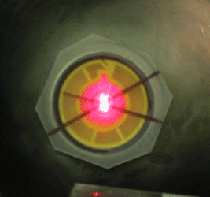
As you can see, that's a 2" core with just the right amount of film to make it fit into the opening in the reflector. We used the opaque side of a DTS snap-loc case (sorry, Karen) as the support backing. We applied Krazy Glue to the inner and outer diameters to secure the roll of film to the plastic backing and then we used those radiating lines on the core to locate the centre, drawing the "X" on the plastic backing with a Sharpie marker.
For anyone who is wondering what an Align-O-Tron is...it's a laser kit for doing optomechanical alignments. Your lamp house alignment to your aperture is a critical alignment. It used to be done with rods or string. This way is a lot more fun.
I had to make a pinhole aperture plate, too. The one I ordered from Kelmar has not arrived yet.
~Manny
*BTW, it was explained to me that the reason the Align-O-Tron "pyramid" doesn't come with "steps" for all of the existing reflectors is that some of the manufacturers did not (or would not) provide him with the specs on their reflector openings.
Also it is a good idea to have a flat mirror mounted on the back of the plug with the pinhole in its centre as it is important to be able to bounce the beem back to the source to ensure that the alignment is actually representing the complete optical centerline of the system
I'm curious to know how much difference in light output you get after doing this alignment on the old Christies.
I wander what shipping to the UK would come in at? OUCH probably.
But maybe I should first state that the difference is due to poor alignment (or no alignment) in the first place. We had really, really, REALLY dim screens prior to this. On one of them I actually thought perhaps the dowser wasn't fully opening up. I was going to have to do these alignments with a string kit until I saw the Align-O-Tron mentioned here on Film-Tech. I thought, "gee [i]that/i] method looks way more fun."
I buy gadgets all the time and some only look good on paper, but this one turned out to be a worthwhile investment. Seriously, you shoulda seen these screens before the alignments were done. I still have a few more screens to go. I'll see if maybe a photo can do justice to "before" and "after."
One day (soon) I'll have aligned all 20 of my lamphouses. I have some ORCONs, too. They are scattered over three different islands and so I would have to schedule some trips to get them all done. For right now, I'm getting my technique (and, as you can see, my accessories) in order.
~Manny.
"The first casualty of war is innoncence." -- Tagline for "Platoon."
Peter shipping to the UK is around $25
Manny try a dime store for inexpensive round mirrors. I stole one out of a makeup compact of my wife's (don't tell her). The one I used in the picture on the web page was a cheap bathroom portable mirror that I busted the plastic frame off of.
------------------
Greg Mueller
Amateur Astronomer, Machinist, Filmnut http://www.muellersatomics.com/
------------------
John P. Pytlak, Senior Technical Specialist
Worldwide Technical Services, Entertainment Imaging
Research Labs, Building 69, Room 7525A
Rochester, New York, 14650-1922 USA
Tel: +1 585 477 5325 Cell: +1 585 781 4036 Fax: +1 585 722 7243
e-mail: john.pytlak@kodak.com
Web site: http://www.kodak.com/go/motion
What would the total price be, including shipping? Email me like.
I've used the Strong laser with great success, but it's quite pricey, and I'd really like to get one of my own.
A Kaleidoscope is an instrument with three surface coated mirrors inside a tube. The viewer's eye is placed near one end and a variety of objects are placed near the other end. As the objects are rotated, the viewer sees endless rotating and geometric patterns from reflections within the mirror lined tube. (Enough of the old teacher coming out!)
The Delphi Glass catalog shows front surface mirror as # M5397 in one size fits all 12" x 16" for the cost of $21.95 plus shipping.
http://www.delphiglass.com
This same glass was used in rear projection 16mm and television projectors. We had an old film chain with these mirrors to place the RCA TP-16 image into the camera.
KEN
quote:
The snood doesn't matter at all
The heck it doesn't. Try getting light out of a console with both the reflector mount and projector shifted to one side. I've always thought alignment kits should come with a means to find the center of the front of the lamphouse.
Also, the front of the reflector should have the center defined as well, to ensure a true alignment. The mirrors in the plugs do this, if they're exactly perpendicular to the reflector optical axis (bumps and flash in the coatings can prevent this), but not all kits have mirrors.
------------------
Better Projection Pays!
As Gord says, we did visit a theatre with a light problem (ORC 4K). He found the front end of the lamphouse about a half-inch low, even tho the snood lined up fine with the Vic. 8. Correcting for optical height improved the light dramatically.
In theory, if properly assembled, the lamphouse snood should be in alignment with everything else, but who is to say that the mirror assembly hasn't been disturbed in the past?
I guess the three basic components of any projection system, (bulb, reflector and lens) all have to be in the same vertical as well as horizontal alignment if decent light is to be expected.
I've gotten extremely high light readings after correcting these kinds of misalignment. If you've had lamphouse openings more than large enough, projectors lining up with the snood from the factory (automatically making a reflector-to-projector alignment correct), or reflectors slow enough, you've just been lucky. Otherwise, the center of the snood (opening) IS part of the optical train.
If the opening didn't matter, it wouldn't be large at the rear and small at the front.
Naturally, aligning the reflector with the projector will give an increase, that's like saying water is wet, but it's important that ALL the centers coincide - not just the front and the back elements.
Quick test with a string from the outside of the reflector, all the way around, going to the respective corners of the aperture. If anything is in the way, the string will hit it.