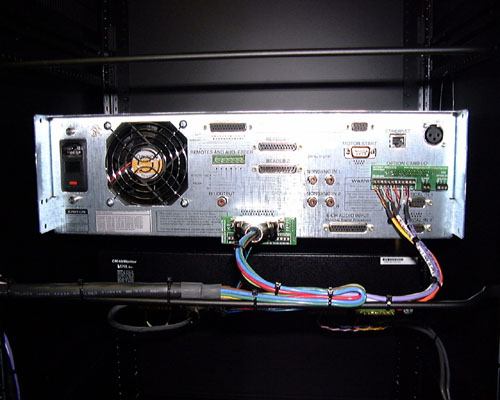
But...installing the CP-650 was no bed of roses...
Mic/Mux pinout differs from that used on the CP-500...Why? Now I have to have two different XLR-to-D9 connectors instead of just one.
I don't like the display. I know that the old one (on the 500) became a problem but this one represents too much of a step backward for my taste.
Is it really necessary for the front panel to stick out of the rack like that?
The software is a little clunky...
Do you really have to disconnect/reconnect every time you want to "send changes" or am I missing something? I found this was the only way to ensure that my changes got sent. They were not automatically transmitted when I saved them or when I disconnected. I found that reconnecting was the only sure way to ensure that the changes got through.
What is up with the mic calibration? I got a dialogue box a couple of times that said "Mic level is too low or too high." Well, could it be any more vague? Which is it...too low...or too high? You'd think they should/could program it to determine that...
It also seems like I'm going to have to get some more Dolby parts if I want to tie the CA-21 (Automation) to the remote volume of the CP-650. Why did that need to change to involve a special part?
 But I guess thats a question of cost...
Bye,
(Sorry for my really BAD English)
------------------
Jean-Michel Grin - Europlex Cinemas (Switzerland)
For instance, even the format buttons only have the format numbers (something only the CP-200 has any meaning with). Try to explain to a newbie that the "04" button is Dolby-A and that they will almost never have to use it!
Then there are the three buttons for the menus that hang out there in the open...put them behind the cover (even if it is just the flip down cover)...out in the open means "press me!" And to add insult to injury, the first menu option is the "Fader, Local/Remote" so the prize for pressing the wrong button can be NO SOUND with a mysterious "0.0" staring at you until you realize what you did (yes I've been paged over this one).
Sound wise, it is fine though a bit noisy for my tasts (almost unusable for screening rooms with speakers in close proximity) though it is better than the CP-500 in that respect.
The CP-650 also seems a bit more reliable than the CP-500.
From an installation standpoint...it is a nightmare! Only the one "main output" with a DB25 connector so you are screwed on your monitor feed. If you buy or upgrade to "EX" then your output for the surrounds must move to the Option I/O connector (also a DB25)...rather dumb and inexcusable. So what is Dolby's answer...why call Odyssey products, of course...they make kludge boards...an example is shown below.
Again, in a typical mall theatre, a CP-650 will do just fine...in a special venue house with flexibility needs...it can prove to be inflexible.
Steve
------------------
"Old projectionists never die, they just changeover!"
Manny, look carefully at the difference between the two mic cables. You'll find it's possible to simply ad a link between two pins in the DB9 connector of you're CP500 cable to get it to work with both.
I've never used the CP650 on board RTA. I don't really have a problem with using the scope to display it, that's how we used to work with the Arta600, and very well it worked too. It's just that I carry an Arta80, so there really is no need for me to use the on board gadget.
BTW How tight are Dolby getting? I'm installing a pair of 650 with changeovers, there I am merrily wiring the cells etc, and find that in the bag of bits is ONE DB9 connector, I checked both 650s and had two connectors for two processors. This seems a bit 'scrooge' to me, as the cost of a DB9, relative to the cost of a CP650 is small to say the least.
. Many people are using breakout boards from Odessey, Ultra Stereo, Bay Area Cinema Products since soldering in the field is sometimes a problem...even the mini-gas torch type are giving the airline fits in our travels.Actually we did use odyssey stuff on a couple of jobs where the all teh gear had been shipped as apackage from the US. It was ok on the CP500 site, but at the time they didn't make anything for the EX outputs of the CP650, so the other site that used 650 was hald wired with odyssey, and half wired by yours truly and colleagues.
I also have a smaller wooden rack that does just the opposite. If I ground the equipment, it really "sings".
I crimp 99% of my DSubs so field installation of them is a breeze. If the CP-650 had two outputs (main and monitor) then things wouldn't be as bad. Though they NEED to fix havng the Ls and Rs channels be in different places when EX is implimented...that is a serious design flaw. And referring people to use Odyssey boards is a cop-out.
Whereas I've always crimpped my Dsubs, I've never noticed that Dolby isn't supplying a connector for each potential connection. That would be like not providing a fanning strip for each connector in the older Dolby gear...something that just wasn't done. Yes, Dolby does seem to be slipping here.
But this all goes to my previous statement...if you are building a typical mall theatre...that seems to be what they are targeting.
Pete...have you tried a Panastereo CSP-1200 yet? While certainly not perfect, they are MUCH more condusive to special venue and high-end.
I am working on an installation that has 2-35mm/16mm projectors (featuring optical, Dolby Digital DTS Digital), , Digital Video (Dolby-E, AC-3, PCM), Analog Video (your various Lt/Rt stuff like VHS), Analog Video 5.1...all controlled with an AMX (AMX can control the CSP-1200 via the RS232 port) and there are inputs to spare!
Again, nothing is perfect but it might be worth considering in your future special venue or high-end installations.
Steve
------------------
"Old projectionists never die, they just changeover!"
Pete: About that cable...even though I am sure your modification would allow me to keep just one cable for use between CP-500s and CP-650s my argument was really that no modification to the mic/mux cable should have been necessary in the first place.
John
As to Non-Sync not being in the surrounds...I haven't noticed...Dolby's normal method is to have Left to Left, Right to Right and "magic surrounds." You can change the decode to a "pro-logic" that will do a normal 2:4 decode that you might find pleasing.
Steve
------------------
"Old projectionists never die, they just changeover!"
)Source: NS1 or NS2
NR: Off
Decoding: Non Sync (As Steve mentioned, this sends L directly to L and R directly to R while creating surround ambience with the matrix. Better for music than Pro Logic movie decoding as the latter will generally have things bunching up in C when it's music that was not mixed with matrix playback in mind)
Use the option that allows LF to be sent to the sub.
You can if you want also go to the virtual patch bay and cause either L or R to play through C as well, but only if you want it big and loud and don't care about stereo imaging which doing this will pretty much destroy.
Come to think of it it might be fun to play one of those early Beatles tunes with the singer on one channel and instruments on the other using a custom format to put L on L, C, R and R on the surrounds or something like that.
Steve
------------------
"Old projectionists never die, they just changeover!"
In the theatre I do not get anything in the surrounds (I got up on a ladder to check).
On the CP-45 (with the Non-Sync jumper set to "Normal") I get most of the sound coming out of the surrounds.
For details...check out the DA-20 manual on how to modify the CP-55 so the SRA-5 uses the DT inputs on the Cat. 222.
Steve
------------------
"Old projectionists never die, they just changeover!"
It's extremely annoying to have Mono and 'A' hard-locked into buttons when (although it's nice to have them as an OPTION) I will never use them.
Also, the 5 second (maximum) fade to mute is too short by about half. When playing vocal music in the cinema, it really needs at least a 10 second fade. I ended up having to create a macro in the Multimation3 automation to achieve this.
Another problem is the DTS-ES option. Sure, it's nice to have it there, (you can assign it to U2 from memory) but that makes it a non-revertable output. If you actually ask the 650 to play the film in ES with this output it will, but if for some reason the dts unit fails or has the wrong discs in etc., it will not revert to the backup format. Instead, (of course) it just sits there...mute. Thus, the option is pretty darn useless. A better option would have been to allow the external digital output to be assigned with ES. Of course, it's really only a problem if you simply CANNOT use the SRD-EX track, but that does happen occasionally so the print MUST run in DTS, but can only run in 5.1 as a result.
I do like the error rate being included on the main screen though... It's always nice to SEE those 0 and 0. error rates.
One more thing... The Panastereo processor 6 years ago could do a cross fade between formats. Completely programmable and able to be done at cross fade time you desired. It was a fantastic addition. Yet, here we are so many years later and the new DOLBY can't even give that option a whirl. It made for some great presentation changes.
Good ol' Ray.
Both seem to be outstanding in their fields!
At this point in time, the Panastereo stuff seems most flexible for new equipment. The fact that it sounds the best too doesn't hurt either!
Steve
------------------
"Old projectionists never die, they just changeover!"
I never used a cP650 but I read the manuals. Can you explain me better the ES problem, I didn't understood it well...
Antonio