
What type of exhaust sytem (if any) is necessary for carbon-arc Super Trouper followspots when used indoors from a theatre balcony (i.e. not in an enclosed booth)? Do the require a special exhaust system like film projector lamphouses do, or is it safe to operate them for short periods (probably 10-15 minutes max. for pre-film introductory speeches, etc.) in a 900-seat theatre?
I've seen the arc Troupers used without ventilation in outdoor and large-venue (basketball arenas, etc.) environments without ventilation, but have only seen the xenon models used in theatre environments (also without ventilation).
One or two Super Troupers will (hopefully) be replacing a rather wimpy 1000w incandescent followspot in the near future....
Dave
I am sure Pat will chime in and give us the straight skinny on them....
 fit if we ran carbon like that now. All we did for venting was to secure a 4-5' section of hose to the lamphouse and drape it over the backside pointing down. The spots operated for 1-1/2 to 2 hours per show, 14 shows a week with no complaints from the audience seated around us (of course in those days smoking was allowed in all showrooms here--which pretty much masked any carbon soot or odor problems). Obviously we had regular maintenance calls to clean the hose and carpet.
So, can you get away with running carbon like that for the occasional 10-15 minute stint?
More than likely.
Is it safe? By today's overly-protective standards, probably not. You may want to rig about 8' of hose such that it drapes over the back side of the lamp down to the floor and terminate it in a box with a damper, filter, and blower in it. Don't know the cfm needed for those lamps but it isn't much.
BTW congratulations on obtaining those spots. When properly maintained and operated they put out a beautiful light. I'm surprised one can still get carbons for them. Spare parts will be a problem though--here in the Neon National Forest the local Strong parts dealer gave away all their carbon-arc spare parts years ago.
As always, have fun!
Paul
Does anyone bother to use carbon-savers in follow spots, or is it considered too risky when the exact burning time is not known?
Thanks for all the suggestions given so far and please keep them coming.
In these days of environmental paranoia I am finding that the old adage, "It's better to ask forgiveness than to ask permission," serves well. I recall in the "old days" we never vented the follow spots since they were used occasionally and were of significantly lower wattage than the projector lamphouses which were used nearly continuously.
I've never heard of using carbon savers in follow spots.
Should you run low on carbons, I can help you.
Good luck.
Never saw anyone here use carbon savers in those lamps. Since it only takes a few seconds to shut down and "stretch" the carbons, no one bothered with savers. In a live show one can always find a moment to go out and stretch. You should be able to get around 1+20 to 1+30 burning time on a fresh trim. For 10-15 minute burns you'll easily be able to burn stubs.
Paul
I agree with the majority. Running them for 10-15 minutes at a crack shouldn't be a problem, assuming the room has enough ventilation.
I've only seen them just vented to the room.
I think it would be best to get something to scrub them with, though.
Trapping the ash really shouldn't be much of a problem, it's pretty big. You could bend some sheet metal & build a little filter box with some cut to fit window AC filter foam sheets & a muffin fan.
What bothers me is C + O2 -> CO2
Even when they were just dumped to the projection booth, the booths still had lots of exhaust for the room.
Josh
"All projection lamps should be adequately ventilated. The recommended practice as set forth in the report of the Projection Practice Sub-Committee of the Society of Motion Picutre & Television Engineers (Journal of the S.M.P.T.E., Vol.,XXXIX, September 1942, pp. 158) is as follows:
"'The carbon arc exhaust system shall be a positive mechanical exhaust system independent of all other ventilating systems of the theatre. Each projector, spotlamp, stereopticon, or floodlight machine, of the carbon arc type, shall be connectred by a flue to a common duct, which duct shall lead directly out of doors.'"
Blah, blah, blah, c.f.m, etc. It's in the National bulletin #5, "Operating Precautions".
Maybe John Pytlak can search up the RP # to further agonize poor Scott.
Ventilation is definitely on the list, but will probably have to wait a while. Just getting the thing up to the theatre balcony is going to be, umm, "interesting."
On a semi-related topic: the Super Trouper is in reasonably good shape, but the base is rusty. I was going to just sand off the rust and repaint it, but I'm concerned about the friction head, which needs to move smoothly. I'm wondering if it might be better just to ignore aesthetics and leave it as is and just repaint the black part of the base. Thoughts? Also I'm willing to be that someone out there knows the exact type of spray paint that I need to get to match the black part of the base....
Show us a picture, Scott! I tend to minimalist cosmetic repair on antique stuff if possible, if the original cosmetics are good enough to be useful & appreciated. I sort of like finding good, original condition items that just have a small well-done patch, etc.
The bearings on those old lamps were very beefy and smooth. Have you tried moving it around yet? You probably won't need to do anything more than clean and lube them. As for paint, I guess the real old Supers were black. The later ones were crinkle-finish gray. Probably the same paints recommended on this forum for restoring projector heads.
Paul
Who may end up as a ship's master stage electrician for NCL shortly...
"When the money runs out, so does I."
Another Film-Tech member and I disassembled this to get it to the theatre, but there is still some question as to whether it will fit through a particular doorway.
I'm pretty sure that this is the long-throw model, as it was previously used at the Boston Garden (large basketball arena). I think I will have to get some neutral-density gels in order to avoid blinding people with it.
The short-throw can be used for some pretty long shots. We used to use short-throws in the Caesars Palace Circus Maximus showroom at about 110' to the stage. When they switched to Xenon they went with the long-throw version. Never did like those--they were very awkward lamps to run.
Paul
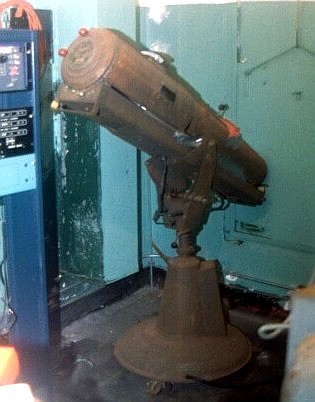
Paul -- I'll post pictures in a couple of weeks when I get this set up. We need to have an electrician come out and put in the twist-lock plug and check the wiring to be sure that the circuit can safely handle 30 amps.
Is there a medium-throw arc model? Ours has a separate rectifier, but has a color boom in the middle of the barrel. The base looks like the same one as the xenon model (judging by the photos on Strong's web site). Actually, it looks kind of like the modern Gladiator spots; it seems that the current Super Troupers have rectangular barrels.
Strong switched to the new pedestal with that shallow cradle design when they converted to Xenon. Unfortunately the new design doesn't balance as well (narrower range of tilt angle) since the center of gravity moves more with that cradle (over center effect). Ah well. Just balance it for the tilt angle you will use most often. Keep a knee under it when you operate, and it won't get too far away from you. All good 'Vegas spot operators keep a knee under the lamp--helps control the lamp and frees the hands to do the fancy simultaneous color, size, focus and strip changes we were famous for.
Yeah, all the Xenon models except the Gladiator have square-section barrels.
Looks more "modern" I suppose.
Paul
quote:
Strong carbon arc Trouper in origninal black paint.
If you restore one, it should come out looking just like this.
That's a strange looking spot, I never saw anything that looked like that. How old is it? It's got a sort of modern, streamlined look to it, but the fact that it's carbon, and quite rusty, suggests that it may be older than it looks. The lamphouse looks rather small, or is it just that the whole thing is very large, with a normal sized lamp? It's difficult to tell from the picture. How are the carbons arranged in this, is it a reflector or a condenser arc?
Most of the spots I've seen over here have been 1930s Stelmar, or 1950s Philips, which look rather similar, with a 'haystack' shape lamphouse, and a colour magazine right at the front, operated by rods or wires. The bed of the thing on which everything is mounted is made of steel bars, and there are sliding weights, which can be moved to adjust the balance of the thing. I can't find a picture of one at the moment, but there are some pictures of a Stelmar spot on the www.cinephoto.co.uk site, in the 'Arcs and spots' and 'Odeon Leicester Square' sections. The Odeon also had a BTH spot.
Can anyone tell me what this spot is:
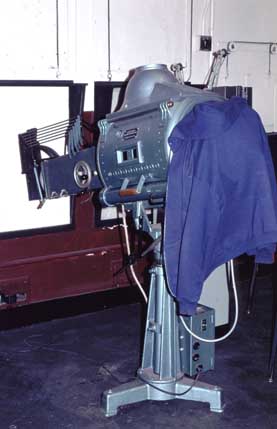
This is likely to be an American model, as I saw it in an American theatre.
This looks like a half way between the sort of spots I am used to seeing, and the Strong one. A more typical European spot would have the pedestal further forward, with the lamphouse behind it, as with the Strong one.
The National Carbon Bulletins available in the maunals section of the film-tech site mention a type of ac arc, where the carbons are almost parallel to each other. I have never seen this arrangement, what type of equipment used it?
More modern spots seem to use mainly CSI, (I don't like the colour), or HMI lamps, xenons don't seem very common, but in film projectors, xenon is the norm, I have never seem an HMI projection lantern. Why the difference, is HMI cheaper to use in spots than xenon?
In an interesting one-off, the Stardust Hotel here modified its center booth short-throw Super Trouper by fitting it with a Peerless Magnarc lamphouse in order to get enough light for use in the long-running Lido de Paris show.
The Genarco Metro is my sentimental favorite since it was my "break-in" lamp at the Tropicana Hotel in 1974 when I was recruited into IATSE Local 720. The Metro was the total opposite in spotlight design philosophy from any of the Strong lamps. To wit:
Operator position: Strong--right side, Genarco--left side
Lamp optics: Strong--reflector, Genarco--condenser lens
Carbons: Strong--in-line, Genarco--offset negative, rotating positive
Size control: Strong--slide handle with auto-focus and separately controlled iris
Genarco--rack and pinion wheel with integrated iris and separate manual focus lever
Shutters: Strong--horizontal blades; control mounted above the barrel; no lamphouse douser
Genarco--horizontal and vertical blades; controls mounted below the barrel; lamphouse douser
Fader: Strong--internal doors or front-mounted iris
Genarco--front-mounted iris
Color boom: Strong--magnetic pull up or mechanical latch
Genarco--gravity drop
Output: Strong--varied with spot size, getting dimmer with increased size; efficient
Genarco--constant regardless of spot size; inefficient at any size smaller than flood
The Genarco's were magnificent brute-force lamps that simply blew away the competition with raw light output, especially when set for flood. We had five of them here in town--the Tropicana's two are still intact though no longer in use. The Strong's were more of a finesse lamp perfectly suited for the precision cues demanded in showrooms back then. There must have been hundreds of them in town in their heyday.
Many of today's smaller spots use HMIs instead of Xenon--probably due to cost and maybe safety concerns (spots do get banged around more than projectors). HMIs put out a very discontinuous spectrum somewhere in the 4000s K correlated color temp. Acceptable for stage use but not the best for image projection--colors get all messed up in a way similar to what happens when shooting under regular (i.e. not Kinoflo) fluorescent lamps.
Regards,
Paul
BTW you might try posting your request over on
rec.arts.theatre.stagecraft
Those guys might know where stashes of old frames be.