This is topic Trouble with Brand New Strong Platters in forum Film Handlers' Forum at Film-Tech Forum ARCHIVE.


To visit this topic, use this URL:
https://ft-forum.com/ft/cgi-bin/ubb/ultimatebb.cgi?ubb=get_topic;f=1;t=003946

Posted by Joe Redifer (Member # 3) on 09-02-2002, 01:35 AM:
 
I have 2 factory new Strong platters. I have had them for 3 weeks. They are A3 phase controls and were manufactured in May and July of this very year. When I first set them up they ran great. Payout was smooth. So smooth, in fact, that it seemed like the decks and film were standing still. But over the course of a few days the payout began to become unsmooth. The film drags around the brain, sometimes even 2 wraps thick, for the entire show. I retime each deck and everything is smooth again for a few days. But then they begin to drift again! The problem does not follow a particular brain.

I do know that variac controlled platters are very nit-picky with the timing. Mess with the speed of one deck and you affect them all. But I have seen these things payout slower and slower over the course of my shift so I am sure that no one is tampering with them when I am not there. The platters need to be retimed once every 5 to 7 days it seems.

Any suggestions on what I can do to make these things run smooth 100% of the time? I would like to stress again that these are brand new.

I am ready to answer questions if you all need more info about the set up.


Posted by Paul G. Thompson (Member # 655) on 09-02-2002, 03:56 AM:
 
Joe, are both A-3's doing this, or just one of them? If they are both doing it, I would look for a common cause. The only thing that would be common is the input AC power.

Also, check the control rod from the elevator to the variac. If the jam nuts are loose, it could be doing some nasty adjustments to itself.

Another thing to look at....where is the elevator riding when the pay-out falls behind, and where is it riding when the platter is running normally? You will see a change over the course of the movie. If it is favoring the timing hole in the mast, it is probably riding too high. I would recommend you verify the variac setting before you start to time your platters. Remember - you have two holes in the mast. A Threading hole, and a Timing hole. The Timing hole is the upper hole.

I could be wrong on this, but when the elevator is resting on the bottom, the wiper on the variac should be about 50%. Would someone verify that setting, please?

Be careful of your motor tracking. If it is set too heavy, the motors will require more current. This was also a common failure with the Christie Autowind I's and II's. It caused alot of module failures on those machines. The SCR in the A-3 phase controls might not like that, either.

Never raise the elevator without turning off drive motor switches first. The surge current could damage the SCR's in the phase controls.

I believe that if Strong's engineers did something about the inductive spike that could occur across the SCR's, the phase controls would last a very long time.


Posted by Gordon McLeod (Member # 33) on 09-02-2002, 09:50 AM:
 
Simple Joe replaced those platters with old ORC's since we know how well you like them
 
Posted by Ken Layton (Member # 133) on 09-02-2002, 12:00 PM:
 
I would double check to see that the contact point (brush) in the variac is seated properly and didn't pop out cock-eyed during shipping. Also check all the connectors on the variac box to see if any pins have slid back in the connector housing (pay particular attention to the connectors that go to the column).

 
Posted by Mark Gulbrandsen (Member # 72) on 09-02-2002, 01:22 PM:
 
This is how my personal experience with Phase Control has been, and its why I always replace them with micros. Phase control is VERY sensitive to the constant timming drifting around that these platters ahve ALWAYS exhibited. If ya get the micro's with .5oz(not the standard 1.0 oz)paddle tension you will never have a problem! Even the standard micros work better and are more stable than Phase Control ever was. The only other stable Strong Alternative is the Digital Control Platters which work very well.
Mark


Posted by Paul G. Thompson (Member # 655) on 09-02-2002, 01:47 PM:
 
An experiment I might try on mine.....I have one phase control that still works, and yes, it does fall behind especially near the end of the movie when the elevator rises.

I might increase the size of the ballast resistor inside the motor can by a couple of Ohms. The resistor is a 25-watt 2 Ohms. This resistor is switched in series with the motor during the take-up mode. The elevator will ride lower if this resistor is electrically larger, hereby allowing more power to be applied to the pay-out motor so it won't fall behind. After it finally blows all the SCR's and is converted to micros as Mark describes, one can put 10 ohm 25-watt shunt resistor across the micro switch so the platter will not whip so badly.

I tried that already, and it works to a degree. However, the resistor I used was not large enough in resistive value. It has to be large enough so the platter will not creap in the pay-out mode while the plunger is engaged in the threading hole. It will be a trade-off between variac settings, the resistor value and motor tracking pressure for it to work right.

On a second thought, I think I will take a phase control unit and install it on a retro fitted micro-switch pay-out head on a CFS platter. The 10 ohm shunt resistor inside the motor, but I am not sure how the phase control will like that resistor. I'm gonna find out!!!!

So, off I go to Oak Harbor to snitch a brain for modification.

The old orange POTTS and blue CFS platters used a set-up very similar to this. Check the schematic, and you will see.....

As far as the Strong Digital platters are concerned, the jury is in. They have been out in the market for about 5 or 6 years now, and according to the feedback I have received, it is a very reliable machine. I will consider them in new construction.


Posted by Brad Miller (Member # 2) on 09-02-2002, 04:03 PM:
 
Stay with a Christie or SPECO platter Paul, at least until Strong finally admits to the serious design flaw in no breakdown backtension and either corrects it or designs some kind of add on clutch. That defect simply cannot be forgiven. I have passed a few emails to the powers that be, and thus far I have been told in happier wording the bottom line of "we don't care".
 
Posted by Steve Kraus (Member # 476) on 09-02-2002, 06:27 PM:
 
Note that the purpose of the resistor that is put in the circuit on takeup is to increase the voltage that is available for payout. Without it the variac would settle into equilibrium at a lower voltage (exactly the same voltage as exists now after the resistor). Takeup would be unchanged but that would limit the voltage available for payout to that which is driving the take up and while they may be close in speed there needs to be some allowance for when payout needs more than the take up side (like when there's a full load on the payout deck and little on the takeup). The resistor shifts the variac equalibrium so that more voltage is available.

Perhaps this will help with your experiments.


Posted by Paul G. Thompson (Member # 655) on 09-02-2002, 08:11 PM:
 
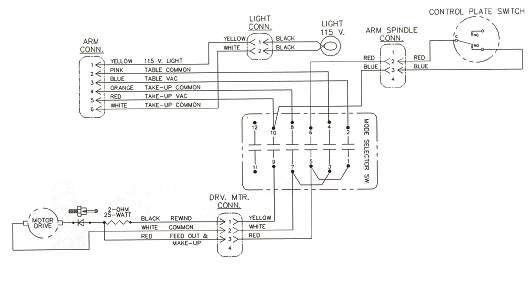
Steve, that is exactly what that resistor does. I explained that in my post, but perhaps it was not as clear as the way you explained it. Thank you for explaining it another way. Here is a schematic on how that resistor is tied in the circuit.

Notice the 2-Ohm 25 watt resistor is in series with the motor on the rewind (take-up) mode. I have a tendency to believe if a 4-ohm or maybe an 8 ohm resistor was used, it would give the phase controls a little better head room to play with.

I installed a phase control on a CFS pay-out head. (it fit perfectly.) I have not tested it yet, hopefully I'll be able to do that in a few minutes.


Posted by Steve Kraus (Member # 476) on 09-02-2002, 09:10 PM:
 
I rememember years ago telling people there had to be such a resistor (or diode or other limiting device) for the reason I explained--without ever opening up a motor or looking at a schematic. I just knew something was required.
 
Posted by Paul G. Thompson (Member # 655) on 09-02-2002, 10:06 PM:
 
Steve, the diode is used to give the motor some extra OOMPH! Those AD/DC motors love DC, even though it is not filtered. It is almost possible to put the motors like that in a run-away condition when run on DC. If, for some reason the diode shorts out, the motors won't be able to get out of their own way. I have had a couple of failures of those diodes.

It looks like my experiment is going to work with the phase control on the CFS platters. It ran nice and smooth, but I could not complete the test of running a movie with it. I was jazzing around with the little potentiomenter, and I might have popped the LED. In addition to that, the cheap crimp jobs of the wires on the pin plugs broke. Those were factory crimps - only about two three strands of the wire were actually crimped and the rest of the strands were busted. Nice quality ....but it didn't come from Strong International.

That specific brain died while running a movie once....then it was put in the brain repository. Now I know why....


Posted by Steve Kraus (Member # 476) on 09-02-2002, 11:11 PM:
 
I doubt half wave rectification is going to add any oomph as it's effectively like cutting the voltage in half. But that's for both modes.
 
Posted by Paul G. Thompson (Member # 655) on 09-02-2002, 11:45 PM:
 
Believe me, Steve...it does....I am talking about series-wound motors.

I used that trick on desoldering vacuum pumps and other equipment using ad/dc series wound motors while I was in the navy.


Posted by Joe Redifer (Member # 3) on 09-03-2002, 02:36 AM:
 
OK back on subject here:

I do believe this is perhaps a payout/brain problem... more specifically the spring that returns the payout arm. Perhaps it is just too stiff since it is so new. The film needs to tug just a bit harder to make the platter turn at the right speed, and when it does (after wrapping about 3/4 of the way around the brain) it unwraps and the payout arm moves back a touch. Then the cycle repeats again and again. The elevator does not move at all during this. All I know is that the Strong phase control A-3's at my old theater that is now over 10 years old never had problems like this. In fact I think we only had to replace one brain due to a bad LED the entire time I was there.

I'd rather spin both decks by hand myself than have a microswitch system. Hey waitaminute that's actually happened with a microswitch system!


Posted by Paul G. Thompson (Member # 655) on 09-03-2002, 01:18 PM:
 
That spring is like a hair-trigger, and I don't think that is the cause. More than likely, the pay-out heads might have a little Poly-Grip or a rock in the pay-out arm bearings.


Posted by Joe Redifer (Member # 3) on 09-03-2002, 04:04 PM:
 
All of them?
 
Posted by Paul G. Thompson (Member # 655) on 09-03-2002, 05:23 PM:
 
Joe, check and make sure they have a nice easy feather-touch swing with absolutely no binding whatsoever. I have experienced some binding in mine from time to time, especially if the roller fingers start dragging on the plate. A crowbar should fix that. I have had some pivot studs loose on those arms, too. Apparently the factory didn't tighten some of them down like that are supposed to be. I have received some that were just plain bent! (must have been squashed in shitment.)

Incidentally, make sure the platters are level. If they are not, the swing arms do not like it. They should practically stay wherever you set them.


Posted by Wes Hughes (Member # 981) on 09-04-2002, 12:17 AM:
 
I agree with Paul about the feed arm dragging a tiny bit on the plate...have had that happen a few times.

In my phase control experience I have found it nearly impossible to time them so that they pay out perfectly without touching any of the feed plate bumpers for the entire show. SO, as I have said in previous threads, I time them to spec (as close as possible), then raise the motors a bit more so they are timed slow. Most of my Strongs and Potts platters will wrap 3/4 or more around the brain. I have platters that have been doing that for YEARS and I have NEVER seen any film damage from it....and no brainwraps with phase control or micro since they are timed slow.

After spending a small fortune to convert some of my platters to phase control a few years ago I am converting them, one stack at a time, BACK to microswitch as the phase control modules crap out.


Posted by Joe Redifer (Member # 3) on 09-04-2002, 02:00 AM:
 
Too bad there is no way to convert to SCDC.

I have found a workaround and will post it in a few days if it seems to be a rock-solid method, which I think it will be.


Posted by Paul G. Thompson (Member # 655) on 09-04-2002, 02:05 AM:
 
Let us know, Joe. We are all anxious to get those damned things to work right.
 
Posted by Sam Hunter (Member # 1119) on 09-04-2002, 11:20 PM:
 
Just what is the theory behind platter operation?

------------------
Samual Hunter Sr.

KC5ZSL


Posted by Joe Redifer (Member # 3) on 09-05-2002, 12:13 AM:
 
The theory is:

1. Build up all film reels onto one of three decks.

2. Feed film out from center of roll using fancy-schmancy centerpiece.

3. Film goes into projector.

4. Film is projected and audience is amused.

5. Film exits projector and returns to platter system, taking up on different deck.

6. Show ends.

7. Repeat from step 2.


Posted by Paul G. Thompson (Member # 655) on 09-05-2002, 12:34 AM:
 
Lower deck spins with film tail flopping around to amuse the booth cat.
 
Posted by Tim Reed (Member # 137) on 09-05-2002, 12:50 AM:
 
Sam, the first platters were called "no rewind" systems. It's effectively a cart machine without the loop splice.

73,
de KJ5KX

------------------
Better Projection Pays!


Posted by Leo Enticknap (Member # 534) on 09-05-2002, 04:22 AM:
 
I used to have a problem with the spring-loaded arms on the feeders of Cinemecannica CNR-35 platters. The spring was designed to return the arm to its 'neutral' position when no film was passing through; but the flow of film would pull the arm, thus moving the variable resistor it was attached to and powering the motor.

I think the problem was that the springs were very sensitive to temperature variations. If you suddenly had a very hot day the spring would expand, which would make the arm reluctant to return to 'neutral', effectively running the feed plate too fast. On a cold day the opposite would happen, increasing the resistance on the arm and running the platter too slowly. I remember one very cold day on which I'd forgotten to switch the air handling unit on in one of the boxes: the first show virtually wrapped because the feeder arm was so stiff. If the temperature in the box remained steady at around 20-21, then no problem.


Posted by Sam Hunter (Member # 1119) on 09-05-2002, 08:35 AM:
 
Thats pretty good Joe,
Man, that was a S.A. type answer.
HA HA.
Let’s try it this way;
The film pays out under a controlled resistance or tension.
The brain controls the take-up speed and tension.
The brain senses film tension and adjusts motor speed accordingly.
Is this accurate?

------------------
Samual Hunter Sr.

KC5ZSL


Posted by Joe Redifer (Member # 3) on 09-05-2002, 04:13 PM:
 
The brain does not control take up speed. Take up has its own separate control. Some platters, like the Strong, use a variac to control take up speed which ALSO controls payout speed based on the take up speed. That is very inefficient in my opinion, because then the timing of an individual deck can effect the timing of the other two.


Posted by William Hooper (Member # 71) on 09-06-2002, 01:01 AM:
 
It's basically a demand system.

The projector pulls the film from the center of a platter.

That film as it comes from that platter passes through rollers to create a slack segment, then through a widget called a "brain".
The brain detects by changes in that segment if the platter is moving fast enough to pay out the film at the speed the projector is pulling it. The speed of the payout platter is controlled by the brain.

Potts platters rule.


Posted by Paul G. Thompson (Member # 655) on 09-06-2002, 02:04 AM:
 
Lets not forget about the 2-Ohm resistor in series with the motor used in the take-up platter. During the pay-out mode, this resistor is electrically removed from the circuit by a switch. It is very important. Without that resistor in series with the take-up motor, the pay-out will never keep up with the demand. CFS, Potts, and A-3 machines all use this 2-Ohm resistor in line with the take-up motor. I am certain you will find a resistor in series with the take-up platter in all non-digital platters where the operating reference for the entire machine is based on the take-up. The variac sets this reference.

As with any electrical/electronic device, it is necessary to establish a reference when you reverse engineer it for troubleshooting purposes.

It makes me angry when some manufactures won't release a schematic on some of their equipment. Any good technician will be able to reverse engineer practically anything on a simple PC board such as the Phase Control of the A3's. Ken ran into that snag.

Well, Mr. Engineer, We are not idiots! We will figure it out. If your design is patented, pony up, please. We have to keep some of your junk running in the field. At least make it easier for us to do just that! We are not interested in how "part happy" you are. We want to help you make it as good as it can be through our suggestons.

OK - Flame me....see if I care. I get tired of some of the I have to contend with in fixing some of your un-documented garbage.

You know it is true.

End of rant.....


Posted by Sam Hunter (Member # 1119) on 09-06-2002, 08:30 AM:
 
I only ask these questions because I never fooled with one before or watched one long enough to see what was happening.
Why is it important to control payout? Is it because the film is basicaly just laying on top of the platter and would pull off if the feed speed was not fast enough or pile up on the floor if to fast?
Also according to yaw , the takeup is kinda like a reel takeup system ie its speed is regulated by nothing more than the sound projector itself.

------------------
Samual Hunter Sr.

KC5ZSL


Posted by Paul G. Thompson (Member # 655) on 09-06-2002, 10:38 AM:
 
Sam, unlike the reel-to-reel systems, the film pull by itself cannot start the pay-out platter rotating. There is nothing securing the film to the platter once the center ring is pulled.

On the other hand, the IWERKS and IMAX platters are just the opposite. IMAX and IWERKS pull from the edge of the platter, and taken up on the center. However, there is a center ring in place even on the feed platter. Those platters can be looked at as a horizontally mounted reel-to-reel system. Even so, there is undoubtedly some kind of motor assist on feed-out because of the tremendous weight of the print. At the end of the presentation, 70mm IMAX and IWERKS must be rewound.

You can't really look at a conventional 35mm platter as a reel-to-reel system because the center ring is removed on feed-out. The 35mm system is said to be automatically rewinding as the movie runs. At the end of the show, just remove the center ring, re-thread, and start the next show.


Posted by Scott Norwood (Member # 30) on 09-06-2002, 02:11 PM:
 
Sam -- the takeup end of a platter system is a bit different than a reel-to-reel system in that the film passes over a tension arm on its way to the takeup deck. This arm regulates the speed of the takeup motor, thus assuring constant takeup tension throughout the length of the film.

With most reel-to-reel systems, the takeup reel is connected to the soundhead by means of a belt which drives the takeup clutch on the lower reel arm. Tension is adjustable, but does not remain constant throughout the entire reel. Some machines (e.g. the electronic Kinoton models) do have motor-driven takeup and provide constant takeup tension, but that is the exception rather than the norm.

Paul: the newer IMAX setups use platters very similar in concept to conventional 35mm setups and films do not need to be rewound. The 2-strip 3D setups, in particular, are quite impressive to watch when running.


Posted by Paul G. Thompson (Member # 655) on 09-06-2002, 03:23 PM:
 
Scott, cool! Thanks for the information.
 
Posted by Gordon McLeod (Member # 33) on 09-07-2002, 10:54 AM:
 
Originally the IMAX theatres used hte MK1 reel unit (pictures of it under ontario place)
It consists of 4 reels 2 feed out and 2 takeup (they are reels with no top side hence reffered to as platters) they are 48" diameter
THe upper two are for one title (feed and take up) and the lower one is the second film feed and take up
feed is on the right and take up is on the left the same direction that the film travels through the head (same as VistaVision)
SO as one is showing the other can be rewinding
The feed and take up sides are servo controlled so the projector doesn't pull the film off it put is pushed off.
Think of it as a Eprad Double Mut on its side

Then there is the MK2 reel unit that placed the 4 disks one above the other on two different angles to the post (looks more like a platter) and again it rewinds and uses a servo control
(Pictures of the MK2 under Ontario Science Centre)

Finaly there is the QT which stands for Quick Turnaround unit.
It is a beefed up custom platter from Kinoton and operates like a conventional platter and is available in a 5 deck and 3 deck version with up to a 7' disk


Posted by Dave Macaulay (Member # 813) on 09-09-2002, 10:42 AM:
 
Are these platters level? I've seen similar trouble with the phase control models when on a rather slight tilt. The weight of the dancer arm vs that puny spring means they are very sensitive to gravity.
 
Posted by Joe Redifer (Member # 3) on 09-09-2002, 08:50 PM:
 
Yup, they are level. I made sure of that. But it no longer matters as the problem has been solved. Keep watching the pages of Film-Tech for step by step instructions!
 
Posted by Rick Long (Member # 213) on 09-09-2002, 09:36 PM:
 
We are watching!
 
Posted by Paul G. Thompson (Member # 655) on 09-10-2002, 01:16 AM:
 
Darn Tootin', Joe. We will be looking for the cure. Hope you post it soon.


Powered by Infopop Corporation
UBB.classicTM 6.3.1.2