This is topic Autmoation cues for the TA-10 in forum Film Handlers' Forum at Film-Tech Forum ARCHIVE.
To visit this topic, use this URL:
https://ft-forum.com/ft/cgi-bin/ubb/ultimatebb.cgi?ubb=get_topic;f=1;t=003954
Posted by Alex Grasic (Member # 1371) on 09-03-2002, 10:35 PM:
Hello everyone! With the rerelease of Spiderman & MIB (playing together), I have been hit with one question! Does anyone know how to setup intermission cues for the TA-10 system? Or is it different for each automation system depending on how they were initially setup? Any help would be great!!
Posted by German Marin (Member # 918) on 09-03-2002, 11:58 PM:
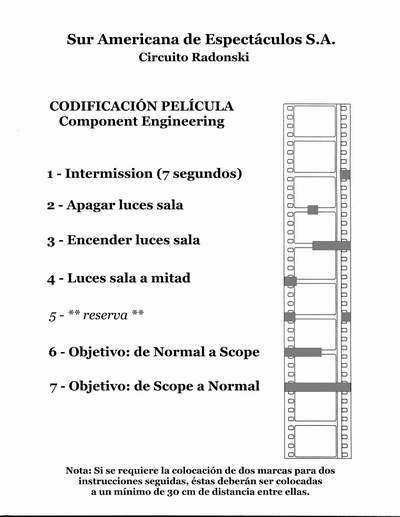
This is the TA-10 codes we're using in 31 of our screens:
1.- Intermission (7 seconds)
2.- Auditorium lights off
3.- Auditorium lights on
4.- Auditorium lights middle
5.- Reserved
6.- Lenses: Flat to Scope
7.- Lenses: Scope to Flat
Note: If you need to use two cues mark for two differents commands the minimum distance between they won't be less than 30 cm.
Posted by Alex Grasic (Member # 1371) on 09-04-2002, 12:07 AM:
This is great but unfortunately, every theatre is different in how the cues are setup. At my theatre, your #2 cue shuts down the machine, your #4 does the same, and your #7 takes the lights down all the way. I just need to find out how to figure out which cues do what on any specific unit and how to modify them if necessary.
Posted by Peter Kerchinsky (Member # 1098) on 09-04-2002, 04:22 AM:
We are using the CE automation also and our cues are entirely different.
My suggestion is contact my buddy Don Olsen at CE and ask him. He's a wizard at this.
Also, are you building both prints on one platter table? If this is the case I don't believe the first print will shut down by itself due to the way the fail safes are set up, but could be wrong.
Ask Oly.
Posted by Alex Grasic (Member # 1371) on 09-04-2002, 08:06 AM:
Does Don have an email contact??
Posted by Bill Purdy (Member # 202) on 09-04-2002, 10:35 AM:
Yes, Don does have an e-mail contact:
dolson@componentengineering.comYou can also find a lot of cueing information at the same web-site. Pete's suggestion is a good one though, because Don will help you work out a solution which will save you a lot of time. Give him a call at (206) 284-9171.
------------------
Bill Purdy
Component Engineering
Posted by Gordon McLeod (Member # 33) on 09-04-2002, 12:34 PM:
You will need to have your service engineer install a switch on the TA10 to initiate a stop select for the intermission
Posted by Robert E. Allen (Member # 1351) on 09-04-2002, 01:18 PM:
Geeze guys! If you're running intermissions did you ever think of putting an operator in the booth at that time? I'm sure he/she could handle it. Even a poorly trained minimum wage employee should be able to successfully shut down a machine and turn on houselights. Next thing I expect to hear is someone trying to find an automated way to sweep the floor. Are we really trying to make human beings obsolete? It's already been shown that a well trained human will enhance your screen performance. We're not all gone yet. Look around. You may find one near you.Bob
The Old Showman
Posted by John Pytlak (Member # 331) on 09-04-2002, 01:26 PM:
Unfortunately, automation is a "fact of life" when you have more than a few screens. But a good projectionist is still needed to assure "film done right".------------------
John P. Pytlak, Senior Technical Specialist
Worldwide Technical Services, Entertainment Imaging
Research Labs, Building 69, Room 7525A
Rochester, New York, 14650-1922 USA
Tel: +1 585 477 5325 Cell: +1 585 781 4036 Fax: +1 585 722 7243
e-mail: john.pytlak@kodak.com
Web site: http://www.kodak.com/go/motion
Posted by Alex Grasic (Member # 1371) on 09-04-2002, 01:30 PM:
Totally agree but when there's one operator for 18 screens, there is never a guarantee that he or she would even remember to stop the film after the first feature. I'd rather just have it so that we can start the show and not worry about it anymore after that point!
Posted by Steve Kraus (Member # 476) on 09-04-2002, 05:58 PM:
Do they have to be on the same deck? Then how about not hooking them together? Interslip the leaders and let the show end normally. Oh wait...that would require 3 minutes of rethreading labor and everyone knows that there is no longer a need to clean the gate between shows.
Posted by Brad Miller (Member # 2) on 09-04-2002, 07:19 PM:
quote:
It's already been shown that a well trained human will enhance your screen performance.
A quality automation properly set up enhances a presentation too.
Bob, give me a 30 plex with curtains and all of the fixins' and CA21 automations and I guarantee I can outdo you plus your 29 clones. Automation is not necessarily a bad thing. Not all automations are good news, but infering that automation in general is bad is not true. Plus automations can be frame accurate for changeovers, light cues, even the start of the show can be synchronized with the atomic clock if you want. Only  can live up to frame accurate human presentations.
Posted by Robert E. Allen (Member # 1351) on 09-04-2002, 07:55 PM:
I'll give you "as good as" Brad. And if that were the case it would mean you are a well trained, conscientious operator. Unfortunately, there are far too many houses where that is not the case. Automation is not the problem. Corporate brass installing automation in a effort to cut down their overhead and believing it can do everything and needs be attended only occasionally by a barely trained, minimum wage employee is the problem. In my experience I have never heard as many complaints about poor screen performance as I have since automation has become prevalent. Again, it's not the fault of a good automation system but the bottom liners who refuse to hire, or fail to train, qualified personnel to run it.Bob
The Old Showman
Posted by Alex Grasic (Member # 1371) on 09-04-2002, 08:34 PM:
I don't think hiring qualified personnel is truly an issue either. We had a man working at our theatre who had been in the industry for over 20 years and just the quality of his work was total crap. He knew everything that had to be known about projection, machine maintenance, on screen presentation etc., but he didn't know how to apply it at all. I do a better job with it all now than he ever did. Ever since he was fired, our complaints of our on screen performance have dropped to about 1/10 of what they were before. I think it is also more of a matter of people who care about what they're doing, not as much as being qualified or not.
Posted by Robert E. Allen (Member # 1351) on 09-04-2002, 09:48 PM:
You're absolutely right Alex. To know what to do and then not be conscientious enough to do it is a real problem. I've know a few like that. How sad for the imdustry.Bob
The Old Showman
Posted by Brad Miller (Member # 2) on 09-04-2002, 10:29 PM:
Bob, I firmly disagree. The term isn't "just as good", it is definitely "better". You are arguing to get quality staff in the booth and the rest doesn't matter. I see your point and agree with you wholeheartedly that having a knowledgeable and most important...CARING operator is of paramount importance. However there is such a thing as human error, and human error racks up a whole lot more "errors" than a quality automation system does if you were to keep a tally.There is also the factor of economics. Spending more money on quality equipment and automations when the theater is built FAR MORE THAN makes up for itself in having to pay for qualified operators on every screen as each month goes by. Let's just pick a random number out of the air and say that you make $12/hour running a single screen. So what happens when we clone you and put you in a 4 plex? That's right, suddenly it becomes a $48/hour payroll. But what about a 20 plex (which seems to be about *average* today)? That's $240/hour on projection staff Bob! That's roughly $3600 a day spent just on projectionists! An automation like the CA21 would be paid for and the theater would be saving money without losing one ounce of showmanship within a week's time!!! Instead put in good equipment and a full blown automation and hire 2 operators at $18/hour (totaling $36) and forget about it. The operators make more, thus they are happier. One guy can run the booth, the other guy can be on standby in the event of a breakdown just wandering around ensuring that everything is nothing short of perfect. That's more than enough staffing for a 20 plex, and quite honestly...overkill.
Bottom line here, what is it that you can do that an automation cannot do? The answer is NOTHING except framing and focus (which is just not a problem with good equipment that has been properly set up and even just a halfway decent projectionist). The automation can start the show. The automation can turn off the annoying slides (even when it reaches a specific one), do a curtain call timed however you like, fade out the non-sync at whatever speed you desire, play a cd intro welcoming everyone to the theater cued up and played at whatever volume and sound format you want, start the projector at a predetermined second, open the douser on the exact frame specified, vary the volume on each trailer, take the lights (as many zones as you want) to whatever lighting levels you have programmed, and so forth and so on and so on. I know it sounds terrible, but with today's automation systems like the CA-21 and possibly the CNA-200, the automation can do a BETTER job than any human...even Steve Guttag! 
Getting back to the subject of this thread though, can the TA-10 do all of this? Nope! So in this case, a human is the only alternative to obtain that kind of showmanship.
Posted by Scott Norwood (Member # 30) on 09-04-2002, 10:39 PM:
Brad, can your CA-21 strike an arc? (sorry, had to! I basically agree with Brad's point here)(and, no, I can't do frame-accurate changeovers, though I can come pretty close if I'm familiar with the film and equipment)
Posted by Brad Miller (Member # 2) on 09-04-2002, 10:58 PM:
Yes Scott, yes it can. Granted it may require some robotic attachments, but yes. 
Posted by Robert E. Allen (Member # 1351) on 09-05-2002, 03:36 PM:
I have to admit, Brad, that the industry has made great strides in technology. So much so in fact that much of it bogles my mind. But it's been my experience that those operating with it often do not allow for it's limitations. For example, I'm not aware of a system that allows for the increase or decrease in audience size and the necessary adjustment to the sound level or a system that automatically adjusts the focus after the lens has heated up. It's been my experience that the operator leaves the booth as soon as a picture hits the screen and on a number of occasions I've had to seek out the manager and ask him to adjust the focus or volume. I understand that putting a well paid operator in every booth would break the theatre's financial back and I didn't mean to imply that.
It would be nice (and good for the industry) if there were more qualified and consientious operators in theatres. But even the now infamous "minimum-wage, poorly-trained" employee should be able to adjust the focus and sound level if he/she would stay in the booth long enough to do it. Automation is not the do-all savior of the exhibition industry. Even it requires someone who knows and cares about what they are doing. Bob
The Old Showman
Posted by Brad Miller (Member # 2) on 09-05-2002, 04:17 PM:
Bob, one person is plenty for a multiplex provided like I said above he is trained properly and cares. When threading he must pass by projector after projector. It isn't hard to look out the window quickly and check for focus drift. As such, one person can do just as good of a job. I've had plenty of minimum wage highschoolers run a first class presentation in multiplexes I was in charge of and the occasional problem/complaint was extremely rare and most time nothing more than someone wanting to scam a pass because they did not like the movie. Also with modern equipment properly set up and exclusive emulsion out winding, I have never seen "focus drift" like can be seen when running reel to reel winding emulsion in.
Posted by Ken McFall (Member # 845) on 09-06-2002, 02:20 PM:
Automation love it or hate it... it's main virtue is consistency.
The show's will be consistently good.... or bad it's as simple as that.I love the TA10, simple very reliable with no programming of the automation itself required. Move a print, lace it up and its done.
However...... there's always an however, it requires consistency and a little effort from the projection team when making up the print. But I'd rather have an automated show than the differing standards of each individual.
I don't need to stand at the back of an auditorium and know who's running the show by the 'standard' of the presentation. As things stand I can be confident of the consistently high presentation standard at my theatre when I'm not there because the automation never has a hangover or gets upset and throws a temper tantrum. That means more to me at the end of the day.
Posted by Ken McFall (Member # 845) on 09-06-2002, 02:39 PM:
With regards to the cues for the TA10 I use the following format.Cues that cover the soundtrack are used when the show is 'Off Screen' and non sysc sound is on so avoiding the thump as the cues passes the sound reader. the mid frame cue is the interval cue, most important cue of all. It's mid frame so it never suffers wear no matter how long we run the print for.
Cue 1 Masking to 1.85 (Taped over as it's a permanent feature of all leaders.)
Cue 2 Interval start / end / Interlock show start.
Cue 3 House lights 'Off' (Taped over as its a permanent feature of our Feature leaders)
Cue 4 House lights to 'Low'
Cue 5 Masking to 'Scope' (Combined with cue 1. it is not taped over so can be applied / pealed easily as required)
Cue 6 Spare.
Cue 7 All stop. Wired via a switch on the front panel so we can stop on the feature change if required.
We use three types of leader, one is the basic lacing leader which contaims the 1.85 masking cue as standard. If we are running a feature only show a house light off cue is added at the join onto the feature. Next is the interval leader which contains an interval cue to start the interval event and an additional interval cue to restore alarm functions. We have a one minute break between our adverts and the feature. This leader never changes. Then there is the feature leader itself which has an interval cue to 'end' the interval, plus a making cue, followed by a 'house lights off' cue. These leaders never change from week to week so the only cues we ever have to apply when making up a print are the 'house to low' at the start of the end credits and the final 'interval' cue to end the show.
Very simple in day to day use and reliable in operation.
Hope this gives you another angle on cue policy.
Posted by Gordon McLeod (Member # 33) on 09-07-2002, 11:04 AM:
Alex the TA10 is a very versatile unit because the installing engineer programs in effect a perment peg board and the foil positions activate those functions
It is important from a service point of veiw that the functions/foil locations are consistant within the service area of the engineer to aid quick troubleshooting
As such it is very bad practice for booth staff to modify it since that person may not be there when service is required and a lot of time can be lost reverse engineering then
Posted by Ken McFall (Member # 845) on 09-07-2002, 12:08 PM:
Whilst that is a very vaild point.... what if the initial setup was not optimal. \Quite often engineers are not projectionists and lack the experience of using the equipment to find out what does and does not work in the real world.Any cue setup will work.... but nothing beats practical hands on experience with a system to find out what is best. If you can avoid using cues that cover the sound track when 'on screen' then you should do so, it improves the presentation by removing the loud thumps as the cue is read etc.
So don't stick with a poor setup just because the engineer 'likes it that way', it's your show after all. Work with him if you can to get the results you are happy with.
Posted by Gordon McLeod (Member # 33) on 09-07-2002, 01:18 PM:
Any operator who modified an installation with out appoval would be looking for a new job.
STandardization within a circuit is important and the fact that certain locations will have different requirements can lead to some cues being in less than desirable locationsIdeally we would all have Cinemation MK4's installed
Posted by Ken McFall (Member # 845) on 09-07-2002, 04:35 PM:
Hmmmmm I agree that operators should not change things but standardisation is often the bottom line 'easy' option. If it ain't right then it should be changed. Engineers aren't god's, although I know one who thinks he is and is generally considered to be a c***!! sorry that slipped out!As for cinemation.... I still miss the clunk clunk clunk as the stepper moved down a line and that little lamp told you what had just happened..... but that's pretty much history now. We have apparently moved on and have to move with the times.... Ludites and all :0)
The thing with a debate such as this is that everyone's point of view is valid. There you are I got out of that nice and easy!
Posted by Gordon McLeod (Member # 33) on 09-08-2002, 10:31 AM:
Ken said"Hmmmmm I agree that operators should not change things but standardisation is often the bottom line 'easy' option. If it ain't right then it should be changed"
Sorry an employee does not have the right to change or alter a companys head office decision and if they say it is X so be it or find alternate employment.It may be all well and good to say this makes it better but a given operator will not be there for ever and that leaves a can of worms for the next one
Also in many instances standarization allows for alot of trouble shooting to occur over the phone with out billing the theatre for a service call. In the case of some of the ones I service it would entail a 4 hour flight and then a 8 hour drive.
Also most engineers now are responsible for the service of far more screens than one can barely handle and in many cases with in a complex there will be different brands of equipment to interface to and to allow for that a standardized interface is required
Another point is some cicuits bicycle prints between locations or make up in one location for several complexes so foil standardization is important
But the bottom line is if you expect the engineer to be able to efficiently service it dont mess with it