
Has anyone a suggestion on what to look for?
By the way, are you experiencing your problem on start-up? Or, are you experiencing this after start-up? How far into the reel are you when it happens? The clutch setting might be just too tight if it is happening sometime other than start-up. Restoring the loop on the fly is very easy to do, but it is still a pain in the rump to do it, especially if you snag your finger on a splice and it drags your finger(s) through the pad roller and sprocket. (Been there)
If you are running 6,000 foot reels, you have to be vary careful about your clutch settings as well as their cleanliness and over-all condition.
RCA had a real crappy clutch in some of their 3D magazine setups. They were not a conventional disk-leather-disc sandwich design. If they got oily or dirty, the projector would come up faster that the clutch could compensate for. This resulted in a little slack in the film. When the take up finally comes up to speed, it would jerk the loop away from the constant speed and holdback sprocket. Back in the old days with Acetate film, it would strip out the sprocket perfs, especially if the holdback sprocket is worn out. Those sprockets took a real beating and wear much faster than any other sprocket.
I'll almost bet your holdback sprocket teeth are worn to the nubs.
------------------
KALEE FOREVER. CARBON ARC, THE ONLY LIGHT FOR THE STARS!
ALL PARTS FOR VICTOR AND KALART VICTOR 16MM PROJECTORS.SERVICE TO 35 AND 16MM PROJECTION EQUIPMENT.
35MM sprockets made to order.
I've just been running loops on this thing so far, this problem popped up as I was heading out the door.
The magazines are Simplex, same silvertone finish as the Simplex 35 & the sound head.
The holdback sprocket teeth seem great.
quote:
By the way, are you experiencing your problem on start-up? Or, are you experiencing this after start-up? How far into the reel are you when it happens? The clutch setting might be just too tight if it is happening sometime other than start-up.
Right at startup. Thread, hit the motor, bam, it snatches out the loop.
{ EDIT )
Just saw you guys' replies after sending this post. Thanks!
I know this may be a dumb question but I will ask it anyway.
Are the takeup reels "easy start?" The center hub and the flanges are not tightly fastened so that when the machine starts and there is a rapid wind in the takeup, the hub turns freely from the heavy flanges. This 'inertia' in the flanges can cause the film to be abused in the sound head exit sprockets. Dirt coupling the flanges to the hub of an "easy start" may also cause this problem.
The solid reels are ok for the feed spindles but they are death in the takeup magazines.
Hope this is helpful.
Sincerely, KEN
Just as a passing thought.....is there any binding of the take-up shaft? Take the belt off, put a reel on the spindle and give the shaft assembly a spin. It should spin freely. If not, time to dismantle, clean, and lubricate the shaft and the bore.
I'll be back there on Friday, & will go through all the suggestions.
I really appreciate this, everything is going MUCH slower there than it should due to rust, age, disuse, deterioration, etc. Being able to picking up some speed on troubleshooting in that booth is excellent.
It is probably dirty stiff loose belts, and some coagulated oil in the spindle bores, as well as deteriorated clutches. All are very easy fixes, and will cost little money (if any at all) except for the cleaning materials and the labor involved. If you have leather belts that are shot, you might want to consider using "Roundthane" belts. I never had any trouble with them, although I still prefer the old leather ones.
#1 Make sure you are using slip hub reels for takeup. It is basically impossible to run solid flange 6000 foot reels as takeup without that bounce.
#2 Check your clutch for wear and proper tension. I am finding that a dry pad is MUCH more reliable and consistent than an oiled pad, but others will disagree.
#3 Check your pad roller tension to make sure the film can't effortlessly slip past the sprocket with the pad roller closed.
#4 Make sure you don't have any oil on your takeup belt or pulleys. Odds are since you are running a Simplex that they are covered in oil.
Now two more things...
#5 Consider adding a slow start kit. That extra second or two as the motor gets up to full speed makes a tremendous difference.
#6 Make sure after you thread the projector that you turn the motor by hand until the tension grabs at the takeup reel, then advance a few more frames minimum just to be sure.
Hope that helps.
quote:
I've just been running loops on this thing so far, this problem popped up as I was heading out the door.Right at startup. Thread, hit the motor, bam, it snatches out the loop.
I think Scott Norwood is on the right track. How are things on the drive side? If it goes as soon as you hit the motor switch, a woodruff key or teeth could be missing. Something could be spinning free.
------------------
Better Projection Pays!
One has to remember that William's machine has been sitting idle for close to 5 years now. The problems he has does not surprise me for a machine that has been sitting that long.
Since there has been so many thoughts expressed here, I will be happy to talk to William on the phone if necessary to get more answers to help him solve his problem. William, please email your phone number to me, and I will be happy to call you.
I completely agree with all of Brad's comments with the exception of No. 5. However, if for some reason William's soundhead is not equipped with a flywheel, a slow start kit may be in order. William, what size reels are you trying to use?
Incidently, Roundthane can be obtained from Strong International, Wolk, and probably others as well. Someone told me that Lowes Hardware might even carry it.
If push comes to shove, I have heard of people using a "V" belt and it works nicely.
I disagree with the woodruff key theory. The magazine is driven by the external constant speed sprocket shaft gear. That gear also drives the projector. If the key was sheered, the projector head would probably not run at all, and if it did, you probably see all your loops disappear in the projector head in less than one second.
William is only losing the loop between the constant speed sprocket and holdback sprocket in the sound head. If there was a chipped gear that drives the projector, he would definately hear it.
If the upper Bronze gear in the soundhead gearbox was heading south and it jumped a tooth or two, it would cause that loop to disappear between the constant speed and holdback sprockets. I seriously doubt that being the case, since there is no real load on the holdback sprocket other than the tension of the take-up anyway.
Paul
For those of you who also have just about any soundheads in a booth that have been idled for that long, you will probably have the same problems. It probably would not make any difference if you have a flywheel-equipped motor or not.
I can't speak all of the soundheads, but I can say this:
If you have some old RCA 10** soundheads without flywheels, there is a slow start kit built into them....in a form of a power resistor inside the 4-inch black box mounted on the motor. That resistor is in series with the motor's starter switch and the start winding, unless someone has removed or defeated the resistor over the years.
Century has an after-market kit you can either make or buy. I can't remember what the Motiograph SH-7200 or Weber Syncro-Film soundhead used. I am mostly familiar with the Century, RCA, or Simplex Soundheads.
There is a difference of opinion on how the slow-start kit is installed. Some say it is acceptable to place a 1 or 2-Ohm 200 Watt resistor in series with motor and forget about it. It works....but keep in mind that the resistor is always in-line with the motor even when the motor is running.
An older 1/4 horse motor like the Leland that the SH10** and the Robbins & Myers the RCA soundheads use draw about 4 to 5 amps when running under normal load.
Let's say you have a crappy electrical system in your city like they did in most cities years ago. You were lucky to have 105 volts on a good day. At 5 amps of motor current draw with a line voltage of 105 volts, the motor will only see about 100 volts. Sure, the motor will run. However, it will be starved of electrical power. Magnetic "slip" will occur, and the motor's inductive reactance will decrease. This will cause the motor to run at a hotter temperature, and eventually will burn out. In addition to that, the resistor will get hot which could create a potential fire hazard if not placed in an isolated area where it can't set something else on fire.
There are many old cities in the boonies that have old electrical systems, not to mention the old theatres that have electrical systems that are nothing short of a total disaster.
I prefer the other way. The same way RCA and others did 60 to 70 years ago, maybe even longer than that. Put the power resistor in series with the starter switch and start winding. When the starter switch dis-engages, the resistor is basically disconnected. The motor run winding will then receive full line voltage without being short-changed.
I have seen many motors burn out because of electrical power starvation. Not only that, but the power resistor in series with the start winding can actually save the motor from start-winding burn out in event the starter switch failed. The resistor would usually fry and burn out before the start winding would. 
Save a couple of bucks and do it right. It is your choice.
There is nothing wrong with a 2 ohm in serries almost every SH1000 or RCA in canada (even the 4 stars) when running large reels had a inline resistor and never a problem. In fact it is probably the smoothest rampup I have seen excluding running them on an inverter
P=I squared R. You can't argue with mathematics.
5 amps on two ohms = 50 watts of power down the drain, and a 10 volt drop across the resistor. If the line voltage is 110 volts, the motor is only getting 100 volts.
Too low.....Eventually the motor will fail, usually on a Friday Night.
If you guys are going to do that, at least make sure the voltage applied to the motor is within the designed specification. Measure the voltage across the motor, not the motor and resistor.
Most motors I have seen are rated 105 to 120 volts, and I personally don't like the idea of powering it with 100 volts. It is simply out of parameters.
Here is a classic example of an out-of-parameter operation in general electronics: One of our transmitters here at the radio station was running out of parameters for about 15 years or so. Result? $1,200 worth of burned up inductors, $700.00 for a rebuilt modulator block, $200.00 for a -72 volt power supply, and several modulator drivers at the tune of 400 bucks each. All just within the last two years, not to mention the lost revenue because of transmitter down time. 
I prefer to operate motors and electronic equipment within the designed parameters.
Sorry, gentlemen---I have to stand firm on this.
The biggest problem I see with William's set up is the fact it sat for 5 years. Anything sitting that long needs to be cleaned, checked, and readjusted. I am guesing he does not have a XL (cone) take up and has the later part Simplex part Powers takeup which can be touchy on the adjustment. Since thre AAFMPS painted all their rebuilds hammertone gray they might be the XL type. If so the adjustment is completely different. Also as Brad mentioned you need floating hub reels for take ups or you will have problems. Some pictures of his project would be nice to look at. Hope you get it working.
Dick
If you elect to use the resistor in series with the motor, check to make sure your applied voltage to the motor (AT the motor) is within specifications with the resistor in line. If the voltage is not, at least put a time delay relay that would bypass the resistor after motor start-up.
I will not question Gordon or Dick saying they have not had any real problems. This is probably because a 1/4 HP motor is such an over-kill and is probably "playing" with the projector to begin with. Some projectors have not been blessed with such an over-kill.
I just think it is a bad idea to run anything outside its designed parameters.
I have changed motors because of run winding burnouts in a theatre that suffered from low line voltage.
As a thought - the motors the 5-Star uses (and others as well) can be ramped up slower without using that resistor. Just put in a start capacitor of a lesser capacity. The size will probably depend on what kind of motor is being used, but some experimentation might be needed to fit your needs.
Projector No. 1....It is equipped with a Dayton motor, 1/4 HP rated at 6 amps line draw. This motor is in series with a power resistor for a slow ramp on start-up. The motor draw while running is 4.33 amps, and the power resistor is dropping 8.37 volts. The voltage at the motor terminal block is 115 volts.
Projector No. 2....It is equipped with a Crompton/Greaves 1/4 HP rated at 5.2 amps line draw. This motor is in series with a power resistor for a slow ramp on start-up. The motor draw while running is 3.27 amps. and the power resistor is dropping 7.46 volts. The voltage at the motor terminal block is 115.1 volts.
Projector No. 3....It is equipped with a Gould (Century) 1/4 HP rated at 3.8 amps. There is no power resistor in series with the motor. There is a ballast resistor wired in series with the start winding. The motor draw while running is 3.04 amps, with 120 volts at the terminal block in the motor.
You will notice projector #1 and projector No. 2 voltage drops on the resistors plus the voltage appearing on the on the terminal blocks do not appear to add up. Remember this is an inductive/resistive circuit, which is mathematically vectored.
I then came home to check one of my R&M MI-4275PA motors. It is a 1/4 HP motor used on the RCA-1040 soundheads. This motor has a rated draw of 4.6 amps at 110VAC. With the motor running under a no-load condition, the current draw was 3.96 amps with 122VAC on the motor terminal block. The starting current was 17 amps.
When I was at Southsound, the Leland motors on the Simplex SH-1007's had about a 5 amp draw when running, and the starting current was about 25 amps. My R&M KS-145-frame motors I had on my 9030's drew about the same as the Lelands did on startup, but the run current was about 4.5 amps.
I am very glad this discussion took the floor in this thread. While I was checking the characteristics, it was noted the power resistors in Projector No. 1 and Projector No. 2 were too hot to touch even for my alligator hands! This can be a very bad situation. Read on....
Last week, we had an intermittant seize up, and it pulled the motor down to a complete stop. How long stayed in that position before the power was shut off, I don't know. It is an unmanned booth. When I got there and diagnosed the problem as a locked up movement, there was no apparent damage to the motor. However, it did take out the motor's circuit breaker. If it had not, that power resistor could have started a fire. There was evidence of adjacent wire overheating in the resistor's area. That resistor must have become hotter than Hell before the breaker tripped.
After I turned three sheets of green in color, I have immediately decided to convert to a start-winding ballast as soon as I possibly can. In event of a lock-up, it'll probably take the breaker out faster, hopefully. I think the ballast will still protect the start windings from burning out, especially with projector No. 3. Just a guess, but I think the resistor in No. 3 is rated at about 50 watts.
If you want to check your line draws, be sure your line clamp is calibrated, and the needle is not sticking. A sticking needle can happen when you are using Amprobe line clamps. The needle might stick or be inaccurate if the lock slider is not be fully disengaged!
For those who have the power resistor in series with the motor, I would strongly advise you to check it and make absolutely sure it is clear of anything that could catch fire.
Come on get on the DIGITAL bandwagon...if it is digital, it HAS to be better!Steve
------------------
"Old projectionists never die, they just changeover!"
Most of the time I use digital meters because of their accuracy. The meter I used for the tests was a digital line clamp. It is far more accurate than my old Amprobe.
After I turned three sheets of green in color, I have immediately decided to convert to a start-winding ballast as soon as I possibly can. In event of a lock-up, it'll probably take the breaker out faster, hopefully. I think the ballast will still protect the start windings from burning out, especially with projector No. 3. Just a guess, but I think the resistor in No. 3 is rated at about 50 watts"
Probably the resitor save the machine from other gear damage when it locked up
THe resistor should be mounted in a ventelaited metal cabinet and heagt resistant wire is normally used (appliance)
The wattage should be 200 watts in most applications not 50
The Gould (Century) motor that I did testing on probably is a 50 Ohm power resistor which has been in service for at least 20 years now. If it is a 2 Ohm resistor, there is just no way it could be a 200-Watt device It is just too physically small. The Gould motor that is on the other machine (by the looks of the ratings) is a very efficient motor as compared to the others I tested. That 50-Watt (if that is what it is) resistor is in the start winding circuit only.
If the use of the 200 Watt resistor desired to be placed in series with the motor, mount it as Gordon suggests to be on the safe side. Don't use any power rating smaller than 200 Watts for this purpose as Gordon already pointed out. I certainly agree with Gordon about that.
As for me, I won't use them in series with the motor. I am converting mine to the way they did it 70 years ago.
Next time I get a chance, I'll verify the rating on that specific resistor used in the Gould motor. I will also verify the size if the resistor in the R&M motor used with the on the 1040 and 1050 soundheads. I am guessing R&M used about a 100-Watt resistor used with the start winding. I would also guess that the power rating and electrical reisitance value of the resistor selected by the motor manufacturer was based on operating characteristics and efficiency of the motor.
Whatever the values are, I'll let you all know as soon as I find out. I might also point out that the less efficient motor may require a 2-Ohm resistor greater than 200 watts, depending on how big of a power hog the motor is.
If the motor is really a big power hog, maybe a 1 Ohm 200-Watt power resistor might be a better answer. There are several variables to take into consideration when the correct size is selected. The "One Fits All" theory may not always be the best solution.
Dick, that is a very good call. Too many people "bump" the motors to verify the projector threading. As you, Gordon and I know, that is a very bad practice and is nothing short of abusing the machinery.
Brad, if you have people doing that to your machines, throw them out of your booth! I would if it were mine...
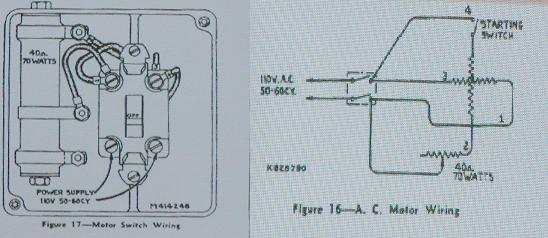
Looking at the RCA 1040 setup, the R&M motor on the 1040 soundheads use a 40-Ohm starting resistor. The resistor is rated at 70 Watts. Mine is tapped at 26 Ohms. See page 17 of the 1040 manual from the FT Archives.
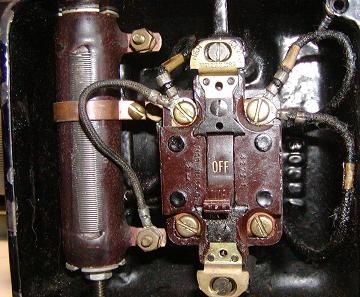
Below is a picture from the manual. Pardon the quality, as I took a picture of my monitor screen.
Below is a picture from the Oak Harbor booth. The left picture shows the location of the power resistor in the ORC Console. The picture on the right is apparently a factory aftermarket slow start kit.
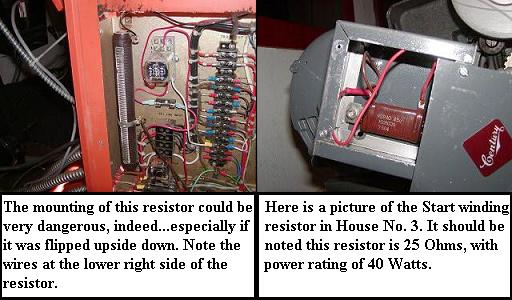
The advice that Gordon, Dick, and Brad has made is right on target. If those big "dogbones" are installed, mount those things where it cannot set something else on fire.
I forgot to take pictures, but fyi the magazines are 2,000 foot silver painted Simplex magazines. There are some Simplex magazines for big reels here too, but they're black ones from some old XL or something.
1. there's no real reason to strap them on for a booth with just occasional shows & no 3D foreseen
2. The top one might foul the wall
3. It's nice when all the projector is more or less the same color.
Steve
------------------
"Old projectionists never die, they just changeover!"
Steve, thanks for the info. Those kits work very well! There is absolutely no signs of overheating or deterioration. Since it is using a 25-Ohm resistor and the R&M uses one at 26 Ohms, the 25-Ohm is what I will experiment with. Since the Dayton motor is so much of a power hog, I will stay in the vicinity of a 70 to 100-Watt rating and get rid of those big 200-Watt dinosaurs. If I have to mount it in the console, I will put a heat shield in it to keep any heat away from the wiring in event of a starter switch failure.