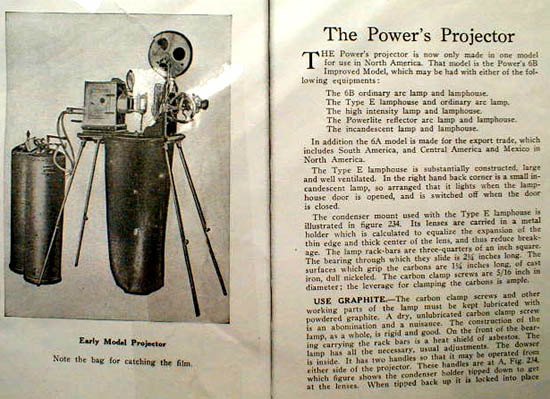
This is from the turn of the century, apparently before the invention of the takeup reel.
Now lets see what we have here. A hand-cranked projector, an arc lamp with an open window, but no takeup reel. Instead, the film is simply unspooled loosely into a big canvas bag, so the bag can contain up to 1000 feet of unwound nitrate film.
Meanwhile, we have a burning carbon arc, blazing plasma, with an open, unprotected front, about six inches away from the open bag of unspooled nitrate film.
Whew!
Now I understand that this equipment was manufactured around 1900, and motion picture film was so new that even the oldest film would be absolutely fresh by modern standards ...
Does this strike anyone else as a bit, well, unsafe?

A friend of mine in the theater business who was at the opening of several silent theaters & whose father operated theaters & nickelodeons before that mentioned that in the days the film was cranked into a box or basket you had to be attentive & careful & catch the end of the film as it passed through - or you'd spend a LONG time digging through that wad of film.
Try and focus while maintaing the picture on screen. It is a front shutter machine and the crank will bring one of your hands in the way of adjusting the lens. Oh and there is a fire-shutter so if you go too slow, you lose the picture.
The bag was standard equipment and the lower magazine was optional.
For those of you that like the Powers projector, listen to "Smilin Lou Powers" on http://www.wbcb1490.com from 3:00 - 5:00pm Eastern Time Monday-Friday. He took his stage name from the Powers projector (and has "ERPI" for car tags) and owns many antique projectors and sound systems, some of which are on display at the museum of the moving image in NY and down at Universal Studios Florida.
Steve
------------------
"Old projectionists never die, they just changeover!"
I did have the chance to toy around with a couple of old Powers units a few years ago, although they were not hooked up for power to their low intensity arc lamps and I did not try to thread them up with film.
The guy who had them in his shop, the late Al Moffa who rebuilt and sold projection equipment near Allentown, PA, had only recently acquired them when I saw them during a visit. It was definately different having to hand-crank a projector while maintaining a proper speed. I'm just glad we switched to motors and sound heads before Hollywood started releasing the 12 and 13 reelers like "Titanic" and "Gettysburg!" 
I would imagine that as you were unspooling the film into the bag, the film would shift around quite a bit. It seems to me that when it came time to rewind, you could potentially have a problem with the film tangling up and jamming. Was this a common problem?
I was paging through a 1900 Sears catalog reprint, and found a few pages of motion picture equipment. One of the descriptions lists the available options for an Optigraph projector (Price: $35.00)
quote:(Grammatical anomolies in original text)
"At purchaser's option, this machine can be fitted with lenses of different range without additional expense. The new 1900 Model No. 3 Optigraph represents the highest point of perfection attained in this class of machine and is the high class exhibitor's standard of excellence. It will run films backwards as well as forwards without stop or complicated adjustment. This will double the length of an exhibition, and is one of the most entertaining and available features in connection with the motion pictures, It has large reels accommodating as high as 500 feet of film, or if provided with special reel 1,200 feet can be handled. In this way a whole exhibition can be placed on reel at one time, dispensing with the necessity for changing films during the exhibition. It can be fitted with an automatic rewind attachment, which will take up and rewind the film as it runs from the reel. This is, however, a feature not regularly supplied.
The catalog also describes the range of films available:
quote:Nothing like mounted cavalry charging backwards to overstimulate the audience, eh?
Hundreds of interesting and realistic subjects are now being exhibited through the agency of this machine. Our list is practically unlimited, and there is a range from grave to gay, from the sublime to the ridiculous, charges of soldiery in actual engagements, naval battles, mounted cavalry charging at full speed, acrobatic performances, trains at a great rate of speed, and in fact all kinds of locomotion, from the mule train to the limited express, and from the smallest boat to the Atlantic Liner are shown.
The catalog also shows an acetylene gas generator that looks very much like one of the tanks pictured, for $8.00, accompanied with a gas burner for $7.00.
The optigraph projector is the great ancestor of the Motiograph. Mr. Roebuck, of the famous catalog firm, sold one to Mr. Brenkert and his two sons, who began projecting as showmen, then as suppliers, franchising territories to projectionists they equipped and trained, eventually founding the Brenkert Light Projection Company, inventing spot- and flood-lights, the Brenograph, and the Brenkert BX 80, -40, -60, & -100 projectors, until their company taken over by RCA.
I have a 1900 Optigraph head at home, and a complete Powers #6, with
special Powers intermittant, with motor and SOS sound head added by the projectionist who used to project for farm audiences from a towed house trailer in half the state of Iowa (his brother serviced the other half with an identical trailer rig.)
------------------
John P. Pytlak, Senior Technical Specialist
Worldwide Technical Services, Entertainment Imaging
Research Labs, Building 69, Room 7525A
Rochester, New York, 14650-1922 USA
Tel: +1 585 477 5325 Cell: +1 585 781 4036 Fax: +1 585 722 7243
e-mail: john.pytlak@kodak.com
Web site: http://www.kodak.com/go/motion
Some limelights used an ether saturator, a device which bubbled warm air or oxygen through a tank of ether, picking up enough vapor to burn with a hot flame, these were said to be even more dangerous than using gas.
Unwinding nitrate film into a bag or box, or even just a pile on the floor, was normal, even the longest films were just a few hundred feet. Of course, there were no cinemas at this time, films were shown as a short item in the programme at variety theatres, music halls etc, with the projector just set up in the middle of the audience; the results were in some cases sadly predictable.
In the uk, the Cinematograph Act 1909 required that films only be shown in properly constructed cinemas, with fire exits, separate, fireproff projection boxes with no access from the auditorium etc. Many new cinemas opened in 1910, and some of them are still operating today.
A loose pile of film will normally rewind onto a spool quite easily, providing it is not disturbed before rewinding, but it is quite likely to be scratched, or to pick up dirt in the process.

As to tangling in the bag...nope you shouldn't have a problem there...tangling only happens when you MOVE the film not as a result of it laying down on itself.
Ever needed to turn a reel around whilst it is in the middle of a platter pack (built up tails first)? One method that will not harm the film is to wrap by wrap lay it down in a figure-8 fashion and then spin it back up onto a reel. It doesn't take as long as you would think and it won't harm the film nor will it tangle.
Steve
------------------
"Old projectionists never die, they just changeover!"
quote:
Actually, "The Clansmen" by D.W. Griffith was probably a 12+ reeler (I think I remember hearing that it was 16 reels). At least I didn't say that "I remember when I saw the clansmen first came out..."
What was the date of this film? Surely, it was much later than any projector which dropped film into a bag or box, the latest projector I have seen, other than toys, which did that was from about 1901-2.
Steve
------------------
"Old projectionists never die, they just changeover!"
Steve: I've often thought that operating a front-shutter machine must not be for the faint-hearted. Get your finger in the wrong place (e.g. when reaching over to focus while looking at the screen) and it could be very painful!
Gerard/Stephen: Whilst being trained at MOMI, I was introduced to the delights (not) of the endless loop platters that were used in some of the exhibits. As the prints were acetate in those days, they were quite notorious for breaking on those platters, and the film would accumulate on the floor until the problem was spotted on one of the CCTV monitors. In such circumstances it was drummed into me to look carefully at the pile until I spotted the end and then to lift it off, i.e. not to sift through (and thus tangle) the film pile searching for it. The technique invariably worked, and you could lift the film cleanly off and pass it through a Selvyt and onto a running spool.
As far as hand cracking a machine with an open spinning shutter and pressurized tanks of combustible gas and bubbling ether vapor inches away from nitrate film winding open-air into a box on the floor....excuse me, but these guys weren't projectionists but kamakazi operators with huge death-wishes. I am not sure I would have the same "love for the booth" that I have if that was what I could look forward to every day. You had to have one set of steel balls to do that on a daily basis. I'll bet there wasn't much time or even inclination for "presentation values" in those days, although he did get to do that creative stuff like running the picture backwards -- evidently that was considered great showmanship -- they get to see it forward AND they get to see it backwards; how can you beat that for the price of a 5 cent ticket?!! I imagine most of the focus for the projectionist skilled in the use of the Power's Projector would mainly be to just keep alive for the next show!
Bet they didn't send the Ticket-Taker up to the booth to "RUN THE SHOW" in those days....hehe.
I never would suggest adding splices to the print! Having it hit the floor (or quickly throw a clean trash bag on the ground for a covering)...you can reverse the reel in less time than it would take to run it through. Laying the film takes less than 5 minutes...pulling it up takes little more than a minute or two (high speed on a MUT). You can generally be back on the screen in less than 20 minutes with one more interruption if you don't have a trailer split reel or no more interruptions if you do.
Steve
------------------
"Old projectionists never die, they just changeover!"
Intolerance (1916) was 13-14 reels.