This is topic Need Prestoseal splicer instructions in forum Film Handlers' Forum at Film-Tech Forum ARCHIVE.
To visit this topic, use this URL:
https://ft-forum.com/ft/cgi-bin/ubb/ultimatebb.cgi?ubb=get_topic;f=1;t=004002
Posted by Jeff Logan (Member # 1163) on 09-17-2002, 12:24 PM:
Does anyone out there have any instructions, parts manuals, etc.
for Prestoseal heat splicers. A photocopy would be great, or maybe
it could be posted under the "Manuals" section of this forum.
Thanks for your help.
Posted by John Pytlak (Member # 331) on 09-17-2002, 12:33 PM:
Do any of these heat seal splicers (made for photofinishing use) fit your description?:
http://www.sourcetwo.com/products.php?which_page=products
http://www.ppi.com.sg/pho-pro.htm ------------------
John P. Pytlak, Senior Technical Specialist
Worldwide Technical Services, Entertainment Imaging
Research Labs, Building 69, Room 7525A
Rochester, New York, 14650-1922 USA
Tel: +1 585 477 5325 Cell: +1 585 781 4036 Fax: +1 585 722 7243
e-mail: john.pytlak@kodak.com
Web site: http://www.kodak.com/go/motion
Posted by Jeff Logan (Member # 1163) on 09-17-2002, 01:34 PM:
Thanks for the quick reply John. Unfortunately neither of those links are for this make or model. My unit was made by the Prestoseal Manufacturing Co. of NYC probably in the late 1960's or 1970's. I think the government bought lots of them for their labs and/or theatres. It has no model number stamped on the nameplate.
Posted by John Pytlak (Member # 331) on 09-17-2002, 01:42 PM:
Unless I'm mistaken, one serious problem with using heat seal splices for motion pictures is that they are not transparent, and will show on the screen.------------------
John P. Pytlak, Senior Technical Specialist
Worldwide Technical Services, Entertainment Imaging
Research Labs, Building 69, Room 7525A
Rochester, New York, 14650-1922 USA
Tel: +1 585 477 5325 Cell: +1 585 781 4036 Fax: +1 585 722 7243
e-mail: john.pytlak@kodak.com
Web site: http://www.kodak.com/go/motion
Posted by Bill Purdy (Member # 202) on 09-17-2002, 03:59 PM:
My first awareness of "Prestoseal" was about 1950 when I was getting into the recording business and we had "Prestoseal" 1/4" tape splicers. They were wonderful when used with acetate tape (which was all we had then) except that I have discovered that the splices have started falling apart in my 40 and 50 year old tapes. I know they made a 16mm version as I saw one in the film library at the University of Texas. Further, John is correct, they discolored the area around the splice (sort of a brownish color), but for classroom films this was better that badly made cement splices. The process was that you put the two ends in a channel under a couple of spring clips and lowered a clamp arm which had a nylon block in it which went against the tape (film) and was latched down with considerable pressure. You pushed the button and a heating element below came on for a timed interval (adjustable) and then you took out your nice clean splice. I think that the film version had a miniature light box in it so that you could inpsect your work. I don't know if they ever made a 35mm version. I haven't seen or heard of them much since I left that job in '61. They never really were too popular as they were expensive. Most folks used splicing tape and now it's all done with ones and zeros.------------------
Bill Purdy
Component Engineering
Posted by Leo Enticknap (Member # 534) on 09-18-2002, 07:03 AM:
quote:
You pushed the button and a heating element below came on for a timed interval (adjustable) and then you took out your nice clean splice. [...] I don't know if they ever made a 35mm version.
If they did, then I wonder how many idiots tried using it on nitrate. That button would very likely have been the last one they ever pushed!
Posted by John Pytlak (Member # 331) on 09-18-2002, 08:32 AM:
Leo noted: "If they did, then I wonder how many idiots tried using it on nitrate. That button would very likely have been the last one they ever pushed!"That brings up an interesting question. Although an ultrasonic splice will NOT work well with triacetate or nitrate film, would the localized heating used in an attempt to make an ultrasonic splice be likely to ignite nitrate film? 
------------------
John P. Pytlak, Senior Technical Specialist
Worldwide Technical Services, Entertainment Imaging
Research Labs, Building 69, Room 7525A
Rochester, New York, 14650-1922 USA
Tel: +1 585 477 5325 Cell: +1 585 781 4036 Fax: +1 585 722 7243
e-mail: john.pytlak@kodak.com
Web site: http://www.kodak.com/go/motion
Posted by Leo Enticknap (Member # 534) on 09-18-2002, 10:22 AM:
My experience in deliberately igniting nitrate (for entertainment... oops, sorry 'demonstration' purposes) is that it doesn't catch immediately, i.e. you have to apply conductive heat for a 1-2 seconds before it catches. If the timed interval on the Prestoseal joiner were any more than two seconds, I'm pretty sure that would be enough to do it.I don't know whether you would risk igniting nitrate by attempting to join it ultrasonically in error. I can't see that error being made very often, though, simply because nitrate is so much thicker than polyester. It smells different, too. Back in the 1950s when the Prestoseal was in regular use, there would probably have been lots of nitrate still circulating in theatres, hence my comment that any 35mm joiner which worked on the principle of applying intense, localised heat would have been a liability in any projection box.
Posted by Gerard S. Cohen (Member # 994) on 09-18-2002, 08:18 PM:
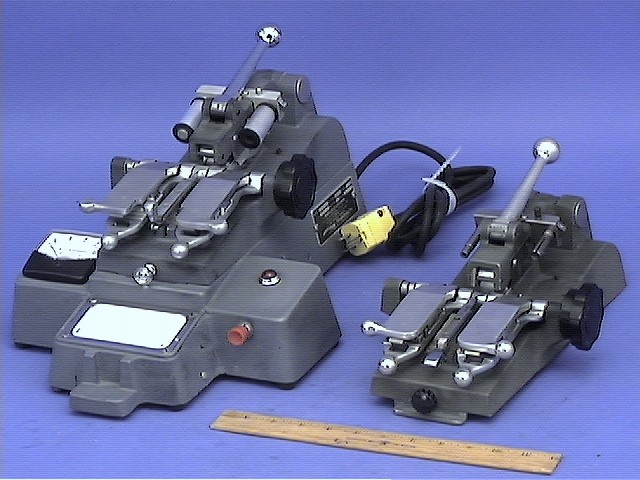
This Prestoseal 35mm and 16mm splicer sold on eBay for $119.50 last week. The seller said it was tested and works perfectly, but he didn't know anything about it nor how it works.