 it can mean anything from distorted output - to no output. Generally, only three things can happen in an electronic curcuit:
(a) What exactly is clipping?
(b) What causes it?
(c) Just how does it harm loudspeaker drivers?
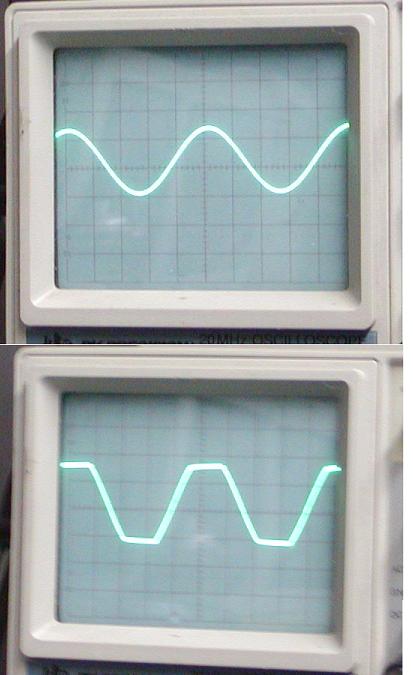
This is one of those things that's a little easier to show on a scope then explain with words.
Improper adjustment of gains (pre-amp circuit) can cause the input to the actual amplification circuit to be greater than its limits.
------------------
John P. Pytlak, Senior Technical Specialist
Worldwide Technical Services, Entertainment Imaging
Research Labs, Building 69, Room 7525A
Rochester, New York, 14650-1922 USA
Tel: +1 585 477 5325 Cell: +1 585 781 4036 Fax: +1 585 722 7243
e-mail: john.pytlak@kodak.com
Web site: http://www.kodak.com/go/motion
(d) What causes "blown" amplifiers?
Well, "blown" is not really a techinal term it can mean anything from distorted output - to no output. Generally, only three things can happen in an electronic curcuit:
A component "shorts" - an unintended, low resistance (example: a cap shorts, directly connecting the signal on the two sides together);
A component "opens" - a disconnection of a conductor (example: a winding (wire) in a transformer heats up an melts, breaking the circuit);
Or the component changes it's operating parameters (example: the actual PN junction inside a transistor is forced to pass too much current; not enough to short or open it, but enough change the way it works .... as if you tightened the lug nut on a car tire enough to crack/distort the stud but not enough for it to break off.)
The job is to find which of these things happened to your broken piece of equipment.
~Manny.
"And you...Deja Vu...I'll always remember you!"
Hillary in Top Secret
(a) What exactly is clipping? Basically, it is like trying to stuff 10 lbs of manure in a 5-lb bag. You have to clip some manure off to make it fit. The BOTTOM picture of the two shows what a clipped sine wave looks like, and the TOP shows what it a clean sine wave is supposed to look like..
(b) What causes it? Over-driving the amplifier's circuitry, or a malfunction within the circuitry.
(c) Just how does it harm loudspeaker drivers? Inductive loads have AC resistance called "Reactance." Inductive reactance is the product of 2 pi times the frequency times inductance. The clipped portion represents no change in magnetic fields. The inductive reactance then turns into a non-inductive load (resistive) which could cause the voice coils to burn out if the DC component is strong enough or applied long enough.
If you apply a high enough DC to an inductive device, it'll toast it.
In addition to the information others posted, I hope this helps.
Jeff said:
quote:
"Highly clipped audio is also rich in high frequency harmonic energy. This won't do your high frequency drivers any good."
Indeed, it is.
A pure square wave is comprised of the fundamental frequency and an infinate number of odd harmonics. The more odd harmonics, the squarer it will be.
A sawtooth waveform is comprised of the fundamental frequency and an infinate number of even harmonics. The more even harmonics, the more linear rise the sawtooth's ramp will be.
Hey, guys...I am going on what my memory says from about 44 years ago...so please feel free to correct me if I am in error. I cannot recall what a fundamental frequency containing an infinate order of odd and even harmonics look like. Anyone know? A back-to-back sawtooth? I don't remember....
The pictures taken by Paul show nicely that a clipped signal has the same amplitude as the unclipped, but since it covers a bigger area, it also contains more energy and is therefore perceived as being louder. In addition to this, the square waveform elements contain odd harmonics and the signal is distorted.
It has to be understood that analogue components do not simply go into hard clipping from a certain point onwards, but that the signal gets more and more distorted as this point is approached. Equipment driven at the very edge of its performing abilities delivers distorted sound which is subjectively heard as louder than the undistorted.
A lot of the endless discussion about playback levels in cinemas is caused by equipment which is too weak and delivers distorted noisy sound which appears to bee too loud even when the SPL meter says the level is OK.
In digital equipment, all clipping is hard clipping, because when the maximum amplitude value is reached (all bits=1), there is no further headroom. Often, digital processors do not get properly aligned because people set the gain factor at the amplifiers to reach the specified sound pressure level with pink noise. If you then equalise by raising more than lowering individual frequency bands, the processor output is doomed to go into hard clipping when you there are signals approaching full scale, because the digital channel sum is above 0dB. To avoid this, you need amplifiers which can give you more gain so that you can lower more frequency bands in the digital equliser. And of course, the amplifier needs enough power reserve to handle full scale signals which are 20dB above reference level without clipping or even approaching clipping.
Most sound systems I know do not meet those requirements and as a consequence deliver noisy sound which is "too loud". If you ever have the opportunity to hear a system with enough power reserves and proper alignment in the digital and analogue areas, you will be very surprised by how "not too loud" movies played back at reference level are.
Another commonly neglected factor is the effectiveness or sensitivity of the loudspeaker, that means how much electrical power you need to reach a given sound pressure level. But that`s another subject...
Michael
quote:
Hey, guys...I am going on what my memory says from about 44 years ago...so please feel free to correct me if I am in error.
Paul, you pretty much stated what I've been learning this past year. AFAIK, you are right on the money. Good memory.
I still have not found the correct name for the complex wave that contains an infinate number of odd and even harmonics. I asked an FCC certified field engineer that is old enough to have gone to school with Marconi, and he said the best way he could explain it is this:
You will have one mell of a hess displayed on the oscilloscope.. 
So I guess it is not a back-to-back sawtooth...Oh, well....
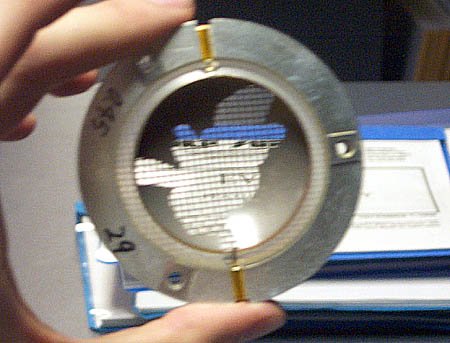
When the driver diaphragm is changed, use a non-magnetic screwdriver. If not, that powerful magnet will displace the position of the screwdriver tip - and will punch a hole in your brand new one. Been there.....
In fact, I think you will see a caution statement on the flyer that comes with the diaphragm kit.
In fact, all of the "Rane Notes" are interesting and quite informative. If you haven't read them, you should!
Steve
------------------
"Old projectionists never die, they just changeover!"
------------------
John P. Pytlak, Senior Technical Specialist
Worldwide Technical Services, Entertainment Imaging
Research Labs, Building 69, Room 7525A
Rochester, New York, 14650-1922 USA
Tel: +1 585 477 5325 Cell: +1 585 781 4036 Fax: +1 585 722 7243
e-mail: john.pytlak@kodak.com
Web site: here
"It has to be understood that analogue components do not simply go into hard clipping from a certain point onwards, but that the signal gets more and more distorted as this point is approached".
This really depends on the design of the analog equipment. If you are talking about a CP200 (which was designed back in the late 1970's), yes this is true, but modern analogue equipment is quite different.
For instance, the THD of a current QSC amplifier (or a Panastereo sound processor) falls until the point of clipping is REACHED, rather than APPROACHED. The problem with older equipment, relates to the method of gain control, rather than the absolute level of the input signal.
Modern, high performance analog equipment will produce reducing distortion until the actual level of clipping is reached, and thence forth, (like digital) will severely clip.
------------------
Ray Derrick
President/Chief Engineer
Panalogic Corporation Sydney, Australia
Phone: 61 (0)2 9894 6655 Fax: 61 (0)2 9894 6935
Once again to be more accurate, in modern analog equipment distortion stays pretty much constant up to the point of clipping, it is the noise level which falls compared with the signal level, so it is the combined THD+N figure that falls as the signal level rises.
My reference to gain control methods is aimed at the once common use of VCA's (voltage controlled amplifiers) which have the characterisic of increasing distortion as the signal level rises. I hate those things!
Now, regarding equaliser settings, I would agree wholeheartedly that a poorly setup system will increase the risk of distortion. However I would have considered the same problem to exist for analog equipment. So Michael I don't quite understand what you are getting at.
BTW Michael your English is very good. If a dummy like me can understand you, then you are doing very well indeed.
------------------
Ray Derrick
President/Chief Engineer
Panalogic Corporation Sydney, Australia
Phone: 61 (0)2 9894 6655 Fax: 61 (0)2 9894 6935
 Seriously, I didn`t mean to make a general comparison between analogue and digital equipment. The reason I kept referring to digital processors is simply that most units in use in the cinema today are digital processors.
QUESTION: where cinema applications fit here ? category one , as in studio recording ?
JBL itself if some of its cinema appl papers recommends amps with twice the IEC rating, for instance on the 5000 serie. For the subwoofers, they recommended 1xIEC and multiply the subwoofers to increase SPL pressure rather (doubling the nr of stacked subs yields about 4-6dB).
also, the volume of the room is a direct influence on the power required and the number of speakers of course (especially subwoofers for instance). And power compression intervenes at some time also.
I often read here that it's better to increase the number of subwoofers to reach those 105 or 115db SPL at 2/3 the distance rather than increasing the power feeding them.
Also, equalizing which sometimes requires a boost at certain frequencies creates needs for more amp headroom and thus bigger amp or more use of bridging.
David
------------------
Ray Derrick
President/Chief Engineer
Panalogic Corporation Sydney, Australia
Phone: 61 (0)2 9894 6655 Fax: 61 (0)2 9894 6935
It's not the shape of a waveform that blows speakers when an amp clips. And the ouptut doesn't become DC, either. It's the excessive power that does it. When amp clips severely, the average power in the signal is much, much higher than if the signal were reduced to the point where it's clean. An amp could actually put out more power than its rating.
For an extreme example, let's say an amp driving an 8-ohm load puts out a sine wave that just starts to clip when the waveform peaks reach 60 volts. Its RMS voltage is 42.4 volts, and the power delivered to the load is 225 watts. A 60-volt square wave, OTOH, which would resemble a very severely clipped version of the sine wave, would deliver twice as much power--450 watts--into that same load.
While it's also true that clipping produces a lot of harmonic energy, that additional harmonic power in itself does not greatly endanger HF drivers in systems with passive crossovers. That's because even in a square wave, the fundamental is about 88% of the total power. Thus, if the amp is putting out a 60-volt square wave into an 8-ohm load (450 watts), the fundamental is about 400 watts and the rest of the power is in the 3rd, 5th, 7th, and higher-order odd harmonics.
-Bob Lee
Applications Engineer
QSC Audio Products, Inc.