
How or where can you connect to the cp 45 to get a raw preamp signal out put? This is the problem. I have a Perspecta Sound Integrator that needs the single coming from the solar cell to go into the input of the Perspecta. Then from the Perspecta the output will go into the Aux/Non Sync 2 Left Right Center input on the CP 45. My problem is, is getting an out put from the preamp before the switching of the format, so it's right from the cell and after the Proj Changeover. Do you get what I'm saying? Can I pick it up from the test points? Unlike the CP 55, there is no preamp out on the back panel.
Bernie
Josh
Bernie
Bernie
I almost got to see that FORBIDDEN PLANET presentation. I also ran it but when I did, I didn't have enough time to go hunting for a PS integrator. I think Dolby actually made one at one time that was a simple CAT card plug-in card....or so I was told. I also ran NORTH BY NORTHWEST that was supposed to have Perspecta with no chance to try to get it to work.
So what you are saying is that that PS integrator needs a solar cell level signal IN, but you need it AFTER change-over, right? How bout if you can grab a signal out of the CP45 anyplace after the change-over, even if it is already preamped to line level, no reason why you can't just put a 20db attenuation pad on it and drop it down to solar cell level or whatever the integrator likes to see at its input. Test points should be fine, especially if you are throwing a 33k resistor between it and the PS integrator input -- the CP45 won't even know the load is there.
I sure want to catch a show at the Jersey one of these days.
For anyone who is within walking, riding, swimming or flying distance of this theatre and the restoration project that these guys have been working on for years, this is a MUST see. The theatre is a beauty to behold in and of itself, but more importantly, Bernie and Bob Furmanek and the rest of the crew are our kind of people.
Frank
Frank,
I knew a guy in LA that made a solid state one but he would never sell or give out any info on it. It used the Cat 150 slot A few years later I found one from Dion Hanson at Cineman in the UK. Pluggs into the Cat 150 slot also and works great. I have had no problems with it at all.
Dick
I can't help you with the CP-45, I've never even seen one of them yet. Are you aiming to acquire the worlds entire remaining stock of integrators, and put them back into use!
I hope all goes well with the show at the Loew's this weekend, North by Northwest should look good on that screen, sorry I can't be there to see it.
When I was at the theatre in April, you had a switch, not in use, but in one of the rooms off the projection box, labeled something like 'mono', 'magnetic' and 'Perspecta'. Have you kept it? I rather hope that at least one of them will be preserved, even if not in use, as it is described in the original Perspecta documents in the Widescreen Museum, and is thus of historical interest, as part of the original installation.
I still have some booklets and other things, I will have to get them over to you sometime. I would like to come to another show at the Loew's, but getting time off work, booking flights, hotel etc. takes time, so I was not able to do it for this weekend. The Sci. Fi. weekend was advertised several months in advance, so I was able to arrange everything, including getting a Passport, but this weekends show was only anounced a week or two ago, at least as far as the e-mail list and web site are concerned. Would it be possible for future events to be anounced further ahead?
Are the Brenographs still in the condition they were when I saw them? If so, could I have a go at giving one of them a clean-up etc., next time I am there?
I hope you are still using carbons, knowing how much the things cost now, and hearing about the reported difficulty in obtaining good ones, the future doesn't look bright. (Pardon the pun.)
The four track mag penthouse I acquired over there, along with another, similar one, and a Dolby MPU-1 is now installed in the private cinema of someone living in the English Lake District. I had difficulty finfing a Cat.93 12kHz. switch card, but managed to get one from Boston Light & Sound. Projectors also converted back to carbon. Picture and sound both very good.
Hope to see you again soon.
Dick, I also have one of the cards from 'Cineman', and can confirm that it seems to work well. While very different in design to the original units, it seems to be functionally pretty close. For those who haven't seen these cards, they are the same size as the Cat. 150, which they replace. They are all analogue, and have about eight ics and a large number of caps, resistors and diodes. Are components are mounted through the card, there is no surface mount technology used, so the card could be easily repaired or modified, if needed. One additional feature which the card has is the ability to send the sound to the surround output, as well as L,C and R, when all three tones are present. This feature can be enabled by moving a jumper, but I haven't tried it. One of the original Perspecta documents claimed that it was intended to introduce a surround channel, with a 25Hz. control tone. I have found no evedence that this was ever implemented. I would be intrerested to know if the gentleman I met at the Loew's who had worked with Robert Fine on Perspecta, I'm sorry, I can't remember his name, can shed any light on this. The 'Cineman' card is all hand soldered (a lot of work), but the card itself is very professionally made, no rough, hand-cut corners etc. When I bought my card earlier this year, they cost 300 pounds, not cheap, but not not unreasonable, considering the amount of work involved, and the very small quantities produced. I am very glad to see some of the original integrators put back into use, but I think there is a place for the modern cards as well, for one thing, there are much easier to take to a theatre for a one-off show, they can be carried in a coat pocket, and installed in a minute or so. The only problem with them is that they can only be used in a processor which takes a Cat.150. The CP-50, 55, 65 and 200 are all fine, but not the 500 or 650. I'm not sure about the 45 or 100. It is my ambition to have a 200 with all the 'extras' some day.
Hmm...on second thought I'd like to see the front and the back of this thing.
It's a long defunct process but some folks have created decoder cards for both Dolby and Ultra Stereo processors; on the former, it would temporarily take the place of the Cat.150 2:4 decoder card. On a digital processor it could be done in software if someone were to take the time to write the code.
Is there a simple way for someone to record 5.1 on a PC and a format whereby this can be distributed to others (who have 5.1 playback cards)? If so it would be interesting to hear a recording of Perspecta decoded playback and see how it sounds (to the extent possibly with this arrangement).
A note of the Dolby card for Perspecta. They never really got it right. Not only does the Perspecta pan the sound to LCR but it also controls the gain and also filters out the cue tones that you might hear on a normal play back . It's like a little rumble in the bass. TheDolby card never allowed for the gain and never filtered out the cue noise, although it did pan properly. But if you come across one for a dolby unit, I would pick one up for the hell of it. Remember also, that MGM cartoons from the era are Perspecta too. So I bet some of your Tom and Jerrys are Pespecta encoded. It will say it on the leader in the track if it is.
Hi Stephen,
The Loew's looks exactly the way it did when you left in April. We had a little fight between the "volunteers" running the place and the film people. So I haven't been back there in months. I'm on to bigger better things at the Rahway, so I hope. Just took over the curator position for the Wurlitzer Theatre Pipe Organ there. Now, this is a place, the next time your here, you must see. Glad to see you got all that stuff back with out a problem.
Thanks again guys.
Bernie
I have played with the Cineman "PerSpecTa Card" (a Dolby Cat. 150 sub). I'd recommend it to anyone wanting to play back a perspecta film, including Tom and Jerry shorts.
Steve
------------------
"Old projectionists never die, they just changeover!"
Bernie,
The Cineman UK card has four LED's which three of them match L C R and vary in intensity. It sounds like the screen channels are matching them. I don't have my Fairchild hooked up anymore so I can't compare. I know it does work differently then the old ones do but it sounds good. Lots of old films have remixed soundtracks yet still say "Perspecte Sound" on titles and leaders so don't believe all you see. I have had a few say so and not trigger at all. Would love to have heard "Forbidden Planet" on it.
quote:
Stephen,
I have one of the boxes you mentioned. It is a Fairchild "Systems Switching Panel" Model 312 and has a multi ganged three position switch with two large treminal strips. To save me the trouble of tracing the multiple gangs do you have a drawing for it. I am using mine in a SA-4 into a CP-100. I picked up another SA-4 and wanted to switch between the two rather then risk dropping one of the boards. Did you get any information for changing speeds, surround jumper or anything else with you card?
Sorry, I don't have any info on the switch unit, I read about it in an article in the Widescreen Museum,
It is mentioned near the end. There are two other Perspecta articles, plus some on Fantasound in the Museum, all of which make interesting reading. I have just checked my printouts of these articles, there are circuit diagrammes of the integrator and power supply, but not the switch unit.
When I was at the Loew's Jersey I saw this thing, not in the rack, but leaning against the wall in one of the rooms, and immediatly recognised it as the switch which had been described in the article.
I have never even seen a SA-4, was this the chassis to mount an external Cat.150 for surround sound with the CP-100? Could a later processor with a built-in Cat.150 be made to work with one of these, and switch between the two? How about the CP-200, and its mysterious accessory unit? What was that intended for, and is there any way it could be used with a second decoder?
Documentation with the card - nil. Just the card, well packed, in anti-static bag and a padded box, and a receipt for payment. At the time I bought my card, there had been a delay in the production of the latest batch, and I had to wait for a while. I can't remembber the details now, but Dion was very busy at the time, and was out of the country, Susan gave me the option of having the card as soon as it was ready, or of waiting for Dion to return. Maybe I would have got more documention if I had waited. Dion did say that he would send me instructions on setting up various processors with the card, but I have just realised that I have not received them. I will have to get in touch with him to ask about it.
There is one jumper on the card, marked 'surr off' and 'on' the card is shipped with this option disabled, and I have never changed it. there are five leds on the front edge of the card, the top one is red, and indicates a Perspecta track being played. the others are yellow, and indicate left, centre and right channels, and surround, i.e. all three other channels active, and jumper set for surround on. As far as I can make out, there is no delay on the surround channel, and certainly no way of adjusting it. I can't remember now, with normal stereo, is the delay on the Cat.150, or elsewhere in the processor? If the former, then it would obviously not be there when the Perspecta card was in use.
I thought I read somewhere that the filters on the card could be tuned to allow for differing projector speeds, but this is not the case. There are no variable components on the card. I have only once had a problem with this, the first time I tried to use it, the projector had a weird electronic speed control, which had beed set for an odd speed, 25.5 fps I think it was. I have used it with several other 'normal' projectors without problem. If necessary, it would not be too difficult to replace components to re-tune the filters.
This is what the thing looks like:
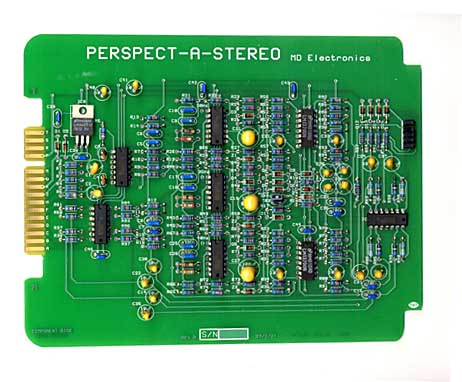
As you can see, it is well made, and I think getting the PCBs made up must have been a fairly expensive exercise, for the very small quantity involved.
I don't use the card very often, if you, or others on these forums, would like to borrow it to try, let me know.
I would say that the card works well, but I have not been able to test it against an original integrator. I have only heard one of these twice, firstly some years ago, in this country, with a unit which was not in good condition, and had a lot of hum, and, this year, with the refurbished unit at the Loew's, which sounded much better. The processor at this theatre is a Sony digital one, so it was not possible for me to take my card with me to compare with it directly. If anyone has both an original Perspecta integrator in good condition, and a Dolby processor which uses a Cat.150 decoder, please contact me, and if someone can provide a good Perspecta track, then we can do such a test.
Of the film I have heard, the sound varies greatly, I borrowed two short clips from unknown features, which were in very poor condition, and have run a number of cartoons, plus I heard 'Forbidden Planet', and the various other shorts and extracts which were shown at the Loew's. The tracks varied greatly; on some the process had been well used, on others it was absolutely dreadful, with the sound jumping around all over the place, seemingly at random. Of the Perspecta tracks which I have heard so far, I would say that 'Forbidden Planet was probably the best. Perspecta was quite widely used on cartoons, which is probably the worst place for it, as many of them rely heavily on music, for which Perstecta is not well suited. For dialogue and effects, Perspecta, when well done, can sound surprisingly effective.
It has been calimed that one version of the 'Forbidden Planet' DVD has the Perspecta tones intact on the mono French track, but this has been denied by others. I haven't heard the disk, so I don't know.
There have also been claims that there have been DVD, and possibly Laserdisc, releases where the Perspecta track has been decoded, and re-recorded in 3 channel Dolby Digital, again, I don't know if this is correct, nor which titles or equipment may have been used. If anybody has any more information on this, please let me know.
Considering that the process was only used for a few years, almost 50 years ago there seems to be a surprising amount of interest in Perspecta today.
Whatever the pros and cons of A type Dolby Stereo, it did manage to become widely used, and long lived, something which no other release format since Academy mono optical had done at the time.
Question is, the original integrators, are these the Fairchild units or something pre-Fairchild? And if I can grab one of these, it would be a given that the caps would have to be replaced, correct? Not that that would be any big deal, but I like the idea of a single card that I can just replace in the processor when a PS title comes along. I am wondering if I would be better off putting my efforts into getting a Perspecta-Stereo card.
Frank
PS -- Bernie -- sent you an email yesterday and it bounced; is there a new email address for you?
[QUOTE]In a conversation last night, I found out that I may be able obtain an original Perspecta Sound integrator. Since we run retrospective, chances are we will eventually get others titles with PS tones and this time I want to be prepaired and have it working in time.
Question is, the original integrators, are these the Fairchild units or something pre-Fairchild? And if I can grab one of these, it would be a given that the caps would have to be replaced, correct? Not that that would be any big deal, but I like the idea of a single card that I can just replace in the processor when a PS title comes along. I am wondering if I would be better off putting my efforts into getting a Perspecta-Stereo card.[QUOTE]
Another integrator possibly back in use, I've just done a mag installation, and I've recently heard of another theatre, in Germany, which has converted from xenon to carbon. That makes four, one since closed, one private, and two still open two the public. I wonder what will make a comeback next?
Yes, the original integrators were made by Fairchild. The one shown in the museum documents has a solid front panel, with the three meters mounted directly on it, but the one at the Loew's had a large rectangular cut-out in the main panel, with the meters mounted on another panel behind. I don't know if there is any other difference between the two versions.
If you can get an original integrator, it is anybodys guess what condition it might be in. It is likely that at least some of the caps would need replacing, The circuit diagrammes are available in the Widescreen Museum, I'm not sure how readily available the valves (tubes) are, if any need replacing, nor if the test films can be found anywhere, or if the neg still exists, and you gould get one printed.
For a permanent installation, I would say get an original, if you can find one in good condition. If you need something you can easily and quickly move around for one-off shows, then I think a card is a better bet.
In a CP-200, I programed the CP-200 to turn on the surround feature and off...and without a doubt, off was preferred! I would say on some films with some delay on the surrounds...it might be a nifty effect but that is it.
As to the RED LED on the card...that is to signify that no control tones are present so it will force a hard center (mono) reproduction...once a control tone is sensed, off goes the RED LED and the other LEDs will show what the card is doing.
On the two reissues showings I worked on (Turner has brought back a couple that showed at the Senator theatre in Baltimore, MD)...the card tracked the tones perfectly...the tones varied in intensisty as with the tones so went the channels.
Steve
------------------
"Old projectionists never die, they just changeover!"
quote:
As to the PerspectaCard's surround generator...stay away from it!! In fact, some of the cards had the wrong diode stuffed in it (they got a zener and small signal diode swapped). On the PerspectaCard, when all three tracks are active, the surrounds are tuned on to fill up the room...interesting theory (though not mixed that way) but they forgot a crucial element to it...they didn't provide for a surround delay. What you get is this horrible echo effect that is dependent on your auditorium size.
In a CP-200, I programed the CP-200 to turn on the surround feature and off...and without a doubt, off was preferred! I would say on some films with some delay on the surrounds...it might be a nifty effect but that is it.
Agreed, I have never used the surround feature, it does seem to be just a gimmick, and was, of course, never done on the original integrators.
quote:
As to the RED LED on the card...that is to signify that no control tones are present so it will force a hard center (mono) reproduction...once a control tone is sensed, off goes the RED LED and the other LEDs will show what the card is doing.
Yes, same on mine, red indicates normal mono, or Perspecta, and the card automatically switches to the correct mode, as did the original integrators. Three yellows, one for each channel, plus one for the surround, ignore that one.
quote:
On the two reissues showings I worked on (Turner has brought back a couple that showed at the Senator theatre in Baltimore, MD)...the card tracked the tones perfectly...the tones varied in intensisty as with the tones so went the channels.
What were the titles that you ran? Do you know if the tracks were just re-prints from the original negs, or had they been re-recorded or processed in any way? How did you think they sounded?
From what I could tell, they did a reprint of originals though they did restore them to the point the colors were perfect...except...for the opticals where they would fade from one scene to the other. You went from a mint perfect picture to what appears to be a cut, the grain goes up, the color goes all whacky, the fad occurs, the cut back to the original and all is well again. Mind you the cut was done on the negative that made the print (the prints were splice free).
I don't think they were reprocessed sound since they were still in perspecta...if they were going to go through that much trouble they would have struck the prints with the modern digital formats or even SVA. Instead they requested Perspecta Decoding and all were pleased.
As to the sound...I was the best damn mono I ever heard! It had a much better fidelity than your plain jane mono film. There was actually some high-end though no bass (naturally since the control tones are down there).
Steve
------------------
"Old projectionists never die, they just changeover!"
Frank,
When I got my Fairchild to work I replaced all the caps which is no biggie. The filters needed a heat gun to melt the wax to get to the caps. If memory serves all the caps in each set of filters were the same value and the coils were wound spacific for the 30, 35, 40 Hz trigger tones. I didn't feel I was getting enough tone level so I changed the voltage divider values after the 63 Hz filter to get more tone level. Other then the 40 Hz filter being a little low it worked great. Filters were like old Collins machanical filters we used in ham radio. I think they were +/- 1 Hz. Was so excited to hear it I never got around to playing with the cap values. The Cineman UK card would be an easy way out.
John,
I have a DCG Hare model 360A, s/n 13 but have no information on them. Mine is missing the pre amp, front cover, and power supply. The way things swing out this one was much easier to service and looks to be built like a tank. Do you have any info or parts for these. Power supply should be no problem and I have a brand new late Fairchild one. We found it on a shelf in a Chicago theatre supply 15 or so years ago on a visit.
Stephen,
That is the same card I have and have been told Dolby has one also. Dion told me that they could just change a couple of componants to set of for projector speeds. My card is set up for 24 fps and my motors are fine so I didn't have to get new values.
Dick
Frank
quote:
I bet if I threw in an outboard delay for the Perspecta pseudo surrounds like we do on our non-sync sound, it would eliminate the echo and if you set a conservative surround level, just enough for a kind of ambience fill, it may actually be very effective. We pump our CD through a Sansui Vario Matrix Decoder (2 -> 4) and delay the surrounds; it just makes the room come alive with sound; however,the delay really essential if you want to prevent that hollow echo sound -- a particularly erksome problem in a 2500 seat house.
Frank, do you have anything with a Perspecta track on it at the moment, or can you get hold of anything? I don't at the moment, I have returned everything I had to its owners.
If you do have any, or can get hold of some, would you like to borrow my card to try? It only takes a minute or so to set up, and is small and light enough to post without difficulty, which is something the original integrators were not!
If you do manage to get one of the originals, and get it working, you could do a direct comparison between the two, which would be interesting, and is something I haven't been able to do.
I need to use the card again next May or June, I don't know the exact date yet, but it's free until then, if you want to try it.
Your idea for the surround might work. I don't know how it works on the card, all I know, is that the surround can be activated when all three of the main channels are active. At what level, I've no idea. Just turning it full on when all three tones are present, at any level, would seem to be a bad idea; maybe it's proportional to the sum of the other three channels, or their average, or something. I don't know. I have no other documentation, and trying to trace the circuit design from the component layout on the card, to see how that part of the thing works seems like hard work. To try it out, I would have to borrow a print from somebody, and a cinema to run it in, and I don't have time to do that at the moment.
Stephen.
p.s. I see you are from Brooklyn, When I came over to see the Loew's in April I was only there for five days, I couldn't get any more time off work then. There were quite a few places I wanted to visit, but didn't have the time, so I am hoping to get back over sometime, maybe next spring. Would there be any chance of me having a look at your theatre while I am there.
The theatres did not want to pay the cost of installing the system.
The public didn't like it.
When done badly, which it seems it often was, it could sound terrible, and this gave the system a poor reputation.
Film makers didn't like using it due to the restrictions it placed on them in the creatin of the track.
The advantages it gave were not thought to be worth the bother.
There were technical problems, such as break through of the tones to the sound channels, or slightly incorrect projector speeds causing strange effects.
Were any of these the true reason, if not, why did it happen? Are there any records of how the system was received by the film going public of the day?
At the end of its life, did Perspecta just quietly slip away, or was any announcement of its discontinuance made by any of the studios? I know that some of them had previously announced that it would be used on all future productions.
It goes without saying Film-Tech members are always welcome to check out our theatre. However, by next spring there might be not much more to see than the construction crews and our place pretty much pulled apart -- our major renovation project has finally gotten off the stalled track. We are very happy about it, but it is going to be a major disruption.
But come on by anyway -- we can always tell war stories amongst the ruins!
Frank