
 But we cursed them on hot summer nights.
 It wouldn't have been too hard to plumb those water-cooled carbon jaws and projectors to heat the water going to the rest rooms.
------------------
John P. Pytlak, Senior Technical Specialist
Worldwide Technical Services, Entertainment Imaging
Research Labs, Building 69, Room 7525A
Rochester, New York, 14650-1922 USA
Tel: +1 585 477 5325 Cell: +1 585 781 4036 Fax: +1 585 722 7243
e-mail: john.pytlak@kodak.com
Web site: http://www.kodak.com/go/motion
------------------
John P. Pytlak, Senior Technical Specialist
Worldwide Technical Services, Entertainment Imaging
Research Labs, Building 69, Room 7525A
Rochester, New York, 14650-1922 USA
Tel: +1 585 477 5325 Cell: +1 585 781 4036 Fax: +1 585 722 7243
e-mail: john.pytlak@kodak.com
Web site: http://www.kodak.com/go/motion
The David Lean in Croydon, recently built, very small, maybe 50 seats, has a pair of 100W xenons, and these are vented, so it doesn't always go by size.
In the summer-time at the drive-in, onion rings seem to stay pretty warm while sitting on top of the Super Lum-X lamp houses. And like John did, I enjoy the heat of the booth while trying to run a show while it is snowing out in the fall.
I've also run several booths with two machines with 1kw and/or 500w lamps without ventilation; heat wasn't a major issue there, either. Of course all of these use modern (supposedly) ozone-free xenons.
I will soon have a carbon arc Super Trouper followspot (essentially the same thing as a Strong "Utility" lamphouse) running unvented in a large theatre, although it won't be run for more than a few minutes at a time (and, then, only occasionally) and will be on a theatre balcony, not an enclosed booth.
I'm not necessarily trying to suggest that any of these setups is optimal, just that the smaller lamps can be run unvented without adverse consequences for the operator, though lamp life probably suffers.
Newer generations of xenon lamp design have corrected much of those early problems, which unfortunately has led manufacturers to used the term "ozone free" quite loosely. Even the most modern xenon bulbs are not ozone free, and yes, a single bulb will give off low levels of the gas that is said (by someone) to be harmless, but that's looking at one bulb at a time. Given the nature of multiplex operation, rarely is a single bulb fired in most booths -- there are many of them and the ozone accumulation can be significant if it is not properly vented by a properly designed ventilation system.
Some years ago a civil suit was filed in Brooklyn against Cineplex-Odious and the management of the Alpine Theatre here because the venting system was inadequate and always in bad repair with management refusing to address the problem. The union projectionists were getting very ill. OSHA became involved and found very high levels of ozone as well as even more toxic gases. The case was settled, and the ventilation system was upgraded.
When a large multiplex is designed with a common booth, the idea of ozone-free bulbs becomes a real issue; proper ventilation needs to be part of the design, not an afterthought.
I believe that in NYC the building code for projection booths still requires that if the booth is going to have a ventilation system for the general booth area, it must be a separate system from the projectors which must always be vented. I think that is still on the books, but then again, the requirement for a licensed projectionist to be present in the booth at all times is also still on the books, but its a reg that management pretty much laughs at.
Frank
Energy can not be created, only tranformed from one form to another.
Therefore, by definition, a motor can not act as a generator with any gain in energy. However in the past, cinemas have used motor/generators to provide d.c. power from an a.c. supply instead of using a rectifier.
True, but there is ongoing research into conserving energy in motor vehicles by utilising the energy of the moving mass during decelleration and braking to generate potential energy stored in batteries. Normally, braking produces heat and is wasteful of the energy it took to overcome inertia at starting and accellerating.
Almost since the invention of motorcars, magnetos, generators and alternators have been used to recharge the battery, driven by the gasoline engine itself. Driving similar generators from the wheels
on decellerating would be a further conservation, if storage of electrical energy permitted the use of electrical motors part time during the use of the vehicle.
Perhaps this research, and the frequent announcement that such a vehicle's production is imminent, is what suggested Matthew's posting of this thread?
As for a projector, I don't think regenerating electricity for a few seconds off of the fly wheel would be worth the equipment expense. 
------------------
Better Projection Pays!
I think in the USA Federal law requires the utility to accept power from wind and solar generation and possibly (not sure) from co-generation systems. But they are not required to pay you retail rates for it which is what happens when the meter goes backwards. They'd install other metering for this purpose and give you wholesale rate credit.
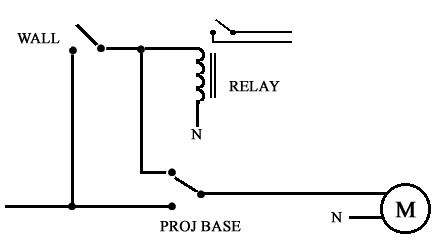
If you run the motor via the base switch (wall switch off) and then switch back to the normal position, the coasting motor will generate sufficient voltage to backfeed and lift the relay. This is seen by looking at the CP500D, which will sit in DD even with nothing running and only default to SR when it gets a contact closure on one or the other motor relays. Motoring at more than a low speed and as you switch off you see the CP switch briefly into SR then back to DD.
Database of State Incentives for Renewable Energy (DSIRE)
Net Metering
Last DSIRE Review: 07/18/2002
Incentive Type: Net Metering Rules
Eligible Technologies: Solar Thermal Electric, Photovoltaics, Landfill Gas, Wind, Biomass , Hydro, Renewable Transportation Fuels, Fuel Cells, micro turbines
Applicable Sectors: Commercial, Industrial, Residential
Limit on System Size: no limit
Limit on Overall Enrollment: 1% of peak demand for each retail electric provider
Treatment of Net Excess: New rules pending. See summary for details.
Utilities Involved: Investor-owned utilities only
Date Enacted: 1999
Authority 1: Ohio Revised Code 4928.67 (SB 3)
Authority 2: Case No. 01-0573
Summary:
Enacted in 1999 by the State General Assembly as part of an electric utility restructuring bill, Ohio's net metering rule requires investor-owned utilities to offer a net metering option to customer-generators who own qualifying systems. Qualifying systems include wind, solar, biomass, landfill gas, hydropower, fuel cells and microturbines and must be intended primarily to offset part or all of the customer-generator's requirements for electricity. There is no cap on system size but the total installed capacity is limited to 0.1% of each utility's in state customer peak demand.
When the rule was enacted, the Public Utilities Commission of Ohio ordered utilities to purchase excess generation from their customers at a full retail rate. However, in June 2002, the Ohio Supreme Court ruled in favor of the utilities that this exchange was unreasonable and illegal, in Case No. 01-0573. While it is not yet decided how excess generation will be handled under this new ruling, it is likely that the utility will purchase excess generation from the customer at avoided cost, or that it will be credited to the following month for a period of up to three months.
Net metering system must meet safety standards of the National Electrical Code, the Institute of Electrical and Electronics Engineers, and Underwriters Laboratories. Utilities cannot require the customer-generator to comply with any further safety and performance standards.
Contact:
Kurt Waltzer
Ohio Environmental Council
Columbus, OH
Phone: (614) 487-7506
E-Mail: kurt@theoec.org
Yes, depending on the electrification system and the type of equipment on the locomotive some use regenerative braking to slow or hold speed in check on downgrades without the use of regular brakes. The train going down the hill can quite literally help the train going up the hill by feeding power back to the catenary.
Otherwise they typically have dynamic braking where the energy is burned up as heat in resistance grids. This is also a common feature on most but not all diesel locomotives. Most diesels use an electric transmission (engine drives generator; traction motors turn wheels) so this comes quite naturally with only a bit of added equipment although some flatland lines do without to avoid the expense.
I believe the Acela train can feed dynamic braking-produced power into its DC link (the bus between the rectifiers and the AC traction motor inverters) as this bus also feeds the HEP ("hotel" power for the cars) inverter. Thus, free HVAC and lights aboard the train while coasting! IIRC it goes into dynamic automatically as it coasts across phase breaks (gaps in the overhead catenary) so there's no interruption in HEP and the lights don't go out in the cars.