
Me, I have Century's and a mixture of Strong/Potts at my big theatre. They all have this problem when there isn't much film on the take up deck. After 30 minutes or so you can usually stop the system with no problems, but at the start you are going to have this problem.
Even though a lot of people here hate it...and some even go as far as to mildly insult those who do it calling them "unprofessional", "poorly trained", people who have "no business in the booth", I thread up differently at Strong equipped theatres....I let the leader touch that no-no void called the floor. I was union trained from my childhood on, and I know this is not desired, but I have never had any dirt issues, and I think the ill effects from this practice (at least in my case)are greatly exaggerated. I am very good at limiting the amount on the floor since I thread from platter to projector to platter and then turn the rewind deck until the start of the programme is at the correct position to actually start the projector minus 1.5 feet of slack that will get used in the lace-up of the projector itself. Then I thread the projector, letting that 1.5 feet or so touch the floor. Then I get the take up platter ready removing the slack.
I do motor down at theatres with platters that can handle it.
You can also just turn off the rewind platter. The machine will stop pretty quick.

Probably your easiest way to solve this is to order the larger 19" center rings. (Note 19" is Christie's standard ring size) Those teeny tiny Strong rings force the platter to really blast away at the speed upon startup. Using the larger rings will make starting easier on the platter (and the film that will wrap on payout) as well as allow you to stop the projector without crashing the platter's elevator and bending your guidance rollers out of alignment. Strong really should make these the default ring, and only ship the smaller rings (that come standard with the platters) for trailer work upon special order.

But really, why would anyone design a ring so small as standard issue in the first place? I mean it is really small. Problem is my theater chain might not want to spend the money on the newer rings. I bet that they are not cheap.
Brad: I didn't even think about the larger rings. They just might help the problem of the the platters STOPPING without the trolley slamming against the top of its rails. I have never had any STARTING issues though.
Joe: It helps by lacing as you would at a changeover house...with the appropriate countdown number in the gate so you don't have to motor down after the machine is laced.
You NEVER have the problem with Kinoton as there is no way the platter can go from zero to full speed like the Strong & Christie can. Thats one of the reasons I hate them....
Brad's suggestion seems to be the best low tech remedy... that way the motors won't get up to such highs revs.... but you'll still have to keep a close eye on it. One other solution... do your motors run off inverters or are they 'as supplied'.
If you have inverters you could always slow the run down time to accomodate the platter.
Wes: in changeover booths, I usually thread to the first part of the leader that has framelines marked on it and then motor down to "8" or whatever works best for that particular machine. That avoids excessive handling of the leader and makes it easier not to let the leader touch the floor (which I admit that I still do when working with platters). The only exception would be with Kinoton machines, where there is (by default, anyway) no way to run the motor without striking the lamp; in that case, I do thread to the starting frame to save some lamp life.
The larger rings definitely work, as I have a couple and have tried them. As far as either ring not taking up, that has never been a problem. The startup issue I speak of is the film wrapping around the brain a few times (thus, wrapping on itself causing damage) until it gets up to speed. Using the large rings satisfies both issues.
Also, I say this because you keep posting bad tips, which tends to destroy the whole benefit of these forums. Lacing on the start frame may be convenient for changeover houses, but that is precisely why reel changes look so bad. This is NOT "film done right". All caring operators thread up on the leader and then motor down to the start point, making sure there is ample leader for the protection of the film (not just what is supplied). The CA21 automation even has a cueing feature built in for just this purpose! I know you don't believe in anything I or the good people here tell you, but I assure you that your presentation could be bettered if you would break your bad habits. It's sort of like seeing changeover cues or the CAP code or even seeing FilmGuard in action for the first time. Until you see the distraction or difference for the first time, you honestly don't notice the problem (and as such refuse to believe there is anything wrong with the presentation). Once you see the difference, any less than perfect presentation will from that point on drive you crazy. The film damage and dirt you claim to not have IS there, you just don't see it. I as well as many other people on this forum would see it though. Come visit me sometime and I'll point everything out to you at a less-than-ideal local theater and destroy your typical moviegoing experiences for the rest of your life.
My booth runs nicely. I have been around such things for 20 years, am a qualified tech with install experience and I think I have applied what I have learned...the good and the bad...in such a way that I am quite satisfied with my presentations.
You say "...I say this because you keep posting bad tips, which tends to destroy the whole benefit of these forums."
I say that is another veiled insult. I am not a know-it-all, and have never claimed that any of my procedures for accomplishing something in the booth are the BEST or the ONLY RIGHT WAY as you and others sometimes not so mildy push. I think deciding whether something I say is a "bad tip" or not is up to the reader. The reader can choose to apply the tip or not.
You say: "All caring operators thread up on the leader and then motor down..."
I say there are plenty of "caring operators" that do things completely different from other operators. Not just concerning this subject of booth operation, but concerning every aspect of theatre operation.
You say: "I know you don't believe in anything I or the good people here tell you..."
I say WOW! You claim to know even more than I previously thought! You know things about my emotions and beliefs that I wasn't even aware of myself. Seriously, I have learned a LOT from these forums. But I am lucky enough to have been in and around this business long enough to separte the BS from what I really want....what I think are the "bad tips" from the good ones.
You say "The film damage and dirt you claim to not have IS there, you just don't see it. I as well as many other people on this forum would see it though."
I say one more time that I am no know it all, but I am also no amateur. I NEVER said that my presentation was perfect. I do not need to be tutored in something that is second nature to me. My definition of a perfect screen presentation is not possible with current technologies ANYWHERE. I simply think that my presentation is good the way it is.
Anyhow, thanks for the info on the 19inch rings. I knew they were around but no one I know had ever used any. I might get a couple for trailer changes and such.
The problem Wes is the newbies here who are trying to learn and improve their presentation don't have the experience to be able to differentiate between the good tips and the bad tips. Remember, there are people who read these forums who have less than a year's projection experience, or even less than a month. Most of them have been trained poorly too and are here to try and improve their presentation any way they possibly can, and you are not helping. I am now asking you politely to cease your comments when you know you are posting information that is less than ideal. You should know better. I never said you or anyone has to do things exactly one certain way, for there are multiple acceptable ways of doing things. However if you cannot differentiate proper techniques vs. "good enough", then you will not be welcome here any longer. That's the nicest I will be regarding this. Your further comments are not necessary and again, I have zero respect for anyone who does not do everything in their power to treat their films in the best possible manner.
Of course today's discussion wouldn't even be an issue if Strong / Potts had put a taller elevator into their design. SPECO modified their original LP270 platter design when these complaints came up. Where's the retrofit kit from Strong?
Shaun, Joe is running Simplex XLs. They have a pretty good ramp down, but apparently not enough.
Richard, Joe's projectors do not have flywheels. He can only use the motor switch. It's a weird situation indeed. Regarding Strong, a minor re-design of the platter would not increase it's cost. To hell with quality anyway, right? Cheap, cheap, cheap is always the better decision.
Joe, I really think your best bet is to hit the manual motor switch, then at a predetermined point on the leader press START and release the manual motor switch. That way you don't have the first trailer exposed out of the film roll, you don't have to worry about the first trailer getting abraded while the Strong platter tries to get up to speed and you still maintain the benefit of a decent length of leader.
My projectors have a slightly "longer than normal" ramp down speed I'd say. They stop a bit slower than most projectors that I have worked with. But when the leader is motoring and the Strong motors sucking at full force due to the wimpy rings and I suddenly switch the motor off, the Strong motors simply have too much torque to stop fast enough. Never a problem with Christie platter motors.
If Strong would be willing to swap the 13 inch rings for 19 inch ones, I would be an extremely happy camper! Also, if Strong has any other solutions they want to try, I would certainly be happy to field test for them.
They are not very stable machines on start-up. Some of them will scare the crap out of a newbie when they see those things "take off" on startup.
Mine handle the ramp-down just fine, even at the very beginning. From time to time some doofus forgets to remove the DTS Logo on the movie that is moved to another house, and if I catch it, I'll motor it off manually. The platters stabilize nicely in that period of time, and the ramp down causes absolutely no problem.
Another way to look at it...if the equipment you are installing cannot handle being turned on and off, why don't you just remove the manual motor switch? Also, what is that saying for the equipment's reliability factor? Of course any projector will last longer if it is not abused by turning the motor on and off, but what machine cannot make it through it's warranty period if someone motors down the leader on each show for the year or two warranty period? Of course Joe doesn't even have the capability to manually turn the projector over by hand, so he has to do a running start, thread on the cue frame or motor the leader down.
This is also why automations without a start cue are a foolish design that does not take into account respect to the film...and that cost excuse be damned here, it wouldn't jack up the price of an automation enough to matter for such a feature to be implemented.
And Gordon, I think our Simplex projectors are well beyond their warranty! I doubt I could break them even if I wanted to, anyway.
I'm not big into arguments, so i'll leave it with a compliment.
In my 20+ years of showing films...I've yet to loose a motor and the bulk of my time has been in changeover booths were the starts and stops are many times more than in a platter booth...still...no motor failures and some are going on 40-50 years of service.
Steve
------------------
"Old projectionists never die, they just changeover!"
I know that the operators are going to let it touch the floor, so I put the framing marks -- just ONE frame for picture and ONE for sound -- very early on the leader to force them to limit where it touches the floor.
Just in case anyone is curious...If there is a need to splice the leader, there are little "tick" marks to indicate where framelines are.
The operators use the "Run Down" feature (Christie/Pennywise CA-21 automations) after lacing/threading. A foil cue stops the motor at the countdown point.
There is another long gap between the start point and the dowser open cue (another foil cue). It's all black film with white frame lines. (Don't worry Brad, now that I know about the all-black leader with the frame lines between the sprockets, I'll be switching for the next batch. The white frame lines sometimes show up in scope movies.) Basically, the idea is that the operators will be cutting a black frame each time they build-up/tear-down, so they'll need a lot of them. Also, I wanted to put just that much extra distance between a potential "handling area" and the actual trailers.
With so much leader, I have accomplished a couple of things:
1. The motor runs for a while; it isn't "bumped" on and off.
2. If there is a problem with the threading, the run-down will let the projectionist know. Same for the platter...If something isn't right, the run-down will reveal that, too.
3. With so much film between where the leader is handled and the point where it actually meets up with actual program material, it is unlikely that the program material will be molested.
~Manny (Practically Perfeckt In Every Way.)
I think Gordon's concern is for those who "bump" the motor off and on REPEATEDLY to get to a precise start point, which obviously puts considerable wear on the gear train with accelerations and decelerations against the inertia of the projector's gear train.
------------------
John P. Pytlak, Senior Technical Specialist
Worldwide Technical Services, Entertainment Imaging
Research Labs, Building 69, Room 7525A
Rochester, New York, 14650-1922 USA
Tel: +1 585 477 5325 Cell: +1 585 781 4036 Fax: +1 585 722 7243
e-mail: john.pytlak@kodak.com
Web site: http://www.kodak.com/go/motion
The larger rings helped, (elevators would still hit the top, but wouldn't pull on the film) and smoother performance overall at startup was noticed when we used them instead of the small ones. There were instances where we specifically used the small rings as a precaution on large movies. (i.e. GWTW, Titanic, any Double Feature...) They got pretty durn close to the edge! 
=TMP=
My idea of "bumping" is not allowing the motor to come up to full speed and stabilize.
Joe -- I don't know why those Simplexes are without flywheels -- I'm assuming they are 5-Star soundheads? The flywheels serve three purposes -- one is to slow the start-up, two is to extend the slow-down, and third is to smooth operation when running at speed. I think the combination of starting and slowing too fast is causing problems you describe, just as Paul states, where the platter sees a huge supply of film and is just reacting on the take-up side when the projector stops. I would never run a Simplex without the proper flywheel, you're just asking for long-term trouble.
The larger take-up rings won't change what happens on the take-up side of the AP Platter. The takeup runs the variac that supplies power to both take-up and payout on an AP-style. The larger ring does help stabilize payout since its rotational speed is reduced, but the take-up isn't affected.
We did supply one large and one small ring with (I think) the DMC Platters, our first digital control type, but got complaints from customers that they only wanted one type and that was the small one. When the SCDC became the standard platter, we went with two small rings again. I never understood that myself, because the extra 20-minutes or so of film capacity is seldom critical and I like the slower speed of the platter. We didn't do it because it was "cheap", we did it because that was what our main customer base wanted.
On new platter orders, customers have the option of substituting one large ring for a small one. This applies ONLY to SCDC platters, as they have the independent take-up and payout controls. AP-style platters technically need the same (or close to the same) diameter on both take-up and payout sides to operate correctly -- they can tolerate some difference, of course, but not on a regular practice.
Pat
Will Strong substitute BOTH small rings for large rings if requested? (That would solve the issues on the AP models.) If the answer is yes, at what point is the cutoff for substitution? Date of order? 14 days from receipt of platters? End of warranty period?
BTW, Joe has phase control models. What are the options there?
What is the price difference between the small and large rings? Are we talking just a buck or two, or $20?
I'm tellin' ya, a couple of minor changes to the platter design would solve these issues. Is Strong interested in improving their products? (This question keeps getting dodged, so I'm asking again.)
 If that helps any of our problems, I would be happy, but I want the flywheels anyway. They're only $145 or something like that.
I don't have much a problem with "bumping", and neither does our equipment, if it's done reasonably and with knowledge of effects. I've seen operators bump 5, 6 times or more and that's simply excessive. That current inrush, motor strain, belt stretch, etc., just adds up faster. A good operator should be able to bump, WHEN NECESSARY, one or two times and get where he needs to be.
In your car, you have every right to do all the jackrabbit starts and stops you want, but certainly you realize that you're going to be going through brake pads and clutches (and tires and suspension parts, etc.) faster too, right? Is that a "reliability problem" or an "operator problem"?
This effect is going to be harder on these machines Joe has without flywheels. That startup and slow-down is going to be quicker and harder on components.
As to a reliability factor, come on. Any projector, whether it's one you like or don't like, is better off running than doing start and stop, start and stop, over and over again. The worst effect on a Simplex is probably stretch of the motor/soundhead drive belt in normal operations. But again, without flywheels, hard starts could have some effects on the mechanism itself. The machines should have flywheels, so why blame the equipment because somebody took them off before Joe got to them?
Automation. While I understand the desire for a "start cue", the fact is that the greatest majority of operators I've ever dealt with, whether here in the US or overseas, do not use it unless they have an Endless Loop or are running interlocked. It seems easy to thread up on 5 or 6 or 7 every time. The great majority of automations are certainly designed that way and that type of operation is described in manuals as the normal method of operation.
An automation or some sort of control without a motor switch? I don't think so.
Pat
You will be removed in 24 hours if you cannot answer the questions put forth. That should be plenty of time to come up with a sugar coated response to questions asked of you and the company you represent.
I'm melting, I'm melting...
Pat
Pat: In many ways I can understand Brad's frustration over the 'question dodging.' Brad wants everything to be perfect and when he sees a flaw in something, even a minor one, it bugs him.
Brad: Pat has been very helpful on this forum aside from not answering all of your questions. However, I can understand why Pat might be reluctant to get into an open debate over the merits of certain aspects of Strong's products. Not only is this understandable from a simple business point of view, its also understandable because he could clearly not win such a debate. The people he would be arguing against have already made up their minds about Strong platters. Lets go to Ted Costas for an example. He did engage actively in a debate about the merits of THX. If you remember correctly, no one 'won' that debate. There was no meeting of minds at the end. Everyone walked away from that more bitter than before thinking the same things about THX-positive of negative-they had before the debate. If I remember correctly Ted wasn't around much after that debate. Is it surprising then that Pat is reluctant to engage in something similar to that?
It's not my fault the original people who bought the equipment for this theater went with Strong. However it is now my problem to continue to maintain it from this day forth. Unless Strong is willing to buy back their equipment so the theater can put something else in, I expect support from them whenever problems turn up. This is not asking too much from any company. If they cannot take care of their customers once the sale has been made, far be it from me to stand in the way of anyone posting their problems publicly. I'll probably be first on the list.
Maybe my mind is going, but I don't remember any bad blood from Ted. Ted has always been around supporting THX and is now at Dolby cheerfully willing to assist in any way he can. I fail to see the similarities here. Pat is selling various products, and from everything I've seen in the last month once he has your money, if it doesn't look like there is a forthcoming sale in the immediate future, you can take a walk off a cliff. Please prove me wrong Pat. Your lack of assistance helps neither of us.
Now...does anyone want to take a stab at why half of my SCDC platters are wrapping film between 180 and 360 degrees around the brain and half are running normally?
I'm not going to confirm or deny your accusations against Strong and Pat. I don't want to distract from my main point which was that threatening Pat with deletion of his account isn't going to solve this problem.
*sighs* I've tried to make the peace the best way I knew how. The problem is now that each side has taken a stand and backing down from a stand is very hard. I really hope someday (hopefully soon) we can put this behind us and get back helping each other with problems wherever we can.
I really think Ted's thing was just coincidence. Not everyone posts all the time for whatever reason and no one is expected to post every day or week. Sometimes people just have nothing to say, but a month later will have a dozen questions or lots of input to someone else's problem.
Don't take this thread as a failure to make peace on your part. First off it's not your fault nor responsibility. Second, the situation is pretty cut and dry. I have requested solutions to problems with Strong equipment to Pat and Rick, and Rick is the only one that has given any assistance. Most of the time Pat has not responded to any questions, but the few times he did (like my start cue question) ended up causing more problems with the equipment because I later found out through trial and error that it had to be done another way. If you followed the CNA-150 thread, it turns out that each automation must be set to it's own sync ID (like I originally had guessed) and NOT all set to "0" like Pat said to do. Then there was a serious grounding issue from the original installation which I have since resolved with tips from 3 forum members. Then there was an issue with cues placed on fullcoat occasionally missing a cue, which seems to have been caused by the original point of this very thread. What was happening was that occasionally the Strong takeup platter would crank up to speed and not stop before the elevator slammed into the top of it's travel. This appears to have actually bent the rollers on the failsafe just a tad bit, as when looking head on to the failsafe, the rollers were not level, but angled downward on the outboard side as if they had been pulled on hard. Because of this the gap between the proximity detector and the film was excessive, but it did still manage to read most of the cues. (A theory I heard tonight was that the oxide in the fullcoat was confusing the sensor.) Removing the failsafe and physically bending the rollers back straight has 100% solved the occasional missed cue problem in the houses I have done that to in the last 5 days since I made this adjustment. So I am *almost* ready to report that the CNA-150 issues have been solved...but where was Pat during all of those emails and the phone calls I made? He certainly was not helping or responding in any manner, and that is the issue here.
On a similar note that you might not be aware of, Strong does not actually make their platters. Another company makes them for Strong. When I contacted them to inquire about a few things, I was told that since other people had not complained about them that their platters were perfect and nothing was wrong. It was made very clear to me that these guys had no interest in improving their platter design, even though the things I mentioned were minor and wouldn't have cost hardly anything. My question above to Pat about whether Strong is interested in improving their products is directly related to that conversation with the people who designed and build their platters. I simply want to know of Strong International has the same attitude toward customer complaints that the makers of their platters has. Pat has been dodging that one for about 3 weeks now.
Speaking of Strong platters, I have devised a super simple breakdown clutch that anyone can build for under $5 with supplies from their local Home Depot. This will work on any platter that requires the motor to be disengaged from the deck for breakdown. The end result is a perfectly tensioned, perfectly flat film wind without operator intervention. Although I am not an advocate of breaking down films at high speed, if you DO need to break down at a high speed for a late night pickup, this clutch will keep the film tensioned well. The projectionists at this theater have been overwhelmed at the difference, and I feel the general population reading this website will find it a great improvement to their platters. Again, we're talking less than $5 here and the one clutch can be moved to any platter in the building, so it's not as if a 20 plex would have to spend $300 to install a clutch on each deck. This place has 3 MUTs and 3 clutches that stay with each MUT. I will post the exact parts needed and exactly how to do it in the tips section hopefully in the next few weeks as soon as I get the time to make a page.
As far as threatening Pat's account, you can call it that if you wish. However if he is going to turn his head any time a legitimate problem with his equipment turns up, I see no reason for his presence on these forums. These forums are here for people to spread knowledge and help other people. Whenever a manufacturer posts, I consider that expert advice from as high up as possible. (This is why I only said one week to cool off, not the usual month.) I don't know what kind of stress Pat may be going through right now, nor does he know what kind of frustration I am going through having to self-teach myself problems that other people have already been through. If I was getting good support from Strong, my time spent troubleshooting and figuring out what the problems are would be greatly lowered. Hopefully after Pat gets away from the daily grind and takes a mini-vacation at ShowEast for a week he will return refreshed and with a better attitude toward his customers. If not, then the ban will be permanent and there will be no loss. It's a simple solution, not a threat.
So, got any idea about my SCDC wrapping?
quote:
The larger take-up rings won't change what happens on the take-up side of the AP Platter. The takeup runs the variac that supplies power to both take-up and payout on an AP-style. The larger ring does help stabilize payout since its rotational speed is reduced, but the take-up isn't affected.
Pat is correct. We must remember the variac controlled platter's operating platform is based on the take-up. The takeup motor has a ballast resistor in series with the motor which will allow for a little correction capabilities in the pay-out. If the resistor was removed in the take-up line, both platters would turn at the same RPM. There would be no headroom for the pay-out to operate with, regardless of what kind of pay-out control is being used. This includes Phase control, or micro-witch configurations. A bigger center ring will not solve any real problems, except for (up to a point) stability of the pay-out. I think the real culprit that knocks rollers out of alignment is the inertia of the rotating platter, not the torque of the motor. The Xetrons XNR's, the older CFS and Potts as well as the Potts A-3 and the Strong A-3 will all do the same thing if the motor is started and then shut down before the platter stabilizes. If you question my thoughts, just try a little experiment. Shut the projector down after the platter stabilizes. If you have a normal rundown time of the projector motor, the platter will come to a nice smooth stop. If it does not, the Variac should be adjusted to the reference mark with the elevator full down with the micro-switch off. I think that is about 50% on the variac's wiper.
The Pro-35's and the Centurys don't have that big of a flywheel, so the ramp-down of the projector will be much quicker, and the elevator might strain a little on the upper stop springs of the elevator. The Simplex SH10**, and the RCA 90** and the 1050 should never have that problem. As far as the 5-Star soundhead is concerned, it never has caused any problems with my Strong A-3's. Why Joe's motors have no flywheels is beyond any reasoning.
Pat also said:
quote:
The flywheels serve three purposes -- one is to slow the start-up, two is to extend the slow-down, and third is to smooth operation when running at speed. I would never run a Simplex without the proper flywheel, you're just asking for long-term trouble.
Very true on the last sentence. Without the flywheel, the inertia of the take-up platter will over-run everything.
The use of a larger ring would require drilling some new holes in the platter dish. If those holes are not exact, the film would not be concentric on the platter. This could lead to print shifting as the show progresses. Also, if one big ring was used to wind the take-up, and for some unknown reason the operator used a smaller ring on take-up for the next immediate show of the same print, a serious problem could develope. The pay-out may constantly fall behind.
Pat cited that in his last paragraph:
quote:
AP-style platters technically need the same (or close to the same) diameter on both take-up and payout sides to operate correctly -- they can tolerate some difference, of course, but not on a regular practice.
Why Joe's platters are constantly over-shooting and under-shooting puzzles me, since it is not a variac based machine. I think the SCDC module is the problem or it is a mechanical problem with the pay-out head. If the pay-out heads are switched from one machine to another, and the problem does not follow it, there could be a problem somewhere in the wiring or its electronics.
Remember, the old Potts and CFS platters would whip like the dickins on pay-out if the shunt resistor across the micro-switch is burned out. Installing the shunt resistor in the A-3 platter really reduces the violent whipping, whether or not it is using Phase controls or Micro-switches. At one time Pat indicated favorable results with Strong's Phase control retrofits on the old CFS platters. I can vouch for that, as my experiment did the same.
Joe might have a severe timing issue, also. I wish I was there to see what the blazes is really going on. At this stage, we know Joe has a problem, with no answers. But one thing will help, Joe. Get some flywheels on your 5-Stars!
Gordon, you have a very good point about "bumping" with a 3-phase motors. That could be a disaster.
I would think that besides Joe getting flywheels that he could adjust the variac so that the platter can barely grab on takeup without the elevator dropping fully. Feel free to point out if I am missing anything with that theory, for it's been a few years since I played with a microswitch Strong and never actually tried that one. That is something that came to mind after the theater closed.
One possible tip I got tonight was to order the 70mm kit. Although I've never seen it, apprarently the 70mm kit has a couple of extra elevator rollers, which puts more film in the accumulator, thus making the elevator move slower. Why they don't just do that on every platter is beyond me. If there is a way for someone to pull the film in a manner that would cause the elevator to slam to the top of it's travel, then more thought needs to be put into the design. SPECO solved this years ago with their LP270s. Strong could do it now.
I didn't think the SCDC machines were variac based.....
And, yes - I'll eyeball that ring as you suggested. I just looked in the manuals section - I didn't see it. Is it hid in a manual somewhere? And which manual?
Geez, we should just start a chat!
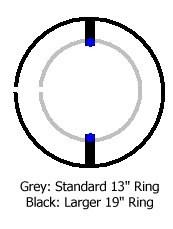
Blue dots are posts.
"X" number of pulling ounces on the pins of the 13-inch ring (however many it would be) will represent much less pressure in the holes than it would with a pull 3 inches further away. It might take a couple of years to do that, but it will still happen.
Joe, I re-edited my post about the percentage the variac should be with the elevator all the way down. Set it at spec. Anything less of a percentage specified in the book might cause the variac to fail if the elevator is raised to the extreme top position.
If the pay-out platter does not creep with the pay-out fully off and the elevator is pinned in the "threading hole" the variac setting is very close to being correct. The threading hole is about 1 inch below the "timing hole" on the platter mast.
If it does creep, then the variac is probably out of adjustment. (The percentage point the brush is higher than what it should be.)
You know maybe it's just to darn cold up here for the aluminum to stretch at all and is keeping the platters in like new shape.
Yes, I have phase controls. I have tweaked with the variac and it does help a little. I can get it so it is just fast enough to take up with the 13 inch ring, but then the platter wraps notoriously when threading, and likes to engage the wrap detector. I imagine if I had the 19 inch ring that this wouldn't be an issue.
As far as the 19 inch ring not helping take-up, I think I may have to disagree. I do not have a 19 inch ring to test, but I know that the platter does stop smoother with a bigger diameter wrap on the take up platter. I have had to stop movies for one reason or another after the trailers have ended and the feature was about to begin, and the slowdown and stop was noticeably smoother. Same goes with all of the movies we have with intermissions. The movie stops at the cue, and then sometimes, just for fun, I will motor down the leader a bit and stop it and it slows down fine. And again, everyone thinks I am turning on my motor for a second or two and then shutting it off. NOT TRUE! The motor gets up to full speed and the variac elevator settles near the bottom of it's travel on the platter column.
Flywheels will probably help. You can blame the former techs of Mann Theaters in Denver for removing the flywheels (these techs are now with Colorado Cinemas). I am amazed that they left the sound drum flywheel intact!
I know if you slow them down they tend to wrap when lacing.... but if that's the case don't pull the film off so fast. It's only going to take a few seconds more.
Kinoton platters, whilst very different from the one's being talked about here, have their initial speed set for slightly faster that that needed to feed film from a freshly pulled ring, about 10% faster is enough. Can your platters be slowed down in a similar manner. As the payout and takeup speeds are controlled by a single variac this should reduce the problem.
Does anyone know what the max rpm of these platters is, and what it needs to be to takeup/feed on a freshly pulled ring. As paul says its nothing to do with current etc its purely to do with the momentum of the platter and the fact that the control is calling for full speed when you initially start the projector. As the problem is not there if the platter has become stable, not calling for full speed, reducing the maximum speed will reduce the momentum....
As for using large rings..... they have been a real boon to me. They fit into the same locating holes as the normal rings and have a locking arm so the ring is solid with a print on it.
Spooling on a feature is quicker and allows us to spool on the print and drop ads etc in later. We run onto a large ring on a prints last show so there is less tension and speed when spooling off. All in all very good.... except the price!!
Unfortunately I don't have any experience with the SCDC platters so can't offer any help. I do have a bit of experience with the Alpha and AP platters though, so if I ever see an opportunity to help out Joe (one where people more qualified than me aren't offering their input) or another forumer with those platters I won't hesitate.
So if a theatre has purchased brand X then the people who work there and or service it must accept that and also take responsibility if they modify or operate it contrary to the terms of the warranties
Of course this is not the way the manufacturer designed it so I should just forget it, right Gord?
The 19" center ring info is on the manuals page under "Field Bulletins".
Joe:
I have seen instances where the EEPROM in the SCDC center feed has either had memory corrupted (which then would need to be either recalibrated according to the manual or reprogrammed to be a centerfeed unit by using the serial cable and a laptop) or the SCDC centerfeed circuit board itself may be defective.
I'll say it again... I have phase control platters. From what I hear of the SCDC's, I am glad I do not have them.
And don't worry Gordon, no modifications to the payout assembly or motors or anything like that are being made. These failed on their original design.
Thus, if you run a theatre you could call it "What Should We Do Tonight Solutions." Even better would be a detergent maker called "Cleaning Solutions."
But I am also fond of "Specific General, Inc." And "Clampco." (3 guesses on the origin of the latter.)