
can anyone help me out here.
I've installed a DTS6D onto a DA20 this morning, into a CP55. It all works fine BUT, there's always a but... how do you wire it in so that the audio will switch in this manner...
DTS has audio if valid time code....
Drops to SRD if no time code or reversion
Drops to SR if NO valid DTS or SRD.
Switches back as valid data is restored.
I've spoken to DTS here in the UK and we have not been able to find a solution. If I want DTS I have to turn off the DA20 to allow the auxillary audio input to pass thru to the CP55. There is nothing in the manual that explains the setup.
What's needed is a means of telling the DA20 to pass thru the DTS audio to the CP55 while DTS timecode is valid, irrespective of their being valid SRD. If not then pass SRD audio to CP55.
Regards Ken.
So how about an interface board that switches the audio output from the DA20 or DTS6D into the CP55, also to break the DA20 control line so that SRD cannot revert to SR if DTS is playing!!
This way the DA20 can 'think' what it likes... as long as there is valid DTS the interface relays remain on and audio from the DTS is passed into the CP55. Also while there is Valid DTS the DA20 control line is broken so it cannot switch formats UNLESS it is the active format at the time.
However, IF DTS does revert the interface relays will switch off, allowing SRD audio to pass thru into the CP55. At the same time the control line will be restored and SR reversion is once again possible.
When valid DTS is restored the interface will switch in passing DTS audio into the CP55, at the same time breaking the control line.
(Breaking & enabling the control line is very important as I don't want reversion to SR if SRD drops out whilst valid DTS is playing)
Hope this makes some sense to you all.
I could always do it the lazy way and just turn off the DA20 when we are running DTS, reversion to SR would be there as required. However I would lose SRD for the rest of the show which I'd rather not do. Also, its another thing for the duty projectionist to remember to setup....
I'd like to make it a matter of disk in,lace up and run.
I've seen this working on a CP500 but as the CP55 only has one 6 channel input it's not simple.
All comments welcome.
thanks for that, armed with your info I'll dig a little deeper into the DA20 manual and see what I can find. The DTS was never the problem... the DA20 pass thru is so it's finding how to switch the pass thru relay via the DTS.
It seemed such a simple idea at first but its starting to get more complicated......
I'll get back to you if I can't find what I'm looking for.
Reagrds Ken
My guess is that this will work for you but you will have to make some of your own cables...and link the D564's output to the board the D565 (CP-55 logic interface) via a pin-pin 25 pin Dsub cable.
Steve
------------------
"Old projectionists never die, they just changeover!"
I'd seen the diagram in the manual, but the DTS UK guy I was speaking to suggested there may be a problem with doing it that way.
I don't exactly know what the problem was, seems it can be troublsome at times? He's sent off for some more info so I hope to get some clarification on this.
The whole issue revolves around controling the DA20 pass thru connector. But all of the manuals I'm looking at are very unhelpful on this aspect.
I'll check out the conector you're talking about, got one anyway, and see what I can come up with.
Thanks for the suggestion.
Steve
------------------
"Old projectionists never die, they just changeover!"
I was only passing on what I'd been told and had not yet been able to confirm it. When I get in tomorrow I'll start to play and see what I can work out. Making leads etc is not a problem it's just time, isn't it always
If I have to I'll turn the DA20 off when running DTS and let it reverts to SR....but thats not an option long term as far as I'm concerned. When I make my mind up to do something I'll not rest until I've done it 
If you fancy hopping on a plane you'd be very welcome...
I'll be checking back on the postings to keep me right.
The system is installed and working, I make my own mounting brackets for the reader, and I ran 'Red Drangon' thru this morning and it was fine, there was no reversion to SR setup but it didn't drop out anyway. DTS time code is very robust and has a nice long allowence before it reverts, so it seldom does.
All I really have to finalise is the input or output switching, automation, which is not a problem and a quick b-chain on the DTS.
Oh and in between I'll be busy around the building doing the usual maintenace, ordering, dealing with staff issues and contractors. Tons of time to spare 
But I'm sure I'll be looking for more help if I run into problems
Regards Ken.
Karen at DTS
khultgren@dtsonline.com
I have settled on one of two ways to achive what I want... I can try to use/modify the interface card for the CP65 as Steve has suggested, but that won't allow for the DTS Sub to be controled by the DA20...
Or, and this seems to be the way I may have to go as it will switch all channels, is to make an interface that switches the output of the DTS and DA20 into the CP55, controled by the DTS itself.
It's not practical to start trying to modify the DA20 and I'd not be happy trying... one slip and no SRD and that would put a smile on at least one persons face that I know.
Whatever I end up doing will have to be external to the DA20 and the DTS6D. It will have to give full functionality and be reliable and require NO setting up apart from inserting the DTS disk. It should give two stage fallback and recovery!
I have no doubt I'll get it done, I'm just seeing if there are any easier ways... Turning off the DA20 should NOT be an option. Maybe DTS should consider this and come up with something that can be easily manufactured and be available to your customers. I can't for one moment believe this is an unreasonable or rare request.
Not knocking DTS at all... just so you know
Reagrds Ken.
When I say the D567 arbitrates the audio I mean just that...when the D567 board pulls in (via the +5 and /DTS lines on the automation cable) the DTS gets full access to the Digital input on the host processor (CP-55 in this case).
The above also solves the sub not being switched through (though I believe the SUB is switched on those DA-20s that have the Cat. 611A ...there is a 4th relay on it).
The other board, the D564, has the relay to block the DA-20 from selecting SR when it drops out. You will need to pick up the +5 and /DTS signals from it sinc it will be connected to the DTS-6D first.
So lets look at the various combinations of events...
The trailers pick up Dolby Digital and the DA-20 gets all excited and selects "AUX" on the CP-55...the D567 board is not on since the DTS is not playing so the DA-20's signal is passed through and the CP-55 plays the DA-20's audio...all's well.
Then the next advert is only analog...the DA-20 seltects SR...no problem there.
Then we get another Dolby Digital preview and "click" we are back on the DA-20 (see above for the logic and signal path).
Now the feature starts...it is in DTS...the discs start a whirring and the magic green "DIGITAL" LED comes on and "click" the D567 and D564 boards both activate...the DA-20's signal is replaced by the DTS signal and the DA-20 "sees" the "AUX" button get pressed again but since it is in digital..what does it care it still thinks it is running the show.
So now we are in DTS. But hey some dufus at the lab didn't catch that the lamp that exposes the DTS track was off and the track disappears so the DTS player reverts to SR by dropping out the two boards (D567 and D564) and "presses" the "SR" button but since the D564 dropped out the DA-20 sees that so it scratches it's microchips and presums operator error and reselects "AUX."
We are now in Dolby Digital. The next reel is fine so the DTS player reaquires it's time code and just like before...steals the Digital input away from Dolby.
Now we are in DTS...R-3 comes up and since someone made a horrible splice, the DA-20 wants to drop out...but the D564 board blocks the SR pulse from reaching the hapless CP-55 and the DTS plays on...
Dolby reaquires and selects Digital (where it already is) and none is the wiser.
What the above example demonstrates is that either digital or both may be running without interferring with the other. The priority is given to the DTS unit since it is last in the signal and logic paths...they made the interface boards, they should get some bonus points!
Steve
------------------
"Old projectionists never die, they just changeover!"
I'm going to spend time exploring your suggestion don't worry about that. Your explanation is exactly what I envisaged and should work! thats down to me to get it togeather... I really do appreciate your time.
It sure beats the 'turn off the DA20' advice given so far.... again not knocking anyone.
I'll keep you informed as to how I get on over the next few days.
Thanks again....
Back when the various studios had their preferred digital formats and roll around digital racks were more in vogue...I designed and built the Cardinal MDI-6555 digital interface for the both the CP-65 and CP-55. The board would attach to the backplane of either processor though it had to be "stuffed" for the specific processor.
The MDI-6555 would allow up to three 6-channel digital sources feed the single digital (or AUX) input.
The MDI-6555 also fixed the problem of the DTS player aquiring its digital, selecting digital and then having the automation take the sound out of digital when the douser opened at the start of a show. Likewise it nixed the problem of tail-outs by the automation selecting non-sync and having the DTS player "fault" to its back up optical format after the rating strip ran through.
Here is the prototype of the last incarnation of the board.
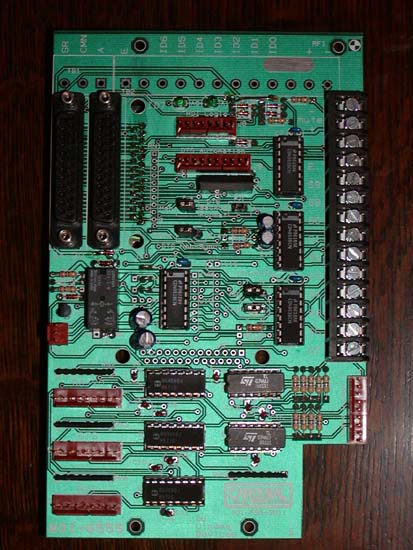
This one is "stuffed" for the CP-65 version.
It was nice for what it did...though most theatres don't fool with multiple digital players anymore.
Steve
------------------
"Old projectionists never die, they just changeover!"
I already had one of the cards you suggested and have ordered the other today, its only a few pounds so not an issue. Its a pity that your MDI-6555 card is not available as it sounds exactly what I need.
However, I still have one further option which would be to put the DTS 6D back into an SR only screen, where it was originally, and use a DTS 6 with the CP55. The advantage is that the DTS 6 is wired in between the DA20 and the CP55, unlike the DTS 6D which is wired into the DA20. When it has vaild DTS the DA20 is cut out and when there is no vaild DTS or the DTS 6 is turned off the DA20 is allowed to pass thru.
This method would be the easiest of all!! The only additional wiring would be to control the DA20 format switching thru a relay controlled by the DTS 6 so that the DA20 cannot force a reversion to SR while there is valid DTS. While the DTS is valid the DA20 can do what it likes, it may think it is reverting but in reality the formats won't have changed at all. If DTS does revert the control line would be restored along with the format switching for the DA20.
Clearly the DTS 6 was designed with multiple digital formats installed, as you say there is a tendancy not to install multiple digital formats today, which is maybe why the DTS 6D had this design change. Also more modern processors can cope with more than one 6 channel input. It could also be a cost issue as I'm sure it must be cheaper without the additional switching required.
Either way the DTS 6 seems the more attractive, easier solution..... unless anyone knows differently?
Choices, choices.... what am I to do
is that any better
just to let you know how things are going...
I've used the relay card from DTS, thanks for the suggestion Steve, as a switching interface between the DTS 6D and the DA20. 5v switching is supplied by the DTS 6D so when there is valid DTS the interface switches out the DA20 and the DTS 6D into the CP55.
Brad, I've also passed the sub signal thru the switching so all channels are switched as required.
Basically it works like this....
If there is no valid DTS then the interface remains off and the DA20 is passed to the CP55. Valid DTS and the interface is switched on and the DTS is passed thru to the CP55.
Two other things had to be considered. Firstly, as SRD is in fact running in the background it could revert to SR, thus switching out the DTS. So an interface relay has to be included that switches out the DA20 format selection to the CP55 while DTS is playing so reversion of the DA20 in the backgound simply does not happen.
Also 'IF' the DA20 has reverted to SR, and the DTS itself then reverted the current format would still be format 10 (Digital) on the CP55 so NO SOUND! Therefore the DTS6D must revert to format 10 (DIGITAL) NOT as you would expect SR. As format 10 is selected it will automatically revert to SR if required or stay in SRD if all is well.
As we are still 'On Screen' with the shutter open when valid DTS returns the interface will switch back in and a format 10 selection is made.
Finally, I personally don't like the way DTS switch to Non-Sync at the end of the show and GRAB sound when there is valid DTS. So I always install an inteface with the projector shutter so that the DTS can only select formats 'IF' the projector shutter is open, ie 'On Screen'.
It all runs like this....
Show running with NO DTS, automation pulses Format 10 (Digital) SRD plays or reverts to SR as required.
Valid DTS starts and interface switches out DA20 and DTS In and format 10 (Digital) is selected, DA20 format selection is disabled by interface.
(DA20 is happily running to itself in the background, and may revert but does not actually do anything)
DTS reverts due to damage.... Interface switches off and passes DA20 to processor, at the same time the DA20 format selection is enabled again and format 10 (Digital) is pulsed just in case SRD has reverted, if so DA20 will then revert to SR.
Valid DTS is restored and the interface switches DA20 out and DTS in, also format 10 (Digital) is again selected.
At the end of the show the automation will fade sound out, select Non-sync, and fade sound back in. DTS format selection is disabled as the projector shutter closes so the DTS cannot make any further format selections.
I've had it all running today and whilst very untidy it all worked a dream..... it needs more testing and lots of simulated reversions just to be sure, but so far so good.
Finally I'll make sure it all tidy and mounted in a metal box for additional screening.
Thanks for everyones suggestions.
Regards Ken
Had it all running perfectly this morning. Did dozens of single and double reversions and it worked a treat.
One thing I did forget was that the automation pulse from the DTS 6D should always pulse format 10 (Digital) so a link between SR AND DTS on the back of the DTS 6D needs to be made.
This way when there is valid DTS it pulses format 10 and when it reverts it pulses format 10, as the interface relays drop out and pass the DA20 into the CP55.
Reversions from DTS to SRD are instant, as are reversions from SRD to SR. It is noticable when a double reversion is done, DTS to SR, however as this is only ever going to happen if a print is very badly damaged so its not a problem.
Hope this is of interest to you all.
Regards Ken.
quote:
It is noticable when a double reversion is done, DTS to SR, however as this is only ever going to happen if a print is very badly damaged so its not a problem.
...or if a film has a DTS soundtrack but no SR-D. Universal released a fair few of these in the mid-late 90s (Jurassic Park 2 and the restored Vertigo spring to mind) and I'd get the odd French or Bollywood film which was DTS only, but I'm sure there aren't enough of them for this to be a major issue.
Very funny comeback Ken, I laughed myself off my chair when I read that. I like a person with a sense of humour. BTW didn't you play Jodie Foster's dad in Contact?
The logic switching involved here could be very easily (and efficiently) done using a cheap little microprocessor. Maybe it's worth us making a little outrigger box for this function. But are there enough people out there running both a DTS and a DA20 to make it worth the effort?
Also Steve, I must say your "example" post was very well written. Well done!
------------------
Ray Derrick
President/Chief Engineer
Panalogic Corporation Sydney, Australia
Phone: 61 (0)2 9894 6655 Fax: 61 (0)2 9894 6935
I've finished the interface box with everything inside. It's not the tidiest of things but its very solid. I'll mount it inside the rack in the morning and give it a final test.... then its a permanent fixture.
Now for my next project.....
I'll say it one more time ... and I hope we can put it to rest now
As for looking like Jodie Fosters father in Contact, well I may have looked like him at one time but nature has taken her toll, my gut is getting bigger and everythings heading south!! And I've a lot less hair now. Hope Brad won't have me up for misrepresentation with my pic being out of date!! I'm still quite cuddly and hugable 
And back to topic...
one of the reasons for not using a ready made logic card from DTS was that I don't like DTS 'Grabbing' the sound when time code starts and switching to Non-Sync when the film finishes. I much prefere to leave the format selection to the automation which does a great job.... we have CE's TA10. The other thing is our processors, CP55 & CP45's, all have fade out & fade in and I found that allowing the DTS to do it's own thing often switched format during the fades. That's why I have the interface with the projector shutter so that the DTS cannot do anything if the shutter is closed. It's very much a personal thing but it's worked fine here for a long time.
The modification for 'Fade In' is unusual and I belive mine are the only one's to have such a mod done to them. In a multi screen situation with films often starting at the same time it allows fully automated presentation that is consistent from one show to the next, something I value more than 'Ultimate' presentation that cannot be guaranteed. We don't have auto len's changing but it does let us leave a show to run if we have to. One of our screens has a clock start as well so it helps there to have full Fade in & Out.
As it stands I can be sure that my shows run exactly the same way with no individual personality f***ing things up behind my back.
This was the reason for trying to get the DTS & DA20 working togeather so that rather than turning the DA20 off when running DTS, and forgetting to turn it back on, I can be sure we run everything in the appropriate format.
However, if you do come up with something that'll do everything I want then let me know
I'm always happy to get my hand's on new gadgets...
Speaking of photos I was thinking of sending Brad a photo of myself from 20 years ago when I was the spitting image of George Clooney (I wish). I get pretty sick of seeing that ugly old guy (whoever he is) over there on the left.
 !
!it's not just the non-sync that needs to be disbaled... ALL format selection has to be disabled so you don't get the DTS grabbing sound as and when it likes. Also as the tail runs out you can get switching from non-sync back to DTS or SR...
As I'd posted before we have full automated fade in and out and the DTS tends to switch formats during the fades etc... It much easier not to let DTS control formats except for reversion.
As for non-sysnc I don't use that switching option at all...
As with most things this is the way I prefer to work and it runs very smoothly and consistently. It provides me with a high level of presentation that I can guarantee each and every show..... that's the strengh and weakness of automation. It can be consistently good or consistently bad depending on who makes up the print. I've done my best to remove individual preference from the show so that everything runs the same way every time irrespective of who made up and who is running the show.
I have a logic board for use with the CP45 and ended up not using it because it didn't perform in the way I wanted. No fault of DTS just that they designed the system to work in a different way that does not suit our configuration. Maybe with different automation and a newer processor it would all come together.
The bottom line is that it works and does exactly what I wanted... so a big smile at this end
By the way... what's a DFP-D3000.... is it a Sony processor?
------------------
Ray Derrick
President/Chief Engineer
Panalogic Corporation Sydney, Australia
Phone: 61 (0)2 9894 6655 Fax: 61 (0)2 9894 6935
------------------
John P. Pytlak, Senior Technical Specialist
Worldwide Technical Services, Entertainment Imaging
Research Labs, Building 69, Room 7525A
Rochester, New York, 14650-1922 USA
Tel: +1 585 477 5325 Cell: +1 585 781 4036 Fax: +1 585 722 7243
e-mail: john.pytlak@kodak.com
Web site: http://www.kodak.com/go/motion
------------------
Ray Derrick
President/Chief Engineer
Panalogic Corporation Sydney, Australia
Phone: 61 (0)2 9894 6655 Fax: 61 (0)2 9894 6935
It has been 1960 days since the last post.