
Josh
I seriously doubt if they could be obtained from anywhere other than Dolby Labs. Josh, if they are solder-in chips, better make sure you have the right equipment to do the job if you are fortunate enough to "land" some. It might be cheaper to upgrade to state-of-the-art cards, and find a buyer for the old cards you have. I suggest you find out what your cards are worth on the fair market and act accordingly. I never looked inside the cards, so I really don't know what is in them. I don't have the equipment or facilities to work on them anyway.
With the new and improved version of the chips, (if there are any) beware of other circuit changes that might have been necessary to make them work.
Remember....Screwdriver getwitzen and gerfingerpolkin make for sparkin und spitzen...
I swiped the idea out of the PRO-35 manual. 
Frank
quote:
"Dolby is using consumer NR chips? In what? Not in its Cinema Processors, one would hope?!"
Frank, I am with you on this one.
Apparently, he is not happy with the sound of them. If the modules sound like companders, maybe there is another problem with the CP-55 or he has some really old modules. What do you think?
Maybe he wants them to build something himself. In that case, Gordon is on target.
JJ
In contrast, the Cat280, Cat300 and Cat350 cards all use a near identical circuit that uses discrete ciruitry and which is "real" SR.
IMHO the Dolby SR process is one of Ray Dolby's finest achievements. The Cat280 is a masterpiece of design. It is a real shame that the 222SR card was ever allowed to see the light of day.
------------------
Ray Derrick
President/Chief Engineer
Panalogic Corporation Sydney, Australia
Phone: 61 (0)2 9894 6655 Fax: 61 (0)2 9894 6935
I had no idea Dolby used the "S" chips.
Personally, I always thought the Eprad StarBelch sounded better than the CP-55. Maybe I have been around turbine engines too long and it ruined my ears. 
Is the "A" part of the 222SR/A legitimate?
------------------
Ray Derrick
President/Chief Engineer
Panalogic Corporation Sydney, Australia
Phone: 61 (0)2 9894 6655 Fax: 61 (0)2 9894 6935
But as a result of all the work we had to do in building a case to defend our position, I came up with a much better way to achieve the same decoding algorithm as a Cat280 using a somewhat different technique. The result is the CM353 card which is used in Panastereo processors and is now also available in a separate adapter for upgrading older processors that do not have SR.
Now I have a policy of not plugging my own products on this Forum, as I don't believe it is an appropriate place to do commercials - and I just blew it! Sorry folks, it won't happen again. Gordy it's all your fault, you must learn to be more accurate!
------------------
Ray Derrick
President/Chief Engineer
Panalogic Corporation Sydney, Australia
Phone: 61 (0)2 9894 6655 Fax: 61 (0)2 9894 6935
The SMART CopyCat 280 card has never been the subject of a court case and has never been challenged by Dolby. We have never claimed that it is a true SR card. Our claim is that it is a SR Emulation card. By that, we mean that it closely mimics the action of a true SR card for MOST situations, but not all.
We did an AB test one time at ShoWest where we took a soundtrack of a movie from a laserdisk, ran it through a Dolby SR encoder, Model 363 with Cat 300 SR cards, and then decoded the encoded signals with the real Dolby CAT 280 cards and the SMART CopyCat cards. The decoded outputs of each set of cards as well as the original unencoded source material directly from the laserdisk player could be selected with a switch and fed to headphones. Probably about 100 people listened and switched back and forth. Only about 5 out of the 100 could consistently tell which was which, and then only in certain parts of the movie where the decoding of the CopyCat cards did not track properly. I do not claim ANY scientific validity for the test, but its results were such that I believe our SR emulation circuit is definitely good enough for most people.
Our circuitry is extremely simple, and as such, it will not decode every soundtrack situation properly. However, the worst thing I hear is at times, there will be a slightly higher amount of high frequency material due to the bandsplitting arrangement we use where mid-band material will open up the signal path for the higher frequencies also. Sometimes this manifests itself as a slightly higher level of hiss. The other thing I sometimes hear is a low frequency level alteration due to the way the very low frequencies are handled. However this is manifest as a slight raising of very low frequencies at lower levels which is somewhat like a loudness effect on a home stereo, so it does not really sound bad.
Now for the purists out there, I am sure you want nothing but the true SR noise reduction, and I have no argument with you. And you can get that with the Cat 280 cards, the Cat 300 cards, etc. Or you can use the new patented Panastereo CM353 SR cards and also get the real thing. The CM353 is a real work of art. We at SMART and, I am certain, Ray Derrick, the designer, will put it up against any thing out there.
As for the name "CopyCat", I always thought that was rather cute. I did not come up with it, my boss did.
The Cat222SR/A with it's SR shorcuts was obviously developed by Dolby so they could fit SR into a CP65 chassis. There is no way in a month of Sundays they could have squeezed the circuitry on even one, let alone two Cat280s onto just one little piggy back pcb for the Cat222. I would say they had no choice.
We only received notification that our patent had been granted a few weeks ago so we are still waiting for the formal documentation to arrive from the US patent office. I will send you an e-mail when we get the number. We do have the App. number but that is of no use to you.
BTW sorry that I misunderstood your non-compliment remark.
------------------
Ray Derrick
President/Chief Engineer
Panalogic Corporation Sydney, Australia
Phone: 61 (0)2 9894 6655 Fax: 61 (0)2 9894 6935
------------------
Ray Derrick
President/Chief Engineer
Panalogic Corporation Sydney, Australia
Phone: 61 (0)2 9894 6655 Fax: 61 (0)2 9894 6935
Thanks for the information; actually I asked because I wanted to get some feedback from the knowledgeable folks here -- I have a pair for our CP50 and my experience has been that they sound just fine. My room is very large -- 2500 seats -- so it is very difficulty to hear minute differences in things like hiss or low-end emphasis. All I know is they sound silky smooth and very natural. Plus, I have no Dolby cards to do any kind of precise A/B tests. To my ears, and happily to my audience, our theatre sound is very impressive. Besides, even if we had the Cat 280 cards, audio band compression and expansion tracking are not easily tested with common test equipment.
Actually if you consider the minimal amount of anomalies that the CopyCat might produce, and the very limited conditions of audio content when it would even become audible (I've never heard any), the price differential is like manna from heaven -- enough to make many an art house or non-profit which ALWAYS must live right on the edge of the ledger line between the black and the red. The CopyCat is very attractive.
I don't know where I heard that rumor about a patent court case between Dolby and Smart -- probably just more of my brain cells dying.
Frank
Thanks very much for the compliments on the sound of the CopyCat cards.
Actually, you heard correctly that there was a patent infringement case between SMART and Dolby, but it was NOT the CopyCat card that was involved. It was the CM333 SR card in the Panastereo processor. In a previous post in this thread, Ray Derrick, the Panastereo designer said this:
"We came up with a process that decodes SR very precisely without infringing Dolby's patents (which are almost extinct anyway). Our process now carries a US patent of it's own because it uses some original concepts. Mind you Dolby did try to sue our USA based sister company over our first attempt at SR which admittedly came awful close to infringement (not deliberately I might add), but fortunately for all concerned that was sorted out before it got to court."
As a result, the Panastereo SR card was re-designed and is now the CM353 which, as Ray says, is now patented in its own right, does not in any way infringe Dolby's patents, and it absolutely decodes SR soundtracks properly. And as Gordon says,"Your new card is far cleaner sounding."
Perhaps the confusion may have come about because of the two different company names. SMART owns Panastereo, and even though the law suit in question was over the Panastereo card, SMART was the corporate entity that Dolby sued.
I hope this clears this up a bit.
Some of the emulators are horrible all the time, some mistrack when certain signals are present. The only SR cards that sound right to me, thus far, are Dolby Cat. 280, 300 and 350.
Now in this age of digital correctness...the analog track is often thought of as the backup...and if money is tight, why blow a hefty hunk on genuine SR back up...they are $900US per channel (list).
As far as someone's being "better" than Dolby's, don't be silly, the films are encoded using Dolby's...it is a complimentary process...unless you decode it exactly as it is encoded, you are just approximating it. When the films are mixed, they are not monitored for quality on other SR decoders...just Dolby's.
This should NOT be construed to say that Dolby has the only or even the best way of achieving a high-quality of noise reduction. If say the Pana CM-353 was used on the encode, I'd suspect it would perform the best on the decode...it might, in the overall scheme of things, perform better as well. To the best of my knowledge, I have not heard a film that was encoded with the CM-353.
Steve
------------------
"Old projectionists never die, they just changeover!"
I have edited some of the original contents of this post as I think I may have misinterpreted Steve's comments. I would like to add that it is possible to reproduce to absolute precision the algorithm of any analog circuit with a quite different analog circuit, or for that matter in the digital domain. I have not had the opportunity to test the digital SR decoding in the CP650 but it is technically possible that they have reproduced the algorithm used in the Cat280 family with great precision. It would take a lot of processing power as the algorithm is complex but it could be done.
------------------
Ray Derrick
President/Chief Engineer
Panalogic Corporation Sydney, Australia
Phone: 61 (0)2 9894 6655 Fax: 61 (0)2 9894 6935
Nope, I haven't e-mail you regarding my SR evaluations...been a bit busy and I haven't done enough listening to the CM353 to carry on that sort of conversation....as you know, when I get going it can get quite lengthy.
Now as to having made up my mind...what a load of crap! If anything, I would have come into listening to the CP-650 (or any digitally based emulator) predisposed to dislike it. In fact, I have found the CP-650 to be surprisingly faithful though not perfect.
But true to my statement in a previous message, the only SR decoding that I have not found fault with has been genuine Dolby 280, 300, and 350s. Some emulators I have spent more time with than others. I've been pretty vocal about one (made by Dolby even) that I simply can't stand.
As to the CM-353 I haven't done as rigerous a test as with other units. It has been more casual. On one title, nothing jumped out at me as being wrong. On a couple of others...something seemed off in the HF department. I tend to key off on the HF much more so than a LF mistrack. This is even true of speaker systems and even digital systems. There is one combination of digital types and speaker brands (and in particular a HF compression driver) I simply can't sit through the movie I find them so horrible and yet others will consider them the most natural sounding.
Believe me, when I have something more concrete you will get it.
As to other people's opinions of how well your product (or others) perform, they are entitled to them as am I to mine. In fact, everyone IS entitled to MY opinion 
I have supported your product, and will continue to do so. In many respects, it is the best out there. Do I think it is perfect for me? Nope. I didn't design it and you and I do things differently.
You can believe I am predisposed to prefer Dolby or any other brand of any other product and you'd be wrong. I judge things as I see/hear them. Do I have some "brand loyalty?" You bet! If one gets good service and support out of a company, it goes a long way to satisfaction. But that NEVER clouds how I evaluate a product and I don't like it being even inferred. If I like something, I like it...it is that simple.
Steve
------------------
"Old projectionists never die, they just changeover!"
As far as someone's being "better" than Dolby's, don't be silly, the films are encoded using Dolby's...it is a complimentary process...unless you decode it exactly as it is encoded, you are just approximating it. When the films are mixed, they are not monitored for quality on other SR decoders...just Dolby's.
That is a very good point, but... Dolby themselves are offering several different solutions for decoding SR (as widely discussed here recently) - "classic" analogue, S-chips based, digitally emulated as in the CP650. They see the CP650 as superior to earlier products, don`t they?
So, theoretically, can an alternative manufacturer not claim the same for his products? Or that the other components of his unit were of superior quality, resulting in overall better sound?
I really mean, theoretically. I am NOT referring to any particular manufacturer here, neither Sony which I like (obviously I am the only one on this forum), nor Panastereo which I never heard, or any other.
But I think it is good to have people like Ray who issue fresh challenges and keep the competition alive.
Michael
I have no qualms with saying that the Panastereo CSP-1200 is the best analog processor on the market. Furthermore, anyone that liked the CP-65 will think it is the best processor yet. It is VERY flexible and sounds good. It is the closest thing to cinema "high-end".
As for the dreaded Cat 222SR/A....I agree that it legitimized the other psudo-SR cards out there. The only "reason" I can imagine for it was cost. That is, to lower the cost of the Dolby processor to make it more competitive.
Steve
------------------
"Old projectionists never die, they just changeover!"
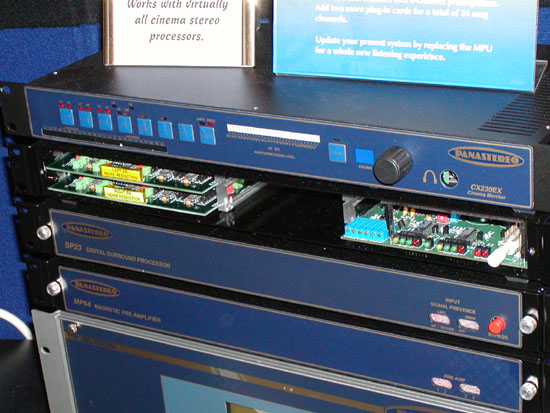
The unit with the front panel off is Panastereo's outboard SR offering. On the left are two CM-353 SR cards. On the right is the controller card complete with trims to calibrate it's input and output to your processor.
Also pictured are the other fine 1-U gizmos by Pana. The SP-23 surround SX decoder (aka EX) which can have up to three 1/3-octave EQs in it and the new mag preamp unit which can accept Pana's 6-channel mag preamp cards (4 cards for 2-projector 35/70 and dubber)
The rear of the SR unit is pictured below...kinda reminds one of the SRA-5 of yesteryear but it costs a whole lot less and is more flexible.

That is about all of the ShowEast pictures I have.
Steve
------------------
"Old projectionists never die, they just changeover!"
Studio installations are a little bit different in Europe.
Over here it is common practice to use a cinema processors in the monitor chain.
Up to now it is a CP 65 S with the Cat 448 dubbing card to provide the routing.
With the introduction of the new Dolby Digital encoder unit with digital in- and outputs the CP 650 with the Cat 778 digital input interface board is certified by Dolby. This allows the studios to stay in the digital domain.
The new DMU encoder also includes a software implementation of the 4-2-4 matrix encoder and SR to encode the print master. I guess they use for SR the same implementation as used in the CP 650.
So Dolby seems to be pretty sure that the digital SR is legitimate.