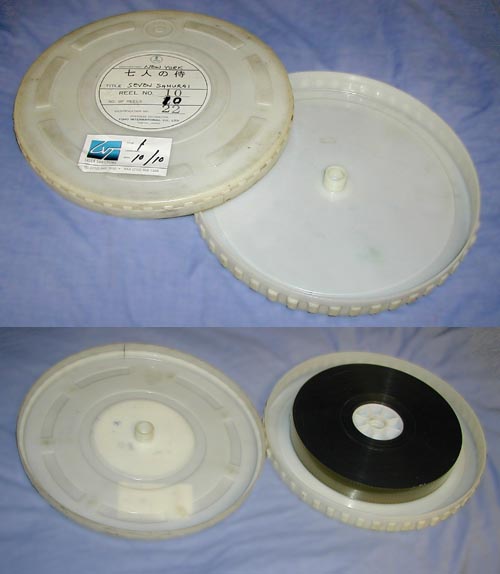
This is topic Cans with shafts to hold the cores steady in forum Film Handlers' Forum at Film-Tech Forum ARCHIVE.
To visit this topic, use this URL:
https://ft-forum.com/ft/cgi-bin/ubb/ultimatebb.cgi?ubb=get_topic;f=1;t=004116
Posted by Michael Brown (Member # 890) on 10-18-2002, 09:49 AM:
O.K I just had a print of the Japanese film Ringu.On cores in cans (since I'm in Europe it's usual)
But the cans had a nice treat I've never seen before. In the center in both the bottom and the lid were shafts that actually fit through the center of the core (I should really start referring to these as bobbins since I am in the UK :rolleyes  .
.
I think its a good idea> its stops the films sliding around inside the can. Any thoughts?
Posted by Leo Enticknap (Member # 534) on 10-18-2002, 10:05 AM:
Do you mean the quite thick orange ones that have weird flanges on the side which can make the cans a tad difficult to open?If so the French national film archive, the Cinémathèque Française, has been using them to ship their viewing copies for years. I agree - the centre spindle is an excellent idea for keeping the reel in place. I'd love to know where you can get them. These are the cans we usually get at present: vented for prevention of VS but they don't have any centre spindle.
It's a pity that France's own commercial distributors can't follow their archive's lead: they still seem to re-use the thin sheet-metal aluminium cans in which raw stock is supplied to the lab. Needless to say, these get eaten alive in most shipping boxes, especially the 'green goddess' ones in which the slot was about half an inch shorter than the diameter of a 2,000 foot can, thus crushing the side of one when inserted using brute force.
Posted by David Rigby (Member # 1301) on 10-18-2002, 10:26 AM:
On a related subject I protoptyped a few stacking boards for 6000' cores that use a "bobbin" in the midle to locate the core. These ths make storing and moving film on 6000' cores without cans very easy....just need to find a way of making the things easily (and out of plastic...)David
Posted by Frank Angel (Member # 248) on 10-18-2002, 11:22 AM:
I've seen those plastic containers with the raised center "spindle" a number of times with foreign films, other than from France. Problem is, there was never any indication on the can who manufactured it. It is a great advantage having that spindle to keep the film spool from smacking around in the container. Perhaps we can keep an eye out next time we see these and contact the distrib to see where they get them.
Frank
Posted by Paul Mayer (Member # 355) on 10-18-2002, 12:05 PM:
Those resin cans are quite common in Japan, as is shipping them in what looks like a duffel bag. Don't remember seeing a manufacturer name on them though. Maybe jointly developed by Toho and Toei pictures? Funny, those cans remind me of the tortilla warmers one sees in Mexican restaurants here...Ja ne,
Paul
Posted by John Pytlak (Member # 331) on 10-18-2002, 01:07 PM:
Leo wrote: "...they still seem to re-use the thin sheet-metal aluminium cans in which raw stock is supplied to the lab. Needless to say, these get eaten alive in most shipping boxes..." 
The gray or gold coated STEEL cans Kodak uses for raw stock are quite sturdy and durable, and are reused for processed film by most customers. Kodak packages large rolls of print film raw stock in thick vacuum-seal bags, that maintain excellent roll integrity and protection.
------------------
John P. Pytlak, Senior Technical Specialist
Worldwide Technical Services, Entertainment Imaging
Research Labs, Building 69, Room 7525A
Rochester, New York, 14650-1922 USA
Tel: +1 585 477 5325 Cell: +1 585 781 4036 Fax: +1 585 722 7243
e-mail: john.pytlak@kodak.com
Web site: http://www.kodak.com/go/motion
Posted by Leo Enticknap (Member # 534) on 10-18-2002, 03:29 PM:
No offence intended, but my experience was that if you put five or six of them in a pile and then put the pile in a box which doesn't offer much in the way of structural protection, then they're not as durable as the thick polypropylene ones. And that goes for cans supplied by Kodak, Agfa, Fuji, OrWo or whoever. In particular they tend to get buckled and dented very easily, making them difficult to open.The polypropylene ones do eventually shatter altogether, granted, but over the life of an average release print I always had less of a problem with them.
Posted by Pete Naples (Member # 761) on 10-18-2002, 04:16 PM:
I've seen quite a few similar cans during various festivals, mostly hailing from continental Europe. Always thought it was a good idea, but you can be assured it'll be uneconomical for distributors to use. Protect the film in transit??!!
Posted by Steve Kraus (Member # 476) on 10-18-2002, 04:51 PM:
There are or were two different kinds of stock cans. The gray or gold Kodak can is indeed very sturdy. The kind which is described as flimsy is shiny and silvery in color and made of very thin metal. Perhaps these are from other manufacturers?The central hub does sound like a great idea.
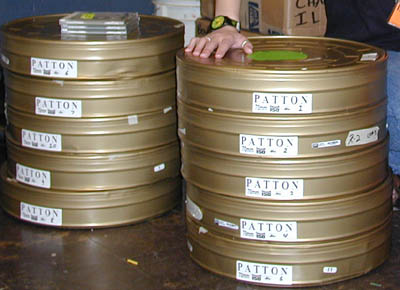
Of course best of all are the 70mm tins. Not because they are constructed differently but because of what awaits inside. 
Posted by Jon Miller (Member # 163) on 10-18-2002, 10:43 PM:
I've seen quite a number of prints from Mexico produced under the auspices of IMCINE (Mexican Institute of Cinema, a government-operated cultural development organization) arrive in blue plastic cans with a molded-in center post to hold the core. The cans appared fairly robust, although they can crack from the punishment of shipping under the right circumstances.The center post is a great idea, as long as the end of the film is securely taped down.
Posted by Leo Enticknap (Member # 534) on 10-19-2002, 06:15 AM:
I've never seen a 70mm tin! All the 70mm prints I've ever handled came in sodding great transit cases - one per reel - with the reel itself mounted on a running spool. Most of the running spools were badly thrown together with lethally sharp edges, and I'd always run the prints from a set of house spools.Showing 70mm this way was a great personal fitness regime!
An afterthought on the above: steel or aluminium containers are obviously no problem for pre-print material, because it is never likely to be transported long distances and the element will spend 99% of its lifetime sitting on a shelf. But if an element (i.e. most release prints of mainstream titles) is going to be regularly subjected to Securicor abuse over a relatively short working life, then IMHO inert, reinforced polypropylene is the way to go.
For proof of this, look at the top left container in Steve's picture. Immediately below the bottom right corner of the three DTS disc cases you'll see a dent in the side of the can. After a few crossovers the metal 2,000 foot 35mm cans would be so deformed by dents like these that they'd be completely unusable - you certainly wouldn't have a hope in hell of forming an airtight seal.
Posted by Steve Kraus (Member # 476) on 10-19-2002, 11:20 AM:
Of course the labels on the tins are ones I made. You can barely make out 70mm; between that and the reel number are D150 and DTS logos. I presume that print was eventually put in reels and cases. In the meantime I found some bubble wrap and put several wads in each can to protect the rolls when I returned the print. The only handling problem (with a very gentle Kinotone platter*) was that many of the cores had distorted inner diameters and would not fit the flange hub of the MUT but the core adaptor comes off and building up the shaft with a couple of narrow strips of gaffer tape enabled smooth handling. I would have replaced the cores if I'd had a supply (even 35mm doubled up) but I did not. Not sure why the core middles were damaged but it didn't seem like it was from rough shipping.
(This was at Ebertfest last April and a search will no doubt turn up discussion of the print and DTS etc.)
* Plattering just the 70mm & a silent, otherwise C/O with two Norelco AA-II's.
BTW, back to the topic, I found one of the shiny silvery thin metal cans and it was indeed from Kodak but it's probably 10+ years old. Not too often nowadays that something gets thicker, heavier, and generally better. Thank you, Kodak.
Posted by John Pytlak (Member # 331) on 10-19-2002, 01:17 PM:
Steve Kraus wrote: "BTW, back to the topic, I found one of the shiny silvery thin metal cans and it was indeed from Kodak but it's probably 10+ years old. Not too often nowadays that something gets thicker, heavier, and generally better. Thank you, Kodak."You're welcome! The change was made quite a few years ago, when it was recognized that if a can rusted, it could contribute to vinegar syndrome. The new cans are stronger, and coated with an inert rust-proof coating. The gold ones are specific to the Kodak VISION line of film products.
For raw stock, metal is preferred to plastic, for its superior properties as a moisture and vapor barrier, especially with cold storage.
------------------
John P. Pytlak, Senior Technical Specialist
Worldwide Technical Services, Entertainment Imaging
Research Labs, Building 69, Room 7525A
Rochester, New York, 14650-1922 USA
Tel: +1 585 477 5325 Cell: +1 585 781 4036 Fax: +1 585 722 7243
e-mail: john.pytlak@kodak.com
Web site: http://www.kodak.com/go/motion
Posted by John Hawkinson (Member # 1135) on 10-19-2002, 02:56 PM:
Can someone supply an image of one of these cans-with-shafts?
Thanks.--jhawk
Posted by Michael Brown (Member # 890) on 10-22-2002, 05:32 PM:
The cans had 'IMAGICA' embossed on them. Don't know if that is the manufacturer or just the lab.
Posted by Paul Mayer (Member # 355) on 10-22-2002, 08:32 PM:
Now we know where those cans came from! Imagica is one of the major motion picture labs in Japan. The company's profile (in English): here Don't know why they list their establishment date as 1 Apr 02--I've seen their credits on films dating back to at least the mid-'80's.
Ja ne,
Paul
Posted by Helmut E. Dorausch (Member # 1356) on 10-23-2002, 12:58 PM:
Transfilm Inc. currently offers 35mm "shipping cans" in 1000 ft. and 2000 ft. We refer to them as shipping cans, because of a considerable amount of material that has been added to provide added strength, and eliminate the warpage.
Both versions include the center core locator. They can be personalized with your company logo, and are textured on the outside for placement of removable labels. (There are areas on the top, and side that are polished, to accomodate permanent labels)
Feel free to contact me if you require additional info.
PEACE
Helmut E. Dorausch
Transfilm Inc.
Manager of National Operations
E-mail @: helmutdorausch@filmtreat.com
Posted by Brad Miller (Member # 2) on 10-23-2002, 03:25 PM:
Hi Helmut,I just realized I was going to get you some pictures of reels on some platter MUTs for you. Did you ever get out to see a Christie MUT?
Posted by Steve Kraus (Member # 476) on 10-30-2002, 09:11 PM:
Jhawk asked:
>Can someone supply an image of one of these cans-with-shafts?