This is topic 3-phase demand question in forum Film Handlers' Forum at Film-Tech Forum ARCHIVE.
To visit this topic, use this URL:
https://ft-forum.com/ft/cgi-bin/ubb/ultimatebb.cgi?ubb=get_topic;f=1;t=004118
Posted by Jack Ondracek (Member # 1466) on 10-18-2002, 03:03 PM:
In another discussion, we're trying to establish which is the best way to go:Some of our accounts have 3-phase services, which include a peak demand surcharge on top of the charge for actual kilowatt-hour consumption.
I've also seen a sites with both single and 3-phase installations. the 3-phase services supply (and meter) only that equipment which runs on 3-phase power. All other equipment and lighting is routed to single-phase panels.
Given that some equipment can be purchased either single or 3-phase nowadays, The question is (site capacitity notwithstanding) whether a given amount of "work", horsepower or whatever, would be best run on single-phase lines up to a certain point, before acceding to 3-phase operation and its accompanying demand surcharges. Given a choice, is it economically equivalent to run area lights on 3-phase circuits if single phase panels area available?
Would a new installation be smart to have both kinds of services installed, if 3-phase was also needed?
Jack
Posted by Paul G. Thompson (Member # 655) on 10-18-2002, 04:35 PM:
Three Phase is the way to go in a commercial enviroment. If you elect single phase, you will regret it.In a residential envirmonet, as far as I know Three Phase is not available. It is not needed. Homes don't have heavy-draw HVAC's, Xenon power supplies in access of 3000 watts, 3 phase blower motors, 3 phase popcorn machines, 3 phase Icee Machines, - you name it.
Call for 3 phase....  You will never regret it. Not only that, but all your 120 volt single phase stuff can be balanced on the load much easier. Remember, 208 volt open delta 3 phase is measured from leg to leg. Each leg to neutral is still 120 volts. there is a 120 degree rotation of 3 phase power, and that is why 208 is measured across each leg.
There are some other 3 phase configurations, but most of them are obsolete. One of them is closed delta. It has a wild leg with is useless for 120 volt devices. Puget Power is not installing those systems anymore. All new construction is 3 phase open delta.
Posted by Jack Ondracek (Member # 1466) on 10-18-2002, 05:46 PM:
Thanks for the rundown on that wild leg, Paul. I have that here, & it ties up a bunch of real estate in my breaker panels.I don't argue that anyone should lean toward single phase... just whether it would be economically positive to also HAVE a single phase service for those items that aren't 3, thereby bypassing the demand surcharge.
Posted by Paul G. Thompson (Member # 655) on 10-18-2002, 07:24 PM:
Jack, maybe I mis-read your question. I think that the extra cost of bringing single phase into the building in addition to the 3 phase would be substancial. If you think it is cost effective because of a surcharge, maybe it would be a good idea. I was not aware of a demand surcharge in our area. As an example, Southsound Cinemas is strictly 3 phase, with no single phase power coming into the building. Another example, Old Cinema 5 in Mount Vernon (Now defunct and dead) was strictly three phase, with no single phase entering the building.
By the way, welcome aboard! Good to have you with us.
Posted by Steve Kraus (Member # 476) on 10-18-2002, 08:12 PM:
I'm on a demand meter (I think most commercial service is) but I don't pay a demand charge as I squeak by under the threshold for energy usage (kWh) and peak demand (kW) that I don't have to pay it. Instead I get hit with an additional several cents a kWh as a separate line item on the bill called "in lieu of demand".My service is 3-phase.
Posted by John Hawkinson (Member # 1135) on 10-18-2002, 08:20 PM:
I believe Jack's question basically boils down to, "Are 3-phase devices more efficient than single-phase devices, and if so how much?"And the answer of course is, "it depends" (also known as "I don't personally know enough about this to give you a good answer"). It is the case that large motors run notably more efficiently on 3-phase power than single-phase. Googling around, Action Machinery has a chart that asserts that a 1/2 hp motor is 33% efficient in single-phase, and 50% efficient in 3-phase. But at 10hp, it's 64% and 67%.
To answer Jack's question definitively, we'd need to know what the 3-phase rates and demand surcharges were, etc.
I can't really speak to how efficient 3-phase rectifiers are vs. single-phase rectifiers, but I imagine the win is even less than with motors.
I think the only way you end up with both 3-phase and single-phase service is if the 3-phase service was added in to an existing single-phase installation.
--jhawk
Posted by Matthew Bailey (Member # 601) on 10-18-2002, 08:44 PM:
208? I assume that 3 phase for theatres is 220-240.
Posted by John Hawkinson (Member # 1135) on 10-18-2002, 08:52 PM:
Matthew asked, "208? I assume that 3 phase for theatres is 220-240."No, I think you have a misconception. In the US, 3-phase Y power always produces 120V hot-to-ground, and 208V hot-to-hot (well, for low-voltage. There's also 277V/480V, and higher voltages...)
Single-phase power produces 240V. Commonly "220V" is used to refer to all sorts of things, including a) devices that take either 208V or 240V b) Only 208V devices c) Europoean (and other) power standards d) only 240V devices. We could probably go on at length here, to what end I am not so sure...
--jhawk
Posted by Steve Kraus (Member # 476) on 10-18-2002, 09:25 PM:
The attraction of three phase power for rectifiers is that it is much easier to get smooth DC with it.Single phase:
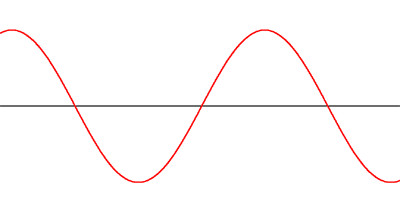
After full-wave rectification:
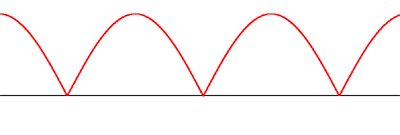
Note how the voltage drops to zero each half cycle.
Three phase:

After full-wave rectification:
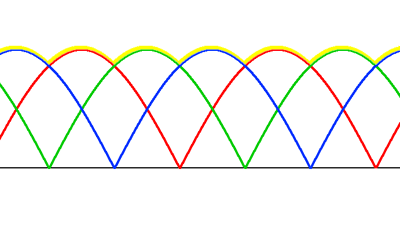
The yellow across the top represents the rectifier output voltage. Without any filtration or regulation it's almost DC with some ripple.
BTW, Euro household voltage used to be 220 but is now nomimally 230 just as we used to talk about 115 but it's now mostly about 120.
Posted by Gordon McLeod (Member # 33) on 10-18-2002, 10:18 PM:
Typically 3 phase motors have lower starting currents that can ping the peak demand meter. Also they have better power factors and torque
Rectifiers are more efficient and better filtered
Posted by Adam Fraser (Member # 1074) on 10-18-2002, 10:50 PM:
We have some 550v 3 phase or so run into the theatre for our old Allis Chalmers HVAC blower motors we used to use, so there are many non standard higher voltages out there. Now we have two 3 phase 208v motors that take its place. The power control room for one screen is at least 8' by 12' of wall to wall panels.
Posted by Paul G. Thompson (Member # 655) on 10-19-2002, 12:05 AM:
Steve, good job on your waveforms and explanations. It nicely shows why smaller value filter capacitors can be used in 3 phase retifiers. Matthew, two legs of single phase power have a 180 degree phase shift, so it comes out to 240 volts.
Three phase open delta power (or some call it "Y" power) has a 120 degree phase shift between each leg, and that's why it comes out to 208 volts between legs in the normal industrial market in the USA. Special applications might require a higher voltage - as Adam pointed out.
Posted by Jack Ondracek (Member # 1466) on 10-19-2002, 12:23 AM:
Thanks, Guys.
I got what I was looking for, and then some... all of which helped.
Jack
Posted by Ken Layton (Member # 133) on 10-19-2002, 09:11 AM:
Welcome aboard, Jack. 
Posted by Steve Guttag (Member # 268) on 10-20-2002, 08:10 PM:
If you don't have 3-phase power, and the question is on the value of obtaining 3-phase...nowadays it isn't as easy a question...Switching rectifiers often do NOT need 3-phase power... and there is no particular penalty for it on the final output...the larger rectifiers often will be 3-phase only to keep the current draw per leg down.
As for projector motors...3-phase motors should be run via a controller of some sort to keep them from "banging" on. For cinema use, there are many motor controllers to choose from that will take 120VAC single phase and generate 230VAC 3-phase.
Next I'm waiting for one of you guys to go through the math of WHY when you have 208 VAC when you have each leg starting with 120VAC (and a 120 degree phase shift).
Steve
------------------
"Old projectionists never die, they just changeover!"
Posted by Paul G. Thompson (Member # 655) on 10-20-2002, 10:22 PM:
Steve said:
quote:
Next I'm waiting for one of you guys to go through the math of WHY when you have 208 VAC when you have each leg starting with 120VAC (and a 120 degree phase shift).
Well, Steve...Lets turn that around and let you be the teacher.
Rotating Vectors are not my bag.....
Posted by Steve Kraus (Member # 476) on 10-21-2002, 12:23 AM:
Too late at night, Steve, for math I can't recall but not too late for purty pictures.Everyone knows that the AC voltages we usually speak of are RMS average, right? That is, the voltage is varying continuously as a sine wave so we describe it as the average of the absolute value (a straight average would be zero since it's negative half the time). For a sine wave the relationship between the RMS average and the peak to peak voltage is the square root of 2 divided by 2 which is about .707. So your 120V USA household voltage is 120/.707 or about 170 Vpp.
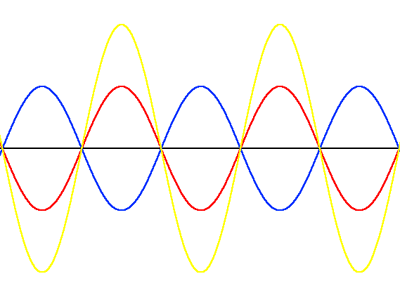
With single phase, the two legs from opposite ends of a transformer can be thought of as being 180° apart. The yellow line represents the difference between the two legs and would be the voltage you get connecting across them. I'm too lazy to show a scale but if the red and the blue are 170Vpp then the yellow is about 339Vpp, (times .707 = 240Vrms).
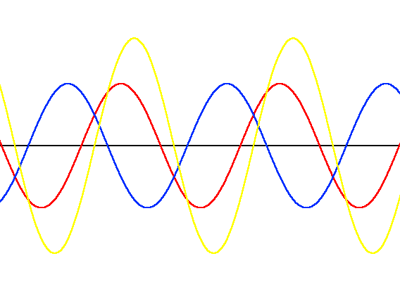
Here is three phase. Red and blue represent any pair of phases, and are 120° apart. Once again yellow is the difference between the two legs--you'll notice it is crossing the zero line when red and blue intersect. The lesser phase difference means this voltage isn't going to have as high a peak--only about 294Vpp. Times .707 gives you about 208Vrms.
Posted by William Bunch (Member # 1040) on 10-21-2002, 12:53 AM:
Where I am in northern Japan the low side is 115 while the high side is always 200 volts. And at 50 Hertz !! Does not matter single or three phase. Makes for some real challenges when ordering equipment parts from the USA. US manufacturers usually only make stuff for either North America or Europe. There is no mathematical match for here.Southern Japan is better off. They have the same strange voltages but at least they are on a 60 Hz system. (less damaging heat)
Bill BuncH
Misawa, Japan
Posted by Paul G. Thompson (Member # 655) on 10-21-2002, 06:34 AM:
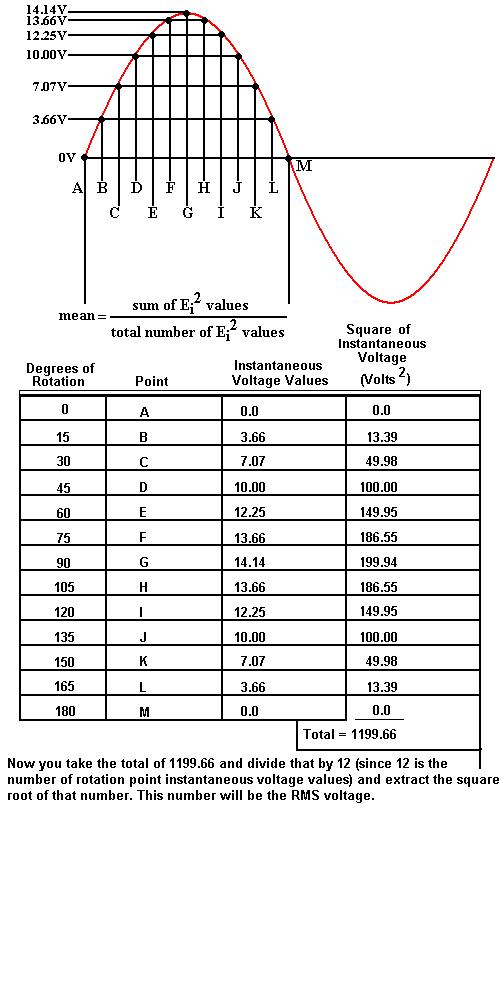
Sooner or later, someone is going to ask how the RMS value is determined. Here is the answer:
Posted by Steve Kraus (Member # 476) on 10-21-2002, 07:51 AM:
A common first year computer science class programming problem is to find the area under a curve like this sine wave by using a series of rectangles or trapezoids, repeating the process each time halving their width for greater accuracy and comparing the result with the prior estimate, stopping when the difference is less than some amount or beyond the precision of the computer.
Posted by Steve Guttag (Member # 268) on 10-21-2002, 09:01 AM:
Actually, First year calculus often does the approximation by means of rectangles, then trapizoids and finally arcs...at least, we did.
Visually seeing the graph, as Steve K did it is easier to see how the two sources add up. The math form actually takes more effort due to the phase shift. The periodic sine wave takes on the form of A*Sine(theda + phi)Where A = the amplitude, Theda is the degree (in radians) of interest, and phi is the phase shift. If there is no phase shift, phi goes to 0 and it is a simple equation.
When I have the time, I'll go through the whole process.
Steve
------------------
"Old projectionists never die, they just changeover!"