This is topic Audio Popping on Change-Over in forum Film Handlers' Forum at Film-Tech Forum ARCHIVE.
To visit this topic, use this URL:
https://ft-forum.com/ft/cgi-bin/ubb/ultimatebb.cgi?ubb=get_topic;f=1;t=004177
Posted by Joe Beres (Member # 678) on 11-06-2002, 07:09 PM:
When changing over from projector 2 to projector 1, there is a slight, but audible pop that comes through both the booth monitor and mains. It is slight, but still a problem. It seems to have developed, or at least become more pronounced recently, but nothing really has been changed in the booth. I am hoping to get some advice on where and how to start chasing down this problem.Here is the equipment we have:
Century (Westar) SA heads
Century (westar) R3-Optical soundhead
Kelmar ECC-35 Changeovers
Dolby CP-55 Processor
Xetron XTN 4000 Lamphouses (soon to be changed out for Ultra 80s)
I know it could probably be any number of issues causing the popping, but any advice would be appreciated. thanks!
Posted by Daryl C. W. O'Shea (Member # 1303) on 11-06-2002, 07:18 PM:
It could be the changeover shutter coils causing the noise.
Does it happen when the picture changes or when the sound changes (or do you do both at the same time?).
Posted by Matthew Bailey (Member # 601) on 11-06-2002, 07:19 PM:
Could use a potentiometer or a miixer to cross fade between the soundheads of the outgoing & incoming projectors.
Posted by Joe Beres (Member # 678) on 11-06-2002, 07:24 PM:
Daryl, Thanks for the quick response. I hadn't remembered to add this information. I have seperate controls for picture and audio, and the pop is only heard when changing over the image, regardless of which projector is set for audio.
Posted by Daryl C. W. O'Shea (Member # 1303) on 11-06-2002, 07:34 PM:
It sounds like it's the Kelmar changeover causing the problem.
Check out this thread here for some solutions.
Posted by Steve Kraus (Member # 476) on 11-06-2002, 08:40 PM:
That was primarily about hum problems.The question is why would he start having this problem if he didn't before. There's probably not too much that can change on the changeover solenoids outside an actual failure. Does the pop occur as you make contact (push the button) or break contact? Yes, it's hard to tell but try holding it on briefly (very briefly) to see. Could wear on the button contacts cause a bit more arc than you had originally and make more RF? Are there capacitors across the buttons--there should be--a .1mF disc or something like that with voltage rating of at least several hundred volts.
Maybe this has nothing at all to do with the changeovers and everything to do with interference pickup. Check the shields on your solar cell leads--they should be grounded at the CP as you see in the manual but isolated at the projector end. Maybe something is touching. Check the grounding of the sound rack and look for something amiss with the wiring behind it. Do you hear the C/O pop if you are in non-sync? How about with the CP off (amps on of course)? It's getting picked up somewhere and it didn't before or at least to a much lesser degree so your answer is in there someplace.
Posted by Josh Jones (Member # 447) on 11-06-2002, 08:58 PM:
I would also try the capacitor across the switch idea. Be sure the capacitors have a high enough working voltage or you'll have more trouble.Joe, which theater do you work at down there. I have been known to drop in on the Heights from time to time.
Josh
------------------
"Film is made of silver, video is made of rust"
'nuf said
Posted by Paul G. Thompson (Member # 655) on 11-06-2002, 10:15 PM:
Check your equipment grounding. See if you can detect if it is coming in through the front end, mid-stream, or whatever. Once you establish the point of detection, it is usually very easy to swamp out.
Posted by John Pytlak (Member # 331) on 11-07-2002, 07:12 AM:
I agree with Steve that if the problem has recently developed without any other changes in your wiring or sound system, it's likely that there is just some increased arcing at the contacts that control the power to the changeover solonoids. Clean the contacts and use a snubbing circuit (capacitors) if necessary.------------------
John P. Pytlak, Senior Technical Specialist
Worldwide Technical Services, Entertainment Imaging
Research Labs, Building 69, Room 7525A
Rochester, New York, 14650-1922 USA
Tel: +1 585 477 5325 Cell: +1 585 781 4036 Fax: +1 585 722 7243
e-mail: john.pytlak@kodak.com
Web site: http://www.kodak.com/go/motion
Posted by Joe Beres (Member # 678) on 11-08-2002, 01:10 PM:
Josh Jones, and his Dad, happened to be blowing through the Twin Cities today. I got a call from Josh's Dad, and he told me that Josh brought all of his parts and tools to check out the problem with the popping. (An unbelieveably pleasant surprise) First, Josh tied a cap into the switch, but that didn't fix the problem, but will probably prevent the same problem down the line when the switch starts to go. Then he found a cap that had been tied in between the switch and changeover on the other projector. One leg of that capacitor had come loose. He put it back in place and voila! No more popping!
Thanks everyone for all of the advice, and thanks to Josh for being the whiz kid he is and his Pop for being so damn supportive. (And Paul for providing Josh with all of his toys and much of his expertise)
Posted by Brad Miller (Member # 2) on 11-08-2002, 02:56 PM:
Just wait until you get the bill!
Posted by Paul G. Thompson (Member # 655) on 11-08-2002, 03:37 PM:
Well, hearing that made my day. 
Thank you for the plug, Joe. Maybe I am doing something right after all.
Posted by Josh Jones (Member # 447) on 11-08-2002, 08:12 PM:
Glad to have helped Josh
Posted by Bill Carter (Member # 156) on 11-08-2002, 08:22 PM:
Hey Josh...Any time you want to come back and do a couple of (paid) days work at
St. Anthony Main... give me a call!
Bill
Posted by Steve Guttag (Member # 268) on 11-09-2002, 09:36 AM:
<raising an eyebrow> And just where was this capacitor again? (Just trying to visualize what capacitor came undone and where it was in circuit).Steve
------------------
"Old projectionists never die, they just changeover!"
Posted by Steve Kraus (Member # 476) on 11-09-2002, 10:22 AM:
I was wondering the same thing.
Posted by Josh Jones (Member # 447) on 11-09-2002, 01:32 PM:
There is a piece of SLO cord coming out of the pedistal with three wires in it. Those 3 wires go into a erostrip and then up to the changeover. The snubber circuit, which had a .1uf cap and a 10 ohm resistor in series, was hanging out of the eurostrip and wrapped in yellow electrical tape.good memory eh?
Josh
------------------
"Film is made of silver, video is made of rust"
'nuf said
Posted by Steve Guttag (Member # 268) on 11-09-2002, 05:56 PM:
Oh Josh, I'm afraid you'll have to do better than that! A drawing or at least a description of a complete circuit. I (and probably Steve) could picture a capacitor connected somehow.Was the RC network across the coil or was it on one side to ground? Those are the answers we are looking for.
Steve
------------------
"Old projectionists never die, they just changeover!"
Posted by Josh Jones (Member # 447) on 11-10-2002, 03:55 AM:
'twas across the hot and neutral of each coil, not to ground.Josh
Posted by Josh Jones (Member # 447) on 11-10-2002, 04:06 AM:
I was feeling ambitious so I made ya a stinking drawing 
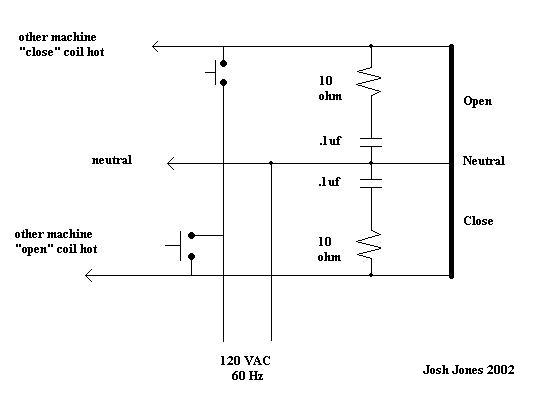
Josh
Posted by Steve Kraus (Member # 476) on 11-10-2002, 10:38 AM:
Well, what do you think of those resistors, Steve? Also is it better to have such an arrangement near the C/O coils (as the impulse source as the field collapses) or near the button contacts (as the radiation point of RF as the opening contacts arc)?
Posted by Steve Guttag (Member # 268) on 11-10-2002, 07:01 PM:
What about the resistors?They are the right way to do it on a theoretical level and seem to be doing the job here. A capacitor can not have it's voltage or current change instantaneously. Current through a capacitor is described by the equation i(t) = C*d v(t)/dt. That whole differential thing prohibits the instantaneous voltage change. As such, without the resistor, the small resistance in the wire must serve as the total resistance.
Anytime you connect a capacitor or inductor directly it is technically bad design though often functional.
In fact, it is this very same principle that is causing the popping sound. As the inductor (what we call a changeover coil) is disconnected, it too can not change voltage (or current) instantaneously. As the switch contacts release, the coil raises the voltage to the point it breaks down the air and causes and arc and the "pop" is born. The RC circuit gives the exponentially increasing voltage a place to go besides the switch. The capacitor directs high-frequency (a pop) to the neutral and away from the switch and other sensitive (sound) devices.
So to answer your second question...it is best to put a snubber circuit as close to the source of the noise...in this case, the changeover. It isn't the switch that is causing the problem..it just receives the abuse...you would want the snubber right on the coil leads.
Steve
------------------
"Old projectionists never die, they just changeover!"
Posted by Paul G. Thompson (Member # 655) on 11-10-2002, 09:56 PM:
Just thought I would let you know I was listening...