This is topic updating trailers on a print that is held over in forum Film Handlers' Forum at Film-Tech Forum ARCHIVE.


To visit this topic, use this URL:
https://ft-forum.com/ft/cgi-bin/ubb/ultimatebb.cgi?ubb=get_topic;f=1;t=004195

Posted by Dave Ganoe (Member # 53) on 11-10-2002, 11:57 PM:
 
Looking to hear about some ideas on how to do this quickly and painlessly. For example, a certain feature has 5 trailes on it and the next week the company wants to change 3 of them. Don't want to unload the whole print to do it and don't want to damage anything doing it other ways so I would appreciate some advice from others. Thanks.

 
Posted by Brad Miller (Member # 2) on 11-11-2002, 01:02 AM:
 
Center drop.

What kind of rewind bench do you have? What kind of platters?


Posted by Antonio Marcheselli (Member # 373) on 11-11-2002, 07:23 AM:
 
Strange thing, I was going to post the same question!! I use CNR platter with CNR rewind bench.
If you have just trailers on the head of the feature, I use the bigger center ring in this way: I rewind the movie on the bigger ring (during a normal projection). Meanwhile I rewind a new set of trailer plus the threading leader on a normal ring. At the end of the show you can just remove the old trailers (removing the print from inside the center hole) and put back the new ones that fill perfectly. Splice the two parts and you're ready.
I hope that my explanation is clear enought...

BUT, my question is more complicated...

Let's suppose that I have:

- trailer
- ADS
- Movie

Suppose these situations:

1. Change only the trailer
2. Change the ADS but NOT the trailer
3. Change the movie, the trailer, but not the ADS.

Terrible, isn't it?

Point one is simple. What about point 2? If I have an identical spare trailer I can prepare a set of trailer+ads. But what about if I do not have a spare trailer like that?? I have to remove it previously from the screen and splice to the ADS, then splice ADS + trailer back on the correct screen? What about a faster way??

Point 3 is when we have to shift movie between screens (so, with its trailer) but Not the ads. Someone suggested me to swap trailers previously so that on the night I have just to change ads+trailers together.

Any help will be appreciated.

Bye

------------------
Antonio Marcheselli
16plex VisPathe' Campi Bisenzio
Florence, Italy


Posted by Brad Miller (Member # 2) on 11-11-2002, 07:34 AM:
 
Trying to explain this in words is going to be damn near impossible. This has been something on my "to do" list (to create a how to change trailers page). I'll try and work on that to show the various proper ways of accomplishing this.
 
Posted by Steve Guttag (Member # 268) on 11-11-2002, 07:41 AM:
 
I'm an old sponge kinda guy. On trailer service night...I'll sponge off the trailer pack (use sponges cut into 2"x2" x 12"...send them into the pack and at the end of the show...pull the pack and remove/add as necessary. For multiplexes...I pull the sponges/previews after an hour of film has gone through (it won't slide at that point), and do the same so at show turnaround, just drop the new pack in.

Steve

------------------
"Old projectionists never die, they just changeover!"


Posted by Antonio Marcheselli (Member # 373) on 11-11-2002, 08:09 AM:
 
Steve,

What are "sponges"?

------------------
Antonio Marcheselli
16plex VisPathe' Campi Bisenzio
Florence, Italy


Posted by Scott Norwood (Member # 30) on 11-11-2002, 08:11 AM:
 
This is where Christie platters really shine.

At a local 6-plex, I often do an insane number of trailer changes. It's usually stuff like: replace the 5th trailer, remove the 4th trailer, and insert a new trailer between the 2nd and 3rd trailers. This can easily be done in one operation between shows on Christie platters, but I doubt that anything else could handle it. Like Brad said, it's near-impossible to describe without pictures, though.


Posted by Brad Miller (Member # 2) on 11-11-2002, 08:22 AM:
 
No joke there. Christies beat all other platters hands down on trailer changes due to the raised brain. I will of course make TWO pages, one showing all the options on a Christie platter, and the other using a Strong for 'all other platters' demo.

There is really no reason at all to stick anything in the roll during takeup for a trailer change. There are plenty of tricks to do what you need.


Posted by John Pytlak (Member # 331) on 11-11-2002, 08:26 AM:
 
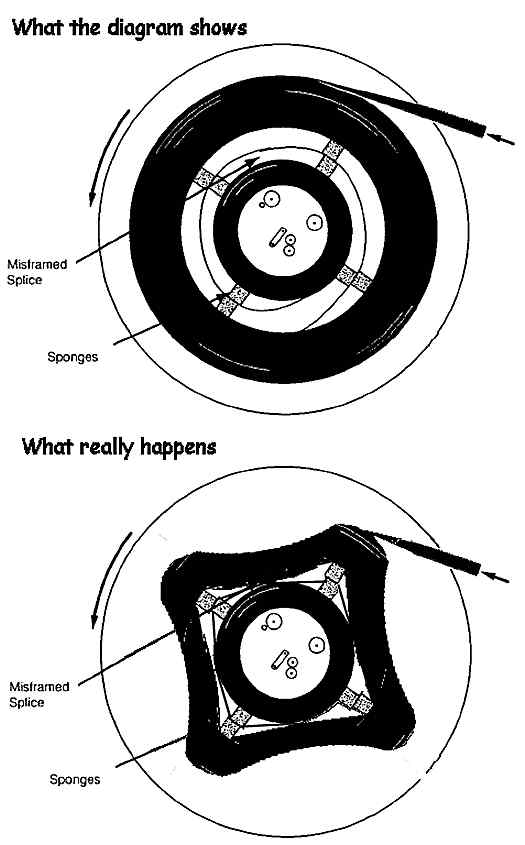
The "sponge trick" was first discussed in 1980 in Kodak's publication H-50-11 "Film Notes for Reel People", on page 8:
here

------------------
John P. Pytlak, Senior Technical Specialist
Worldwide Technical Services, Entertainment Imaging
Research Labs, Building 69, Room 7525A
Rochester, New York, 14650-1922 USA
Tel: +1 585 477 5325 Cell: +1 585 781 4036 Fax: +1 585 722 7243
e-mail: john.pytlak@kodak.com
Web site: http://www.kodak.com/go/motion


Posted by Antonio Marcheselli (Member # 373) on 11-11-2002, 08:27 AM:
 
So, I'll wait for the new pictures! I'm so curious, I cannot understand what do you mean...

Bye

------------------
Antonio Marcheselli
16plex VisPathe' Campi Bisenzio
Florence, Italy


Posted by Daryl C. W. O'Shea (Member # 1303) on 11-11-2002, 08:30 AM:
 
It might be easier to make a 'serious' Film-Tech Training video for this one. Mind you, not as much fun.
 
Posted by Brad Miller (Member # 2) on 11-11-2002, 08:32 AM:
 
I may do that. Gotta get an anamorphic adaptor for the video camera first. No need in shooting a training video that isn't in 2.39 aspect, ya know.

Hmmmmm, perhaps 3 simultaneous downloads running side by side for "Internet Cinerama"!


Posted by Steve Guttag (Member # 268) on 11-11-2002, 10:01 AM:
 
I even sponge on the Christie...lets me yank trailers during the show...just kinda prefer it.

I've done buldges on SPECO and Strong/Potts without incident...as I call it...double-decking as well.

Steve

------------------
"Old projectionists never die, they just changeover!"


Posted by Ken Lackner (Member # 1002) on 11-11-2002, 10:52 AM:
 
quote:
I even sponge on the Christie...lets me yank trailers during the show

I'm sorry, maybe I am missing something here. How the heck do you pull trailers while the show is running??


Posted by Joe Redifer (Member # 3) on 11-11-2002, 11:50 AM:
 
Easy. Pull the ring. Remove Steve's sponges. Tear the splice. Remove trailers. Change trailers. Wait until show is done to resplice.
 
Posted by Steve Guttag (Member # 268) on 11-11-2002, 11:51 AM:
 
Sponge off the trailers...wait until 3-reels feed on to the take up platter, remove the sponges and break the splice...go and service the trailer pack. You are going to want to tuck or tape the loose end down to avoid it spilling down the center of the platter.

Steve

------------------
"Old projectionists never die, they just changeover!"


Posted by Brad Miller (Member # 2) on 11-11-2002, 03:45 PM:
 
Oh my, there's another example of where the Christie shines, being that it is impossible for the film to fall down into the deck of a Christie platter. (Besides, tucking the film in the center like that would cause scratches.)

Steve, I know what you are recommending works, but there is a big IF you know what you are doing and are very careful that needs to be attached to that. I can see a lot of people trying to follow that advice and dumping prints onto the floor because of that recommendation. Without very detailed explanations and pictures, I really don't think you should be pitching that idea. Someone reading this is going to try it, destroy a print and lose their job because of that little tip.


Posted by Steve Guttag (Member # 268) on 11-11-2002, 05:28 PM:
 
I can honestly say, I've NEVER had any mishap in the decades I've been doing the manuver. As with all suggestions or tips, use at your own risk. You know us reel-to-reel guys...we just gotta play with film whilst it is running to feel like WE are part of the show!

Steve

------------------
"Old projectionists never die, they just changeover!"


Posted by Antonio Marcheselli (Member # 373) on 11-12-2002, 05:09 AM:
 
Uhm, I believe I understood what you mean with sponges.

My question is: once you've removed the old trailer, how can you put in the "hole" another one? In other words, how can you rewind a trailer of the exact size of the left hole?

Let's suppose that you have to change 16 trailers in a multiplex in just one show and two projectionists: is it possibile in your opinion? If made after the shows, how much time would you spend (again, two projs) to add/change 16 trailers?

I'll wait for your answers!

Bye

------------------
Antonio Marcheselli
16plex VisPathe' Campi Bisenzio
Florence, Italy


Posted by Scott Norwood (Member # 30) on 11-12-2002, 05:36 AM:
 
You want to change 8 trailers (per operator) between shows? This is definitely possible with Christie platters. Not sure about other models?

Steve: if I understand your method correctly, the center ring is no longer necessary to hold the film on the takeup deck after the first hour has run through?


Posted by Mike Williams (Member # 1140) on 11-12-2002, 07:12 AM:
 
I must be missing something here... but if you pull the center ring during the show (or break a splice near it), what is binding the print to the platter? Will not the resistance from the elevator or control arm cause the print to slip on the platter or is the weight of the print usually enough to keep it from slipping?

Maybe this only works on Christie platters that have years of residue from using those "sticky poos" so there is enough friction on the platter to keep the print from spinning off.

This definitely needs a training video.


Posted by Steve Guttag (Member # 268) on 11-12-2002, 07:39 AM:
 
Yes, an hour of film is enough to overcome the T-U elevator (shuttle, yo-yo or spring). It will not slip...not on a Christie, not on a SPECO, not on a POTTS/Strong...I won't eat my green eggs and ham!

As to putting the previews back in...no problem...you have plenty of room...the fact they don't mate up (diameter wise) is of no consequence. If you got carried away with the size of the sponge, you could cause a platter like the Strong to not be able to keep up (since the payout speed is dependant on the TU speed).

One operator could do your 16 trailer changes...at least _I_ could do all 16.

But not all operators are created equal. What I can do or Brad or others isn't what everyone can do. I don't claim my methods will work safely for everyone.

Steve

------------------
"Old projectionists never die, they just changeover!"


Posted by Dustin Mitchell (Member # 372) on 11-12-2002, 09:41 AM:
 
That sponge idea is a really good one Steve, I might give it a shot.

I am in a gambling mood, so I'll attempt to describe my method for changing trailers without picture. I have a feeling this won't work, but here goes.

Here is the situation. The trailer pack looks like this:
1) Ads
2) Trailer 1
3) Trailer 2
4) Trailer 3
5) Trailer 4
6) Trailer 5
7) Policy trailer/digital trailer
Lets say you want to remove trailer 3 and put in a new one of approximately the same length. To do this, follow these steps:
1) Remove the center ring
2) Tear the splice between trailer 2 and trailer 3
3) Remove the first part of the trailer pack (everything before trailer 3) and place soundtrack down on an empty platter
4) Re-insert the center ring into the now seperated trailers. You may have to make it smaller to get it into the roll, but once its in there expand it until it is snug
5) Flip the trailer pack over and secure the center ring the platter. It should look like you're about to build up a movie and you just got the trailers onto the platter
6) Go back to the second half of the trailers. Break the splice between trailer 3 and trailer 4. Take out trailer 3 and set it to the side to be wound up later
7) Go back to the first half of the trailer pack. Splice the head of the new trailer to the tail of trailer 2. Now, spin the platter by hand until you have 'built' the new trailer onto the platter. Hold the core of the new trailer in place with your finger or a marker
8) Once the new trailer is in the pack and the tail is removed, pick the trailer pack off the platter and flip it upside down again. Remove the center ring
9) Take the now loose first half of your trailer pack and plop it into the hole in your print. Splice the tail of the new trailer to the head of trailer 4

Some notes:
1) The above procedure was developed using Strong platters. Other platters may require different methods
2) The above procedure assumes the new trailer won't be significantly longer than the old one. A Strong platter can handle an 'outward bulge,' ie the trailer pack bulging out of the 'hole' and the excess resting on top of the print, to be pulled down and through the brain during payout. Other platter may not be able to handle this. If your platter can not handle outward bulges, you could insert sponges ala Steve Guttags method to creat extra space for the new trailer.

So, that's how I was taught. If there is something wrong with that feel free to point it out and I'll either defend my methods or abandon them for a better way.


Posted by Shaun Flichel (Member # 1435) on 11-12-2002, 11:33 AM:
 
I have to admit, 2 years ago I tried changing trailers while the show was running, althought the show was about 15 mins from the end, and I could of waited, but of course, i got off 5 minutes after the scheduled end time, and theres no way in hell they would pay me to stay later. It does work, will I ever do it again, no.
Shaun
 
Posted by Antonio Marcheselli (Member # 373) on 11-12-2002, 12:01 PM:
 
Steve,

I wonder how you can set the sponges on 16 projectors (you have to stay at the platter during the time of the trailer, right?) while others are starting the show and while others stop waiting for threading... Perhaps I missed something!

------------------
Antonio Marcheselli
16plex VisPathe' Campi Bisenzio
Florence, Italy


Posted by Daryl C. W. O'Shea (Member # 1303) on 11-12-2002, 01:49 PM:
 
Antonio, I've done it by myself with 10. It just comes down to good planning... if your waiting for a trailer on one machine thread another one or two nearby (or if need be, one at the other end). With two people, and somewhat stagered start times, I usually just use a split ring to spool off the pack and do the changes at the rewind table while the other guy is threading.
 
Posted by Brad Miller (Member # 2) on 11-12-2002, 02:16 PM:
 
Dustin's method is decent, but you really don't need to mess with the center rings. I have half a dozen procedures, depending on which trailer(s) in the roll is being changed as to which is quickest. All-in-all, I can change out all 16 trailer packs at a 16 plex during one round by myself without the risk of pulling the center ring during the show and without having to jack with sponges. No big deal. You do have to plan a couple of things out before the first one in the round drops to get it all done though.

That assumes you will use start timers and change-out trailers/thread in the order they drop. I am never around when the trailers run through. Never had a botched center drop in over 15 years, doing it on a weekly basis.

So Steve, would you consider doing a center drop, then stringing up the print for a multiple screen interlock, setting the timers and leaving the building with no one in the booth? To me I can walk away without worrying about anything going wrong, and although I don't preach the idea, I have done this on many occasions without problems. However I do not like the idea of pulling the ring on a take-up platter, as that is the only absolute thing holding the film onto the deck. I once had a couple of ushers carrying a large box up to the booth for storage and one of them backed into a running platter. It was hard enough to throw the payout's film way off center and barely hanging over the edge, but it didn't actually fall off. With the pull of the takeup and an off center, ring-less print on the takeup platter, if I was running a print your way the first half of the movie would have been destroyed as it met with the floor. Each person has what they feel is a "safe" practice or not. You pull your rings and I'll not worry about being around when an interlock starts/runs. However you don't see me preaching my operator-less interlocks now, do you?


Posted by Daryl C. W. O'Shea (Member # 1303) on 11-12-2002, 02:22 PM:
 
Start timers... mmmm... I wish... I should just install some, if I pay for it they don't care. Digital egg timers are inexpensive.
 
Posted by Brad Miller (Member # 2) on 11-12-2002, 02:26 PM:
 
Go to the Rat Shack and buy you an X10 timer. It looks like a clock radio and has programmable times on it. Each clock can run 4 different items. Then hook up the momentary latch module to the start button and you will have 4 start timers (accurate to the second) with one programmable timer for under $100. Got a 12 screen? Buy in multiples of 3 and set for different "house codes". Put the clock on your booth desk and have remote control starts, or buy the wireless remote control and start/stop the movie from the auditorium. (Great for people who tend to have misframes, as the movie can be stopped before the splice hits the takeup roll.)

Note: you may have to install a specialized outlet running off of one breaker that is left on all the time for the timer and each module, as the signals transmit through the 110V lines.


Posted by Dave Ganoe (Member # 53) on 11-12-2002, 04:24 PM:
 
I will be using Christie Platters. The entire booth is christie, all new setup. All the places I worked before trailer choice was left up to those in the booth. We always kept the same ones during the run of the print. Now I will have to be changing things as the office directs. Got 10 screens to deal with and wanted something simple and not to damage any film in the process. Thanks for all the tips and stuff.
 
Posted by Antonio Marcheselli (Member # 373) on 11-12-2002, 07:01 PM:
 
Brad and all others,

I'm so surprised that it is so easy to change trailers on platters. I hope that Brad will found time to make shots or video because it will help my daily job a lot.

------------------
Antonio Marcheselli
16plex VisPathe' Campi Bisenzio
Florence, Italy


Posted by Steve Guttag (Member # 268) on 11-12-2002, 07:58 PM:
 
Yeah, Brad,...I'd do that too.

As to sponging the film...it is just one way and one that I find easier for me. You don't have to hit your mark with the sponge exactly...just in the vacinity. BTW...some people string a bunch of cores together (2" variety) and feed them in like a snake.

Again, using many types of platters, never had one slip...I also don't leave the pack out longer than it takes for me to service it and drop it back in.

Please, don't anyone feel they need to try my method(s). I'm not double-dog daring you or anything!

I also came from a time and place where managers would hand you a preview to have on for the next show...alot! Necessity is the mother of invention.

Steve

------------------
"Old projectionists never die, they just changeover!"


Posted by Danny Hart (Member # 659) on 11-13-2002, 07:33 PM:
 
Interesting discussion so far, reading all these different methods. Any mainstream cinema in the UK at the moment needs some kind of quick ad/trailer changing method, because of the insane amount of changes, every single week.

This week, for instance, as well as all the usual changes, we are being asked to change a 2 minute BT advert for a 90 second version (both for the same product), and also its positioning in the programme. The 2 minute version is only one for one day - the Harry Potter previews tomorrow (Thursday).

We use the large-sized take-up rings, available from Christie. We also use large make-up plates (imagine one side of a 6000ft spool with solid flanges). We've drilled holes in the make-up plates to accommodate the normal sized take-up rings.

When the time comes for the last performance before the programme change, we run the ads/trailers as normal onto a normal-sized ring. We then stop the show immediately before the feature starts. We cut the join between the end of the last ad/trailer and the feature, lace the feature onto a LARGE ring on the platter, then on with the show.

When the show’s running, we take the ads/trailers, put them onto our make-up plate and edit them on the bench. Once the show is finished, we just remove the large ring from the centre of the feature, drop the ads/trailers in and join the two together. Hurrah!

You don’t actually need the large rings from Christie to do this (I don’t know if other manufacturers make them for their systems), you can make them yourself, if you have plenty rings and loads of scrap film. Just run about 25 minutes (yes, we need that much here in the UK) of scrap onto a ring, grab some parcel tape and wrap, from inside to out, right the way around the ring.

I’ve also used the sponge method in the past - and still sometimes do. It’s a great way of removing just a single ad or trailer.


Posted by Brad Miller (Member # 2) on 11-13-2002, 08:32 PM:
 
quote:
"When the time comes for the last performance before the programme change, we run the ads/trailers as normal onto a normal-sized ring. We then stop the show immediately before the feature starts. We cut the join between the end of the last ad/trailer and the feature, lace the feature onto a LARGE ring on the platter, then on with the show."

There's just one problem with this method, you are damaging a piece of film when you do it. Then there's the other (minor) problem, you have to be there at precisely the right time and you have to stop the movie for so many seconds which looks weird when you are a customer sitting in a theater wondering if something went wrong.

Steve, in a pinch I have used cores when I needed to drop in a new reel 1 or reposition a lights up cue. In those situations, I would definitely prefer the sponges as I have to be EXTRA careful when I use the cores not to put a few horizontal scratches on the film where the cores were inserted.

By the way, I've seen platters throw a print because there were cores/sponges inserted into the roll. That is another reason why I really do not like that procedure.


Posted by Carl Martin (Member # 1146) on 11-14-2002, 04:05 AM:
 
our union guy does our trailer changes after hours so it's not something i have to worry about, but there have been occasions when for one or another reason i've had to access the interior of the film mass and under the circumstances backing the film off onto 6k's was what made sense. sponges probably would have been a better method for excising some footage near the start of reel 2 as i was recently asked to do, but we didn't have any handy in the booth. illustrations i've seen of the method (in "reel people", eg.) show the film continuing to take up in a perfect circle after the sponges, but surely the film would tend to "square off", filling in the gaps between the sponges a little and making the takeup uneven. seems a bit scary. or am i wrong?

carl


Posted by Daryl C. W. O'Shea (Member # 1303) on 11-14-2002, 04:19 AM:
 
As long as you place sponges symmetrically you'll usually be OK.


Posted by John Hawkinson (Member # 1135) on 11-14-2002, 06:33 PM:
 
Surely in the absence of sponges a folded cotton wipe would serve fine (or a clean pocket handkerchief, if you still carry one...).

Brad, I assume you mean the 1" cores. For a moment I had a vision of trying to replace a platter's center ring with a 4" plastic core, but quickly concluded you didn't mean that.

--jhawk


Posted by Brad Miller (Member # 2) on 11-14-2002, 10:35 PM:
 
Actually John, no I meant the 4 inch cores. That gives plenty of room to pull a stretch of film out of the roll to do cue work or repair a splice without having to unload the film. Saves a ton of time, but some platters will toss a print like that.
 
Posted by Alex Grasic (Member # 1371) on 11-16-2002, 01:26 AM:
 
Two things that I have and use: Strong Platters and an EZ Ring!! Can't get easier than that...can it?
 
Posted by System Notices (Member # 2357) on 06-01-2004, 07:58 PM:
 

It has been 563 days since the last post.


Posted by Dino Panagiotopoulos (Member # 1579) on 06-01-2004, 07:58 PM:
 
The EZ-Ring has got the be the greatest invention ever made for a booth.......except maybe for a chair.
 
Posted by Phil Blake (Member # 2012) on 06-05-2004, 11:33 AM:
 
Hi All,

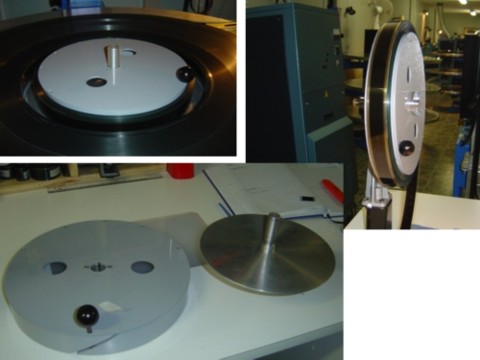
When adding and removing trailers we use a "Film Spinner" this simple device fits onto a blank spindle that locks into the payout module socket. Film is wound onto it , join is cut , the the spinner is placed onto a split reel and trailers added or changed on the bench. Film is then wound onto the spinner , placed back onto the platter , re joined , pin removed from the spinner and bingo the film is left back in the original place ready to go. Makes changing trailers a breeze.

To look at some pictures on this device go to

link removed by Admin

Phil

[ 06-05-2004, 09:57 PM: Message edited by: Brad Miller ]
 
Posted by Brad Miller (Member # 2) on 06-05-2004, 09:59 PM:
 
Phil, please use the UPLOAD feature to put your images on the FT web server so they are always around for archival purposes. Linking off site for these sort of things is not permitted, as your web page will not be around forever.
 
Posted by Phil Blake (Member # 2012) on 06-06-2004, 01:06 AM:
 
tryed to upload image, but would not let me proceed saying password incorrect , trusting the password is the same as my logon one ?
 
Posted by Brad Miller (Member # 2) on 06-06-2004, 02:00 AM:
 
Same password. Full instructions are on the UPLOAD page in the box to your left.
 
Posted by Stephen Frazza (Member # 2320) on 06-06-2004, 10:58 PM:
 
I just happened to see this topic and read about the sponge trick. The next day one of the cues for start of credits wasn't being picked up.So normally I would reel it off the platter and fix it.But I went and bought some sponges and used them on the next show.

Pure genius.

Worked amazingly.I just had to express my joy with this tip.
 
Posted by Tom Petrov (Member # 1534) on 06-07-2004, 01:42 AM:
 
What I do is I used a center ring with four trailers on it that are masking taped to make it look and weight like a heavy movie.

The first show I remove the outgoing trailers and I used my modified center ring. After the show is over I removed the rind and the trailer pack and I add whatever trailers I need while putting the trailer pack back in the enlarged space.

Hope that is not confusing.
 
Posted by John Pytlak (Member # 331) on 06-07-2004, 01:10 PM:
 
Glad the "sponge trick" worked so well for you. Pretty good for an idea Kodak published in 1980! But I'm sure variants of the idea were in use since the "dawn of platters". [Cool]
 
Posted by Andrew Shingleton (Member # 2257) on 06-07-2004, 04:44 PM:
 
We also use the "spinner" that Phil Blake posted about. I think it seems to be quite common in Australia - other places I've worked have also used a spinner and I know of a lot more that I haven't personally worked at that use them too.

I can't imagine not having at least one - they make ad and trailer changes that much easier. Hopefully Phil is able to post some pictures as it's kinda hard to explain exactly how it works. If not I'll see if I can take some photo's myself.
 
Posted by Patrick de Groot (Member # 858) on 06-09-2004, 05:00 PM:
 
A question about the method in the tips part of film-tech.
Is there 1 trailer laying on top of the rewind roller in the picture above the text "Set the film on your rewind table's auto-stop roller and wind directly to a trailer core." or is this the whole trailer block as displayed on the previous picture?
Thank you in advance for your clarification.
 
Posted by Brad Miller (Member # 2) on 06-09-2004, 06:59 PM:
 
Only 1 trailer. If you put 2 or more, the film wants to flop off of the roller during winding over to the core.
 
Posted by Wolff King Morrow (Member # 2226) on 06-09-2004, 09:02 PM:
 
quote: Stephen Frazza
I just happened to see this topic and read about the sponge trick. The next day one of the cues for start of credits wasn't being picked up.So normally I would reel it off the platter and fix it.But I went and bought some sponges and used them on the next show.

Pure genius.

Worked amazingly.I just had to express my joy with this tip.

Yep. The sponge trick is how we've been doing it too. We've got long slender ones that look like oversized french fries. Four of them make a perfect ring around the platter.
 
Posted by Carl Martin (Member # 1146) on 06-10-2004, 04:49 AM:
 
quote: Brad Miller
Only 1 trailer. If you put 2 or more, the film wants to flop off of the roller during winding over to the core.
you can do more if you use your hand to steady the hanging film as it spins. i cup my hand around the film just under the roller on the left side so my fingers are barely touching the edges of the inside layer of film (and nowhere else). i can't quite figure why, but this helps keep the film from sliding against itself so the inner revolutions grow too big and spill out, as well as keeping the outer revolutions from falling off if they start to stray.

i also wind first onto a reel, adding a little tension with my right hand, and then wind from the reel back onto the original trailer core with the original leaders. this way i get a tighter wind and they come out tails up (my own arbitrary preference for trailers).

carl
 
Posted by Phil Blake (Member # 2012) on 10-31-2004, 08:23 AM:
 
Now I have found the shift key [Embarrassed]

The spinner we use to add and remove trailer to made up prints is pictured below. A very simple devive that makes changing trailers a breeze.
 -
 
Posted by Andrew Shingleton (Member # 2257) on 10-31-2004, 05:57 PM:
 
Yep, that's the one! Three thumbs up from me! [Smile]
 
Posted by Jason Black (Member # 684) on 10-31-2004, 08:24 PM:
 
Would someone be so kind as to either upload or email me a picture of the sponge method in use? I always used empty cores, spaced out, to create enough of a break to pull any trailers I needed to pull. I like the method of being able to pull a complete pack and replace with a fresh new one using a center ring drop method. I tried to get the stong large take-up rings a while back but I wasn't able to get them. Does anyone here know what I'm talking about? It's a regular take-up ring, only larger, supposedly to facilitate trailer changeouts?

Thanks!
 
Posted by John Pytlak (Member # 331) on 11-01-2004, 09:16 AM:
 
The "sponge trick" was first discussed in the Kodak publication "Film Notes for Reel People", H-50-11, in 1980, available in the Film-Tech Manuals section:

http://www.film-tech.com/manuals/H5011.pdf
 
Posted by Peter Mork (Member # 1336) on 11-01-2004, 02:51 PM:
 
John, that manual has always bugged me:
 -
 
Posted by John Pytlak (Member # 331) on 11-01-2004, 03:36 PM:
 
The original editor of "Film Notes", Paul Preo, must have had a "magic touch". [Wink] Or "artistic license". [Big Grin]

(He's the guy with all the film on the floor in that issue).
 
Posted by Jeff Akin (Member # 1198) on 11-01-2004, 03:55 PM:
 
Jason, I have one of these large center rings. Inherited it when I took over this theatre a few years ago.

I have no idea what I'd do without this ring. It is a true life saver when it comes to swapping out trailer sets.
 
Posted by Daryl C. W. O'Shea (Member # 1303) on 11-01-2004, 04:49 PM:
 
Jason, the 19" diameter center ring is part number 2468196.
 
Posted by Brad Miller (Member # 2) on 11-01-2004, 06:18 PM:
 
An even better option is to just buy a standard ring from Christie and drill two extra holes in your Strong decks for them. Christie's small ring is 19" (or you could get their really big one) and is 10,000 times more durable than the Strong rings. I would expect for the pricing to be very similar as well.
 
Posted by Joshua Waaland (Member # 287) on 11-03-2004, 02:18 PM:
 
I too have extensively used Steve's "sponge technique". If you take the styrofoam end caps that accompany a xenon bulb out of the cardboard box (the outer shipping box), they usually have four legs on them you can cut off. The styrofoam is used to hold the smaller cardboard box, containing the xenon bulb, in the center of the bigger shipping box. These "legs" are the perfect size for marking trailer changes.

What you do is wait until the last trailer goes through and when it reaches the take-up ring you put this small soft piece of styrofoam (or a sponge) where the last splice is. This creates a lump in the film making it look more like an egg shape on the platter. Then when the feature finishes, unless you are Steve and do it during the run, you have plenty of room to remove the ring and trailers and insert the new ones. I have found this to be a dependable method and always worked for me.
 
Posted by Michael Rourke (Member # 1142) on 11-06-2004, 04:38 AM:
 
Get with the times guys, get one of these:
http://www.rsem.com/equipment-details.asp?partnum=5810007

and one of these:
http://www.rsem.com/equipment-details.asp?partnum=5810014

My last trailer retrieval reel came in metallic blue, very striking.
 
Posted by Scott Norwood (Member # 30) on 11-06-2004, 07:12 AM:
 
Those "trailer retrieval reels" are the most useless pieces of booth equipment ever. Among other problems, the "expandable hub" has a tendency to collapse, rather than stay expanded. Just say "no" to this product. [Razz]
 
Posted by Aaron Mehocic (Member # 15) on 11-06-2004, 06:46 PM:
 
Make it official . . . do a formal review of these products so as we may determine the good and bad points.
 
Posted by Chase Hanson (Member # 2779) on 11-06-2004, 07:14 PM:
 
ima cheap bastard and just rebuild the entire trailer ring, and use that split ring hub mofo ( we call it a drop ring ), to drop it in. Since the hub center ring is smaller than our Strong's you can usually net a trailer or two and still have plenty o' room to reattach to the feature. Excluding the actual trailer ring build it takes me all of two minutes to swap out.
 
Posted by Chris Brown (Member # 2800) on 02-01-2005, 02:37 AM:
 
Interesting topic here...in my booth we have Strong platters. I havent worked with anything else but they seem to handle trailer changes fairly well.

I've never been one to use sponges or any other type of markers...I usually find it easiest to just look through the film for the end of the trailer I need to pull. Long as there is sufficient light, this is pretty easy actually. Anyhow...

Whenever I have to do change outs, I just manually pull the trailer by tearing the splices, then remove the remaining inner ring, put it on another platter, feed the new trailer onto it, then drop the ring back into the center. Sometimes it can be a tight fit, but usually it works ok. Much easier now than it was during the days before we had DCN...throwing a bunch of rolling stock ads made things a lot more tricky. Without those to worry about, its a breeze.
 
Posted by Monte L Fullmer (Member # 2797) on 02-01-2005, 03:23 AM:
 
quote: Scott Norwood
Just say "no" to this product.

I fully agree! I haven't seen one of these POS's for a long time and want to forget these as well. Bad concept from Goldberg.

Chris: head over to the manual section, and you'll see a page with the 19inch STRONG trailer ring that is available. This ring has tabs that the pins are mounted, that this ring can be mounted in the normal platter holes. Wind your feature on this ring, then when it's time for trailer changout, this ring will already enlarge the center of the filmwind for you to reinsert new trailers/REG rolling stock BS.

http://www.film-tech.com/warehouse/wareview.php?id=925&category=2
-Monte
 
Posted by Chris Brown (Member # 2800) on 02-01-2005, 12:21 PM:
 
Very cool, thanks Monte! I'd love to have one of these...maybe I can talk my GM into investing in one or two of these. It would definitely be a little more convenient. Thanks!
 
Posted by Phil Blake (Member # 2012) on 02-02-2005, 09:42 AM:
 
I have posted this piece of vital booth equipment before. The most wonderous implement for quickly adding or removing trailers/ads from a film on a plate. we just call it a film spinner in Australia

 -
 
Posted by Thomas Dieter (Member # 2507) on 02-02-2005, 10:07 AM:
 
While I worked for the movie theatres in Yakima, we use Orc platters with orc building tables. Because of the Rewind plate to tear down the print was about 6" in diameter, we would clean the table, place the trailers that were going to be presented on the film on the free spinning spool, witht he sound track DOWN. If you had it up, it didn't work. Then we would take and have that spin round the rewind plate, until it finished.

We would then, while the trailers are "rewindind" themselves, take out the trailers that need to be taken out from the center of the platter.

Finally, we would place the new trailers in with the soundtrack UP, and spice the two ends together, and vwalla, the film is on screen with everything looking crystal clear.


Powered by Infopop Corporation
UBB.classicTM 6.3.1.2