This is topic Refurbishing Altec Voice of the Theater Speakers? in forum Film Handlers' Forum at Film-Tech Forum ARCHIVE.


To visit this topic, use this URL:
https://ft-forum.com/ft/cgi-bin/ubb/ultimatebb.cgi?ubb=get_topic;f=1;t=004305

Posted by David Stambaugh (Member # 1102) on 12-12-2002, 09:12 PM:
 
(or is it "...Theatre"?) [Razz]

Found this article that explains in detail how older Altec Voice of the Theater speakers can be "renovated" to perform as well as any modern speakers, at less cost than replacing them with new. The article is aimed at theater owners. I have no idea how feasible this really is, but these speakers have a lot of die-hard fans, so maybe this is of interest to someone.

Altec VOT Renovation (PDF file)

Same web site has lots of Misc Altec Info & Links
 
Posted by Ken Layton (Member # 133) on 12-12-2002, 09:21 PM:
 
Nice story! I've always enjoyed Voice of the Theater speakers.
 
Posted by Steve Guttag (Member # 268) on 12-13-2002, 08:29 AM:
 
He harps a bit much on the Alnico loosing its magnatism. While that certainly can and does happen...it isn't as previlent or as severe as the author claims.

I've been turning Altec VOTs back into theatres for years. In my opinion, they were indeed the best this industry has ever offered. The 288/299 series drivers are simply the best compression drivers ever made. The 515 series drivers are the best combination horn/reflex drivers. The Mantaray horns had to be designed with devine intervention. To say they are the best is not good enough...they are damn near perfect.

If you look at a "modern" 3-way system...particularly the EAW stuff and then look at a picture of an A-5 side-by-side...the similarity is uncanny. Right down to the asymetrical horn flare (the A-5's horn points down...just like all the modern 3-way crap).

Some bad advice given in the article was to recone any 515 frame to a 515-G series...the G series spacing is significantly different...a G series cone kit, will fit, but will be misaligned. A 515B should use the 515B,C,E cone kit (aka R515). I don't know what the claim of the "straight 16-Ohm voice coil) is. Now if your reconer has access to the G series cone kit in part form (the voice coil separate from the spider) and has the proper alignment fixtures, a successful conversion to a G type driver can be performed. Older non-suffixed 515s can not take the G series kit...the air gap is too small and the flux isn't right.

There is nothing particularly wrong with revamping the older 288s with the 299 diaphragm, despite the claims of the article. The later 288s and the 299 have a "tangerine" phase plug that uses radial slits as opposed to the more commong concentric slits...the results are superior HF response. Your older 288 will still sound like a 288. The extreme HF response isn't too critical in a theatre situation with a 9KHz filter between the audience and the speaker (aka THE SCREEN). You should still have no problem going out to 16KHz with any 288.

For what its worth, I still recone Altec driver and stock many of the diaphragms and can even get you new drivers!

Steve
 
Posted by David Stambaugh (Member # 1102) on 12-13-2002, 10:51 AM:
 
Steve, I knew you had an interest in Altec stuff so I hoped you would have something to add. [Cool]

I have an uncle who was a QA engineer for Altec-Lansing back in the late 60s and early 70s. He worked at their main plant, which I believe was in Anaheim. He was very proud of Altec pro products. He was a bachelor at that time and lived in a small apartment, and he had a pair of "large" VOT speakers in his living room. When he got married he had to get rid of them due to the wife factor...
 
Posted by Steve Guttag (Member # 268) on 12-13-2002, 01:32 PM:
 
I don't know when Altec made the move from Anaheim to Oklahoma City. Hey, what can I say...Altec still is the best...all the other are imitators!

Steve
 
Posted by Frank Angel (Member # 248) on 12-13-2002, 08:11 PM:
 
So what's the connection between JBL and Altec-Lansing? Was JBL formed after Altec? Are the speakers designed by JBL based on Lansing's design when he was with Altec? Do the two coexist? We incorporated old, existing Altec Voice of the Theatre dual bins with Mantaray segmented cell horns for our center channel but upgraded to JBLs everywhere else.

Frank
 
Posted by Steve Guttag (Member # 268) on 12-13-2002, 08:27 PM:
 
James B Lansing was the one and the same with Altec and JBL...he was fired from both companies and committed suicide. Altec came first and was an outgrowth of ERPI.

JBL is living with, to this day, the fact that James B. changed how he designed his drivers when forming JBL. Altec had an outward cone motion when a positive voltage was applied to the "+" terminal. JBL drivers were just the opposite.

JBL is slowly switching all of that though. You will find that the legacy drivers like the 2226, wich replaced the 2225, which replaced the 222x...are, to this day, all positive voltage on red causes the cone to pull in. Same with the HF drivers like the 2446, which repaced the 2445, which replaced the 244x...positive on red causes the diaphragm to draw air into the throat.

New drivers that don't directly replace any previous driver...like the 2242 (as used the 4645C subwoofer) are positive on red causes and outward cone motion. So if you have a system with JBL 4675Cs for stage speakers and 4645C subwoofers and 8330A surrounds...the stage speakers will be out of phase with the subs and surrounds if everything is wired red to red and black to black.

So in answer to your question, JBL and Altec most certainly did co-exist. JBL has had similar speakers to Altec though they were never the same. Altec VOT speakers always had a front vented driver, I don't think JBL ever did (note the screen on the dust dome of a 515 for the air to escape).

JBL's answer to the A-4 was the 4676. The JBL answer to the A-5 was the 4674 and the JBL answer to A-7 was the 4672. JBL's double-15 horn loaded speakers were always horizontal horns (like with the Altec 211 cabinet...the A-4 used the 210 cabinet).

Steve
 
Posted by David Stambaugh (Member # 1102) on 12-13-2002, 09:18 PM:
 
That uncle I mentioned who worked for Altec told me that Altec HATED JBL & JBL products. One of his responsibilities was to check out every new JBL pro speaker that came out and he said they were almost always inferior to Altec's. Since he worked for Altec, he wasn't exactly unbiased, but he really believed in Altec's products. (Keep in mind this is ~30 years ago.)
 
Posted by Frank Angel (Member # 248) on 12-15-2002, 06:36 AM:
 
Yikes, non-standardized speaker polarity -- that's really scary. I better go back and check my Altecs and JBLs -- I may have drivers pulling in opposite directions!

Frank
 
Posted by William Hooper (Member # 71) on 12-20-2002, 06:46 AM:
 
I miss the Simplex W at the theatre I departed when the crew was re-hired with underpaid Mars Attacks aliens.

It had a twin driver multicell, & even with the teensy original Altec amp was more than enough for that 2600 seat barn. I had line on getting the cabinets from a 60's house which had just closed & used THREE of the W's for the screen speakers, but it was not to happen.
 
Posted by Kenneth Wuepper (Member # 1174) on 12-20-2002, 08:03 AM:
 
On a recent job I found screen Left and Right new JBLs and the center was a new Altec. The problem was that you couldn't understand the dialog but it was plenty loud.

Inserting the pink noise card into the CP-55 showed that the center channel was out of phase. Reversing the feed to the Altec corrected the problem.

I am happy to know that this was not a component problem but rather the installers error.

KEN
 
Posted by Paul G. Thompson (Member # 655) on 12-20-2002, 03:19 PM:
 
I can see a potential problem with speaker re-cone jobs by third-party vendors, namely terminal polarity.

Steve, has this been a problem yet?
 
Posted by Steve Guttag (Member # 268) on 12-20-2002, 11:03 PM:
 
Whereas we have always been a JBL, EV and Altec authorized service center, we are prohibited from using non-factory parts except at the customer's written instructions (which will void any existing warrantie(s). I suppose we are not "authorized" for Altec at the moment, since we have not opened up with the new owners of Altec.

Irrespectively, we always obtain our Altec parts right from the source so they are genuine when we are done. In fact, during EVI's brief control of Altec, we use the correct parts, not just what EV would supply.

So, Paul, to answer your question, I haven't come across any polarity reversals.

Having seen 3rd party recone parts in JBL drivers, there were much worse things than polarity issues....like the wrong voice coil entirely! Just because a drive makes sound again doesn't mean it will perform correctly.

Steve
 
Posted by Michael Schaffer (Member # 1204) on 12-20-2002, 11:50 PM:
 
David, "theatre" - British spelling; "theater" - US spelling. From Greek "theatron" derived from "theasthai" - to behold [Wink]
I like the article except that it refers to illustrations not included in the pdf file. That sucks (from Old English "sucan")!
 
Posted by Paul G. Thompson (Member # 655) on 12-21-2002, 12:33 AM:
 
I just checked a Altec 515C woofer that I had reconed about 12 years ago in Bellingham. I have never used it yet. Positive 1.5v on the Positive terminal does cause the cone to move outward as Steve suggests about Altec speakers.

I have a JBL speaker in an Altec 1205 (Portable A-7, I guess) but I have not checked it yet. I think I will soon....just to be sure that speaker in that box is not phased wrong. The 515C I have was supposedly my replacement for the JBL in that enclosure.
 
Posted by Steve Guttag (Member # 268) on 12-22-2002, 10:35 AM:
 
JBL is actually the oddity...I don't know of any other manufacturers that had a positive on red causing an inward cone motion.

Steve
 
Posted by System Notices (Member # 2357) on 08-30-2009, 07:12 PM:
 

It has been 2443 days since the last post.


Posted by Victor Liorentas (Member # 5272) on 08-30-2009, 07:12 PM:
 
I have just lost the horn in my center voice of the theater Altec Lansing speaker [Confused]
The torn diaphragm has 391911 written on it and the driver is 288 c 24 ohms which i am learning is no longer supported or available.

What is my best move at this point to get this horn singing again?
 
Posted by Tony Bandiera Jr (Member # 2365) on 08-30-2009, 08:31 PM:
 
Victor, I might have a diaphragm that would work..but I think it's a 16ohm part. If so , you could add an 8 ohm, 50 watt resistor in series to get close to the original 24ohms (crudely).

I will check later tonight...
 
Posted by Jake Spell (Member # 5294) on 08-30-2009, 09:51 PM:
 
This might be of some help

Great Planes Audio

These are the same guys who used to make Altec speakers. My dad has gotten some stuff from them with good results.
 
Posted by Sam D. Chavez (Member # 1841) on 08-30-2009, 10:19 PM:
 
You don't really need to worry about getting back to the original impedance. 16 ohms will works just fine. The part is still made.

Any good dealer can get you one.
 
Posted by Jeremy Weigel (Member # 4208) on 08-30-2009, 11:02 PM:
 
quote: Steve Guttag
Altec had an outward cone motion when a positive voltage was applied to the "+" terminal. JBL drivers were just the opposite.
A few years ago while checking phase on all of our speakers I came across a JBL 18" sub that pushed the cone out. So I checked the wiring on the terminals first and all was good. So I then pulled the speaker to check the connections inside and found everything just fine.

I then thought that maybe somewhere between the booth and the screen they must have had a splice wired wrong, so I took a short piece of cable and connected it directly to the cone and the cone still pushed out. I figured they must have wound the coil differently at the factory and went ahead and reversed the wires in the cabinet. That auditorium sounds a lot better now that both subs are in phase.

What prompted me to check phase in the first place was that I was replacing all of our surround woofers (the foam had begun to rot) and noticed the (+) and (-)'s weren't connected correctly and decided to check phase and found a lot of mis-wiring of the surrounds. Now that was a pain in the ass to correct and the kicker is that it was that way for almost 16 years.
 
Posted by Tony Bandiera Jr (Member # 2365) on 08-31-2009, 05:35 PM:
 
Victor, I have those diaphragms available. I have two that I am sure are good, PM me if you want them. They are Altec part # 23834 They are for a 288 driver, not sure if the 288c is that different. Perhaps Sam or Steve Guttag can verify...
 
Posted by Steve Guttag (Member # 268) on 09-01-2009, 12:54 AM:
 
Sam is partially correct. If the system has a passive crossover and is expecting a 24-Ohm impedance, then you will alter the crossover frequency by not using the correct part. If it is an active crossover system (bi-amped) then you have many choices...including going down to 8-Ohms for better power efficiency from modern amps.

The correct part for the 288C is the 20221...it is the 24-Ohm version. Please note, if you have an original diaphragm still, then you will also need a diaphragm kit. The original diaphragms (made before 1983) used a Bakelite ring...modern ones use a plastic ring and use much shorter screws. Another key difference is the older ones used screw terminals on the diaphragm, the current ones use push on connectors.

We stock the 20221 as well as all of the other current Altec diaphragms (sorry, no Symbiotiks...except maybe one or two of the ones for the 808/908 series).

Note too, if this is a bi-amp situation, one can also move up to the 299/399 series of Pascalite diaphragms. They handle double the power and are aluminum so they retain the same sound. I've found they have a slightly reduced upper frequency response above 16KHz.
 
Posted by Tony Bandiera Jr (Member # 2365) on 09-01-2009, 01:49 PM:
 
From Steve's post it looks like the ones I have will work, as they are the late models with push-ons, and the 20221 is listed on the box as the 24 ohm replacement.

Mine are the 23834 16 ohm replacements and as Steve noted if you have passive crossovers the impedance mismatch will alter the response.

Hey Steve, what the hell is the "Symbiotic" model all about? It is listed on one of the boxes here as being for the 291 driver..what's it made of that's so special?
 
Posted by Victor Liorentas (Member # 5272) on 09-01-2009, 03:50 PM:
 
Thanks everyone!
We are using a passive crossover [Frown]
I am not sure how old the blown diaphragm is but it uses screws for the terminals.
Does that mean i will need a kit along with this newer diaphragm and is the altered responce something we can fix with eq or...
 
Posted by Steve Guttag (Member # 268) on 09-01-2009, 07:04 PM:
 
Tony,

The Symbiotik was Altec's answer to higher power handling but at the cost of frequency response (at the high end). Instead of pleated aluminum for a compliance, it used something like mylar. Note, the 288, 291, 299, 399 all use the same motor so the diaphragms are interchangeable.

The Pascalite series essentially made the Symbiotiks obsolete. The Pascalite have the same power handling as the Symbiotiks but with almost the same frequency response of the aluminums.

This applies to the 1.4" 200/300 series as well as the 1" 800/900 series. Note, the 290, is NOT in the same series as the other 200s...it uses a phenolic diaphragm and I believe the spacings are different.

As to the frequency differences based on impedance mismatch, no you can't EQ that out. It isn't an EQ thing, it is a crossover thing. You are going to shift the actual crossover point away from 500Hz...on the upside, I believe it will shift up...closer to 750Hz...on the down side, you will develop a hole at the 500Hz crossover point. Merely applying boost in the EQ will induce phase anomalies. Your choices for a good result are, get the proper diaphragm, change the crossover to one that wants the 16-Ohm HF and the proper LF for your system (probably 8-Ohm), use autoformers to get the impedance correct, upgrade to a bi-amped system. The cheapest solution, for sure, is to just replace the diaphragm with one of the same impedance.

Not to worry, the 20221 IS available as are the conversion kits (non-ferrous short screws with 90-degree push crimp terminals). We stock this stuff as I suspect other as well.

Steve
 
Posted by Jarret Chessell (Member # 5077) on 09-05-2009, 04:21 PM:
 
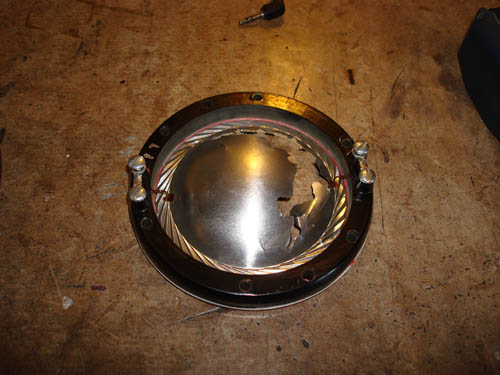
I just put a meter across the toasted diaphragm, I got a measure of 10 ohms of resistance. Would it be fair to assume that it really is more like 8ohms and that someone has already replaced the crossover and replaced a previous diaphragm? Speakers aren't my forté (I specialize in Megan Fox). Victor and I will try to get a picture up so that hopefully someone can better identify what's going on.
 
Posted by Steve Guttag (Member # 268) on 09-05-2009, 06:18 PM:
 
You can't use an Ohm meter (resistance) to read impedance. It will give you a ball park though. Typical impedance curves have the value decrease as it approaches "DC". It is possible someone has put in a 16-Ohm diaphragm or it may be a low reading 24-Ohm one. Remember, its impedance is important at frequencies ABOVE 500Hz on a diaphragm, not anywhere near DC.

Odds are, the crossover was not changed to suit the diaphragm...but we can get to the bottom of that...what model crossover do you have?

Steve
 
Posted by Jarret Chessell (Member # 5077) on 09-05-2009, 11:37 PM:
 
We'll unhook the screen and get back there tomorrow and get model numbers and pictures up.

Out of personal curiosity... say we took a diaphragm like this one, attached a frequency generator running at 500Hz, measured the potential difference across the diaphragm, and put it in line with an ammeter... would I be able to use Vrms/I=R to get a more accurate impedance measure?

I really should brush up my knowledge in this area, I do find it very interesting.
 
Posted by Steve Guttag (Member # 268) on 09-06-2009, 03:23 AM:
 
Actually, yes! If you were to take as many plot points as possible; that is say, starting just below 500Hz...say 300Hz (you need not nor should you do this at High Power!). Use your generator and verify constant voltage amplitude at each frequency, measure the current in the system. Do this at many frequencies and then plot them on graph paper, you could come up with the driver's impedance chart.

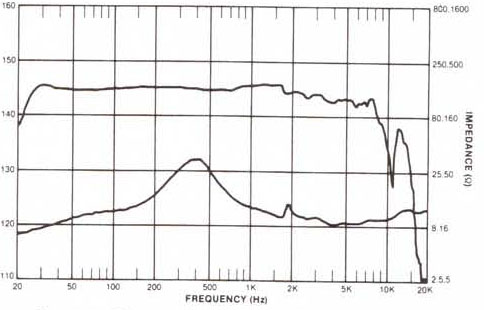
Here is an example of what a typical response chart is versus impedance:

 -

Note, this is a driver mounting just on a tube (for loading), not a horn. The lower line is the impedance and its values are on the right side of the graph. You'll notice that the value is rarely at the 8 or 16-Ohm mark. In fact, the driver impedance is typically the LOWEST it should be within its desired operating frequency range. Note too, near the crossover frequencies (500-1.5K, depending on the system)...that value may vary GREATLY. For the 16-Ohm version of the driver this plot was done for, it is at 50-Ohms!

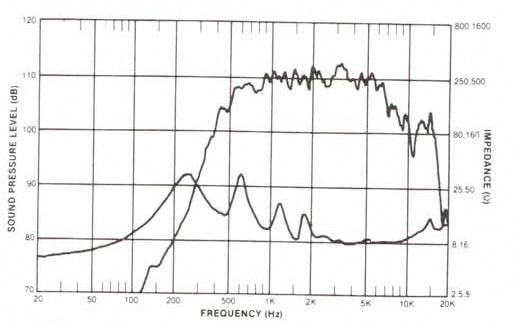
Something may seem amiss...so lets put a horn on the driver and see what things look like:

 -

Now things don't look so smooth (welcome to reality) but also the impedance dropped near the crossover region. It is closer to 35-Ohms. So even your measurement conditions will affect things.

This is one reason why passive crossovers are so tricky to get right. A driver's impedance number alone tells one very little. One really needs to design the crossover around the intended speaker system including all of its components in order to get a smooth transition. The more generic the crossover is, the less likely it is going to fit any particular system. A great advantage to bi-amping is that you remove all of this from the equation. The frequency response of the electronics (analog or digital) is going to be much more uniform through the crossover region. Most passive crossover systems (though certainly not all) today are really just accommodation crossovers that protect the drivers...they rarely, if ever, provide for a smooth transition in either level or even phase. At least in yesteryear, many of the crossovers had multi-tap inductors to try and better match things through crossover and also some adjustability on the HF response. Nowadays, things are pretty much "preset." About the only way a manufacturer can do a spec sheet though is basing the frequency response on an anechoic chamber, which as zero resemblance to a theatre. Which is why what a speaker's response looks like on paper often differs when it is in operation.

Steve
 
Posted by Sam D. Chavez (Member # 1841) on 09-10-2009, 09:22 PM:
 
(Sam is partially correct. If the system has a passive crossover and is expecting a 24-Ohm impedance, then you will alter the crossover frequency by not using the correct part. If it is an active crossover system (bi-amped) then you have many choices...including going down to 8-Ohms for better power efficiency from modern amps.)

Steve, Of course you are pedantically right as usual, but I was trying to deter the tech from putting a resistor in series with the driver and trying to offer practical advice.

Now, we don't really know if this was really a 24 Ohm system as the diagram or HF driver may have been changed a number of times over the years. We also don't really know what kind of crossover is being used here.

Strange things do happen when you misload a passive crossover and the absolutely correct impedance match may require any number of add-on auto formers and only two people I know will go the whole way to get this right.
 
Posted by Steve Guttag (Member # 268) on 09-11-2009, 01:14 AM:
 
Of course, I would never recommend using a resistor to alter the "impedance" of the system...I think my point was more that the correct part exists so why would you put in the incorrect one? Or why would one presume the system has been compromised (different components have been changed out). If anything, I was trying to point out the importance of the driver and crossover being matched as well as possible.

Now, as others have noted, Altec is one of those brands that I have taken a particular interest in and we support as well as anyone. In fact, we were pretty instrumental in getting Great Plains to continue the 20221 diaphragm.

Steve
 
Posted by Jarret Chessell (Member # 5077) on 09-11-2009, 01:27 AM:
 
I do appreciate the explanations and examples you posted Steve. It is a good read. I'm not trying to put the issue on hold.... I've had some issues at a different cinema with staffing and have been locked in a multiplex booth for some time now. Hopefully we can get more information up to tackle this problem correctly sooner than later. It would be nice to make sure everything is correct and is 100% the way it is suppose to be in this situation.

Thanks everyone for your input on this issue.
 
Posted by Louis Bornwasser (Member # 3063) on 09-11-2009, 12:21 PM:
 
I always heard that J.B.L. himself was a lefty which would account for the "backward" polarity. (ccw, not c.wise.)

Obviously, as Steve stated, impedance doesn't matter much if you are bi-amped; you can just reset the gain.

If you are not bi-amped, you must reset the "sensitivity" strapping or control to add or lose gain. A byproduct is that the crossover frequency will shift enough to measure, but it has always been inaudible.

We stock vintage, but new Altec diaphragms as well. Louis
 
Posted by Jarret Chessell (Member # 5077) on 09-12-2009, 12:25 AM:
 
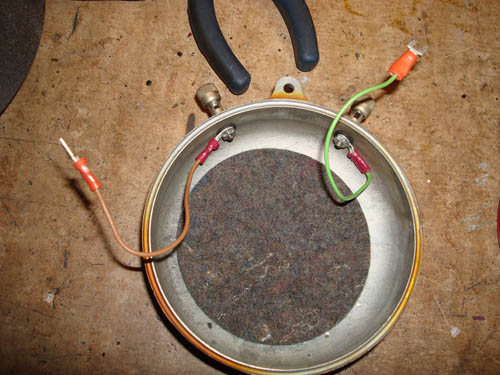
Okay, some pictures... hopefully we can sort this all out now. Photographer was Victor today [beer]

 -

 -

 -

 -

Let me know if you would like additional information,

thanks again.
 
Posted by Tony Bandiera Jr (Member # 2365) on 09-12-2009, 12:40 AM:
 
Sam and Steve:

I knew after I posted this

quote: ME
If so , you could add an 8 ohm, 50 watt resistor in series to get close to the original 24ohms (crudely).
(Bold added)

..That you guys would say something. [Smile] Yes it is NOT the right way to fix the problem, BUT in a very rough sense it should help--a bit. Is it good enough to compensate for the mismatch? Maybe, maybe not. Obviously impedance varies with elements of frequency, inductance (and capacitance?) as well as simple resistance. And as Steve's post with the curves showed, it will vary with the acoustic load on the diaphragm as well.

If I still had my old Altec horn and crossover I would love to set up a test and see what effect, if any, adding the series resistance would have. Would it be good or bad?
 
Posted by Sam D. Chavez (Member # 1841) on 09-12-2009, 01:50 AM:
 
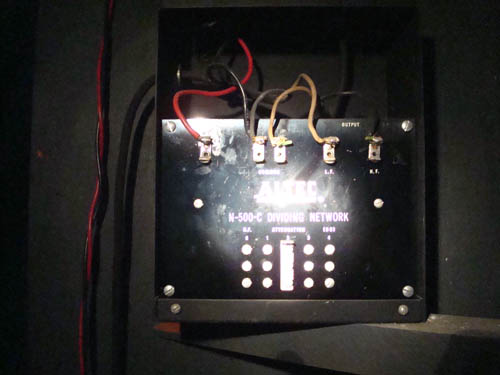
The crossover will like it better but you end up with less energy getting to the diaphragm so there would be a shelf in the response starting at 500 Hz as 1/3 of the energy intended for the speaker gets dropped across the resistor. You may be able to set the attenuator bar on the N500 crossover to make up some of it but it is the wrong way.
 
Posted by Steve Guttag (Member # 268) on 09-12-2009, 05:23 AM:
 
You definitely want the 20221 diaphragm with that set up (N500C). If you flip the diaphragm over and look on the silver ring, there will be numbers rubber stamped onto the ring...one is the ring's number and the other, if it is there should be the diaphragm number (ie 20221 or possibly a different impedance if it had been changed). There is also often the QC inspector's number stamped there.

You will need a diaphragm kit for a modern diaphragm for the shorter screws and the right angle push ons. In a pinch, you can always cut down the existing screws and solder the wires directly to the diaphragm but it is often just easier (particularly behind a screen) to just put the kit in.

Steve
 
Posted by Bob Koch (Member # 1062) on 09-12-2009, 01:58 PM:
 
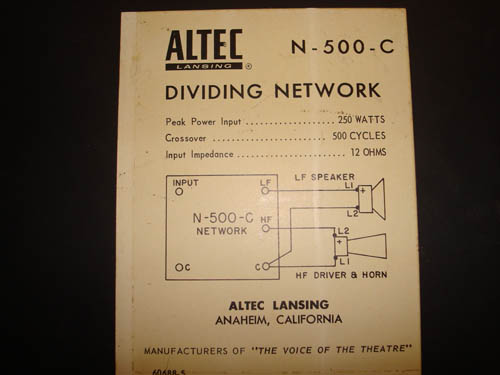
Note the electrical out of phase hook-up on the N500c diagram. Some systems used it; others did`nt. As with most everything else,I`ve forgotten.
 
Posted by Victor Liorentas (Member # 5272) on 09-12-2009, 02:29 PM:
 
Yes i found the #20221 on the diaphragm.
 
Posted by System Notices (Member # 2357) on 04-05-2011, 01:35 PM:
 

It has been 569 days since the last post.


Posted by Victor Liorentas (Member # 5272) on 04-05-2011, 01:35 PM:
 
I used a phase checker device to check phase on all my speakers and all was in phase but i decided to redo the connections on the 288c horn and swap the phase.
I wanted to hear the difference in sound on this center voice of the theater speaker.

At first i thought it sounded clearer but now i suspect it sounds wrong. Since i made 2 changes at the same time its hard to know for sure.I think the new clean connection helped but not swapping phase.
My silly question is should the horn of this speaker be in phase by design or out of phase?
 
Posted by Louis Bornwasser (Member # 3063) on 04-05-2011, 07:09 PM:
 
In former times, you deliberately introduced an out-of-phase, played a "warble tone" (500 Hz with frequency shift) and tuned the horn location for a NULL. Now, reverse the hf and you are "in phase." louis
 
Posted by Steve Guttag (Member # 268) on 04-05-2011, 08:37 PM:
 
Don't confuse the Altec diagram for wiring out of phase...just the opposite. Altec used a convention that had the L1, L2 terminals reference to motion relative to the magnetic structure. As such, Compression drivers push INTO the magnet on forward motion and Cone drivers push OUT of the gap on forward motion. Think of the compression driver as one that is physically mounted opposite from the cone driver. As such, they are IN PHASE to each other if they are wired opposite (L1 on the HF driver is "-" but "+" on a cone driver.

-Steve
 
Posted by Victor Liorentas (Member # 5272) on 04-05-2011, 09:55 PM:
 
Thanks guys!
I used a scv phase checker connected to each amp one at a time which sends a click sound to the speaker and the other piece has a microphone.Placing it directly in front of each driver a green light comes on when in phase and a red when out.
So every driver on every speaker(all 2 way passive) gave a green light. I then put the horn out of phase and the red light came on.
The reason i used this scv phase checker was to be certain of phase despite the wiring.

My question put another way is from the factory would you get a green light or a red light?
 
Posted by Victor Liorentas (Member # 5272) on 04-07-2011, 12:08 PM:
 
So i put the horn on my center speaker back in phase but under my flashlight i could not see positive and negative but i do know that L1 is connected to the left side of horn if your facing the projector.
 
Posted by Steve Guttag (Member # 268) on 04-07-2011, 02:03 PM:
 
Altec did not use Blk/RED or pos/neg...they used L1/L2. Remember, whomever installed the diaphragm needs to have been installed properly such that L1 is connected to L1
 
Posted by Victor Liorentas (Member # 5272) on 04-07-2011, 02:21 PM:
 
I installed the diaphragm months ago (correctly i hope)but since switching to a cp 55 from a Smart mod 8 i have this nagging thought that maybe i got something wrong.
It sounds very good but on some older mono films like Jaws i wonder if it could be a tick clearer in the highs.

Is it possible the mono eq on the cp 55 needs adjusting assuming the Altec Lansing speaker is correct and is there much to tweaking the mono eq without a RTA?
I don't know for sure if the mono eq was optimized or not.
 
Posted by Steve Guttag (Member # 268) on 04-08-2011, 09:49 AM:
 
The diaphragm, if the older style, will have an "L1" rubber stamped on the side of the support. If it is more modern, it will have a sticker...a nuance that may be missed by some.
 
Posted by Victor Liorentas (Member # 5272) on 04-08-2011, 01:00 PM:
 
OK thanks Steve and Louis! [Smile] I am now certain i installed it correctly and phase checking was not needed but it was fun!

I think the issues I am having are due to the cp55 mono eq as every other format sounds great and mono + digital were the only formats sounding good when the Smart Mod8 was drunk at the wheel [Razz]


Powered by Infopop Corporation
UBB.classicTM 6.3.1.2