This is topic Dolby Fader Levels in forum Film Handlers' Forum at Film-Tech Forum ARCHIVE.


To visit this topic, use this URL:
https://ft-forum.com/ft/cgi-bin/ubb/ultimatebb.cgi?ubb=get_topic;f=1;t=004375

Posted by Ken Lackner (Member # 1002) on 01-01-2003, 10:58 AM:
 
What do the numbers on the Dolby faders mean? Are they decibels, or some other unit, or just some arbitrary numbers that Dolby came up with and decided to make "standard"?
 
Posted by Steve Guttag (Member # 268) on 01-01-2003, 11:09 AM:
 
Are you referring to the 0-10 numbers?

If so, then they predate Dolby by quite a long time...it merely breaks the frader's travel into 10 equal amounts and nothing more.

The desire for 7.0 to be the reference has to do with keeping the traditional analog fader from the most sensitive part of it's travel (the lower numbers). Where as the difference between a fader setting of 7 versus 8 might be on the order of 3 dB , the difference between say 3 and 4 might be as much as 20 dB. You can think of the area around "7" as the sweetspot of the fader's range. I'm sure another issue was the ability of the earlier VCA's to track with each other...as one got down the sensistive part of the range, I'm sure the channel-to-channel balance was more likely to be erratic.

Now having 7.0 corresspond to 85dB was fine for analog with only 6dB more of level (91dB)...with Digital and nearly 20dB more level left...many are reducing their faders down to the 4-5 range...which is not what the original intention was.

So Ken, was your question about the 0-10 scale?

Steve
 
Posted by Ken Lackner (Member # 1002) on 01-01-2003, 11:21 AM:
 
That's exactly what my question was about! [Smile] Yeah, my theater has most of it's faders down in the 5 range. [Frown] We get way too many volume complaints when we go much above 6. Our tech does have the processors properly calibrated. So if films are intended to be run at 7, why so many volume complaints??

So if I understand you correctly, a jump from one level to the next (3 to 4, 4 to 5, 5 to 6, etc...) does not correspond to any specific dB level?

quote:
Now having 7.0 corresspond to 85dB was fine for analog with only 6dB more of level (91dB)...with Digital and nearly 20dB more level left...many are reducing their faders down to the 4-5 range
I really don't understand what you mean by that. (Not the part about people reducing their faders, I just said that my theaterd does that too!)

quote:
If so, then they predate Dolby by quite a long time
So whered did this standard come from?
 
Posted by Steve Guttag (Member # 268) on 01-01-2003, 11:44 AM:
 
It isn't so much of a standard as a convienient way of numbering any gerneric fader...even THIS IS SPINAL TAP made fun of the way faders are numbered by making note that Marshall amps have their faders go to 11! To which the reporter asked...well why not make that "10" and renumber it?

So yes, the numbers have no correllation to a dB change. You will find knobs having a 0-10 scale though out their history. Some have called their faders "attenuators" and number them from -infinity to 0dB (no attenuation). For a simple pot that is correct. People don't normally work well with negatives so you wouldn't want to tell people to "set your faders to -5". It is easier to set to 5 or 7. Sony decided to have their fader on the dB scale with "0" being normal, or equivalent to "7" everywhere else. They only gave you a +/- 10 dB range and a knob resolution such that you needed a Makita to spin it down to -10 as fast as you could to get people's ears to stop bleeding. When they came out with the 3000 series they now have +10 but -30 dB. Note the Sony method hasn't taken in the Cinema Industry....Peavey tried something similar with their CinemaAcoustics stuff...a "0" ref with +/- from that.

The pro sound guys try to just bring in their ways and this industry just doesn't change that fast.

SMART took a rather interesting approach on some of their processors...the ModIII only had ONE marking on it..."CAL"...which was used for calibration only. After all, you will turn the knob up or down to satisfy whatever complaints you are having. Since the numbers have no correllation to anything anyway, what difference does it make? (The ability to set things uniformly comes to mind)

So as to digital...if you are mixing a film you are going to get your dialogue levels right and hopefully that will be right for any format of sound...mono though digital. Then the music and effects are added, and added, and added...I little known feature of film mixing consoles are the fader rachets...just like on a roller coaster, once a fader has been slid up...
it may never be brought down again ! Thus films only get louder from there. As the recordest is exposed to these insane levels longer, the less sensitive they get to it and they climb yet higher! Even the dialogue will start getting boosted so as to not get lost on all of these expensive and impressive music and effects.

When you only had 6dB more of range from reference, well that is all you could go up. With 20 dB more, you have a lot more sound you can put down and, unfortunately, they do! I love a loud "sting" as much as the next guy but when the whole damn film is loud...it actually takes away from the track...nothing is emphasized since it ALL is.

So what does 90% of all theatres do...they reduce their fader...for the most part that works but the big explosions are less big and more importantly, the dialogue is reduced to the point where I find it too soft.

Steve
 
Posted by Christopher Seo (Member # 7) on 01-01-2003, 12:32 PM:
 
Steve,

I don't understand the relationship between the headroom of the soundtrack and the level reserve on the fader. Are you saying that given the increased headroom of digital soundtracks, technicians are purposely calibrating systems at 4-5 on the Dolby fader? What would be the purpose of this? Certainly, digital tracks rarely need to be turned up past reference....

So how precisely should Dolby's guide (from the CP650 manual) be taken-- that each increment from 4 to 10 represents 3-1/3 dB, and each increment from 0 to 4 represents 20 dB? Are the digital faders better calibrated than the analog ones?
 
Posted by Steve Guttag (Member # 268) on 01-01-2003, 01:10 PM:
 
Nope you are missing the point....

The people mixing the films have the ability to make LOUD sounds LOUDER and they do....too much. You could probably run your Woody Allen films at 7.0..even in digital even though you probably run your normal digital films at 5 or so.

As to the Dolby manual and the CP-650....in all seriousness...the CP-650's 7.0 is actually 2 dB louder than any other Dolby processor in the past. So yes if you set the CP-650 to 85dBc...it will actually be louder than anything else.

As to a digital fader...that is entirely up to the designer...You can set the scale anyway you want. As I recall, the CP-650 has a double knee...a rapid assent up to something like 4.0 then it changes its slope up to around 7.0 and finally changes its slope again. I think Dolby publishes the actual fader characteristics.

They didnn't publish the CP-500s...and for good reason...I don't think there was any level change below 3.0 or above 9.3

But as has been hashed above...it doesnt really matter what the slope is...what matters are two things...what is reference (that is what was the film actually mixed to) and what level is comfortable to your audience. It is good to know if the level will change drastically below a certain point, I agree.

If that level is 5.0 or +1.8dB or "11", who cares? You know what reference is and you know what level your audience will tolerate.

Steve
 
Posted by Christopher Seo (Member # 7) on 01-01-2003, 02:21 PM:
 
I understand your general arguments... I am, rather, confused about a specific statement you made, the same one that Ken mentions:

quote:
Now having 7.0 corresspond to 85dB was fine for analog with only 6dB more of level (91dB)...with Digital and nearly 20dB more level left...many are reducing their faders down to the 4-5 range...which is not what the original intention was.
You are implying that the increased amount of headroom available with digital makes 7.0 a poor fader setting choice, whereas it is acceptable for optical analog. What is specifically wrong with "having 7.0 correspond to 85 dB," and what do you think would be a better choice?

As far as the Dolby fader characteristic, I was just wondering how well the faders are calibrated; i.e., can I really expect lowering the fader from 7 to 6 to yield a precise 3-1/3 dB reduction in SPL, especially with analog faders. I would imagine a discrete shaft-encoded digital fader to be more precise in this regard. I know the precision is not critical as long as one knows what is relatively good levels, but it's nice to know that when the editor of a film yells for 2 dB more, one can set the fader accordingly.
 
Posted by Howard Johnson (Member # 62) on 01-01-2003, 02:27 PM:
 
We just had a second screen added with 120 seats and DTS we opened with Die Another Day. This film is so loud that we were running it at 3 1/2 we just couldn't stand it louder. The dialogue is a little soft but if we ran it louder audiences complained, there are so many guns and explosions. We now have Harry Potter which is fine at 5 we can hear all the dialogue and effects so I agree about the sound mixers they must be deaf!
 
Posted by Adam Martin (Member # 641) on 01-01-2003, 02:42 PM:
 
I think that the room acoustics and equalization also affect what the audience perceives as volume. Severe echo and poor equalization will make the audio sound "harsh", which the audience will equate with "loud". Poor audio characteristics may also originate with the wrong equipment chosen for the room, a crappy soundrack builder, or improper installation of equipment.
 
Posted by Antonio Marcheselli (Member # 373) on 01-01-2003, 03:23 PM:
 
Howard,

If your system was right at 3.5.... I believe that something was wrong! It cannot be right, also with a very loud movie. I would say that, with a "difficult" audience, 5.0 is the lower volume I can set with any kind of movie.

And, I fully agree with Adam.

About what Steve said: I believe that he meant that if you set the fader at 3.5 you'll loose all of Digital Dynamic. Let's suppose that 7.0 is 85dB and you have a +20dB of headroom. If you set the fader at 3.5 most of the softer sound will be lost because too low. So the total dynamic is reduced rather then projecting a movie at 7.0
Steve, am I right?

Bye
 
Posted by Howard Johnson (Member # 62) on 01-01-2003, 03:31 PM:
 
Hi Antonio, this new screen was properly set up just before christmas with a Vic5B and DTS. The installation engineers felt we should run the Bond film louder but we felt locally that it was too loud for our audiences and us in such a small screen. The Harry Potter film sounds great at 5-5.5 because it hasn't got the continuous bangs you can appreciate the quality of the soundtrack.
 
Posted by Antonio Marcheselli (Member # 373) on 01-01-2003, 03:40 PM:
 
Howard,

There is a LOT of difference in volume between 3.5 and 5.5. 3.5 is, I believe, the minimum fader you can set on the dolby. At 3.5 the dialogue should be barely audible. I had once the privilege to project a show at 3.5 (an action movie) and with 10 people in the auditorium 7 was out to complain.
I understand that 007 is a very loud movie but HP has its loud scenes too! I cannot understand such a difference in fader with two DTS movie.

Bye
 
Posted by Howard Johnson (Member # 62) on 01-01-2003, 03:55 PM:
 
Antonio, Perhaps the print of Bond wasn't very good although the timecode shouldn't be affected. We are new to DTS so we are learning as we go I am looking forward to some more DTS films booked "Rabbit Proof Fence" "The PIanist" "Gangs of New York" and "Chicago" I think that "Gangs" will be noisy but we will see. At the moment we are running Harry in mono instead of DTS as a card has gone in the Dolby unit, I am hoping to receive a new one in the post tomorrow, today being a public holiday.
 
Posted by Gordon McLeod (Member # 33) on 01-01-2003, 05:21 PM:
 
The number means nothing other than a reference one could set up a system with 85dbc at 8 and then most theatres would run at 6 instead of 5 and so on
Bottom line it is the fact that with the increased overused capacity for LOUD that the faders get turned down. The average dialogue is still the best at 7
As fo EQ it is not really the problem as when set up following the ISO curve it is way the mixers did it and you know I have had many ocassions when the manager and audience say turn it down and the mixer says absolutly no
 
Posted by Steve Guttag (Member # 268) on 01-01-2003, 05:30 PM:
 
Obviously, something is being lost in the ASCII translation here.

I am NOT advocating lowering the reference level at all. What I am saying is if the recording engineer only has 6dB available of extra headroom for explosions, music and effects, that is what they seem to use...with digital, they have 20dB and that is what they seem to use ALL THE DAMN TIME.

The problem isn't with the reference level...it provides a wonderful dynamic range to give the ability of the recording engineer to make loud things loud, soft things soft and everything in between....by lowering the fader, you have, in effect, squashed the dynamic range of the system.

This is not the exhibitor's fault. The problem lies with the recording engineers! They don't leave that 20 dB of headroom alone and keep it in reserve for the really BIG LOUD STUFF.

So if you have a guy that records dialogue at a comfortable and natural level but will always record music and effects at the top-end of whatever medium he has, then with a digital track it will be way too loud...with an older optical track it will only be 6dB louder...the track in effect, put a "governor" on his mix board.

Dolby made a nifty gadget which has been dubbed the "annoyance" meter. It merely gives an ongoing account of the relative level of a film over time. It doesn't correspond to dB persay but some propritary level called Leqm.

What it does is measure the soundtracks for the entire length...and comes up with a single number represenation...the higher the number the louder the film overall.

Its nifty since the weight of any part of a film is proportional to the length of an entire film. If you have a 3 hour epic, then a short 1 minute bang em up sequence will not drive your number up substantially.
This device has been in use now with the mixing of trailers and has contributed to lowering the overall level....with a trailer the entire feature is only a couple of minutes so each loud passage represents a major portion of the score.

If the industry adopted the use of this device on mixing features and put requirements on its use in order to receive an MPAA rating and basically put a watch dog on the recording engineer, the excessive levels would come to an end.

Yes, Adam does bring up valid points...the acoustics of the theatre and tuning definately contribute to the harshness of the track too.

As to accurate...the analog faders can be quite accurate...the older ones made with discrete components were less so. Digital faders offer the flexibility of programing the exact response of the fader over it's entire range. With an analog fader, you are even depending on how well the index line was put on the knob.

Steve
 
Posted by Brad Miller (Member # 2) on 01-01-2003, 05:47 PM:
 
I think the biggest confusion here is that most people assume that my 6 is equal to your 6 which is equal to the theater down the road's 6 which is also equal to the theater in the next state's 6 and so forth. Not so. Adam put it best. Acoustics and calibration will make a WORLD of difference. Good acoustics and good EQing I find commonly ends up running movies at 7. Good acoustics but poor EQing generally ends up at 6. Poor acoustics and poor EQing commonly plays at 5 and so forth. They both interact with each other. No two rooms will ever sound the same (they may be similar, but not exactly the same). Also no two faders will ever perfectly match if you go by the numbering scheme. Those numbers, like Steve said, are just there for convenience. And shame on the Mod III for not putting any markings on there. I used to work at a theater that had one of these and when we would do double-ups on that screen we couldn't just leave a note that said "matinee movie = 6 / evening movie = 6 3/4". Oh no, we had to leave notes like "turn the evening movie up about 1/8 inch with the matinee movie about 1/2 inch down from CAL" and so forth. Foolish! The numbers are a guide for booth staff and for the tech to reference 85db at 7, nothing more.

Antonio, Die Another Day was recorded insanely loud. Even at theaters that normally run most movies around 6 1/2 - 7 was running this latest Bond film at 4-5. Often the center channel had to be brought up a couple db too for this particular film so the dialogue wouldn't be lost.
 
Posted by Jack Ondracek (Member # 1466) on 01-01-2003, 06:20 PM:
 
quote:
Often the center channel had to be brought up a couple db too for this particular film so the dialogue wouldn't be lost.
We had to do this with "Ghost Ship"... something I was extremely reluctant to play with because I'd had a tech (with gear I haven't bought yet) come in and align my whole place. It had to be done though... you couldn't hear the dialogue at all through the other stuff going on.
 
Posted by Antonio Marcheselli (Member # 373) on 01-02-2003, 03:36 PM:
 
Brad,

Thanks, 007 isn't arrived yet in Italy...

Let me make a question: if a movie is recorder soooo loud that you have to set it at 4.0, the dynamic range of this movie will be the same if recorded at a "normal" level and projected at 7.0?

Bye
 
Posted by Brad Miller (Member # 2) on 01-02-2003, 03:39 PM:
 
Well, the track could always get quieter, but recording at such a loud level kills the option for the mixers to make certain scenes louder than others, as they are already near the point of clipping. My bet is that Die Another Day was recorded like that because most theaters leave their faders at one setting and they wanted to make sure it played as loud as possible (understanding that most people set their faders on the trailers and leave it for the feature).

Personally I would do exactly the opposite. I would record my films lower so that a fader that normally runs movies at 7 would have to be played at 8. This would not only be such a drastic difference in level between the trailers and feature thus requiring the projectionist to change the setting at the start of the feature, but it would also give me more "power" when I wanted it.
 
Posted by Antonio Marcheselli (Member # 373) on 01-02-2003, 05:09 PM:
 
Brad,

I agree with you. Why destroying a soundtrack just because there are bad theaters/projectionists in the world? [Wink]

However, I feel that 3.5 is not an usable fader, even with a very loud movie. As many of you said, most Dolby's fader drop drastically under 3.0. Loud or not I believe that 3.5 is a symptom of something wrong. But I can be wrong.

Bye
 
Posted by Christopher Seo (Member # 7) on 01-03-2003, 03:14 AM:
 
According to at least the CP650 fader characteristics, a setting of 3.5 is 20 dB below 7.0. That certainly indicates some kind of B-chain calibration error(s).
 
Posted by Jean-Michel Grin (Member # 1360) on 01-03-2003, 03:27 AM:
 
It's not a easy job to set the level right: We receiving a lot of complaints from patrons they find the level too loud or too weak. For example I play the comercials and the trailers, recorded in Dolby SR or SRD at 3,5 on the CP500. And rising up the volume at the begining of the main feature in a range of the fader setting between 5 up to 6.5.
Everything depent of the movie.
 
Posted by Antonio Marcheselli (Member # 373) on 01-03-2003, 02:56 PM:
 
Jean-Michel

I know that movie's fader is not always the same and that promo, trailer and adv are often to be projected at a very low volume. But I believe that 3.5 is too low for everything!!! It may be the movie, but I just suspect something wrong in the B-chain setup or in the DTS level settings.

Bye
 
Posted by Jean-Michel Grin (Member # 1360) on 01-03-2003, 05:02 PM:
 
Antonio,

Thanks for your advice, but I assure you that all dolby processors ave been carfully adjusted with A THX R2 analyser.
The guilty becomes to the sound mixing studio they mix the sound of the comercials too loud. and the patrons will complaint seriously. That's why I reduce the level at the main fader.
But I dislike when a sucker projectionist put the volume all the way down. It seems to me like watching a a movie on my TV set with a poor sound [Mad]
And last week I've checked all Dolby level with a Cat 69T test loop and I assure you that all DTS 6 an DTS 6D are adjusted on 300 mv, a tipical level for the CP 500 and 650.
The problem come from the peoples they dislike a real digital sound.
In 1998 I visited the Cinema Expo in Amsterdam and saw the first premiere of the movie Godzilla. The level setting of the CP500 was 8.5 ! [Eek!] Damned; my ears was painful for one day later !

Bye, happy new year and I beg your pardon for my weak english
 
Posted by Darren Briggs (Member # 1071) on 01-03-2003, 05:19 PM:
 
Well seem to find that in my THX screen most major films like LOTR II and Harry Potter II run at fader 5, but in the other two screens, need to run at 6, all runing SRD.
Very rarely i have to run at 7 in any screen apart from when screening old Variable Denisty mono tracks.
All adverts and trailers run at 4 or 4.5 Max in the THX screen and 4.5 in the other two screens.
Once you know your theatre you tend to be able to guess a fader setting at the start and then go check it in the auditorium ASAP once the film is running. When rehearsing films to myself i tend to like films loud, but also make sure i have a fader level checked for Public screeings.

Darren.
 
Posted by Antonio Marcheselli (Member # 373) on 01-03-2003, 05:39 PM:
 
Jean Michel

I didn't mean that your system had bad B-Chain, you said that you keep film between 5 and 6.5 and it is a resonable fader for a sound system. Let's ignore the adv, I also was used to show adv at 3.5 once...

What I beleive is that if you need to show a MOVIE at 3.5 so, I believe, there is something wrong with the B-Chain. Let's count the acoustic, the speaker, the EQ... 3.5 is always too low for me also for a poor theater acoustic.

I watched Godzilla at 7.2 and my ears was painful too... But was a great experience!!! [Smile] [Smile]

Ehi, you are from Europlex: your society just bought Kinepolis theater in Italy. I have a friend of mine in that multiplex!!

Bye
 
Posted by Ron Lacheur (Member # 1126) on 01-04-2003, 01:28 AM:
 
When we opened Bond, the faders were set at 6.5. This was in a THX theater and we had no complaints to my knowledge.
 
Posted by Jean-Michel Grin (Member # 1360) on 01-05-2003, 10:19 AM:
 
Yes Antonio,

We bought screens in Italy.
Last years and in december 2001 we opened two multiplexes in Greece and in september 2003 we will open 8 new screens in Lausanne (Switzerland) Con tutti Cinemeccanica V5 [Smile] I hope this year or the next made vacations in Italy, but for this moment I'm too bussy.

Bye
 
Posted by Karen Hultgren (Member # 395) on 01-07-2003, 12:02 PM:
 
A fader level of 3.5 seems way too low. Something is not right.

As far as DTS is concerned, we ask that the DTS levels be set to match the cinema processor (CP). To do that, use the DTS "DS3" setup disc's tones and set the DTS outputs for 300mV RMS (unplug the DTS player from the CP and use the E313 break-out board with a multimeter). The 300mV RMS level should match yout CP's buss level. Consult your CP's manual to be sure it's buss level is 300mV RMS.

Karen at DTS
khultgren@dtsonline.com
 
Posted by Jean-Michel Grin (Member # 1360) on 01-07-2003, 02:25 PM:
 
Hello Kareen, Nice to meet you.

I have really checked the outputs of my DTS-6 with the DS3 setup disc. It was 300 mv and everithing work fine.

The problem that we have comming from the peoples in the auditorium (the patrons ? Sorry, my english is too weak) they don't like listen the sound too loud for the commercials and the trailers. They don't care about it, and many time theses peoples complaint at the projectionist and ask to reduce the fader level.
I'ts a shame for me, I really like a powerfull sound; this is a part of the magical at the movie theater. But you know, patrons rules and many time the manager notify to me to reduce the fader level because the patrons complaints.
I remenber me one way, I played the movie "Revelation" a movie about the danger of smoking. The soundtrack and the dialogues was verry quiet. And so I played with the fader on "6". A lady come to me and told me: Are you crazy ? the sound is too loud ! Reduce it now ! I've reduced the level to "4" [Eek!] The dialogue was just audible.But the lady come back one more time and asked to me: Are you stupid ? I told you to reduce the volume. That's unbeliveble Sir ! I will complaint me on your boss !
You see the problem is fron ours customers...
But for me a minima level seting for enjoy a movie not should be less than 6,5 on a processor [Smile]

Kareen I have a question: In a precedent thread you talking about a periodical check of the power supply voltage on a DTS Reader. Could you Mail me the procedure, I can't find it on my DTS book.

Thank you, happy new year, and appologises for my really weak English !

Best regards,
 
Posted by Mike Baer (Member # 1519) on 01-07-2003, 02:45 PM:
 
@Antonio

it is not true,that Europlex boughtv Kinepolis Milano.
I work for this chain.

Greetings Mike
 
Posted by Michael Brown (Member # 890) on 01-07-2003, 03:36 PM:
 
quote:
Personally I would do exactly the opposite. I would record my films lower so that a fader that normally runs movies at 7 would have to be played at 8. This would not only be such a drastic difference in level between the trailers and feature thus requiring the projectionist to change the setting at the start of the feature, but it would also give me more "power" when I wanted it.
Would just end up with the film being played too quiet at many cinemas.

Everybody should mix their films, adds and trailers so that they sound correct at 7. No excuses. That would solve all the problems.
 
Posted by Michael Schaffer (Member # 1204) on 01-07-2003, 04:53 PM:
 
Actually, in my experience, most movies are not too excessively loud when played back on decent and well set-up sound systems at Dolby 7 or SDDS 0dB. The problem is that there are many sound systems which can`t handle high playback levels very well. The resulting "dirty" sound is what makes them appear too loud and unpleasant as we humans do not measure sound levels with our ears but perceive loudness subjectively.
I can imagine that most professional mixing studios have state-of-the-art sound systems and when they play their mix on them, it doesn`t seem too loud.

Dolby probably also decided to make 7 the standard setting to make the processor compatible with the majority of mono releases at that time. Turning the fader up to 10 gives an extra 10dB which is often necessary for old mono films.
 
Posted by Antonio Marcheselli (Member # 373) on 01-07-2003, 07:19 PM:
 
Michael is right on sound quality. If a good sound seems no loud at 90dB a poor one can be "loud" at the same 90dB.

Jean-Michael,
I agree with you about the adv and trailer, I usually project them at 4 or less, this is very normal! But I believe that no one with a good sound system should show a movie at a fader level less than 5.0 other than in some strange circumstances.
All of us has some patrons that are complaint for volume too loud when you are at 4.0... I had once XXX in a DD theater, running at 6.0. I believe that 6.0 was ok, I would set 6.3 perhaps!
There were 4 people in the theater. They complained that the volume was too loud. The ushers told us that that people were the only ones in the theater, so I set immediately the fader at 5.0
Few minutes later there was another complaint about the volume: "too loud". I set down to 4.0. Then that people go away before the end of the movie.

The conclusion is: there are people that are used to the 14" TV, and they'll never understand why at cinema the sound should be so "loud". They think that stereo sound, subwoofer sound, surround sound is "too loud" and they are unhappy of that. I have a talk with a patrons once that says that the movie was great but that she don't like the "echo" from the Dolby. "First you hear the gun from the front and then from the rear". She didn't realize that the rear sound were independent from the front sound! He also told me that in some scene he heard sound from back and believed that people was making noise out from the auditorium... I believe that that kind of people are unable to "immerse" themself in the movie. In fact, they're unable to enjoy a movie!

With this kind of people there is no hope!!! [Smile]

Mike,

Do you work for Kinepolis or Europlex? I have a friend that are working in Kinepolis Milano, he told me that it is an official news!

Bye
 
Posted by Ray Derrick (Member # 1001) on 01-08-2003, 01:35 AM:
 
To get back to Ken's original question, the graduations (0-10) on an audio fader are intended to represent equal increments in perceived loudness. If you turn a fader slowly from 10 all the way down to zero at an even rate, the volume should appear to reduce in a smooth linear fashion. Analog faders use what is known as a "logarithmic taper". This is because human hearing is essentially logarithmic in nature, and using a linear fader would cause the apparent volume changes to bunch up at one end of the fader travel.

Experience in studios over the years has shown that modifying this logarithmic taper can further improve the apparent smoothness, so high quality faders, such as on mixing consoles, use what is known as the "audio taper". The attenuation per division between 10 and 4 is about 3.3dB (making "4" about -20dB below "10"). Below about 4, the rate of attenuation per division may increase in one or two steps (the points of change in slope being the "knees" mentioned by Steve G), or the rate of attenuation per division may increase in many small steps.

Faders on cinema processors may vary somewhat in their attenuation above and below the playback reference level of 7, particularly between processors using conventional analog pots and those using digital rotary encoders, because encoder systems use a lookup table to determine the volume for any given fader setting. So even though the settings all match at level "7", a setting of "4" on a CP500 may be somewhat different to a CP55 or whatever. So one projectionist's 5.5 may be a little louder or softer than another's.

Finally, 70% was chosen for the playback reference level for several reasons, including optimising dynamic range through the cinema processor whilst allowing up to 10dB of gain for very soft soundtracks or where the cinema wants to play a film extra loud for a specific audience - say a rock musical for a young audience who want to hear it LOUD. Also it has always been standard practice in professional equipment to have "10dB in hand" above normal operating level on the fader.
 
Posted by Jean-Michel Grin (Member # 1360) on 01-08-2003, 04:57 AM:


Posted by Michael Schaffer (Member # 1204) on 01-08-2003, 09:02 AM:
 
I don`t think I understand what you are saying, Jean-Michel...

Derrick, how is the difference in the steps above and below 4 implemented technically in an analogue fader?

Antonio, we all know how stupid some people are... Once we played a film (I don`t remember which) with some scenes in a wet cave and you could hear the water running down the walls. A lady came out and complained that there was water coming out of the walls, and when I explained to her that that was an intended effect from the surround speakers, she became very aggressive and insulting. After the show, when the lights came on, I went into the cinema and pointed out the dry walls with the surround speakers and she just ran out furiously...

A final point: People`s TV sets at home are not only less loud, they have no dynamic range. Most people are not at all used to dynamic range as the difference of soft and loud. They simply don`t understand it and can`t handle it as their TV sets and the stuff they listen to on their car radios all has the same narrow dynamics and can therefore be easily turned up and down without losing the proportions (as there are none).
 
Posted by Karen Hultgren (Member # 395) on 01-08-2003, 11:40 AM:
 
Hello Jean-Michel,

Many times the trailers are mixed louder than the feature. That is the way they are delivered to us so that is the way we reproduce them. We never change the mix.

In regards to the reader head, please email me and I will send you the instructions for calibrating it.

Your English is great! I understand you just fine! :-)

Karen at DTS
khultgren@dtsonline.com
 
Posted by Patrick de Groot (Member # 858) on 01-08-2003, 03:35 PM:
 
There is a pdf file from Dolby which discusses the topic "Are Movies Too Loud?"
http://www.dolby.com/tech/toolouds.pdf
 
Posted by Ray Derrick (Member # 1001) on 01-09-2003, 05:44 AM:
 
Schaffer, low cost rotary analog faders use a wiper on a carbon or conductive-plastic track, and the taper is logarithmic (commonly known as Curve C). The track is manufactured so that it's resistance increases more or less logarithmically from one end of the track to the other. "Straight-line" studio faders, such as those made by Penny and Giles, may use several wipers and tracks to achieve more elaborate audio tapers. However the audio taper can be accommodated even in a rotary single-track fader by careful attention to the way the track is manufactured, but these are generally considerably more expensive. From memory, the fader on a CP65 is a linear type and the log or audio taper characteristic is achieved either via the VCA control circuit or in the VCAs themselves.
 
Posted by Michael Schaffer (Member # 1204) on 01-09-2003, 11:03 AM:
 
Thanks for the explanation!
quote:
The track is manufactured so that it's resistance increases more or less logarithmically from one end of the track to the other.
How is that achieved? Do you have a drawing of a fader taken apart?
 
Posted by System Notices (Member # 2357) on 06-17-2015, 06:47 PM:
 

It has been 4542 days since the last post.


Posted by Aron Toplitsky (Member # 6950) on 06-17-2015, 06:47 PM:
 
I just have to ask you all, would anyone know if the screening rooms on Hollywood lots play there films at the 7 setting?
 
Posted by Mike Blakesley (Member # 26) on 06-17-2015, 09:02 PM:
 
They tend to play at whatever the person in charge (director, studio head or such) wants.

There is an endless debate over what sounds good. The main schools of thought are:

- Movies are designed to be played at 7 so they should be played that way no matter what, dammit

- No two theaters are the same, soundwise, so the manager should listen to each movie and decide what sounds best based on the dialogue scenes. Then take into account the type of movie and the type of audience it's playing to (i.e. an action comic book movie can be louder than a "Driving Miss Daisy" and please the audience)

I happen to subscribe to the second group. It was confirmed for me that I belonged in this group when I saw one of the Transformers movies at the Dolby Screening Room in San Francisco. It sounded awesome, but was unbearably loud and I spent the whole movie wishing I had access to the fader. (I suppose the fact that it was a crappy movie didn't help.)
 
Posted by Jim Cassedy (Member # 4115) on 06-17-2015, 10:52 PM:
 
quote: Aron Toplitsky
would anyone know if the screening rooms on Hollywood lots play there films at the 7 setting?
I don't know what they do down in Hollywood, but I do many studio screenings at Dolby's screening
room in San Francisco, and my 'default instructions' there are to run everything at fader level "7"

I can think of only two times in the past year when a director has specifically asked me to
'turn it down a notch". (Unfortunately, I don't have a 'notch meter'- so it's somewhat subjective)

As a bit of fun trivia- - the Dolby room is pretty much acoustically agnostic. The seats were
designed to have the same sound absorbtion properties as the human body, so the room
essentially sounds the same no matter how full or empty it is.
 
Posted by William Kucharski (Member # 7246) on 06-17-2015, 11:32 PM:
 
It was confirmed for me that I belonged in this group when I saw one of the Transformers movies at the Dolby Screening Room in San Francisco. It sounded awesome, but was unbearably loud and I spent the whole movie wishing I had access to the fader. (I suppose the fact that it was a crappy movie didn't help.)

As a fan of at least Transformers 1, 3 and 4, I'd love the opportunity to hear it in a "too loud" theater though the local IMAX did a respectable job with the title.

I went to see it again at a local AMC and went to the lobby twice to ask if they could turn it up at all; so disappointing.
 
Posted by Randy Stankey (Member # 64) on 06-18-2015, 12:47 AM:
 
I happen to be in the camp of "Correctly calibrate your processor."

Yes, I understand that there are people who mix movies way too loud and that even when your processor is calibrated correctly, you still might end up being too loud.

Yes, I understand that movies vary and that the operator should check the levels for each movie and adjust the fader accordingly to the tastes of the audience and the style of movie.

Yes, I understand that equipment and auditoriums vary and that it is very hard or even impossible to calibrate two systems to sound exactly the same.

But I also believe that the technician should take the time to do the job right and that when he does, problems with wildly varying fader levels will be lessened.

The last theater where I set up a 650 would regularly run movies with the fader set between 6.5 and 7.0. Some movies that were extra loud needed the fader on 6.0 but others but some really quiet movies needed the fader on 7.5.

I rarely had to set the fader outside that range.

I say, if you do need to run with your fader too high or too low, you need to get your processor calibrated correctly.
 
Posted by Aron Toplitsky (Member # 6950) on 06-18-2015, 02:11 AM:
 
This is all very interesting! Thanks all for responding.

So when a few new films open at let’s say a local 18 screen AMC, will a projectionist actually take the time to set the proper level for each film? I would think not since most multiplexes don't care much about volume until there are complaints.

It's just been so frustrating going to theaters these days. I usually have to worry if an action film is going to be loud enough. And leaving the auditorium to ask for the volume to be raised is a big pain in the ass. It's not something I'd do. Is it a bit much to approach management prior to a film and request a volume check?

I can tolerate and prefer a loud mix, but to a point I guess. It's funny how seeing Terminator Salvation in the theater was SO loud that I kind of shut down and didn't really pay attention. That day I left not liking the film and didn’t really follow the story. Last week I watched it for the second time and enjoyed it much more. I never thought volume could affect me that way. That was one of the loudest theatrical experiences I ever had.
 
Posted by Randy Stankey (Member # 64) on 06-18-2015, 03:44 AM:
 
With a 650, it is possible to recalibrate for each film but, unless you are in a mission critical situation, it's not necessary. In a googolplex theater it's unlikely that there would be anybody who knows how to do it right, anyway.

The processor needs to be calibrated upon installation and, if done right, it doesn't need to be fiddled with very often. You should be all right to simply have a tech do a preventative maintenance check every once in a while.

You will still have to adjust the fader for each given movie. It should need nothing more than a responsible person going to the theater and listening to the movie and deciding if it needs to be adjusted. But, if the processor is installed correctly, you won't have so many wild swings on the fader level.
 
Posted by Carsten Kurz (Member # 5396) on 06-18-2015, 06:04 AM:
 
In a larger multiplex, there will certainly be no one going through all the auditoriums and check volumes for all movies. If you're lucky, then local staff will be able to make adjustments based on complaints. So, no, it is never a good idea to sit through the movie and suffer. The moment you notice clearly that the sound is too loud or too soft, prepare yourself to get up and find someone. Of course, everyone, even experienced people, may need a few minutes into the movie to actually decide what the current setting will really come to. For some movies, it is easy to decide after a few seconds, for some, you need to wait a while into the action.

From my experience as a projectionist, volumes do vary, but not so much. So, if a movie is really too loud or too soft, most of the time there is something wrong or a deviation from the standard volume is active. Most cinemas are able to control volume through fader cues from their server at run time. That is, they could adjust volume for every trailer or main feature if necessary. When I see what happens in our cinema, variations are small. Our standard fader setting on our AP20 is 4.5 for preshow, and it goes up to 5.5 for the main feature. Quite often I do adjust to 5.7-6. Very rarely, usually on dubbed art-house films, I have to reduce to 5.2 or 5.0. That is actually not much in variation. And I do think, slightly too loud is always better than slightly too soft. From discussions with other projectionists in germany, I know that no one is playing at 7 here too. I am fascinated to hear that some people play at 3.5-4.5, but I can only assume that either the calibration is done different, or their cinema processor uses a very different fader characteristic than those playing at 5.5 to 6, so it could be that in reality, their level 4 is as loud as our level 5.5.

When calibrating an auditorium to official terms, strictly, the same reference level is only secured for fader setting 7 across all brands and types of cinema processors. At 6 or 8, the actual volume can be very different already between different equipment.

Yes, I have come to know cinemas that have no ability to either control volume manually from the auditorium or automatically per server/playlist cue. That's really a pain, as when they have multiple auditoriums, they usually play safe because they do not want to have complaints. One specific cinema I know is owner operated, that means, typically he is the only guy at the box office, and if he needs to adjust levels for his main auditorium, he has to climb three floors over a back-stair to get to the booth and leave the entrance and box office alone. You can imagine what that means for levels.

Well, even in these cases - complain, complain, complain, for both too loud and too soft! At some point he will have to install equipment that allows him to adjust levels.

- Carsten
 
Posted by Jim Cassedy (Member # 4115) on 06-18-2015, 09:40 AM:
 
I was reading backwards through this thread, and waaaaaaaay back on page one
(over 10 yrs ago !) Steve Guttag wrote:
quote: Steve Guttag
Dolby made a nifty gadget which has been dubbed the "annoyance" meter.
It merely gives an ongoing account of the relative level of a film over time.
It doesn't correspond to dB persay but some propritary level called Leqm.

What it does is measure the soundtracks for the entire length...and comes
up with a single number represenation...the higher the number the louder
the film overall.

Its nifty since the weight of any part of a film is proportional to the length
of an entire film.

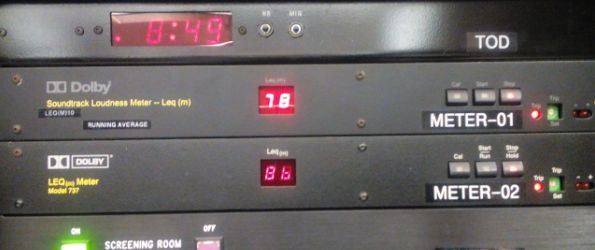
Here's an actual photo of what Steve was talking about:
 -
There are two of them in the photo- - one is 'weighted' slightly differently from
the other. The soundtrack is sampled several times a second, and results are
sent to a computer which can then output the data as either a numerical table
or a graphical "map" of the entire movie sound level profile for analysis.

This still gets used on a regular basis. I've been asked to collect sound level
data for both the "Birdman" and "Furious 7" mixes recently, for example.

If you're curious to know more abou tit, there's a manual in the FT Warehouse.
 
Posted by Randy Stankey (Member # 64) on 06-18-2015, 03:57 PM:
 
quote: Carsten Kurz
In a larger multiplex, there will certainly be no one going through all the auditoriums and check volumes for all movies. If you're lucky, then local staff will be able to make adjustments based on complaints.
I find that to be quite disturbing!

It is the operator's job to check each theater after the start of the feature to be sure that the sound and picture and the conditions of the auditorium, itself, are all okay.

That's the way I have always done it for fifteen years.

It doesn't take very long. Just one or two minutes. It's not a hard job, either. Just stand, quietly, in the back of the room and look and listen. Even in a 30-plex, it won't take long to do if there are a few people doing it.

Now that theaters are 99% digital, I understand that there is nobody who is specifically assigned to be the operator, anymore, but it is a simple thing for the manager to do, himself, or, better still, assign a crew of trusted employees to do it and report back.

Now that theaters are digital, this job has become even simpler!
Since we don't have to continually monitor mechanical equipment, there should be more time and more manpower available to put a real person in each theater for two minutes to make sure that customers are getting what they pay for.

The idea that digital presentation allows theaters to cut payroll falls flat on its face! Even with the reduced staff that digital presentation allows, it is a simple thing to require ushers to "check theaters" when they aren't doing another job.

How many stories do we know of ushers hanging around, out back, goofing off in so many ways? Where are the managers who are supposed to be keeping tabs on these employees?

In my mind, it's laziness. Sheer laziness!
And the advent of digital theaters has simply given lazy managers and employees an excuse to be even MORE lazy!
 
Posted by Buck Wilson (Member # 5885) on 06-18-2015, 04:35 PM:
 
That has not been my experience. The projectionist position and all payroll related to that position was cut day one of digital.

Payroll is extremely tight beyond that. You say ushers plural, but at this 10 screen, there is only 1 at any given time, including weekends. So they are trapped at the ticket box for their whole shift. Skeleton crew at all times, or else the GM will be hearing from the district manager! There is no one else to do it... concession staff is dealing with lines to the door, the one manager on the floor is ensuring rewards cards are being handed out, charity is being sold, refunds are being handled, complaints about long lines are being explained..... It's a miracle that the auditoriums even get cleaned between shows. too often, they don't.

[puke]
 
Posted by Jim Cassedy (Member # 4115) on 06-18-2015, 06:35 PM:
 
^^^^^^^^^^^^^^^^^^
[thumbsup] What he said.
I know theaters that even if they got a complaint, the
staff wouldn't even know where to find the volume control.
 
Posted by Stephan Shelley (Member # 8587) on 06-18-2015, 07:15 PM:
 
In this day and age it should not be that difficult. Most modern processors can be controlled remotely. Like from the computer in the managers office. For instance the JSD-60 has a web interface you can change the volume from.
 
Posted by Buck Wilson (Member # 5885) on 06-18-2015, 09:10 PM:
 
Well sure! But that costs money/effort, you see, cant be spending any of that even if it's directly related to customer service/presentation....
 
Posted by Aron Toplitsky (Member # 6950) on 06-18-2015, 11:54 PM:
 
I just wanted to share some experiences when I’d complain about volume being too low. Of course I complained after seeing the film and not during.

When the first Avengers was released, I had a ticket to see The Raven. Prior to seeing it, I looked in on Avengers for a few minutes. This was playing in a rather large auditorium (AMC Del Amo 18 Torrance CA) and it sounded so dead. When they play the proper volume almost all of their screens sound great. So I figured Avengers was turned down too low and hardly any of the low frequencies could be heard. Then I saw The Raven and it too sounded quite low. I complained on the AMC site and within a week I heard from the manager via email. She explained how they went to each auditorium and adjusted the faders to the proper levels. The manager said they noticed quite a few theaters were turned down and never turned back up. She said they lower the volume and never play at setting 7, out of fear of complaints and blowing their speakers. So they tend to play most films around 5.5. The problem was fixed, the following week I saw Avengers for the first time and the volume was perfect! She gave me her personal email and asked that I would contact her if I had any more issues. Of course since that manager left there have been problems with that theater. Same old crap, movies turned down too low and every now and then I’d have to speak with management. I even posted on this site about how their digital IMAX has lost their powerful LFE. I still haven’t gotten an answer about that. Anyhow, I got quite tired of this so I drive further to my local Arclight where this issue doesn’t occur.

I went to an Edward’s theater in Irvine CA to check out their RPX Theater and it was a major disappointment! Saw Expendables 3 and there was just no power behind the sound system. Not only was it on the low side, but I hardly heard any LFE or surrounds. I mentioned this to the manager who was very nice btw, and he said they had to tone down the RPX a great deal. He made it sound like it was re-EQ’d. Apparently it was too overwhelming for audiences.

So for the most part I’ve had positive experiences with management, but it still frustrates me to go to the movies and worry if the proper levels will be played. In order to avoid this, I have to go out of my way to theaters that care and those that test films out before showing them.
 
Posted by Randy Stankey (Member # 64) on 06-19-2015, 01:00 AM:
 
Yes, Buck and Jim. I get it. We have to do more and more with less and less.

I know that you guys give a shit and I know that you are doing what you can with what you've got.

But I still bet that you guys make it a point to go in and check theaters whenever you can, even if it's not every show or even every day.

I'm talking more about those people who don't seem like they even have two brain cells to rub together. We've all seen them, all too frequently. People like that are just plain dumb and lazy.
 
Posted by Steve Guttag (Member # 268) on 06-19-2015, 06:42 AM:
 
In a Film-Tech DCS system...the volume is automatically adjusted based on tickets sold.

What would be even more cool is to take Dolby's LEQ(m) meter and based on that number adjust the fader for that movie up/down so as to provide a consistent OVERALL level.
 
Posted by Dustin Mitchell (Member # 372) on 06-19-2015, 09:35 AM:
 
So, not knowing much about EQ's, if a theatre is EQ'd with the fader set to 5 instead of 7, would 5 then be equivalent to 7 for 'reference' purposes? Of is the fader setting irrelevant when the EQ is done?
 
Posted by Carsten Kurz (Member # 5396) on 06-19-2015, 04:17 PM:
 
It's definitly wrong to have auditorium faders that keep the absolute levels over multiple shows. Levels should always be reset to a default value after a show. This is an issue with older processors using resistive auditorium fader pots. If an usher dials up or down the volume during his cleaning schedule, it could stay like this for days or weeks. On our system, volume is always reset to the programmed level, and staff can only dial up or down from that setting, and it's reset after every show. And that's not really special, every modern cinema processor and server can do it like this.

- Carsten


Powered by Infopop Corporation
UBB.classicTM 6.3.1.2