This is topic Kollmoorgen light meter, info requested in forum Film Handlers' Forum at Film-Tech Forum ARCHIVE.
To visit this topic, use this URL:
https://ft-forum.com/ft/cgi-bin/ubb/ultimatebb.cgi?ubb=get_topic;f=1;t=004557
Posted by Barry Hans (Member # 477) on 02-15-2003, 11:00 PM:
I was given an old Kollmorgen spot metermanufactured by Fotomatic Corp. It has a high and low scale with the high rating of 4- 30 foot lamberts. Is this thing any good? Does anyone have a manual?
Posted by John Pytlak (Member # 331) on 02-16-2003, 06:15 AM:
An oldie but goodie. Probably fine, but you should get it calibrated.
Posted by Steve Kraus (Member # 476) on 02-16-2003, 08:47 AM:
Has anyone ever done the oft-discussed idea of translating fL against exposure readings taken with a still camera, as in 16 fL = normal exposure @ f#, 1/##, ISO### ? This ought to be mathematically doable (if one knows that the camera is expecting, say, 18% reflectance) and then checkable in real life. If there is any consistency to the translation it would be a boon for theatres to keep a watch on light levels between service visits with a commonly available instrument, thus aiding the cause of Film Done Right.
(Hmmm...Does Film Done Right = English Done Wrong ? Just a thought!)
Posted by Mark Gulbrandsen (Member # 72) on 02-16-2003, 11:30 AM:
They can no longer be serviced as far as I know. There used to be a place in Indiana that repaired them but it is no longer in operation. Few if any camera repair facilities have the equipment, or knowledge to calibrate it in terms of FL anyway. If it is working it could be compared to another known calibrated unit....otherwise its good as a shelf piece...it is quite old anyway. Since the introduction of the USL light meter most other methods of reading screen illumination are now obsolete. The single meter is handy though for calulating screen gain.
MArk @ CLACO
Posted by Barry Hans (Member # 477) on 02-16-2003, 04:37 PM:
I think I am going to compare it to the Minolta meter we have at work. It was serviced - in 1969! I am sure it is out of calibration but how far will be interesting to find out. It looks like there are two small pots for adjustment. I see no other adjustments in the meter.
Posted by John Pytlak (Member # 331) on 02-17-2003, 09:51 AM:
I wrote an article about screen luminance meters:
http://www.kodak.com/US/en/motion/newsletters/pytlak/june2000.shtml
Using a camera exposure meter can be problematic, as it may not have the necessary visual (photopic) response, be sensitive to the shutter frequency, and not have the precision needed (most are only accurate to within about 1/2 stop).
I've toyed with the idea of using "PHOTOGRAPHIC PHOTOMETRY" to measure screen luminance. Sunlit daylight is a very constant light source for both intensity (about 9000 footcandles when the sun is at a 30-degree elevation) and color temperature (D-5500). So if you expose a color reversal slide film to an 90% white card (sheet of 90 brightness white paper) at an exposure that produces a gray density under specified daylight conditions, you have 0.90 x 9000 = 8100 footlamberts reflected by the card, at a color temperature of D-5500. Now 8100 footlamberts is almost exactly 9-stops more than 16 footlamberts screen luminance specified by SMPTE 196M. So if you expose a sheet of white paper illuminated by daylight with the sun at a 30-degree elevation, then ON THE SAME ROLL OF FILM expose the open-gate lit screen with 9 stops more exposure, the gray images formed on the processed slide film SHOULD CLOSELY MATCH for density and color!
As an example, exposing a sunlit 90 percent white card using KODAK ELITE Chrome 100 film would produce a mid-scale gray at an exposure of 1/500 second at f/16. Exposing an open-gate illuminated movie screen with 16 footlamberts illumination on the same roll of film with 9 stops more exposure (e.g., 1/8 second at f/5.6) should result in a near match.
If I can work out the details, this method would provide a means of checking screen luminance, uniformity, and color temperature by simply using an adjustable camera and a roll of reversal film on a sunny day. ![[Cool]](cool.gif)
Posted by Paul G. Thompson (Member # 655) on 02-18-2003, 11:40 AM:
I have an "Oldie but Goodie...." and it looks like it is almost brand new.
It is an old Panavision Brightness Meter that has a supposedly a range of 0 to 30 Footlamberts. It was given to me many years ago. It needs some new jels....where can I get some?

How accurate was this thing when it was new?
Posted by John Pytlak (Member # 331) on 02-18-2003, 12:15 PM:
I'm not familiar with the Panavision meter, but accuracy depends mostly upon the calibration. With proper calibration, the scale on your meter would have reasonable accuracy. I assume the filters were to correct the photocell to a visual "photopic" response, as specified in standard SMPTE 196M. Looks like a nice meter.
Posted by Paul G. Thompson (Member # 655) on 02-18-2003, 01:42 PM:
John, this meter has nothing more than a flashlight battery, a bulb and a reticle. The bulb's intensity is adjusted by a variable resistor. It is of the visual comparison type. The reticle has little plastic colored tansparent windows that produce a yellow blob when it is looked at through the eyepiece. The light inside the meter is adjusted so the reticle seems to dissappear or blend in almost perfectly with what is being looked at. The meter results indicate the amount of foot lamberts.
This thing is color corrected for a wide range of color temperatures, from incandescent to arc lamps, as well as daylight. The meter does not require Zero Balancing, and the unit does not need calibration.
Posted by John Pytlak (Member # 331) on 02-18-2003, 02:15 PM:
The "visual comparison" meters can be tricky to use, as any mismatch in color can confuse the attempt to match the luminance. Also difficult to maintain the output of the "reference lamp" constant. If you service more than a few dozen screens, a good modern meter like the SpectaCine, Minolta LS-100, or UltraStereo Lab PSA-200 is a good investment.
I've often suggested that theatres in a city get together to share the cost of a good screen luminance meter so they can check their screen luminance more often than during a semi-annual service call.
Posted by System Notices (Member # 2357) on 02-28-2005, 12:46 PM:
It has been 740 days since the last post.
Posted by John Walsh (Member # 168) on 02-28-2005, 12:46 PM:
I came across one of those Panavision light meters Paul showed above; I thought it would be interesting to post a picture of the insides and a closeup of the meter itself....
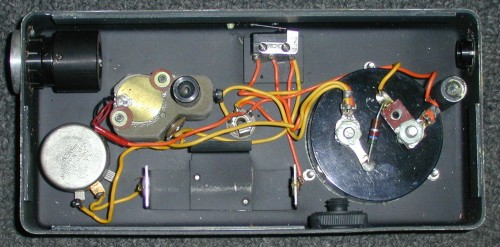
He was right; there's not much to it....
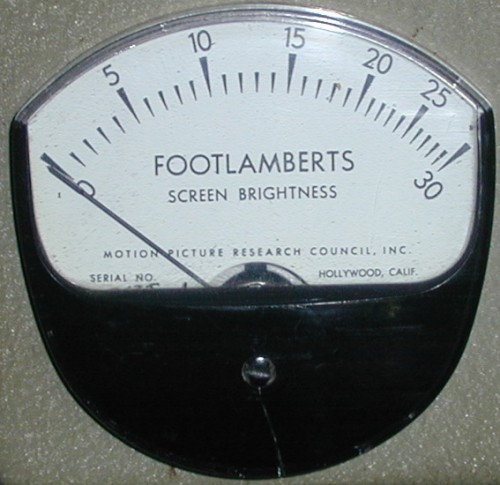
Posted by Frank Angel (Member # 248) on 02-28-2005, 01:59 PM:
Sweet. I want one.
Were these in fairly wide spread use in their day? Any chance I might be able to find one languishing on the shelves of some theatre supply house that deals in used equipment?
John, where did you get yours?
Posted by Larry Myers (Member # 738) on 02-28-2005, 03:45 PM:
Hi
For you camera guys, sunlight brightness ranges in the US from 10000 foot candles in South Florida in June to 2500 in North Maine in December. Most of the time it's around 5000 Foot candles on a typical noontime sunny day which works out to be a exposure of 1/asa at f16. Make it f-11 in December and f-22 in the summer.
Larry
[ 02-28-2005, 05:40 PM: Message edited by: Larry Myers ]
Posted by John Walsh (Member # 168) on 02-28-2005, 07:49 PM:
Hi, Frank... This meter actually belongs to the company I work for. It had an inch of dust on it, so I know no one uses it. I had never seen one before and it took a few minutes to figure it out. When you look through the view finder, you see a ring. The ring is dark when the unit is off. When the momentary button on top is pressed, the ring lights up. The idea is to adjust the pot on the side until the ring matches the "brightness" of the screen area you are viewing. Then, while holding the button down, you look at the meter reading.
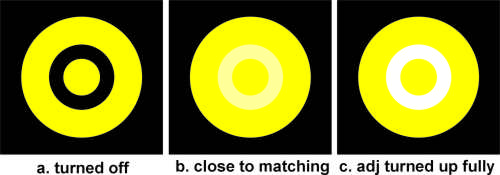
I don't think I would trust it for absolute values, but it might be OK for relative 'comparison' use.
Posted by John Pytlak (Member # 331) on 02-28-2005, 10:34 PM: