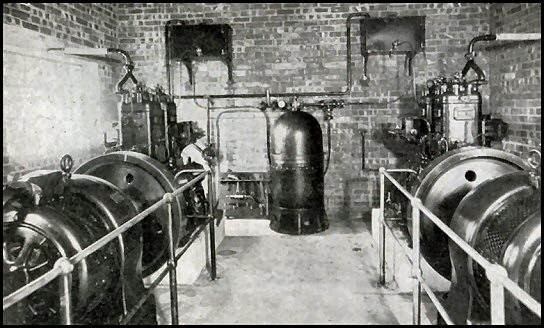
This is topic who uses motor-generators? in forum Film Handlers' Forum at Film-Tech Forum ARCHIVE.


To visit this topic, use this URL:
https://ft-forum.com/ft/cgi-bin/ubb/ultimatebb.cgi?ubb=get_topic;f=1;t=004872

Posted by Scott Norwood (Member # 30) on 05-09-2003, 10:06 PM:
 
The "haunted theatres" thread in yak that led to the discussion of theatre basements has led me to ask this: who is still using motor-generator sets instead of rectifiers? For those who are: why? Is there any advantage?

The theatres that I know of which are still burning carbon haven't run generators in years.
 
Posted by Gordon McLeod (Member # 33) on 05-09-2003, 10:48 PM:
 
The big hertner transvetters typically provided better DC than most rectifiers did
In fact I have had xenons on them that never go black
 
Posted by Chris Markiewicz (Member # 1415) on 05-09-2003, 11:55 PM:
 
The Palace in Hilo, Hawaii is still using motor-generators to run their Ashcraft Suprexes and E-7s.

 -
 
Posted by Mike Blakesley (Member # 26) on 05-10-2003, 12:26 AM:
 
We used to use one that looked just like the one pictured above.

The thing sat right in front of the #1 projector and made quite a lot of noise. One of the first things done after I acquired this theatre was the automation of the booth and the dumping of that generator.
 
Posted by Paul G. Thompson (Member # 655) on 05-10-2003, 02:12 AM:
 
Motor Generators were cool. Xenon bulbs liked them. However, the open circuit voltage was not high enough to allow the igniter to fire and the lamp had to be fired manually. At the Lido Theatre in Mount vernon, I used the MG set as a atandby in event of a rectifier failure.
 
Posted by Gordon McLeod (Member # 33) on 05-10-2003, 08:08 AM:
 
Atlantic audio visual made a booster kit as did xetron and Kniesley to provide a higher open circuit voltage
 
Posted by Bernard Tonks (Member # 809) on 05-10-2003, 09:05 AM:
 
I was fortunate to work in two cinemas with Motor Generators. Both had two generators, one being a standby alternating weekly. The DC was so pure and smooth that once you set the carbon trim they never need touching throughout a reel. The generators at the Regal, Kingston-upon-Thames, a 2500 seats cine-variety theatre was later sold to Thames Television.

There were also quite a few Diesel Engine driven generators, but most later converted to Electric Traction.

The picture shows one of the Motor Generators at the Carlton Theatre, London. You can judge the size of these monsters by the door on the right. The 2nd picture is of myself beside No 3 projector 35 years ago in 1968. [Big Grin]
 -
 -
 
Posted by Michael Harlow (Member # 1353) on 05-10-2003, 09:11 AM:
 
We had a motor generator here in Faversham which was used for the secondary (emergency) lighting. The odd thing was, that it was a DC motor driving a DC generator. Of course there was a rectifier to convert the AC to DC to drive this thing. We found that it was around 50yrs old and although still going strong, it was using some 2kw of electricity and hour, it had to go. We have new rectifiers now and use around 300w per hour. They paid for themselves within a year! The Generator was a Brown Bouvier? and the rectifier was a Westinghouse.
 
Posted by Robert Throop (Member # 61) on 05-10-2003, 09:13 AM:
 
We still use a generator at the Stanley in Utica. It's a Westinghouse 250 amp 100 volt job installed when the theatre opened in 1928. You can still balance a coffee cup on it while it's running with no danger of a spill. The Landmark (formerly Loew's State) in Syracuse also uses a generator.
 
Posted by Stephen Furley (Member # 1277) on 05-10-2003, 04:47 PM:
 
Some photographs from the Loew's Jersey last year, I hope they don't mind me posting them.

 -

These are the long-disused motor-generator sets, installed in 1929, I would guess that they were used until the early '50s, when the Ashcraft equipment was installed, but there is very little wear on the commutators. Note the open frame of the generators, it would be quite possible to put your arm into the frame while they were running! They are bigger than they look, I think about the same size as the one in Bernards picture. I was quite surprised by the size when I saw them again a couple of weeks ago, I had forgotten how big they were. Restoration and refurbishment work is still taking place, hence the paint!

 -

This is one of the three Ashcraft selenium rectifiers which replaced them. They are installed in the original generator room, the block of concrete on the left is the plinth that the generators are mounted on.

Interestingly, the generator/rectifier room, rewind room, and various other rooms lead directly off the projection box, there is no connecting corridor between them, and the whole lot is reached by a few stairs through a door at the back of the auditorium, the regulations here would not have allowed that in nitrate days. Also, thee is no means to drop the fire shutters from the auditorium; in a British theatre there would have been a small red box on the back wall of the balcony with a wire handle inside for this purpose. These were sometimes mis-used during Saturday morning childrens shows! Even the College where I work had this, despite having been built after nitrate finished, and only ever having 16mm installed. I managed to acquire the b&H 609 carbon arc machines when they were thrown out.

In the rewind room there is a massive film storage cabinet, standing about as tall as me, built in to the room, and vented to the outside, I have never seen anything like that here.

 -

This is one of the Ashcraft Super Core-lite lamps which the rectifiers are supplying, mounted on a FP20. The tall object standing behind the projector is an Ashcraft water cooler.

One last picture

 -

This one shows the Brenographs, note the unusal venting system, rigid ducting, rather than a hood.

Bernard, I wouldn't have recognised you from that photograph!

Many early cinemas used Crossley gas engines, made in Manchester, before mains electricity was available. There is one in the small cinema which has been re-built an the Black Country Museum, in Dudley. The autitorium was gas lit, the house light dimmer being a log rod running the length of the building, just under the roof! I don't know if the projection room was gas lit, presumably the cinematograph act would have put a stop to that, after 1910.
 
Posted by Bernard Tonks (Member # 809) on 05-10-2003, 07:02 PM:
 
Interesting pictures Stephen. The commentators at the Carlton were is almost perfect shape after 41 years since opening in 1927, they really were cared for. I had the luxury of two house engineers who looked after them, as they did with everything else including the screen masking and two sets of curtains. I was only responsible for the projection room. The massive 50-foot deep stage with fly tower was in use for one year only; Paramount Pictures took over the Carlton for cinema only use in 1928. Although no longer used, the stage lighting board had salt water dimmers that still worked, I was shown the batten lighting behind the screen.

Re: Loew’s Jersey Theatre, Never seen two Brenographs in a projection box before, are they in working order? Must go there one day, I visited New York nearly three years ago. Would be great if the Brenograph at the disused State Theatre, Grays could be installed at the Odeon, Leicester Square replacing the old Ross Scenograph.
 
Posted by Stephen Furley (Member # 1277) on 05-11-2003, 06:41 AM:
 
Bernard wrote:

quote:

Re: Loew’s Jersey Theatre, Never seen two Brenographs in a projection box before, are they in working order? Must go there one day, I visited New York nearly three years ago. Would be great if the Brenograph at the disused State Theatre, Grays could be installed at the Odeon, Leicester Square replacing the old Ross Scenograph.

Two Brenographs not common; I never saw either place, but I'm told that the Gaumont State, Kilburn had two, and the Gaumont Palace, Lewisham may have done, conflicting reports on that one. The 1929 Brenkert catalogue, available to download from the Film-Tech manuals section, does specify a minimum spacing when two are installed.

The ones at the Loew's are a long way from being usable, I doubt if they have seen use in the last fifty years, but there's nothing that would be impossible, or even very difficult, to put right, given time. The small band of people working on the theatre have achieved much, but there is still a lot of work to be done, so it won't happen overnight.

Basically, the problems are:

The machines are rusty, but it's only surface rust, and would clean up.

Most mechanical parts are seized solid, and will not move, they would need completely stripping down and cleaning.

All sixteen lenses are missing, but most of the retaining clips that held them are still there. I don't think new lenses would be too much of a problem, the people who supply school science labs might have something, even if it meant turning up adapters for slightly smaller lenses, or something.

Some of the condenser lenses are missing, but there are enough to get one machine working.

A few of the twelve mirrors are missing, on all the others the surface has gone, not a major problem to replace.

One section of extraction duct is missing, but could be made. If you lok at the ducting just over the front of the top lantern on the far machine, you can just see a place where one section slides inside another, to allow the lanterns to move.

The large D.C switches have been removed from their housings, but these things can be found.

It's really a question of labour, if I lived a bit nearer, I think I could get one of them working, without too much difficulty, and could probably afford the parts, but I can't exactly nip over there for a few hours in the evenings.

The place is only a few minutes from the centre of New York, the Path trains from Manhattan serve Journal Square station, which is just across the street.

As built, the place was something over 3000 seats, the auditorium is probably about the same size as a British 2500 seater, but the balcony is much bigger, maybe seating an extra ten rows, or so, compared to a typical theatre.

Working Brenographs difficult to find anywhare, the Byrd, Richmond VA has one, still in regular use, recently converted to tungsten lighting, this was the last working one that I knew of still burning carbons. The Enigma, Bletchley Park had one installed recently, it is in good condition, and has many of the accessories, but is a xenon conversion, using vertical lamps in the original lanterns, so it looks original.

The one at Grays was in working order, but the motorised feed had been removed, this was quite common, the worm driven gears had a habit of stripping, and no spares have been available for a long time.

It's a pity that Grays closed, I went there to a few concerts, in the days when the auditorium basically served as a fire escape from the club which used the foyer area. Most original equipment was still there, one projector had been removed, but I understand was still stored somewhere in the building, two of the remaining three had been converted to xenon, but the lamps were far too small for a screen that size, only 2.5k, they really needed at least 4k, I never saw the remaining carbon machine running, so I don't know how that compared. The spool boxes had been removed, but could have been replaced.

Original rectifier plant, mercury I think, was still installed, and usable, but small modern rectifiers in the projection box were normally used. The organ was in pretty good condition, including the piano, and an extra stop was installed not long before final closure, there were a few problems with the Mellotone unit.

There were proposals for use as a church, but these were turned down. The place was listed, but there were problems with water where it shouldn't have been, The club closed, the owners of the building wanted to sell it, I don't know what it's final fate was.

Does the Odeon ever use that Ross device? I visited the box many years ago, the Victoria Xs were still there, but after they had been converted, and I don't remember seeing the thing, but it must have been there. I know that it was converted to xenon at some time. How does it differ from the Brenograph? I've only ever heard of a couple of places that had them.

To return to the Loew's for a moment; anyone who doesn't already know care to guess what the left hand object in this picture in the rewind room is? I've never seen one before.

 -

When I first saw it I thought it might be for storing lantern slides, but that's not it.

Scroll down a few lines to the next picture for a clue.

.
.
.
.
.
.
.
.
.
.

 -
 
Posted by John Anastasio (Member # 607) on 05-11-2003, 07:32 AM:
 
Great observations on those Brenographs, Steven. I've often been up in that booth with the machines and you're right about getting them rebuilt. It would be a real labor of love for someone with a lot of patience and access to a metal shop. Running them must have required two projectionists with a flair for showmanship. I'm sure that Mitch, Steve and Bernie could handle it, though.

The cabinet is for storing Vitaphone discs. The Simplex standard with the turntable for them that you've shown is a working machine, although I don't think I'd want to play any discs with that pickup. The tracking pressure on the stylus is pretty high. Most of that stuff has been beautifully restored by Bob Eberenz, the theater's chief technical engineer, who's done an amazing job. The booth has two Simplexes, a pair of Kinotons, a 16mm machine (a Bauer, I think) and two Brenographs. It's pretty impressive.
 
Posted by Bernard Tonks (Member # 809) on 05-11-2003, 10:13 AM:
 
Come to think of it Stephen, I’m sure you are right in saying that the Gaumont State, Kilburn had two Brenographs. You’ve jogged my memory, I went up into that projection box around 1965. A friend of mine was also the chief projectionist there.

Not sure if the Odeon ever use the Ross device, or remember how it differs from the Brenograph. Last time I saw it was over three years ago, and there was a large plate glass effects disc broken. [Frown]

The Projected Picture Trust did a sound-on-disc full feature showing at Muswell Hill a few years ago.
 
Posted by Frank Angel (Member # 248) on 05-11-2003, 10:42 AM:
 
Great pics guys, thanks. The dual Brenographs must have been a Loew's thing. There was the same setup in the Loew's Kings in Brooklyn. They looked like they were in about the same rusted shape.

They were still using monster generators at the Loews right up until they closed; they were located in an adjacent room and weren't as noisy as they looked like they would be. There is also evidence that before the generators, they were using DC that was supplied directly from Con Ed. There is a big DC panel in the booth that is wired directly to outlets in front of the projectors and followspot. How cool is that? No worry about rectifiers or generators, just plug into a socket and you've got DC with as much current as you could possibly want. I worked a theatre years ago (when I looked even younger than Bernard's pic) and I agree, those arcs driven by generators, once adjusted correctly, didn't budge. You could go an entire show without having to make even the slightest adjustments. I can't say that about our solid state rectifiers today, but then again, today Con Ed sends voltages that vary from 110v to as high as 130v on a daily basis. If you are running a show across the 5pm to 6pm hour, you'd better watch those arc gaps. The Knisley rectifiers don't have voltage control that can deal with that kind of swing without it showing up in the DC output. I've had to buy voltage regulators for my sound racks because at 130v, you can expect lots of equipment to meet their early demise.

Also in this Loews three projector booth was a rack with Perspecta Sound equipment, something that seems to have been commonly found at the larger Loews theatres.

I don't know the manufacturer of the arc followspot that we found up there, but it is an amazing instrument with dozens of pulley's and controls to change the color gel boomerang and to pull multiple lenses back and forth to size the spot. It is made of brass so no rust, and the balance is so precise, that you can move the large, heavy body smoothly in all directions with one finger -- just a beautiful thing to look at and touch. And it's not DIGITAL....imagine that!!

Frank
 
Posted by Stephen Furley (Member # 1277) on 05-11-2003, 12:10 PM:
 
John wrote:

quote:

The cabinet is for storing Vitaphone discs.

Bob Furmanek showed me the cabinet last year when I was first there. I wouldn't have guessed what it was for, I've never seen another one, it's got to be very rare. There's even a disk in one of the drawers.

Are you involved with the Vitaphone Project? I believe that it's based somewhere in NJ.

I met Bob Eberenz last year, when I was there for the 'Forbidden Planet' screening. I came over again in October, when 'King Kong' was on, and then again a couple of weeks ago.

I think it's an important theatre for a number of reasons, it's a fine example of a theatre building of the perion, it's survived relatively unaltered, even the'70s tripling didn't make any really major, irriversible changes to the building, and it still contains a lot of the original equipment, including the original stage lighting board, and buch of the electrical equipment and plant below the stage. The 1986 closure may have been a good thing, if the theatre had remained open longer it may well have received much more drastic alterations.

When I first saw the Brenographs, I thought they looked a mess, but, on closer inspection, I really don't think it would be too difficult to get one of them working.

Where is Trenton, by the way, how far from Jersey City, or New York? One of my other interests is in transport, and I have read about the new Diesel-powered light rail system they are building, from Trenton, to somewhere I had never heard of. I'd be interested to see it when it opens.

Frank wrote:

quote:

I don't know the manufacturer of the arc followspot that we found up there, but it is an amazing instrument with dozens of pulley's and controls to change the color gel boomerang and to pull multiple lenses back and forth to size the spot. It is made of brass so no rust, and the balance is so precise, that you can move the large, heavy body smoothly in all directions with one finger -- just a beautiful thing to look at and touch. And it's not DIGITAL....imagine that!!

It's not a Stelmar, is it, they had wire operated colour magazines.

Wht's happeng to your theatre, you said you had some major building work about to take place last year?
 
Posted by Hugh McCullough (Member # 1542) on 05-11-2003, 03:58 PM:
 
We used to use the Ross Scenograph at the Odeon Leicester Square in the 1970s, about twice a week, before the programme, or when we had organ shows.
We were able to cover the whole of the front tabs with effects from either a clockwork operated gelatine colour wheel or an electrically driven glass flame effect wheel.
This was using the low intensity carbon arcs, and caused no trouble, but somebody at head office engineering dept thought that as we were installing xenon arcs on the projectors we might as well have the Scenograph converted as well.
Morganite xenon houses were installed with 1600 watt lamps.
This was a terrible mistake as the heat from the xenon evaporated all the water from the cooling jacket, and shattered the glass in the expensive colour wheel.
After this, to my knowledge, it was never again used.
Picture on www.cinephoto.co.uk/odeon_leicester_square_14.htm
 
Posted by Gerard S. Cohen (Member # 994) on 05-11-2003, 06:36 PM:
 
Stephen and John,

I've seen cabinets like the ones in the photo in Loews Paradise
Theatre, the chain's flagship on the Grand Concourse in the Bronx, New York City. It had a full stage with spots & floods. The cabinet was full of gelatine sheets for lighting. The theatre was a huge palace type, with gilded putti on the ceilings and walls, and outside, on the facade, a clockwork animated St.George killing a dragon, in metal armour.

The 1934 Neumade catalog has pictures of a 12-drawer and a 24- drawer model, the latter on legs, exactly like your photo on the left from the 24th drawer up to the middle section, where you may have a shorter model attached on top, or a UK manufacture.
Neumade was located in NYC, but moved upstate. Bob Maar has been connected with them for years.

The catalog reads:
S-551 GELATINE CABINET (table style) Same construction as S-550.
Twelve drawers Overall height 16: $75

S-550 GELATINE CABINET For storing gelatine sheets. Keeps them moist and flexible. Twenty-four drawers, each 24"x22"x7/8" Push-hole in bottom of each drawerto lift sheets. Brass index card holder and two pulls on each drawer. Stands 59" high Standard finish baked-on olive gray enamel $165

The drawers are large enough to accommodate 16" sound-on-disk records, so the same cabinet may have been dual-purpose. [This Neumade catalog does not list a disk record cabinet as such.]
I also found a very early, heavy-duty turntable with spare brass electrical pickup heads in the theatre. The theatre closed several years ago.

Gerard
 
Posted by Paul G. Thompson (Member # 655) on 05-11-2003, 08:58 PM:
 
As I was stumbling through the Lincoln Theatre today, I tripped over this thing. I forgot it was even there, and the reason it is still there is because it is too heavy to move. I am not sure when the last time it was used, but I know it was before 1967.

 -

Kind of looks like Darth Vader... [Big Grin]
 
Posted by Gordon McLeod (Member # 33) on 05-11-2003, 09:04 PM:
 
That looks like one of the old motiograph generators
 
Posted by Aaron Sisemore (Member # 145) on 05-11-2003, 10:21 PM:
 
The original single screen booth at Cinema West's Fortuna Theatre still has a complete working Hertner MG set:

 -

The Phoenix Theatre used to have a Westinghouse MG, but in the mid-80's I had disassembled it to make the room it sat in usable for storage.

-Aaron
 
Posted by Paul G. Thompson (Member # 655) on 05-11-2003, 10:26 PM:
 
Gordon, I don't know what kind it is. But the next time I am there, I'll check the nametag on it. That may be a week or two, as I will then go to the theatre to take pictures of the organ and the lofts.
 
Posted by Chris Markiewicz (Member # 1415) on 05-12-2003, 12:09 AM:
 
Here's the backup MG in the Hilo Palace:

 -

This one is not in regular use anymore, but I understand it is still usable.
 
Posted by Don Sneed (Member # 955) on 05-12-2003, 02:25 AM:
 
Wow, thanks for the memories....I once worked at a theatre that you had to change the gears or belt by a lever when the RPM reach a it level then watch the next RPM meter again & push the lever again to reach the correct MG speed & output amperes..the whole process took about 20-30 seconds...strange....all other MG unit was just a start/stop button, they weren't quite by any means, most I ran was under the projection booth, or in a room next to it....thanks for the pictures, these were projection booths when projectors, lamphouses, reels, motor/generator & the booth itself made you feel like a projectionist, they were great in their days, I am glad & thankful to be a part of a bygone era...it's too bad the projectionist of today cannot feel what we had or can understand what a booth was without xenon bulbs, automation, & platters....at the time (1970) I never thought the theatre projection booth would evolve into megabooths, amazing what 30 yrs can do.....
 
Posted by Bruce McGee (Member # 131) on 05-12-2003, 07:24 AM:
 
When I was MUCH younger, I hung out around theatre booths. One theatre was the IMPERIAL Theatre in Asheville, NC. It was razed in 1976. It was the Premier theatre here from 1935, or so, until the late 1960's when ABC Theatres got hold of it. Modern Times (Chaplin) played there for several weeks.

I loved the whine of the generator running. When the projectionist would strike the arc for the changeover, the generator would whine a bit louder for a few moments.

The motor at the Imperial was a 3-phase Westinghouse. I remember that you could stick your arm into the running generator. Remember, these units were built in a day when people were smart enough not to stick their body parts in places that were moving at high speeds. My other memory is the organ blower room. The organ was gone, so I was told, and there was no sign of it in the auditorium. The blower was there, though. It was a Spencer Orgoblo, with a big motor... Leece-Neville brand? When the theatre was demolished, they 'found' and removed the complete organ that had been covered in 1955 when they installed a Cinemascope screen.

The organ was restored, and installed in a small church near here. It plays on...

I'm looking for images of this theatre to scan and post. No luck, so far...

AFAIK, this theatre ran with the original M-G set for its entire life.
 
Posted by Jeff Taylor (Member # 443) on 05-12-2003, 09:16 AM:
 
Just a word on motor generator sets...while solid state rectifiers have been available for years, the majority of the world's elevators are still powered by MG's, and in the older high-rise buildings many of them have been running with minimal maintenance since the days of silent cinema and frequently for 18-24 hours / day. The same can be said of the DC hoist motors. It's an amazing testament to the durability of those things.
 
Posted by Matthew Bailey (Member # 601) on 05-12-2003, 11:11 AM:
 
Some new & existing elevators are either equipped with or had their MG sets replaced with rectifiers. The older DC hoist motors can't be used with rectifiers due to the design of the stationary field & armature. Some dumbwaiters use DC hoist motors with MG sets,but there has been an instance where a DC dumbwaiter motor been running off a rectifier arrangement using modified Christie(?) rectifiers
 
Posted by Stephen Furley (Member # 1277) on 05-12-2003, 12:19 PM:
 
Hugh wrote:

quote:

This was using the low intensity carbon arcs, and caused no trouble, but somebody at head office engineering dept thought that as we were installing xenon arcs on the projectors we might as well have the Scenograph converted as well.

Sounds typical,

"it's working perfectly well, and has been for getting on for forty years, so let's change it."

I suppose no spare disks were available, few of these machines seem to have been made, and I suppose the cost of having a new disk specially made, and finding a way to stop that one from breaking, would have been prohibitive.

The Odeon opened in 1937 did'nt it, that's rather late, i think most of the Brenographs date from about 1928-1935; maybe Ross started making this as an alternative to the Brenograph, but it was just too late, and never caught on. Odeon dodn't normally use Ross equipment, did they? It was all BTH at that time, it was ABC who used Ross. Neither seemed to give a very good light output, but, of course, screens were much smaller in those days.
 
Posted by Bernard Tonks (Member # 809) on 05-12-2003, 02:40 PM:
 
The story behind the Ross Scenograph at the Odeon, Leicester Square, is that Oscar Deutsch the founder, would only allow British equipment to be installed throughout his circuit.
 
Posted by Stephen Furley (Member # 1277) on 05-12-2003, 03:50 PM:
 
Bernard wrote:

quote:

The story behind the Ross Scenograph at the Odeon, Leicester Square, is that Oscar Deutsch the founder, would only allow British equipment to be installed throughout his circuit.

I didn't know that Bernard; It would certainly be consistant with the fact that they always installed BTH projectors. It's a good job he's not alive today, you can't buy anything made here now; that's not quite true, I did buy some British-made stainless steel spirals for my developing tanks recently, and very nicely made they are to. The tanks themselves are Japaneese.

Do you know if it is still there, or did it get dumped during the last refurbishment, a few years ago? If It is, I might write to them and ask if I can have a look at it. The only pictures I have seen of it are the two on Hugh's site, and they don't show any great detail. I've only heard of one other being installed, but I can't remember where that was.
 
Posted by Jack Ondracek (Member # 1466) on 05-12-2003, 07:26 PM:
 
We used Hobart generators at the drive-ins I grew up with. In both cases, I think they were part of turnkey RCA/Brenkert/Ashcraft installs. I don't see much (any) mention of them here. Was this brand not one of the popular models?
 
Posted by Paul G. Thompson (Member # 655) on 05-12-2003, 08:41 PM:
 
Hobart was not quite as poplar as Hertner or Lincoln, but they were a good MG set. I have seen a few, and run a few.
 
Posted by Jack Ondracek (Member # 1466) on 05-12-2003, 09:15 PM:
 
quote:
from Paul...
Hobart was not quite as poplar as Hertner or Lincoln, but they were a good MG set. I have seen a few, and run a few

This ought to be familiar then, eh?

 -
 
Posted by Bernard Tonks (Member # 809) on 05-13-2003, 05:00 AM:
 
Stephen wrote re: Ross Scenograph at the Odeon, Leicester Square.

quote:
Do you know if it is still there, or did it get dumped during the last refurbishment, a few years ago? If It is, I might write to them and ask if I can have a look at it. The only pictures I have seen of it are the two on Hugh's site, and they don't show any great detail. I've only heard of one other being installed, but I can't remember where that was.
Stephen, I almost answered your question in an earlier post as follows:

Not sure if the Odeon ever use the Ross Scenograph, or remember how it differs from the Brenograph. Last time I saw it was over three years ago, and there was a large plate glass effects disc broken.

Added: I can also tell you that, it was definitely there after the last refurbishment!
__________________________________________________________

Stephen also wrote,

quote:
Bernard, I wouldn't have recognised you from that photograph!
At that time I was the youngest chief projectionist in the West End. I was also the poorest paid chief in the West End as I worked for FOX. Things did improve though, and I had the best 35 hour week shift system in London. Normally the staff changed with the Movietone News. I kept my crew for the five years I was there.

Just to mention for interest. There was a massive spotlight room with four carbon spotlights above the projection room of the Carlton. The ceiling opened, but was never used since 1928, the rake was awesome!!! Can’t remember the make of the spotlights, possibly ‘Brenkert’, I remember being disappointed they were not Stelmar's.

Poor picture of the Ross Scenograph. Slides and effects, also a water-cell, are carried on the stages of the lanterns. A four- lens turret is provided for each lantern, and the light is reflected by the adjustable mirrors to any part part of the stage.
 -
 
Posted by Stephen Furley (Member # 1277) on 05-13-2003, 08:51 AM:
 
Bernard,

Different construction, flat bars rather than round ones and castings, wheels, rather than crank handles to rack the lamphouse, bigger fume 'spouts', but, in functional terms, it looks almost identical to the Brenograph.

Pity it's not still working at the Odeon, if there was any chance of getting it repaired I think they would have done it when the place was refurbished.
 
Posted by Gerard S. Cohen (Member # 994) on 05-13-2003, 12:41 PM:
 
The Forest Hills Theatre, Queens, NY, had a power room containing an Orgoblow and next to it, what looked to me like the outer shell of a massive motor-generator with the armature removed. The field coils contained copper wire of such thickness, that by using a bending jig and hacksaw, I made several copper chains, one of which I still use to suspend a large Yankee bird feeder from a hemlock tree in my backyard.

When the theatre was twinned, the power room was sealed off by a wall. Then the theatre was demolished, all except the facade,
which was landmarked, and replaced by a drugstore below and a Staples office supply store above. Sic transit gloria.
 
Posted by Jean-Michel Grin (Member # 1360) on 05-13-2003, 04:14 PM:
 
On a tiny theater in a little town in Switzerland, one of the two DC-Generator was out of order and it was too expensive to fix them.
My chief and I replaced this vintage generator by an Irem rectifier.
The projectionist told us. "Hey guys; the light is beter than ever since You replaced this old generator"
For the story the projectionist here din't have any ideas how to make maintenance on a DC generator.... and even how to adjust the curent rating trought the xenon lamp [Smile]
 
Posted by William Hooper (Member # 71) on 05-15-2003, 12:57 AM:
 
quote:
The Forest Hills Theatre, Queens, NY, had a power room containing an Orgoblow and next to it, what looked to me like the outer shell of a massive motor-generator with the armature removed.
The Spencer Steel Orgoblo for theatre organ installations invariably had the generator for the organ's power mounted on an extension of the skids upon which the blower was constructed. The generator was turned via a belt running from a pulley on the blower motor on the front extension of the fan shaft.

The Forest Hills had a Style D Wurlitzer, which is 2 manuals, 6 ranks, & likely had a small-ish, 7 to 10 hp blower.
 
Posted by Leo Enticknap (Member # 534) on 05-15-2003, 06:27 AM:
 
quote:
The Forest Hills Theatre, Queens, NY, had a power room containing an Orgoblow...
Shouldn't this be in the topic called 'Stupid sexual enhancement device, could be dangerous'? [Big Grin]
 
Posted by Bruce McGee (Member # 131) on 05-15-2003, 08:22 AM:
 
[Big Grin]

The first time I read the name Spencer Orgoblo, my mind went straight to the gutter. Then I read on...

The Spencer Turbine Company produced thousands of air-power systems for the pipe organ industry. I think they are still in business...
 
Posted by Jim Spohn (Member # 1547) on 05-15-2003, 10:06 AM:
 
The Spencer Turbine Company is alive and well making central-vacuum systems and and air-tube delivery systems. Unfortunatly they havent made an Orgo-blo since 1943. I have several Orgoblo blowers, from 3/4 H.P to 25 H.P. Their web site is www.spencerturbine.com Although they no longer produce blowers for organs, I had this girlfriend that.......Jim
 
Posted by Scott Norwood (Member # 30) on 05-15-2003, 11:10 AM:
 
So when will Joe write a review of the Spencer Orgoblo? If nothing else, it certainly has one of the best product names of all time.
 
Posted by Tim Reed (Member # 137) on 05-15-2003, 04:29 PM:
 
quote:
We used Hobart generators at the drive-ins I grew up with. Was this brand not one of the popular models?
Unless I'm mistaken, Hobarts were sold under the MGC (Motor Generator Corp.) name? There were quite a few of them that I remember in Kentucky, Ohio, West Virginia, and Indiana drive-ins. They performed well. Although, as Paul noted, Hertner Transverters were more popular.
 
Posted by Jack Ondracek (Member # 1466) on 05-15-2003, 05:15 PM:
 
quote:
Unless I'm mistaken, Hobarts were sold under the MGC (Motor Generator Corp.) name?
That's possible. The MGC logo is on a red plate in the middle of the current control knob (see above), and also on the serial plate below the control. The generator itself just has the Hobart name on it. It looks like it could have been adapted from a welder, with the addition of a fan in the center of the shaft blowing through a ballast, mounted on the side.

Having seen electic & gasoline welders made by this company, along with the arc generators at the drive-ins I grew up around, it was a little unsettling to see their name on the first electric dishwasher our family bought... back around 1962... sort of like considering that you could buy an ice machine or a crane from Manitowoc!
 
Posted by Tim Reed (Member # 137) on 05-15-2003, 07:45 PM:
 
quote:
it was a little unsettling to see their name on the first electric dishwasher our family bought
I'll bet that created a feeling of deja vu! I think you're right about the welders.

There's still one of the big sets in the Kenwood D/I booth, in Louisville. 350 or 400 amps, something like that. I believe that particular unit has both Hobart and MGC plates on it, but it would be a few decades newer than most.
 
Posted by System Notices (Member # 2357) on 07-06-2006, 06:05 PM:
 

It has been 1147 days since the last post.


Posted by Stephen Furley (Member # 1277) on 07-06-2006, 06:05 PM:
 
quote:
Stephen, I almost answered your question in an earlier post as follows:

Not sure if the Odeon ever use the Ross Scenograph, or remember how it differs from the Brenograph. Last time I saw it was over three years ago, and there was a large plate glass effects disc broken.

Added: I can also tell you that, it was definitely there after the last refurbishment!

I'd forgotten all about this thread, until it was linked to from the carbon arc one.

Nigel Wolland has just retired as chief at the Odeon Leicester Square. A few Saturdays ago, the 9th of June I think it was, a visit was arranged for members of the Projected Picture Tuust. Donald played a few tunes for us on the Compton, and we then went up to the box. The equipment installed on that day was, from left to right facing the screen:

Small subtitle projector, not sure of the make.

Follow spot.

Sony 4K digital projector, not in use.

Three Cinemeccanica dual-guage projectors, the ones which can take the large, tower-type, 35mm spools, overlapping, on the base. They also have a conventional top spool arm for 6k spools. Basement readers for Dolby analogue and digital. DTS and SDDS also installed, but I think only on two machines.

Christie? 2K digital projector, very much in use, the main feature was running on it that week, and they were showing all of the England matches, and the final, of the World Cup live.

1.3k digital projector, not in use, and partly dismantled.

Follow spot.

I think that was it, certainly no sign of the Ross Scenograph; whether it's been thrown out, or it's in store somewhere, I don't know.

Nigel lowered the safety curtain for us, so we could see the original painting on it.

The last time I was in the box at the Odeon it was still Vic Xs, with carbon arcs. That must have been when you were there Hugh, but I don't remember meeting you.
 
Posted by Leo Enticknap (Member # 534) on 07-06-2006, 07:14 PM:
 
quote: Stephen Furley
Three Cinemeccanica dual-guage projectors...
They must be Vic 8s, if they're dual 35/70.
 
Posted by Stephen Furley (Member # 1277) on 07-07-2006, 03:21 AM:
 
Leo, they're like the one at Bradford. I thought they had a different model number for the ones with the base that takes the large spools, but I'm not sure.

These were put in at the time of the last refurbishment a few years ago. Before that they had normal Vic. 8s with 6k spools, and a tower, before that vic.Xs, before that BTH Mk.1 SUPAs, and before that the original BTH machines. Always three machines. For a while they also had two Kalee Vistavision machines alongside the SUPAs. There are pictures of most of this equipment on Hugh's site.

One of the Vic Xs is now at the Enigma Cinema at Bletchley Park.

Leo, I'll send you a private message later today about a couple of things.
 
Posted by David Graham Rose (Member # 1450) on 07-07-2006, 11:03 AM:
 
Greetings All

The digital projector that is actually working in the Odeon Leicester Square is a Barco DP100 and not a Christie.

From Cambridge I bid you all a good night

David
 
Posted by Robert DeLoss Marken (Member # 2440) on 07-07-2006, 11:08 AM:
 
I truly enjoyed reading all the posts and the photos on this thread. It brought back memories big time. In the 40’s and 50’s when I did this work full time most of the houses used the motor-generator. A few used the tungar bulb rectifier, but I would guess the ratio was about 5 to 1. Anyway, the summer of 1954 I was assigned the Beaver Theater in Des Moines, Iowa, a complete Motiograph booth. (The Beaver has been gone many years now). In an adjacent room was a motor driven converter. The lambs were AC, both carbons were the same size. That converter changed the 60 cycles to 96 cycles, a multiple of 24, to eliminate flicker. That was the only AC setup I ran across in those days. It worked good. Bob Marken
 
Posted by Mitchell Dvoskin (Member # 751) on 07-07-2006, 01:13 PM:
 
The Cedar Lane Cinema in Teaneck NJ was using a generator with Peerless Carbon Arc's up until it was multiplexed in 1981. Worked great, never had a problem with them.
 
Posted by Rick Raskin (Member # 1561) on 07-07-2006, 03:28 PM:
 
quote: Bernard Tonks
Although no longer used, the stage lighting board had salt water dimmers that still worked
What in the world is a salt water dimmer?
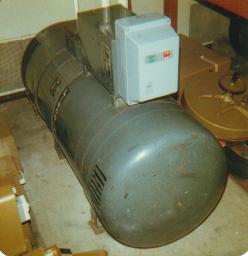
Answered my own question Here.
 
Posted by Fred Georges (Member # 505) on 07-07-2006, 08:46 PM:
 
"The lambs were AC, both carbons were the same size. That converter changed the 60 cycles to 96 cycles, a multiple of 24, to eliminate flicker. That was the only AC setup I ran across in those days. It worked good". Bob Marken

Bob, Can you remember if those were "Cyclex" AC lamphouses? They (supposedly) could burn for 2 hours on a single trim.
 
Posted by John McConnel (Member # 2000) on 07-07-2006, 11:17 PM:
 
In Oklahoma City, the Frontier Theatre, previously known as the Log Cabin Theatre, had Cyclex lamphouses. They told me the lamps operated at 120 cycles per second, but it probably was actually 96. At any rate, they worked fine.

The theatre was down the street from what is now the gay district. It played art, musical, foreign and erotic films of the day, and was an interesting place. It could have been the Castro of Oklahoma City if it had remained. The owner had the demeanor of an impresaro. His wife sold tickets and wore bright red lipstick that extended past her lips. She used a long extension to smoke her cigarettes. The projectionist sat in the lobby between changeovers with his legs spread, displaying his stuff. Some of the movies weren't of interest to me, so I'd sit in the lobby and visit with him.

The theatre met its demise by fire about 1954, and a motel, and later a YWCA, was built on the location.
 
Posted by Tim Reed (Member # 137) on 07-08-2006, 11:10 PM:
 
Ashcraft Cyclex's ran at 96Hz.
 
Posted by Robert DeLoss Marken (Member # 2440) on 07-09-2006, 12:00 PM:
 
Fred – I’m sorry, if I remember correctly everything in the Beaver Theater booth was Motiograph. But as I remember the carbons had to be trimmed for each reel and would last for maybe 2.5 reels, like most of the lamps at that time. Bob Marken
 
Posted by Dave Macaulay (Member # 813) on 07-10-2006, 09:05 PM:
 
quote: John McConnel
The projectionist sat in the lobby between changeovers with his legs spread, displaying his stuff
Hmmmm.
 
Posted by John McConnel (Member # 2000) on 07-10-2006, 09:13 PM:
 
The print was impressive, anyhow. Many men would have been envious.
 
Posted by Tony L. Hernandez (Member # 3524) on 07-10-2006, 11:31 PM:
 
The Comanchee Drive In in Buena Vista still uses one thats been there since '66. Just saw it last week. I took pictures and will post them as soon as I get my film developed.
 
Posted by Floyd Justin Newton (Member # 1316) on 07-31-2006, 11:37 AM:
 
Not digital? OH NO....it'll never work!! [Big Grin]
 
Posted by David Buckley (Member # 2600) on 08-10-2006, 05:23 AM:
 
quote: Rick Raskin
What in the world is a salt water dimmer?
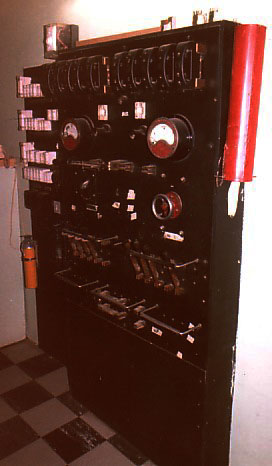
These things were more succinctly know as "piss pots", I'm sure you can guess why...
 
Posted by Phil Blake (Member # 2012) on 08-10-2006, 07:46 AM:
 
We used Linclon DC motor generators at the drive in up until 1980/

I must say they did work quite well there for almost 20 years every now and then it would just stop without reason .

I will never forget the noise they made , we had them located in a small room just behind the rewind bench wall.

Unfortunately I never took any photos of them but I found a pic on the net of one that was the same.

 -

The master switchboard was an eye opener to alot of people, few had ever seen brass knife switches in action.

 -

The lower switches turned on the lamphouses and the large switch in middle was to switch between generator one and generator 2.
Once the generator was started we would manually wind up the amps, they powered BTH arcs at 180 amps.
 
Posted by Bernard Tonks (Member # 809) on 08-11-2006, 06:35 AM:
 
Rex Cinema, Hastlemere in Surrey. The two DC Generators, alternated weekly were driven by diesel engines until changed to electric traction some 25 years after the cinema opened. The generator room was in a separate building, which I was fortunate to see running before the cinema closed . Projection equipment, all Kalee, was still operational although an additional Westrex xenon projector & tower was installed by the leaseholder.
 -
Picture: The Complete Projectionist 1943.
 
Posted by Kenneth Wuepper (Member # 1174) on 08-11-2006, 06:41 AM:
 
The cinema in Grayling, MI was fed DC from the local Diesel power generating plant. The plant was only about 8 blocks from the generator and the wires were all above ground through town. It was possible to put the carbons together and see the street lights dim. The engineer at the plant, however, was not very happy with that. Although there was an alternative source for the AC to supply customers, when the Diesel went down there was no DC for the Carbon arcs.

KEN


Powered by Infopop Corporation
UBB.classicTM 6.3.1.2