This is topic Periscopic projection in forum Film Handlers' Forum at Film-Tech Forum ARCHIVE.


To visit this topic, use this URL:
https://ft-forum.com/ft/cgi-bin/ubb/ultimatebb.cgi?ubb=get_topic;f=1;t=004945

Posted by Peter Schoell (Member # 919) on 05-30-2003, 10:54 PM:
 
I know film has been projected through periscopes with 2 parallel mirrors.Can this be done with 2 mirrors that are at right angles to each other?

I'm looking to build an auditorium in which the film path would travel in a "U" shaped path. Because the mirrors aren't parallel, will I be able to hold focus across the screen?

BTW, George Bush assures me periscopic is a word.
 
Posted by Tim Reed (Member # 137) on 05-31-2003, 12:14 AM:
 
If you're talking about a vertical distance, you won't have to worry about focus... the second mirror rotated top-to-bottom about the light path will flip the image.

If you can, turn the projector in the direction of the screen, and then use the periscope to get the beam around to where you need it.

Not sure about horizontal periscopes, if that's what you're asking, but I would think you'd have the same situation - only with the image flipping sidewise.
 
Posted by Tom Kroening (Member # 201) on 05-31-2003, 01:10 AM:
 
From what I've heard these parascopes are more trouble than they are worth. I would think image stability would be a problem as well as getting a sharp focus. I'm sure it could be done but isn't there any other option?
 
Posted by Per Hauberg (Member # 529) on 05-31-2003, 05:29 AM:
 
Do i remember it right: was it between 30 and 40 % loss of light in one set of mirrors ??

Per
 
Posted by Kevin Baglow (Member # 721) on 05-31-2003, 06:22 AM:
 
Some one north of here has been doing it for about 10 years. They are finally coming to there sensers and building the projection in the right place. they said the horizantal lines in the picture became bowed.
 
Posted by John Pytlak (Member # 331) on 05-31-2003, 08:09 AM:
 
There are many downsides to using mirrors. You must use optical-quality front-surface mirrors. Unless kept perfectly clean, the picture contrast will be adversely affected. Any vibration of the mirrors is magnified, and will appear as unsteadiness. There is a light loss at each mirror surface, which will depend upon the type of mirror and how clean it is.
 
Posted by David Stambaugh (Member # 1102) on 05-31-2003, 12:09 PM:
 
Moyer's old Valley River Twin here in Eugene used mirrors. I only went there once. It's probably safe to say they were not paying a whole lot of attention to little things like cleanliness or alignment of those mirrors. [thumbsdown] What a horrible theatre - skanky in all respects. Luckily the place was eventually demolished and replaced with a Red Lobster restaurant.
 
Posted by Greg Mueller (Member # 17) on 05-31-2003, 12:40 PM:
 
Astronomical first surface mirrors have coatings that will get to about 96% efficiency.
"Periscopic" appears in "Websters Encyclopedic Unabridged Dictionary of the English Language" Copyright 1996 page 1442
 
Posted by Joe Beres (Member # 678) on 05-31-2003, 01:15 PM:
 
I have seen a few theaters that projected film off of mirrors, and the presentation was always subpar. Why is it necessary? Can you tell us more? There are some ingenious perople here that could possibly come up with some other viable suggestions, If you really need to do it, I think you would definitely want to invest in some first surface mirrors and some very sturdy mounts. It would be a big investment though.
 
Posted by Greg Pauley (Member # 503) on 05-31-2003, 01:47 PM:
 
I have two auditoriums using mirrors since the mid seventies in small houses. These two auditoriums were built under a balcony and there was no option to raise the booth higher to get the proper angle to miss people’s heads without the mirrors. We really haven’t had that much problems with them over the years except for the light loss which causes you to run a larger bulb size. I don’t have any problem with image stability since the mirrors are mounted to the wall and ceiling in a very sturdy mount. I would never use mirrors unless there wasn’t any other option, but I wouldn’t be afraid to use them again if I had too.
 
Posted by Stephen Furley (Member # 1277) on 05-31-2003, 03:04 PM:
 
Two of London's main railway stations had 'news theatres' built in the '30s. The one at Victoria closed about twenty years ago, the one at Waterloo some time earlier. In their later days after the newsreels finished they ran cartoons. Originally they had slide lanterns to project train times and announcments on a small screen alongside the main one.

One of these, Waterloo I think, had the projection box built above the auditorium, with rear projection via mirrors, but it was later changed to a more conventional set-up, so I assume it didn't work too well.

Bernard, if you read this, do you know any more about these places? Both have now been demolished, and I never went to the Waterloo one. I was taken to the Victoria one when I was quite young, and I remember seeing a Laurel and Hardy film. I had never heard of L&H at that time. The following day it was anounced in the papers that Stan Laurel had died.

Was anything similar to this built at any of the American stations?

I went to the Victoria one on its last night, I think it was still Academy ratio only, until it closed, if I remember correctly. They were still using the original projectors, but wouldn't let anyone up to the box to see them until an original nitrate print of a newsreel from its opening year which they ran a couple of times had been removed. I had to leave to get somewhere else before this was done, so I didn't get to see them. The place was quite interesting architectually, but was demolished very soon after closure as part of a shopping development above the station. The plainer Waterloo one remained, unused, for many years after closure.
 
Posted by Mark Lensenmayer (Member # 134) on 05-31-2003, 03:58 PM:
 
Two 70's vintage AMC theatres here used periscopes. They did this so they did not have to put in a second level for a projection booth. The projectors sat level with the back of the theatre, then went up about 5 feet to clear the heads of the audience. I believe they stopped that practice by the '80's.

These were the early AMC shoebox style theatres. They were both 6-plexes and seemed HUGE at the time.
 
Posted by Tim Reed (Member # 137) on 05-31-2003, 07:47 PM:
 
TransLux used to have mirrors -- they were rear-projection, too; albeit their mirrors were in the lens barrels. And Plitt in Houston used to use a periscope arrangement to get over the corridor. Every time someone opened the door to the auditorium, the picture on the screen would go <wobbbbbobobobllllle!>

I've seen them in a bunch of drive-in twin-splits.

No, mirrors are never a good idea.
 
Posted by Peter Schoell (Member # 919) on 05-31-2003, 08:59 PM:
 
Wow! Thanks for all the input.
I have 2 reasons for putting in a screen with a periscope.

1) One of my theatres has a small store front as part of the building. I've had it rented about 5 times in the last 7 years and collected about $300.00 total! So I figure I can put in a small screen ( 14 feet) and about 40 seats, even if I only sell 300 seats a month that's $1200.00, also I don't have the empty store space, which is kind of an eyesore.

2) Also in this town is a drive-in that has 5 screens, an 85, 50, and 3 30ft screens. Since the movie companies will alow a drie-in to stack movies, and since they won't allow us to play the same movie at the same time, this means the drive-in can tie up 10 movies at a time. The movie companies usally give me first choice, but in the summer, when we have so many tittles opening each week and then having to hold them for 3 weeks, I sometimes have to pass because my three screens are full. The drive-in will take the film and hold it until labor day, this is what happened with Jurrasic Park 3 a couple of years ago. I ended up playing J3 after Labor Day for 1 pitiful week. I also end up terminating films before i'd like just so I can open something else and pay those first week percents, which are more than driv-ins get charged, but that's another topic.

The room I'm planning will have about 40 high back rockers, small risers, probaly 6 inch, and center surround.
I plan to put the projector in the basment under the auditorium, and run the periscope up the back wall. I'm sure the manager will be overjoyed when she finds out she'll have to run upstairs to rethead 3 rooms then down to the basment to rethread the fourth. As all employers know, employees are always looking for new challenges. OK that's another topic too.
 
Posted by Richard Fowler (Member # 893) on 06-01-2003, 04:49 AM:
 
Your will find your mirror in the auditorium will be quite large. A simple trick is to scale out your projection throw with some graph paper and fold the paper at the distance points for the mirrors to give you a general of the size required. The smaller mirror should be front surface glass and the second mirror should be optical mylar on a frame due to the larger size. These mylar mirrors are available from Hudson Photographic in New York or Vutec in Florida. Another option is to do what Hoyts in Argentina and SK in Sweden have done...build a tunnel / chamber to allow projector and lamphouse on a custom mount to travel up a lift to the auditorium after threading. The Platter and sound stay in the basement. The chamber would take the space of about two seats. I have personally done this for an 8-70 installation to move back the projector to a thread position and send it up a tunnel 14 feet for projection.
Richard Fowler
Kinoton America Inc.
A little jet lagged this morning..........
 
Posted by David Kilderry (Member # 142) on 06-01-2003, 05:50 AM:
 
Hi Peter,

At the former Hoyts Midcity here in Melbourne, they did almost exactly what you are contemplating back in 1976. It was a large twin with about 900 seats per house, they wanted to add a third screen, but lacked space. The solution was to take over part of the foyer for a 225 seater, yet there was no room for a projection room unless capacity was reduced considerably. The news stand in the arcade below was bought and it was transformed into the projection room using a periscope.

The projection room had a Philips FP 20, platter and automation. The beam hit a mirror and went 30 feet up a shaft to the back of the theatre, it then hit a larger mirror and went to the screen. As the screen was small, light and focus were good. It was difficult to get into focus and I found I had to go up to the back of the theatre to check that it was OK. On hot days we would often have the door to the booth open, it sure got looks from passers by as they saw a projection room in the middle of an arcade.

David Kilderry
 
Posted by Bernard Tonks (Member # 809) on 06-01-2003, 07:01 AM:
 
Stephen wrote,
quote:
One of these, Waterloo I think, had the projection box built above the auditorium, with rear projection via mirrors, but it was later changed to a more conventional set-up, so I assume it didn't work too well.

Bernard, if you read this, do you know any more about these places? Both have now been demolished, and I never went to the Waterloo one.

Stephen, I know this will be hard to believe that the projection room at Waterloo was high above the auditorium shooting through a void directly onto a rear projection screen above the stage onto a vast mirror. You actually watched the 60 minute News programme on a mirror [Big Grin] , this was in the early days of 4x3 academy ratio mind you, and designed to overcome the severe projection keystoning. Shortly afterwards this system was abandoned I assume due to problems with reflections on the mirror etc., and the projectors were steeply re-raked for direct projection. [eyes]

In later years Waterloo News Theatre / Waterloo Cartoon Cinema, became a Classic Cinema installing wide screen & cinemascope, with Cartoons during the day, changing to Double Feature programmes from 5pm, eventually full-time. I believe The BTH projectors were original from the opening day. I visited this place a couple of times during the Newsreels era, but never the Victoria Station one.

One of the worst mirror projection system designs I saw although clever, was at the Compton Cinema Club in London’s Soho. Projection was from behind and beneath the screen through mirrors onto a main mirror in the like orchestra pit, which reflected the picture onto a wide screen. The projectors which faced each other about 15 feet apart, were Kalee 37s with xenon arcs on 2000’ changeovers which must have been automated as you could only see the picture in the auditorium.
 
Posted by Gordon McLeod (Member # 33) on 06-01-2003, 08:21 AM:
 
Cinepelx eaton centre had both periscopic front projection and rear screen booths
There were several other periscopes in some of there other locations as well
I was in one threatre once that had a downward periscope through the booth floor to a lower theatre
 
Posted by Fred Georges (Member # 505) on 06-01-2003, 06:24 PM:
 
Mirror projection is certainly a tricky business but, if done correctly is a viable approach. Astronomical grade front surface mirrors are a MUST for the primary. Mylars can be use to good effect for large secondarys but, if budget permits and the secondary is no larger then 30" by 30" I'll go with a front surface Mirror. I'm fortunate to have a custom manufacturer of Astro grade mirrors in my area and they have made Me some excellent ( though expensive) sets in the past. My main problem with large secondarys has been the distortion of straight lines. Even though the mirror backing support plate appears flat most times it isn't. Not the mirrors fault but the supports. In video installations it was easy to do a complementary distortion when converging the CRT projectors to get the correct, straight lined geometry on screen. With film & LCD/DLP projectors I found I had to pre "distort" large secondary mirrors with an adjustable torsional frame. I built one years go, and what a complicated beast it was with 24 adjustment points. It worked well for that installation but I'd hate to have do one again. [Big Grin]
 
Posted by Bill Gabel (Member # 1105) on 06-02-2003, 04:06 PM:
 
Cineplex's Beverly Center in Los Angeles had two perscopic theatres. But during the remodel to make the two large theatres
up stairs they had to lost one of those houses.
 
Posted by Phil Hill (Member # 371) on 06-02-2003, 04:27 PM:
 
Periscopes and mirror configurations are commonly used in special venue and ride simulators to solve a myriad of projection throw limitations with both front and rear projection screens.

Having designed and installed many of these, I agree with what George said in his above post.

However, I would stay away from the Mylar mirrors if at all possible. In addition to the problems George mentions, I have found the large surface area of the thin membrane acts like a passive speaker/microphone diaphragm. The vibrations, especially from the subwoofers, cause the projected image to wiggle, go in-and-out of focus, and do other strange things on the screen and it is very annoying.

ALWAYS use 1st surface mirrors if at all possible.

>>> Phil
 
Posted by Timothy Eiler (Member # 383) on 06-02-2003, 05:49 PM:
 
quote:
Also in this town is a drive-in that has 5 screens, an 85, 50, and 3 30ft screens.
The Screens are 100 ft,60 ft,2@ 32 Ft and the last is 36 ft
Tim
Starlite Drive-in

[ 06-03-2003, 09:36 AM: Message edited by: Timothy Eiler ]
 
Posted by Daryl C. W. O'Shea (Member # 1303) on 06-02-2003, 06:02 PM:
 
Whoa! This isn't the place for booking disputes. You guys (Tim & Peter) need to either pickup the phone or email each other. Don't discuss it here.
 
Posted by Timothy Eiler (Member # 383) on 06-02-2003, 06:51 PM:
 
Had There Been no innacurate information posted about my Drive-In I would have had no need to respond and Would Not have.

[ 06-03-2003, 09:37 AM: Message edited by: Timothy Eiler ]
 
Posted by Ken McFall (Member # 845) on 06-03-2003, 12:32 PM:
 
Odeon Panton Street in London, formerly the Cinecenta, Cannon, MGM, ABC, is a four screen that uses periscope in all four screens.

When it first opened it was all change-overs with eight FP20's with AEI/BTH 2k three electrode lamps. The rectifiers, westinghouse, were sunk into the floor or hidden under stairs. There were two booths with four projectors in each, it was like an oven in there. Eight set's of mirrors to clean and constantly adjust, the audience could reach in and move them. The operator looked out between their heads.

Today they still have the same FP20's but they are down to four, now running with two Kinoton platters upstairs and two Cinemeccanica towers downstairs. The lamphouses are converted Orcons that run off Irem rectifiers...and all connected to an installation that has to be seen to be belived!

Odeon are 'Fanatical about film' by all accounts in this West End show.

But the mirrors remain!
 
Posted by Tim Reed (Member # 137) on 06-03-2003, 07:53 PM:
 
Speaking of mirrors, you should have seen one of the mini drive-ins; those were the ones that had 160-some-odd little screens, built in a circle around the booth. Each car parked in front of its own little 3 x 5 screen. I remember there were a ton of mirrors to pull this arrangement off, and by the time the image(s) hit the rear-projected screens, there wasn't much light left to view.
 
Posted by System Notices (Member # 2357) on 04-02-2005, 03:20 PM:
 

It has been 668 days since the last post.


Posted by Ferdinando Innocenti (Member # 2477) on 04-02-2005, 03:20 PM:
 
Well, I was wondering if it is possible, and if the equipment needed exists, to build a booth in which the turret is not installed on the projector.

My thought: where the lens should be, you can mount a mirror (45°), then another mirror (periscopic projection), then the turret on a bracket. I think it could be better if the light should pass in a rod, such as the integrated rod in Barco DP100.

Do anyone of you know if a system like this exists? Do you think the light loss is much more than in a normal periscopic projection?
 
Posted by Adam Martin (Member # 641) on 04-02-2005, 04:18 PM:
 
You would never achieve focus with the lens being so far from the film plane.
 
Posted by Tim Reed (Member # 137) on 04-02-2005, 09:50 PM:
 
What would be the benefit of relocating the turret?
 
Posted by Phil Hill (Member # 371) on 04-02-2005, 11:16 PM:
 
quote: Adam Martin
You would never achieve focus with the lens being so far from the film plane.
Adam is absolutely correct. If you want to offset the projection point, you need a periscope using mirrors.

Perhaps you should use the Magic Thread Finder and look through some of the other posts in this thread like this :

posted 06-02-2003 04:27 PM CT (US) (2:27 PM Local)

--------------------------------------------------------------------------------

Periscopes and mirror configurations are commonly used in special venue and ride simulators to solve a myriad of projection throw limitations with both front and rear projection screens.

Having designed and installed many of these, I agree with what George said in his above post.

However, I would stay away from the Mylar mirrors if at all possible. In addition to the problems George mentions, I have found the large surface area of the thin membrane acts like a passive speaker/microphone diaphragm. The vibrations, especially from the subwoofers, cause the projected image to wiggle, go in-and-out of focus, and do other strange things on the screen and it is very annoying.

ALWAYS use 1st surface mirrors if at all possible.
 
Posted by Ferdinando Innocenti (Member # 2477) on 04-02-2005, 11:33 PM:
 
In a periscopic projection, if you have a great distance between the first and second mirror, you must use a very big second mirror. This is the problem.

I thought about what Adam said, I know he is right. But I was wandering if it possible to use a system to focus. For example, a lens which doesn't magnify the image, or a second lens just before the turret.
 
Posted by Tracy Bellar (Member # 3049) on 04-03-2005, 01:01 AM:
 
Don't forget the inverse square law. If you double the distance you cut the light in half.
 
Posted by Roger Frazee (Member # 640) on 04-03-2005, 07:58 AM:
 
Sometimes there is no alternative to mirrors. Regal has used mirrors on three occasions, when there was no other choice. The periscope systems were built by Stewart Filmscreen in Cincinnati. The mirrors are mounted on a steel frame, encased in a heavy plastic box, and mounted in the front wall of the booth. Optical glass and front surface mirrors are used throughout. Because the mirrors are in a sealed enclosure, the system requires very little maintenance. The system is pricey, but it works well.
 
Posted by Tim Reed (Member # 137) on 04-03-2005, 11:53 AM:
 
quote: Tracy Bellar
If you double the distance you cut the light in half.
Actually, the light stays the same, it is only spread out over a greater area.

[ 04-16-2005, 11:41 PM: Message edited by: Tim Reed ]
 
Posted by Mark Gulbrandsen (Member # 72) on 04-03-2005, 01:50 PM:
 
quote: Roger Frazee
Sometimes there is no alternative to mirrors.
IMHO then its time to bring in the wrecking ball [thumbsup] and re-do the place so its right.!! Front surface mirrors, no matter how good, still degrade the image dramatically. Were I to go into a place with them and notice it I would want my money re-funded.

Mark
 
Posted by Richard Fowler (Member # 893) on 04-03-2005, 03:00 PM:
 
I have done many rear and front mirror layouts with about 50% would have been eliminated with proper preplanning of the construction space. One location the the installer created (4) periscope ports to go around the airduct and returns placed on the front projection wall with very poor results since the operators would knock the pedestals out of alinement to the mirrors and screens. Two days of relocating the air ducts to the rear of the booth and feed ducts as required solved the problem at minimal cost...no coordination on the job and a tech trying to solve a job with blinders on [Roll Eyes]
 
Posted by Jon Morgan (Member # 3059) on 04-03-2005, 03:20 PM:
 
quote: Tracy Bellar
Don't forget the inverse square law. If you double the distance you cut the light in half.
Actually, since it's an inverse SQUARE proportion, doubling the distance cuts the light by a factor of four.
 
Posted by Gordon McLeod (Member # 33) on 04-03-2005, 08:39 PM:
 
The distance is not an issue only the size of the image
If you maintain the same size of image (and don't get into silly long focal lens) the light level will stay virtually the same if the image size is maintained
 
Posted by Tracy Bellar (Member # 3049) on 04-04-2005, 12:42 AM:
 
Actually, since it's an inverse SQUARE proportion, doubling the distance cuts the light by a factor of four.


If you take any distance and measure the intensity of light then either double the distance it cuts the light intensity in half. If you cut the distance in half it doubles the light. it is called the invese square because it is an exponential increase or decrease in intensity.
 
Posted by Peter Hall (Member # 695) on 04-04-2005, 07:34 AM:
 
The only time the throw comes into play re light is if there is something attenuating the beam, eg smoke (we used to do "Cinema Fumee" in a club here, serious clouds of all sorts between us and the screen) or mist (outdoor stuff). Otherwise you do lose more light on short throws and large screens however this is more to do with the lenses.

We have only done one install of mirrors in 15 years, at Clapham in London. The client had an alternative of losing 33 seats per screen or installing mirrors. We put in optical front surfaced mirrors on adjustable resilient mounts, kept the bottom (larger) mirror as small as we could and it does work OK - is no fun to work with however.

The Plaza in London had upwards vertical periscopes in 3 and 4 - the mirrors were in the cinema and grew when they got hot, meaning that the image distorted quite badly on a hot summer night with a full house.

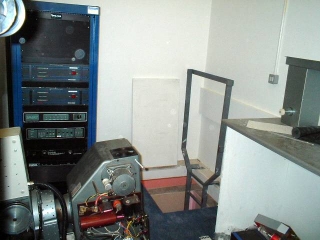
There is an alternative, which we are unconvinced on - as pictured. We are doing 4 of these at the moment - super low budget at the clients direction. The lens height is 400mm off the floor and you need to lie on the floor to focus - note the upside down layout of the racks. There was no alternative in this case as there is insufficient space for mirrors, however we remain concerned about the practicality of this.

 -
 
Posted by Gordon McLeod (Member # 33) on 04-04-2005, 09:24 AM:
 
Tracy that is only partly true but
the image size is the only factor if one changes the focal length of the lens to maintain the same image size the amount of light will stay the same the only thing is extremely long focal length lens or atmospheric haze
 
Posted by Ferdinando Innocenti (Member # 2477) on 04-05-2005, 08:31 AM:
 
Well, I think my english is not good enough to make the situation clear.

A customer of mine wants to build a second room; he’d like to install the second projector in the same booth of the first, so the projectionist could work better with platters. In fact, the second room is very small (about 80 seats), and it’s impossible to build a booth without deleting a great number of seats.

Other problem: in vertical axis, the distance between the projector and the second mirror cannot be shorter than 4 meters, which is about more than a half of the distance between wall and screen.

The solution I have thought (I think it is possible, but I can’t find the equipment) is: projector in the big booth, without the standard turret, turret just before the window of the second room. The focusing problem can be overcome with a kind of integrated rod (as in Barco DP100) or a special optic with focus = infinite, or a beam concentrator, or … I don’t know! I’m sure it’s possible, but I don’t know how. Can you help me?
 
Posted by Richard Fowler (Member # 893) on 04-05-2005, 09:36 AM:
 
You can shift location of lenses if you use relay optics or condensers to create an image "in space" to allow a lens to capture the image. This concept was used in the rear screen drive-in system with 100 or more lenses picking up the image from the projector and is the concept used in telecine film / slide chain to give a common image between different formats. It is possible....but practical...no. The "collector rod" as used in digital projectors are to collimate the light source to give an even field of illumination to the image chips. Speaking of video image, why not put a video tap on the projector ( if you are running 25fps ) and use a video projector for the small room or create a custom projection head / lamphouse to fit the space of one to two seats with the platter in another location. This is being done in Sweden and Argentina. The projector is even threaded in the main booth and sent via a track to the projection room of the other cinema for projecting the show and using remote framing and focus.....Have fun [Smile]
 
Posted by Ferdinando Innocenti (Member # 2477) on 04-08-2005, 04:31 PM:
 
Thanks for your advice, Richard. I tried to find something about "relay optics" but I didn't find anything. Can you help me again? and why do you say that it is possible but not practical?

Thanks in advance.
 
Posted by Richard Fowler (Member # 893) on 04-08-2005, 05:15 PM:
 
Aerial images created in space are usually the work of image condensers or optics to "relay" the image you want to focus on to a different location than the source ( film plane / image on a tube face ). An example on my animation stand I have a lens condenser to pick up the image from a slide or movie projector that is about 0.5 meter from the animation stand top. The image is focused on the condenser so the camera optics can focus on the image "in space". We worked with a 70mm dome show lens which used a camera optic to project the image....this required a set of optics to create an aerial image about 400 mm ahead of the film plane so the camera optic could focus on the image. These systems require high precision with all points collimated or you have light loss, poor image quality...most cinemas would be hard pressed to keep a system maintained. The dome lens was an example...it was cost effective compared to two - three other lenses available but the relay optics absorbed light to the point that the lens was an F/4 which required more lamphouse wattage to compensate and operators would sometimes bump the front portion of the lens enough to knock it out of collimation = image problems.
 
Posted by Tim Reed (Member # 137) on 04-10-2005, 11:37 AM:
 
quote: Richard Fowler
An example on my animation stand
What stand do you have, Richard? [Cool]
 
Posted by Richard Fowler (Member # 893) on 04-10-2005, 12:53 PM:
 
It is a custom stand based on Mechanical Concepts design. Besides normal x/y/z/ controls horizontal travel is three feet to handle special backgrounds. We had the unit set up until last year and is temporarily stored in out office until we move it to a new location with enough height. My smaller title stand with limited movement I recently sold to a studio and they are converting it to a digital scanner for artwork. With computers and programs such as Toonz and Maya, I am the prehistoric guy in regards to the stands. Justin, our computer animator, bangs out two - three 10 second clips a day on Maya but he has noticed on on simple set ups the stands where up to speed in creating an end product. [Smile]
 
Posted by Tim Reed (Member # 137) on 04-10-2005, 01:05 PM:
 
I didn't know you were into filmmaking. Do you have any of your work online?

Btw, I use Animo and Toon Boom for 2D stuff -- Maya, Bryce, and Carrara for 3D. You mentioned the stand so I wondered if you were using it somehow. Great! [Smile]


Powered by Infopop Corporation
UBB.classicTM 6.3.1.2