This is topic Life without film cleaners in forum Film Handlers' Forum at Film-Tech Forum ARCHIVE.
To visit this topic, use this URL:
https://ft-forum.com/ft/cgi-bin/ubb/ultimatebb.cgi?ubb=get_topic;f=1;t=005161
Posted by Carmine Occhino (Member # 1699) on 07-31-2003, 10:23 AM:
I am having no luck convincing management to order the film guard package, not even the bottle. All I have to use is Xecote which seems to help prevent hard buildup in the gate/trap. Given the fact that I run the shows only half of the time and the other guy has problems even brushing out the trap, how long can a new print be kept in acceptable condition ? Am I wasting my time doing all the cleaning and dusting on my shifts ?
Posted by Darryl Spicer (Member # 711) on 07-31-2003, 10:27 AM:
Just remember that xekote is a lubricant for gates and film not a cleaner. I would not suggest using it in the same manner as film guard. I would try and get a sample from Brad and demonstrate it's use for your theater. So long as you have a film cleaner that is.
It is important to keep eveything clean and maintained. I have ran films for months and they stayed in acceptable condition. Minimal dirt few if any abraisions. Keep careing that is what is important.
Posted by Carmine Occhino (Member # 1699) on 07-31-2003, 10:31 AM:
Yes Darryl sorry if I was unclear that is what I use it for..to lubricate the trap and gate.
Posted by John Pytlak (Member # 331) on 07-31-2003, 10:33 AM:
IMHO, using an on-line film cleaner is one of the easiest and least expensive ways of improving presentation quality. ![[Smile]](smile.gif)
A good investment in "Film Done Right". ![[Cool]](cool.gif)
Posted by Mike Blakesley (Member # 26) on 07-31-2003, 02:12 PM:
After seeing the amount of crap that is picked up by the film cleaner, I would never go without one. I was especially surprised by the amount of dust on new prints.
Posted by John Pytlak (Member # 331) on 07-31-2003, 04:05 PM:
The "dust" on new prints often comes from the well-worn and dirty shipping cases. But another factor is that the first few times through a projector, the sprockets and rollers scuff the perforations and edges of the film, generating some debris until the film becomes "burnished". Using a film cleaner removes this debris before it can become stuck to the film.
Posted by Jesse August (Member # 1798) on 07-31-2003, 09:45 PM:
When you speak of film cleaner do you mean particle transfer rollers (P.T.R's).
Posted by John Pytlak (Member # 331) on 07-31-2003, 09:58 PM:
Kodak's PTRs clean the film by simple contact adhesion with a specially finished polyurethane roller. So nothing is put on the film. They are especially useful in applications like IMAX projectors, cleaning raw stock, cleaning printing negatives, on telecines, etc. where nothing can be added to the film.
The other popular on-line cleaner is the web cleaner, originally developed by 3M (and commercialized for motion picture projectors by Christie and Kelmar) as a dry web that captured dirt particles, and now often used with FilmGuard to also treat film prints with a proprietary formula that provides lubrication.
Posted by Jesse August (Member # 1798) on 07-31-2003, 10:09 PM:
I am an IMAX projectionist. And we use PTRs and nothing else. That's why I was wondering what was being discussed. Thanks.
Posted by John Pytlak (Member # 331) on 07-31-2003, 10:25 PM:
I was the leader of the Kodak team that developed and commercialized PTRs for motion picture film cleaning, which just won this year's EPA Stratospheric Ozone Protection Award:
http://www.epa.gov/ozone/awards/03winners.html
http://millimeter.com/ar/video_kodak_receives_epa/
Posted by Joe Redifer (Member # 3) on 07-31-2003, 10:54 PM:
Hey! Media cleaners don't damage the ozone! They need the award, too! Hmmm... my fingernail clippers also do more to protect the ozone than damage it. Another award required!
Media cleaners might win if there were more corporate/political pull behind them. The next president of the US will see to that (we will purchase this president... don't think it can't be done!)
Posted by John Pytlak (Member # 331) on 07-31-2003, 11:00 PM:
quote:
They need the award, too!
Then why don't you submit an application to the EPA?:
http://www.epa.gov/ozone/awards/02index.html
http://www.epa.gov/ozone/awards/NominationForm_Ozone_2004.pdf
Posted by Joe Redifer (Member # 3) on 07-31-2003, 11:46 PM:
Prolly 'cause I didn't invent it.
Posted by Will Kutler (Member # 770) on 08-01-2003, 01:22 AM:
I am a staunch supporter of Film Guard; it really keeps a print clean. I can attest to the fact that by using Film Guard, along with proper film handling, equipment cleaning and maintenance, a print can look just as good after months of use as it did on its initial showing!
But I do have a question for John Pytlak and Joe Redifer. The booth of my old employer was vented directly to the outside with no filters or booth atmosphereic control. The projectors were the Christie package. What would happen is (even with the use of FG), a newer print would leave a rather heavy paste on the gate bands and rollers (especially on SRD Digital Soundheads).I never had any scratches or loss of sound due to this problem, but I would like to know if I could have done something within my realm to prevent this from happening? What do you think was causing this to happen?
Posted by Joe Redifer (Member # 3) on 08-01-2003, 01:58 AM:
When was this theater built? The older Christie trap/gate combo was pretty rough. I had a Christie theater that opened in early 1998 I believe. We had the same problem (multiplied by 24 since we didn't have Filmguard at the time). Christie actually recommended making a loop of fullcoat mag and running it in the projectors overnight to smooth things out. Then the next night I was to do the same thing again, only reverse the loops so they were rubbing against the gate instead of the trap bands.
To my knowledge Christie has resolved this problem as I have not heard of it in the newer installations.
Posted by John Hawkinson (Member # 1135) on 08-01-2003, 06:18 AM:
As long as you're submitting, Joe, don't forget that the nominations deadline for the scientific and technical achievements Academy Awards is today, August 1st 2003. ![[thumbsup]](graemlins/thumbsup.gif)
But on a more serious note, the award Kodak got is not because PTRs are good for the environment. It's because they promoted PTRs and marketted them to major users of 1,1,1-trichloroethane (presumably they mean labs here, not booths that use it to clean off masking tape splices). As far as I can tell, there has been no similar marketting of media cleaners, by Kelmar or anybody else. FilmGuard itself has some advertising, but not very much that I see.
So in the marketting department, FG could do a lot more. Maybe something like a strategic partnership with a projector vendor, etc. Or since Kodak canned Film Notes for Reel People, maybe it's a perfect openning to start a print publication, Film-Tech Notes for Reel People (actually, that might be infringing on Kodak's IP, but you get the idea).
--jhawk
Posted by John Pytlak (Member # 331) on 08-01-2003, 07:19 AM:
jhawk wrote:
quote:
...the award Kodak got is not because PTRs are good for the environment...
![[Confused]](confused.gif) PTRs have allowed film labs and film-to-video transfer facilities to eliminate the use of millions of pounds of ozone depleting chemicals. How is that not "good for the environment"???
PTRs have allowed film labs and film-to-video transfer facilities to eliminate the use of millions of pounds of ozone depleting chemicals. How is that not "good for the environment"???
Although Kodak has discontinued the publication of "snail mail" versions of "Film Notes for Reel People" and "Cinema Notes", the Kodak website contains many of the articles, and a wealth of other film handling information. Brad has been able to post all the back issues in the "Manuals" section of Film-Tech. Kodak also actively participates in numerous Internet User Groups and in presenting tutorials and technical papers at industry conventions.
Posted by John Hawkinson (Member # 1135) on 08-01-2003, 07:48 AM:
John, I was not clear enough, sorry about that.
When I said, "...not because PTRs are good for the environment," I meant that in of themselves, PTRs do not have much of a direct positive environmental impact. Their impact is indirect, in that they enable users to stop using environmentally-unfriendly technology.
It seems to me that the award did not go to Kodak for developing an inert plastic roller--the award went to Kodak for convincing people to stop using nasty chemicals (and to use the inert plastic roller instead).
--jhawk
Posted by John Pytlak (Member # 331) on 08-01-2003, 07:56 AM:
jhawk wrote:
quote:
It seems to me that the award did not go to Kodak for developing an inert plastic roller--the award went to Kodak for convincing people to stop using nasty chemicals (and to use the inert plastic roller instead).
They go hand-in-hand. Developing great technology is fruitless unless people actually USE it. Kodak has always tried to follow George Eastman's philosophy of "You push the button, we do the rest" in developing and marketing technology that enables customers to use our products with ease.
Posted by Brad Miller (Member # 2) on 08-01-2003, 03:50 PM:
Carmine,
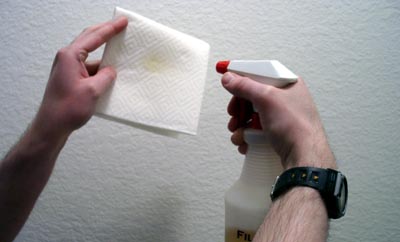
You don't have to have the media cleaner to use FilmGuard. As is shown in the instructions that accompany the kits, you can take a couple of paper towels, fold them over twice on themselves, spray FG onto your "paper towel pad" (saturate the entire surface) and use it that way for lubricating, print shedding and static control.
All you need to do is start the platter spinning (jam something in the brain or use a MUT) and wipe from edge to center so that there is a "wet" appearance to the edge.
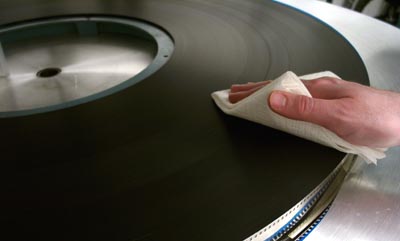
Then wind the film upside down on the next show and repeat for the other side.
Although this trick can't actually wipe the dirt off of the image area, if you are starting with new prints, this will greatly extend the "like new" appearance of the projected image as well as the other benefits above (cuts static, cuts shedding, lubricates print).
Posted by Carmine Occhino (Member # 1699) on 08-03-2003, 12:01 AM:
Thanks for the info Brad...as soon as management wises up and gets me the bottle I look foward to using it
Powered by Infopop Corporation
UBB.classicTM
6.3.1.2