This is topic Low cost homebrew red LED light source for cyan tracks in forum Film Handlers' Forum at Film-Tech Forum ARCHIVE.


To visit this topic, use this URL:
https://ft-forum.com/ft/cgi-bin/ubb/ultimatebb.cgi?ubb=get_topic;f=1;t=005207

Posted by Jeff Stricker (Member # 224) on 08-14-2003, 01:45 PM:
 
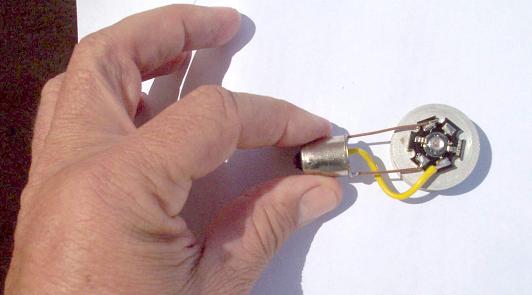
Here’s a low cost way for those of us with home theaters (and a beer budget) to upgrade to a red LED light source for reading those “dreaded” cyan sound tracks. I adapted a $10 (approx) Lumiled Luxeon Star LED to replace the tungsten exciter lamp in one of my SH-1000 soundheads. See Lumileds : Lumileds homepage

The Luxeon Star red LED array comes mounted to an aluminum backplate about the size of a US twenty-five cent piece. It produces a maximum of 55 lumens, which is 10 times the light of a so-called “super bright” LED. It can be operated at 200 mA without a heat sink and up to 300 mA with additional heat sinking. 100,000 hours is the predicted lifetime.

Here’s how to adapt one for use in your soundhead:

(1) Take an old exciter lamp and remove the glass envelope, keeping the base and center wire. Put the lamp in a heavy clear plastic freezer bag and carefully break the glass using a pair of pliers. Carefully remove all the broken glass – might be a good idea to use safety glasses when doing this job.
(2) Clean the center wire and metal lamp base with fine grit sandpaper to prepare for soldering.
(3) Place some tubing over the center conductor to keep it from accidentally shorting to the base.
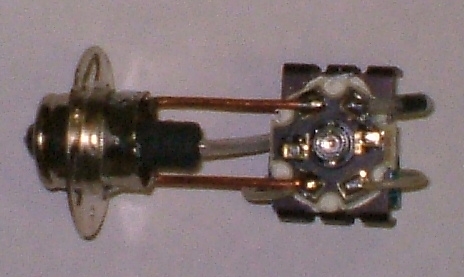
(4) Using two pieces of reasonably stiff solid wire, solder the ground terminals of the Luxeon star to the lamp base.
(5) Solder the center conductor (using some flexible light gauge stranded wire) to the two positive terminals of the Luxeon star.
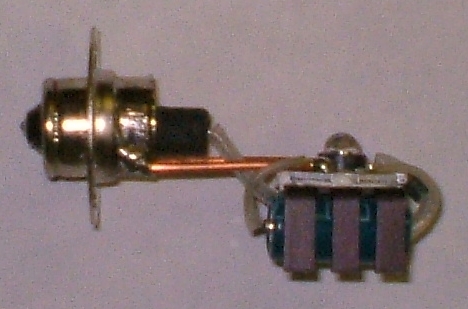
NOTE: the center of the LED array should be positioned approximately in the location where the filament of a standard tungsten exciter lamp would be. See photos:

Front view:
 -

Side view:

 -

Back view:

 -

(6) Be sure the positive of your exciter supply is connected to the center pin of the lamp base.
(7) Next install a suitable dropping resistor in the positive lead feeding the removable lamp assembly. I opted for a 68 ohm, 5 watt resistor, which gives a current of 170 mA from my 13.5 V supply. I also placed a 1000 MFD capacitor across the exciter terminals to reduce the turn on “pop”. There’s plenty of room inside the soundhead for these parts.

See photo below of series resistor and capacitor:

 -

These LED’s are REALLY bright. Don’t stare at it. Performance is superb! Using an eye loupe, the slit appears to be VERY evenly illuminated. I didn’t even have to increase the gain of the preamp. (Although I had to touch up the focus and buzz track adjustment slightly) All this was done using standard silver soundtracks and a Kelmar mono pick up. I need to get another red Luxeon star to test my other soundhead that has a stereo solar cell. No reason to doubt that performance will be just as good. Also, does someone have a small amount of film with a cyan track to test this contraption?

Sorry about the poor available light photo of the LED in operation.

 -

Thoughts? Ideas? Additional experiments?
 
Posted by Jim Spohn (Member # 1547) on 08-14-2003, 02:13 PM:
 
Jeff...Nice work. Very cool idea. Thanks for sharing.
Jim Spohn
 
Posted by Brad Miller (Member # 2) on 08-14-2003, 02:46 PM:
 
The big problem I am seeing is the potential for the light to not be evenly spread across the slit. Do you have a uniformity loop? I would be interested in knowing the results.
 
Posted by Jeff Stricker (Member # 224) on 08-14-2003, 02:56 PM:
 
Brad, No I don't have any test film. I'm just a tinkerer using what I have. Best info I can give you is that I examined the slit of light projected on a piece of white paper affixed on the sound drum. I looked at it with a 5X eye loupe and it looked uniform to me.
 
Posted by Steve Kraus (Member # 476) on 08-14-2003, 03:12 PM:
 
The other question would be whether vibration is going to vary the alignment enough to create microphonics. But overall it seems like a great idea. Someone ought to go into production on this.
 
Posted by John Pytlak (Member # 331) on 08-14-2003, 03:26 PM:
 
Possible issues:

1. Light output (effect on S/N)
2. Uniformity of illumination across soundtrack
3. Microphonics (variation of light with vibration)
4. Life expectancy (how hard do you need to drive the LED?)
5. Wavelength (near 660nm? any unwanted wavelenghts?)
6. Cooling (should you use the recommended heatsink?)
 
Posted by Jeff Stricker (Member # 224) on 08-14-2003, 04:09 PM:
 
I've beat on the soundhead and don't notice any microphonism, but that's not to say there's not any (my ear in the speaker is the "test equipment"). Certainly could stiffen up the support wires if need be.

John, I believe heat sink isn't necessary as I'm running below 200 mA. The Spec sheet I have says heat sinking only necessary from 200 - 300 mA. I decided not to add any additional mass (additional heat sink) to the structure for microphonism reasons. I'm getting plenty of output at this current level (170 mA) and don't see the need to run it at a higher current.

BTW, putting finger on heat sink shows it is only slightly warm.
 
Posted by John Anastasio (Member # 607) on 08-14-2003, 04:46 PM:
 
The wavelength of the Luxeon Star is 630nm... a bit higher frequency than the 660nm standard, but close enough "for jazz" as they say. I'm going to try one myself!
 
Posted by Mark Gulbrandsen (Member # 72) on 08-14-2003, 08:50 PM:
 
Everyone here overlooked the fact that you still have the two pieces in there that cause the MOST degradation to the sound to start with. That is the slit lens, and the solor cell. Thats why I could never ever install a JAX Light and still sleep at night. You're not really doing your customer ANY favor at all by installing one.
Now if ya can come up with a 10 buck way to get rid of those.........
Mark
 
Posted by Phil Radosevich (Member # 508) on 08-16-2003, 06:29 AM:
 
Two comments. What color do you use as the web site lists a cyan color. To reduce vibration why not add a third ground wire or use music wire
 
Posted by Michael Schaffer (Member # 1204) on 08-16-2003, 06:46 AM:
 
None of the listed potential problems seems to be too difficult to overcome. Which shows us that we could have had a simple LED based conversion lamp with a solid frame for maybe $20-30.
Yes, I know the real improvement is the reverse scan, but as a solution for converting to red LED readers it is a great prototypical concept.
We want to play in digital anyway, and only have the analog readers as fallback.
After all, our main concern here is the environment, right? [Wink]
 
Posted by Bruce Hansen (Member # 281) on 08-16-2003, 09:26 AM:
 
Did you use the LXHL-MD1D Luxeon star? I want to try this as well.

Someone correct me if I am wrong, but doesn't a reverse scan reader still have a slit lens, and solar cells? Yes, the lens is better designed, and the whole thing works in reverse, but there is still a lens, and those are solar cells on the other end of the lens, I believe.
 
Posted by Paul Trimboli (Member # 1509) on 08-16-2003, 09:32 AM:
 
That is true about reverse scan, but what Marc is saying is that a bad splice for example can come past and rip the cells out of aligment. That is their main advantage, the ones I have used had no real aligments, all soldered into place. Well in a Cinemecannica one anyway! I am very excited about this cheap development in cyan track reading!
 
Posted by Steve Kraus (Member # 476) on 08-16-2003, 10:48 AM:
 
Yes, conventional cells are subject to damage from errant splices but I believe Mark is referring to the huge improvement in separation and HF response with reverse scan.

But let us be careful here as we are mixing apples and oranges here when we start equating the change to red LED with the improvement that is brought about by reverse scan. Then you fall into the trap promoted by the dye track people who would like everyone to believe that dye tracks lead to better sound. Reverse scan leads to better sound.

I don't know the price of a JAXlight vs. a full reverse scan upgrade but I agree with Mark in general that, assuming a JAXlight is not inexpensive, one would be better off investing in reverse scan and get the big jump in quality.

BUT, conversely, if someone is content with the quality of conventional scan--let's say they run almost always in digital and analog is just a rare backup; or a home user, maybe even mono--well then a ten dollar conversion makes a lot of sense and you don't feel like you're wasting money that ought to have been spent towards reverse scan. If and when you do reverse scan later on you've only wasted ten bucks. Even Mark could probably sleep soundly with that.

Bruce: No, a reverse scan system does not have a slit lens per se. The image of the soundtrack is projected ON TO (and focused on) a mechanical slit with the pickup behind it. Because the image is being enlarged a slit of a given width is the optical equivalent of a much finer slit on a conventional slit lens system but without weird diffraction effects. You also don't have the weird crosstalk effects from light bouncing off the cell, off the back of the film and back to the cell. Separation--at least visually on a scope looking at X-Y--becomes virtually 100%.
 
Posted by Gordon McLeod (Member # 33) on 08-16-2003, 11:11 AM:
 
A conventional forward scan is in effect looking at a shadown of the soundtrack on the cell face so in fact you will not get as good of HiFreq response or seperation because of the scatter effect. The only alternate is the use of a laser slit (ernamann and ACL and Peter Hall et all) as it projectes at a constant width through the film to the cell
Also the gain with red light needs to be higher so an exposed cell is more prone to amplifie extranious noise
 
Posted by Jeff Stricker (Member # 224) on 08-16-2003, 01:19 PM:
 
The reasons why I took on this effort were:

1. I just have a home setup and use only analog sound.

2. To be prepared to read the new cyan analog tracks.

3. Don't have much $ to spend. (also can't afford a commercial jaxlite or reverse scan reader, either)

4. I like tinkering.

5. Figured there might be others with home setups in same boat as me that needed this contraption. [Wink]

Someone asked about color: I purchased this from a guy who sells LEDs at electronic flea markets. He called it "red" so that's all I can tell you about the color. I don't know the specific part number.

Answering another question: Yes, additional wires and other "stiffening" could be added if a person felt that microphonism was a problem.

[ 08-16-2003, 02:26 PM: Message edited by: Jeff Stricker ]
 
Posted by Tim Reed (Member # 137) on 08-16-2003, 04:18 PM:
 
You did good, Jeff!

Cyan not withstanding, reverse scan is inherently noisier, being very sensitive to scratches on the film. (Anyone remember running older prints on Century R4s? Sounded like a rainstorm!)
 
Posted by Phil Hill (Member # 371) on 08-16-2003, 05:11 PM:
 
Jeff, adding to what Tim said, you have great enthusiasm, ingenuity, and enterprise! [beer]

Don't get discourage or let the naysayers get to ya!

>>> Phil
 
Posted by Sam D. Chavez (Member # 1841) on 08-17-2003, 02:51 AM:
 
I differ with Tim Reed's statement regarding reverse scan being inherently noiser than front scan. The Century R4 was truly awful but a better example of reverse scan done pretty well was the Norelco AA11 and even better, the early Western Electric reverse scan soundheads.

The reason reverse scan is in some instances noiser has to do with collimation of the light before it passes thru the film. If you use a point source such as a laser or a single element LED, it will in fact be noiser. The Dolby LEDs both infra-red and Red are 2 x 12 arrays in order to reduce the collimation effect.

Picture a single ray of light intersecting with a chunk of dirt on a soundtrack. The resulting shadow on the pickup is quite significant. If light approaches the soundtrack from a wider angle the effect of the chunk or speck is reduced as some or most of the light goes around the speck.

Faster f2.0 lenses like the ones used in the latest reverse scan readers also improve noise performance over the first generation f 4.5 lenses for the same reason, ie, receiving light from a wider angle.
 
Posted by John Pytlak (Member # 331) on 08-17-2003, 08:42 AM:
 
Welcome Sam! You are absolutely correct about the specularity of the illumination and collection having a significant effect on the "visibility" of surface defects. Diffuse illumination and collection are much less sensitive to dirt and scratches. The very diffuse illumination system in the Thomson Spirit DataCine (designed and built by Kodak) allows almost defect-free transfers without having to use a wet gate.

Some of the earliest uses of "Wet Gate" were in sound readers.
 
Posted by Gordon McLeod (Member # 33) on 08-17-2003, 11:20 AM:
 
Welcome Sam what took you so long getting here
 
Posted by Sam D. Chavez (Member # 1841) on 08-17-2003, 12:25 PM:
 
Would you beleive it's a simple as hating to do the paperwork to get registerd?

I'm glad someone picked out a good picture of me as I had not chosen one.

I probably won't be an everyday participant as I don't wish to appear too self serving on the subject of red or reverse scan readers, and despite some people's opinion of me, I don't know everything and don't wish to take the position that I do.

As a good friend of mine at Dolby Labs if fond of saying, "Those of you who think you know everything are annoying those of us that do".
 
Posted by Tim Reed (Member # 137) on 08-17-2003, 01:00 PM:
 
Well, hello there, Sam! Hope you are doing well.

Yes, you are absolutely right, thanks for clearing that up. I have no experience with the newer f/2.0 optics, as I've been out of the business for some time now. The last one I heard an old print on several years ago sounded just like the R4s! [Smile]

And, hey, we used to have the same saying around my old job! Haha.

John P. said:
quote:
The very diffuse illumination system in the Thomson Spirit DataCine (designed and built by Kodak) allows almost defect-free transfers without having to use a wet gate.

I wouldn't know, John. I could never get CineSite to give me a quote. Guess they figured us small potatos aren't worth the trouble. [Wink]
 
Posted by Gordon McLeod (Member # 33) on 08-17-2003, 01:05 PM:
 
I used to have a boss that would walk in and pick up a pencil off the desk and say "Hm this can't be mine the earser has been used" [Big Grin]
 
Posted by Frank Angel (Member # 248) on 08-17-2003, 09:25 PM:
 
Yah, I bet that was a HUGE laugh-riot after about the tenth freakin time!

And Jeff, congratulations -- you were able to make a $300 JAXlite (sometimes refered to as a JACKthisLite) for ten bucks! For a home theatre where you probably won't get to see cyan tracks for a long, long time, and then only on occasion, seems your solution is perfect -- you can switch exciters from white to red simply by pulling out one assembly and popping in another. Very well done indeed! Can you come work in my theatre?

Now if only SOMEONE would make a reverse scan exciter array with dual LEDs -- red and white -- so that with a flip of a switch, those of us who run 99% silver tracks (and will be doing so long after I retire) can have the benefits of reverse scan, but can flip a switch to get red excitation for the occasional cyans. If only.

Frank

PS -- are we still going to call the light source, even if it is red, the exciter LEDs? Is the solar cell the scanner in the reverse scan unit? Just wondering.
 
Posted by Warren Smyth (Member # 1838) on 08-18-2003, 05:27 PM:
 
Thank you Jeff for an inovative solution. I've been pondering the problem of a home brew for some time. I really want to retain the use of the conventional exciter for silver tracks and at the same time play cyan. I considered cranking up the voltage of the presently under run 9 volt lamp and placing a red filter in front but your's is a much more efficient method. Simply swapping the red light assembly for a exciter lamp doesn't seem too onerous.

Can you tell me if there is much loss in output from the dolby cell with your conversion. I'm wondering if the gain adjustment on the preamp card of my CP50 will cope, or if an extra preamp stage is required to achieve correct dolby level.

Lastly, how can I get one of these devices? Do you think the maufacturers will supply by mail to the public?

There is always a demand for budget solutions. Thanks again.
 
Posted by John Pytlak (Member # 331) on 08-18-2003, 10:34 PM:
 
The Thomson Spirit DataCines are used by many more tranfer houses than just Kodak CineSite. Kodak designed and built the illumination and scanning system for all of them however:

http://www.kodak.com/US/en/motion/products/v2/sehlin04.shtml

BTW, Kodak also provided some of the first high resolution scanning technology used by Industrial Light and Magic (Lucasfilm) over a decade ago.
 
Posted by Jeff Stricker (Member # 224) on 08-19-2003, 02:52 PM:
 
Warren, If you put a red filter in front of a white incandescent
light source, you are left with precious litle red
energy. The LED emits monochromatic (one frequency) red light
so all it's output is useable.

My solar cell output goes to just an analog preamp. I ran standard silver sountracks with this new LED source (don't have any cyan film) and it didn't require any increase in preamp gain from what I was using with a standard tungsten exciter lamp.

There's a guy in South Bend Indiana that sells the Red Star LED's for $10 a pop, but I'm out of town now and don't have his phone number. Send me an email later in week and I'll get his info for you.
 
Posted by Steve Guttag (Member # 268) on 08-19-2003, 07:24 PM:
 
Filtering white light has two problems...First off, the solar cell is infrared sensitive, not red sensitive. So just putting a red filter in front of your exciterlamp will not filter out the infrared light...as such, with cyan you will have all that noise coming through as if it was translucent. Therefore, you need both a red and an infrared filter to make it a bandpass filter.

Next comes fading...your filters are apt to fade over time so even if you got the wavelength right, it is apt to be wrong over time.

Steve
 
Posted by Sam D. Chavez (Member # 1841) on 08-19-2003, 08:21 PM:
 
Regarding the LED replacing an exciter lamp. All off the shelf LED's are to my knowledge spot sources and will inevitably be brighter in the middle and fade dramatically toward the edge. A diffuser can be used to flatten out the light but the output will drop a bunch leaving you having to turn up the LED to get back to where you were before. Dolby Labs and USL experimented with off the shelf LEDs but both concluded an array was needed.

The Dolby LEDs as well as the JaxLight are custom parts and the price is high due to the small volume used in this industry compared to the scale consumer LEDs are used in.

What you are striving for on an analog track is even illumination. Typical slit lenses fade toward the outside edges of the soundtrack by about 3dB even with a perfect exciter bulb.

Dolby Cat. No. 566 used in conjuction with an RTA is the reference to measure the uniformity of the light.

Using a spot source behind the slit lens is akin to using a vertical exciter filament on a horizontal slit. (This was done without much success in the 50's in a misguided attempt to deal with the filament sagging).

Light will get through but mostly in the middle. OK for speech but not for effects which are modulated out to the edge.
 
Posted by Warren Smyth (Member # 1838) on 08-19-2003, 11:32 PM:
 
Thanks for the advice Jeff and Steve. You comments certainly seem to rule out the option of red filters. Sam, I take your point (no pun intended) about the difficulty of achieving uniformity of light across the slit with a single point source.If we still had variable density recordings it wouldn't be such a problem, but let's not go down that track (no pun again).

Diffusing the beam, while not very efficient, may be worth a try. A mini anamorphic lens is a thought, but there would still be fall off of light at the sides. However the commercial solution, an array of leds seems less than perfect for that matter, having a row of "hot spots" at the source.

Anyway, I will be grateful for availability details on the Red Star led Jeff and will contact you. A $10 investment is worth it just for something to experiment with. I don't anticipate running cyan tracks for a while and really just want someting I can use in case I get caught. By that time, there may be a more economical option.
 
Posted by Sam D. Chavez (Member # 1841) on 08-20-2003, 10:18 AM:
 
Warren makes a good Point about an array having a series of hot spots and is indeed correct. They do get diffused and amount to perhaps 1 dB bumps but they are there. You can see them when aligning Dolby Digital readers. These bumps are of no consequence in digital but are less than perfect for analog.

Jack Cashin developed a bar LED to combat this problem. This LED emits a shaped beam of light with no bumps. However, the yield on the production run was something like 40% and essentially the part was deemed not manufacturable and the effort was discontinued.
 
Posted by Gordon McLeod (Member # 33) on 08-20-2003, 12:52 PM:
 
Century played with an anamorphic reader in the imfamous AnaFet
Kinoton makes a read reader assembly that uses a quartz lamp(similar to a slide projector lamp) and a dichroic filter as a replacement to some of there machines
 
Posted by Phil Radosevich (Member # 508) on 08-22-2003, 04:58 AM:
 
I runa jaxlight have for 4 years mostl for trailers,run in dts for the feature,thanks to mark and a fire, I noticed last night that jaxlight has some sort of preamp if that's what it is does anyone know? Jeff what have you done about that?
 
Posted by Jeff Stricker (Member # 224) on 08-22-2003, 07:14 AM:
 
Phil, from the tests I've run using standard silver tracks additional amplification wasn't needed. I'm still looking for a piece of cyan track film to see if the amplifier gain is adequate.
 
Posted by Ray Derrick (Member # 1001) on 09-16-2003, 10:15 PM:
 
Sam said in relation to the Dolby red LEDs "They do get diffused and amount to perhaps 1 dB bumps but they are there."

The amount of diffusion is determined by the distance of the LED array from the point of focus (ie the film). As the LED is moved further back from the film there is a point (about 1mm from the film) where optimum diffusion is achieved. Any closer and the elements start to come into focus. Any further away and the array becomes so magnified that once again the diffusion effectively diminishes.

The spacing between the individual LED elements in the 2 x 12 element array is equal, both horizontally and vertically. If a LED array is correctly positioned 1mm back from the film, adjusting it's vertical position in relation to the lens produces a broad peak in output from the cell, but no discernable dip attributable to the gap between the upper and lower row of elements (at least not that we have been able to measure). It stands to reason that if there are no "bumps" vertically there should be no bumps laterally either. So how did you measure these 1dB bumps in the analog light source Sam?

Of the 12 elements in the Dolby array only about half of them actually fit behind the soundtrack, and are therefore visible to the solar cell, so the remainder are pretty much wasted (except to provide some margin for lateral alignment error).
 
Posted by Sam D. Chavez (Member # 1841) on 09-17-2003, 01:05 AM:
 
I've never actually measured them in analog domain, but like everyone else have seen them in setting up the Dolby Digital readers. I'm estimating that the ripples convert to about 1dB in analog.

Lonny used to advise rotating the LED holder to minimize the ripples although the SR.D could care less.
 
Posted by Ray Derrick (Member # 1001) on 09-17-2003, 05:56 AM:
 
Hmmm. So 1dB translates to an 11% variation in light level, yes?

Considering there are approx 6 LED elements across the whole stereo soundtrack, that's approx 3 LEDs per channel, so we would see about three such "bumps" across the width of each track. Wouldn't such an 11% variation produce rather horrendous distortion?

It would be interesting to test for the actual intensity of any such "bumps" with some accurate measurements. Dolby's illumination uniformity film is not at all suitable, but a weave test film immediately comes to mind. I think there was one such test film available in the past, anyone remember what it was called?
 
Posted by Stephen Furley (Member # 1277) on 09-17-2003, 06:51 AM:
 
Phil, Jaxlight uses the existing cell with a new red light source, this produces a reduced output compared to a silver track with tungsten source, hence the need for the extra pre-amp.
 
Posted by Ray Derrick (Member # 1001) on 09-17-2003, 06:30 PM:
 
I said "weave test film" but "snake track" was the term I was looking for.
 
Posted by Sam D. Chavez (Member # 1841) on 09-17-2003, 11:31 PM:
 
Ray states there 6 elements across the whole sound track. I believe there are 12 x 2, right? Am I missing something?

On the subject of the magnitude of the ripples, I probably mis spoke but I do remember some figure being mentioned many years ago when Dolby was developing an analog optical scanner where you could see the little ripples. Some engineer extrapolated the significance of the ripples and it stuck in my head but I don't remember the figure and if it was worst case or best case.
 
Posted by Steve Kraus (Member # 476) on 09-17-2003, 11:47 PM:
 
Sam, Ray said that only 6 are actually illuminating the active area of the track:

quote:
Of the 12 elements in the Dolby array only about half of them actually fit behind the soundtrack, and are therefore visible to the solar cell, so the remainder are pretty much wasted (except to provide some margin for lateral alignment error)

 
Posted by Sam D. Chavez (Member # 1841) on 09-18-2003, 12:43 AM:
 
Steve,

I thought of that immediately after the post. Still, I don't believe it's quite that extreme. Track is .084. LED array is .144. Don't forget the diffusion or spread works inward as well as outward so the LEDs on he edges contribute as well.
 
Posted by Ray Derrick (Member # 1001) on 09-18-2003, 04:29 AM:
 
Sam, I've not set out to be argumentative here so please don't take it as such. However I did say "approx" six LEDs not "exactly" and it is based on actual observation of the image that is "seen" by the solar cell though a reverse scan lens with the LED positioned both right up against the film, and moved to it's correct position away from the film, not on postulation from theoretical dimensions.

You can also get a reasonable idea by simply laying a piece of buzz track centered directly over a Dolby LED and you will clearly see three complete LEDs on either side laying completely OUTSIDE the inner margin of the buzz track image. By my math that leaves 6 complete LEDs laying within the soundtrack area.

However this second method does not take into account the magnification of the LED array when properly positioned back from the film and observed through a lens which is focused onto the film. As the LED array is moved away from the film, the image of the LED array beomes magnified as it becomes diffused. So the number of elements visible to the solar cell becomes less, even though the image becomes diffused.

Now any "bumps" across the light source, as "seen" by the solar cell, will still be due only to those elements visible to the solar cell, not due to any diffused light eminating from elements outside the view of the cell.

BTW, Obviously I am only referring to one of the two rows of elements for the purposes of this discussion.

Now come think of it, it would have made more sense to offset the upper and lower rows such that the lower elements sat half way between the upper elements to minimise any non-linearity. Now why didn't Dolby think of that?
 
Posted by David Buckley (Member # 2600) on 08-05-2004, 01:08 AM:
 
Jeff

quote: Jeff Stricker
I need to get another red Luxeon star to test my other soundhead that has a stereo solar cell
quote: Jeff Stricker
Also, does someone have a small amount of film with a cyan track to test this contraption?
Did you ever get around to performing these two tests? If so, how did it all go?
 
Posted by Jeff Stricker (Member # 224) on 08-05-2004, 06:42 AM:
 
David, I have not done either test yet. I plan to get another LED in a few weeks for the stereo sound head.

Alas, I don't have any cyan track film yet.
 
Posted by Peter Mork (Member # 1336) on 08-30-2004, 07:13 PM:
 
Jeffrey, I like this idea and would like to build one. I know how to sling a soldering iron but am not much of an electronics guy and can't really see from your photograph how to rig the resistors. Could you help me out here - maybe post a diagram? Thanks.
 
Posted by Jeff Stricker (Member # 224) on 08-31-2004, 07:01 AM:
 
Peter, Not sure how to post a diagram. But place the resistor in one of the wires that goes from the power supply to the LED. The other lead of the LED goes directly back to the power supply. If you wire the LED backwards, it will not light (since it is a diode and only conducts current one way). In that case, just turn the LED around and it will light.

Jeff
 
Posted by Frank Jerkic (Member # 2446) on 10-06-2004, 05:28 AM:
 
Hey G'Day Jeff,
You said that you planed to get another LED in a few weeks for the stereo sound head, have you got around to trying that out yet and what were the results as I would like to try it out on one of my century's
Whats the correct name/description for the Red leds you use
thanxs
Frank [thumbsup]
 
Posted by Jeff Stricker (Member # 224) on 10-06-2004, 07:00 AM:
 
G'day to you Frank. Well, I've been procrastinating some. My stereo soundhead is still running with a tungsten exciter lamp. (I see no reason why it won't wont work because I got a pretty evenly illuminated slit with the LED) I need to get off my backside and get a LED for it. Of course, if I ever get some cyan soundtrack film the need will arise very quickly. The manufacturer of the LED was Lumiled Luxeon Star. I can't remember the distributor I got it from now. I will see the fellow in November and get his name and particulars. Jeff
 
Posted by Paul Trimboli (Member # 1509) on 10-06-2004, 08:21 AM:
 
Frank they are LUMILEDS and avaliable from most electronics shops in Australia now. I got some which I plan to fit to my soundhead. I know a friend of mine tried them on his stereo century soundhead with CYAN film track and it worked, although there was less level which he found was becuase the LEDs he got were the model down from the ones Jeff has used, I am not sure if he has tested it with the brighter ones yet.
 
Posted by Jeff Stricker (Member # 224) on 10-06-2004, 08:42 AM:
 
Paul, sure glad you had good results with your Century soundhead. My main purpose in conducting these experiments was to provide a low cost red LED cyan reader for people with home theater set ups and a limited budget (like myself! [Wink] ).
 
Posted by John Pytlak (Member # 331) on 10-06-2004, 08:56 AM:
 
There is an ISO standard being developed for the spectral response of red readers:

quote:
ISO/DIS 20859 Cinematography - Spectral response of photographic audio reproducers for analog dye sound tracks on 35 mm film

2 Spectral response
2.1 The peak or maximum response of the combined audio reproducer light source, filter, and receptor shall be 660 nm
+ 20 nm / – 30 nm.
2.2 The integrated response of the unit to all wavelengths greater than 800 nm shall be less than 5% of the
total integrated response measured from 400 nm to 800 nm.

Contact Carl Girod at the SMPTE if you have any comment or suggestions for this draft ISO standard.
 
Posted by Edward Jurich (Member # 1787) on 10-06-2004, 09:10 AM:
 
If you just replace the exciter lamp with a red light, isn't that the same as using a JAX light? I've worked with JAX light and I've installed red readers, the red reader sounds a lot better. Using an old cell with a red light does not produce as clean a high end as a red reader. Also, I've found in larger auditoriums that had to have the tubby lower mid-range EQ'd out with the old exciter/cell, still needed the EQ with the JAX light but not with a red reader. I replaced the JAX light with a red reader at the one installation and it sounded much better with the red reader.
 
Posted by Frank Angel (Member # 248) on 10-06-2004, 11:36 AM:
 
Well, I am a tinkerer by heart and love the fact that Jeff has come up with a $10 solution that achieves his original goal quite beautifully, that of being able to play cyan tracks without having to shell out big bucks. The fact that it may not have the advantages of the improvement one can achieve with reverse scan matters not because that wasn't what he was aiming for. He just wanted a viable way to be able to play cyan and get the sound equal to what he has now with a convention white exciter and forward scan.

When Dolby first came on the scene with the CP50, I was able to get my hands on a stereo cell and it wasn't long before I was whipping up my own stereo playback mimicking the CP50 with used stuff from the recording studio that is part of the performing art center here. I was lucky enough to get two Roger Mayer super-quiet preamps with parametric eq built right in, a used Dolby A studio noise reduction unit designed for tape recording, a consumer Dolby B n/r unit, a Sansui 4 channel decoding unit, a Revox 6 channel mixer, three studio 1/3rd octave eqs, a consumer 1 octave eq (for the surround which the even CP50 didn't have), and tad-da! Optical Stereo sound without having to spend what was a fortune (for us) for a new CP50. It was all used equipment and it sounded damn good for what it was.

So now this tinkerer hears all this stuff bout bumps in uneven illumination of the 12 LEDs in Dolby's array and the disadvantages of a single point illumination of Jeff's incredible super bright red LED and me thinks, gee, I saw a variety of these novelty "light sculptures" that used very thin, very bright fiber optic strands to create the effect of hundreds of pin-points of light. They all come to a bundle that is placed next to a bright light source from which they fan out to make the light design. Point is, they are really THIN, probably no more than a millimeter or two in diameter. Me thinks this would be a perfect solution to the problem of uneven illumination between the LEDs in the 12x2 LED array. You could pack, I don't know, say 48 by 8 or even more of these fiber optic filaments into an array to evenly illuminate the entire soundtrack with virtually no unevenness or "bumps" and they would do better than a single point source of light with regard to noisy playback. Adding a bunch of fiberoptic strands to Jeff's Lumin LED Star unit would make the thing cost, what....$10, $20 more than his original $10 solution?

I am surprised Dolby is sticking with trying to physically pack bulky LEDs together when fiber optics seems like it could be a really elegant solution to uneven illumination, or am I missing something?

Oh, and PS, remember I said somewhere in this thread that we really needed an exciter which is capable of changing light sources from red to white with the flip of a switch so that we could easily accommodate both type of prints -- those optimized for white excitation and those optimized for red excitation, re: cross modulation? Well, fiber optics would do just that....you would just physically slide the fiber bundle on the light source end from a red LED to an ordinary white, high intensity 12v quartz lamp.

I see Jeff is already on Google searching "fiber optic filaments"
 
Posted by Bill Enos (Member # 440) on 10-09-2004, 04:00 PM:
 
We have built one of these things, it seems to work ok but will need a preamp before we'll know for sure--that will be tried next week. All the high dollar reverse scans as well as the Jaxlites need preamps as well. If it works, we will use it for about 6 months until a couple problems are resolved.
 
Posted by Jeff Stricker (Member # 224) on 10-09-2004, 05:46 PM:
 
Ah Frank, very interesting idea! [thumbsup] That's got to motivate some of the experimenters for sure.
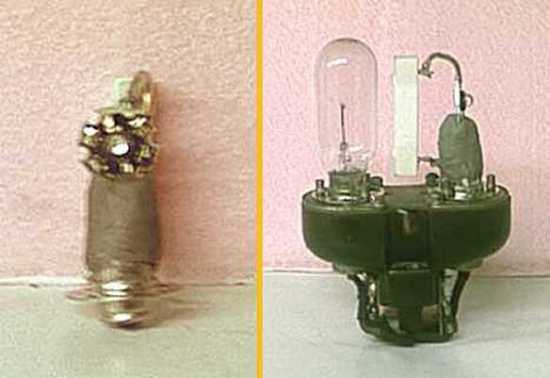
Oh, Ed asked if using red bulb would work. That's the equivalent of a red filter in front of an incandescent lamp. The answer is it won't work. You are not increasing the amount of red light coming from the lamp by using a filter, you are just filtering off the other colors and letting the red pass. The end result using a cyan track won't sound any different than just the unfiltered bulb.
 
Posted by Bruce Hansen (Member # 281) on 10-09-2004, 07:02 PM:
 
I had the idea of removing one of the segment "light pipes" from an LED seven segment display, and using this to "spread out" the light, but have not had the time to try it.
 
Posted by Gordon McLeod (Member # 33) on 10-10-2004, 10:00 AM:
 
Actually Kinoton has a low cost option that is a slide projector lamp nd a red dichroic filter available
 
Posted by Sam D. Chavez (Member # 1841) on 10-10-2004, 02:49 PM:
 
Regarding Kinoton,

I may be wrong but I'm told the filters fade rather quickly leaving you in a pickle. Supposedly, Kinoton withdrew te product but I have not had a chance to track this report down.
 
Posted by Scott Norwood (Member # 30) on 10-11-2004, 02:04 AM:
 
For what it's worth, Bill was kind enough to send me a few dozen feet of cyan-track film. We tried it tonight on a Western Electric (700A - universal base) soundhead with white-light exciter. I had to turn up the sound from 6.5 to 8ish to get "normal" level, but I was encouraged that we actually got intelligible sound from the cyan track. I'm sure that the s/n wasn't so hot, however.

The home-made Jaxlight will be tested later in the week....
 
Posted by Marin Zorica (Member # 1716) on 10-17-2004, 03:52 PM:
 
Hello!,

I definitely must try this with lumiled led's.

I can get them her but i must send special order to get it, does it some other led's can be used???

What is difference in normal film when you using normal exciter light and red light from lumiled led's?

Another problem is that i don't have any cyan film... does anybody could send me a few meters (feet??)

I also think this is great stuff because here where i live , red reader coast a lot and we can afoard it likely....

Jeff - Great stuff, please can you tell me exact type of led's that you using,

thanks!
 
Posted by Bill Enos (Member # 440) on 10-18-2004, 12:04 AM:
 
We tested 2 days ago using a preamp. We spliced in a preamp and ran cyan and silver tracks extensively with the red led and got good results. If you're not rolling in cash or have equipment that nobody makes replacement readers for this seems to be the answer.
 
Posted by Marin Zorica (Member # 1716) on 10-19-2004, 02:14 PM:
 
Did you tested it with stereo readers???

What type of led did you used ??

Are there any difference in sound quality between red led and exciter lamp when you playing normal film??

Also did you notice any changes in channel difference if you try that with stereo reader??

Thanks for help, i also preparing for led reader because they tell me that from Christmas all films gonna be cyan.
 
Posted by Bill Enos (Member # 440) on 10-20-2004, 12:34 AM:
 
We tested with stereo pick-ups using the Luxeon Star red led operating at 285 ma. On silver tracks we couldn't tell any difference between exciter and led. Channel separation etc. was normal
 
Posted by Marin Zorica (Member # 1716) on 10-20-2004, 03:41 PM:
 
Glead to hear that sound is ok!
Can you just tell me what is type of led that you use??

P.S. Does somebody can send me a cople feet of cyan film, so i can try this with my measuring equipment?
 
Posted by Peter Mork (Member # 1336) on 10-20-2004, 06:20 PM:
 
I have built my own copy of Jeff's gizmo with a couple of changes. Haven't tested it extensively but it does light. I'll post a photo soon.

There are many different Lumiled Luxeon Stars available. The one I used was LXHL-MD1D (which I got from Future Electronics at a measly $6.25 per). It is rated at 44 lumens - less than Jeff's 55, which I couldn't find, but should do nicely.

[ 10-21-2004, 01:35 AM: Message edited by: Peter Mork ]
 
Posted by Bill Enos (Member # 440) on 10-21-2004, 12:47 AM:
 
I used the same one as Peter, it will probably go into operation Monday.
 
Posted by Peter Mork (Member # 1336) on 10-22-2004, 01:36 AM:
 
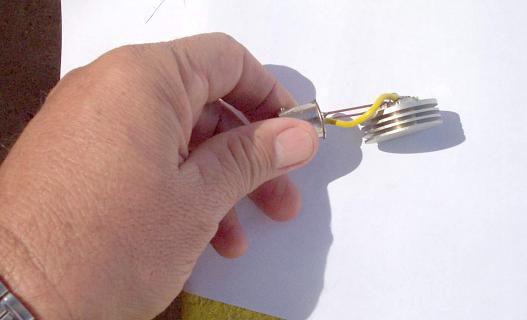
Here is my version of the light:

 -

I decided I wanted it to be self-contained and removable, so I wired the resistor directly to the LED, positioning it behind the disc. Then I smooshed some epoxy putty around the wires and tweaked the position of the LED until it gave the best output with a test film. Once hardened, it can be removed from the holder like any other lamp. (I left out the capacitor - stuck it in the feed line instead.)
 
Posted by Jeff Stricker (Member # 224) on 10-22-2004, 06:55 AM:
 
Looks great, Peter. I like the idea of having the resisor right at the LED. You can turn that one around and have a tungsten exciter if you desire. [thumbsup]
 
Posted by John Pytlak (Member # 331) on 10-22-2004, 11:07 AM:
 
Necessity is the mother of invention! [thumbsup]

Let us know if you are getting enough light, and how the output holds up with time. How hot does the LED feel during operation? Any issues of noise or microphonics?
 
Posted by Mark Gulbrandsen (Member # 72) on 10-22-2004, 06:54 PM:
 
285 mills is quite a bit of current for an LED so be sure to heat sink it VERY well or they will fade out fast!!
Dolbys LED typically runs at much lower current in the later generation of readers with faster optics.
Mark
 
Posted by Steve Guttag (Member # 268) on 10-22-2004, 08:50 PM:
 
Ah but did you all notice that his RCA exciter holder now not only has a red LED but a tungsten exciter lamp for silvered tracks.

Did you measure and notice any difference in focus between red and white light?

Steve
 
Posted by Peter Mork (Member # 1336) on 10-23-2004, 12:22 AM:
 
In the mono head I'm running it in, there's a small drop in output level with the LED, which I boosted at the amp. Sonically it's about the same to my ears as the incandescent. Ran it all day and it was perfect.

The LED barely gets warm at all - the resistor does get too hot to grab onto, but seems far enough apart from the LED to not affect it. I'm happy.

I have no cyan film to check it with, so how well that works I can't comment on.
 
Posted by Jeff Stricker (Member # 224) on 10-23-2004, 07:08 AM:
 
The Luxeon star (from the specs that the supplier gave me)can be operated at 200 mA without a heat sink and up to 300 mA with additional heat sinking. Life was quoted at 100,000 hours if operated within those guidelines. I comes on a metal substrate about the size of a quarter which provides quite a bit of heat disapation. BTW, I did notice that the focus setting needed to be "tweeked" when going from tungsten to red LED. I'm not suprised since I doubt the slit lens has any special coating to correct for chromatic aberation (I think that's the term for different wavelengths focusing slightly differently??).
 
Posted by John Pytlak (Member # 331) on 10-24-2004, 12:09 AM:
 
quote: Jeff Stricker
I did notice that the focus setting needed to be "tweeked" when going from tungsten to red LED. I'm not suprised since I doubt the slit lens has any special coating to correct for chromatic aberation (I think that's the term for different wavelengths focusing slightly differently??).


If anything, the slit lens should have an easier time precisely focusing the relatively monochromatic light from a red LED. With a tungsten lamp, chromatic aberration adversely affects the ability to focus across the visible and infrared spectrum.
 
Posted by Bill Enos (Member # 440) on 12-01-2004, 06:50 PM:
 
Today we finally did the install on the homemade red LEDs. No difficulties were encountered. We had to slightly adjust the focus of the lens, adjusted the output level of the preamps and did a general routine going over of everything else. The tick on change over is no more than with exciter bulbs. Plays black and cyan tracks equally well. The only unanticipated thing is a very low level 120hz hum from the Smart exciter supply, a filter cap. will fix that tomorrow. A back-up LED assy. is in the drawer in the event of a failure, as is an exciter lamp which will work with just a reduction in the level control.
 
Posted by Sam D. Chavez (Member # 1841) on 12-01-2004, 08:27 PM:
 
As a rule of thumb, you need to get the ripple down under .5 mVolt P to P before it is inaudible in a normal theatre
 
Posted by Jeff Stricker (Member # 224) on 12-02-2004, 05:59 AM:
 
Glad these are working out. With ample filtering, you will have zero hum...Jeff
 
Posted by Bruce Hansen (Member # 281) on 12-02-2004, 06:33 PM:
 
If possible put the cap on the LED side of the resistor. (In other words, across the LED).

A swiching type power supply may get rid of the problem as well.
 
Posted by Stan Gunn (Member # 554) on 12-08-2004, 04:39 AM:
 
Hi all
I have completed a commercial install at a country cinema useing low cost leds.In a pair of aussie Raycophone machines,that use rear scanning heads.

The outcome is out standing,[no extra pre amps to muckup the sound either] there was a small drop in vol from ex lamps,nothing the smart 230 couldnt handle with head room to spare.
The low cost fix for good quality sound.

I have a bench mounted sound head to carry out such testing,with a selection of sound optics to play with,you learn alot just by playing around with odds and ends.

Stan Gunn
 
Posted by Oscar Neundorfer (Member # 458) on 12-08-2004, 08:29 PM:
 
Stan,

You actually still have a SMART 230?

That product was long obsolete when I came to work for SMART over 21 years ago.

I had 2 of these in my museum until a few years ago when someone who shall remain nameless decided to "get rid of all the junk laying around". Being the packrat that I am, I was highly agitated with this person.
 
Posted by Mark Gulbrandsen (Member # 72) on 12-09-2004, 08:07 AM:
 
quote: Stan Gunn
The outcome is out standing
No offence Oscar but I don't see with that processor how Stan could hear if the results were "out standing" or not. I'm shocked that there are any of thise still around [Eek!] [uhoh] [Roll Eyes] .

Mark
 
Posted by Richard Fowler (Member # 893) on 12-09-2004, 09:45 AM:
 
I sold a bunch of them to independent operators.... simple puppies for the time and market conditions. [Razz]
 
Posted by Stan Gunn (Member # 554) on 12-09-2004, 09:54 AM:
 
Yes Oscar
There are still 230s AND 130s in use,I service 2 sets in small country multi use halls,They serve the purpose that they were made for, to provide sound in the place the people sit to watch the pictures. The sound is good considering the hall acoustics.
The 230 developed a sever hum, traced to the power transformer one plugpack and a bridge rectifier later quiet as a mouse.

I also have a collection of smart units.

Mark.

When I am outstanding in the hall it sounds ok.

Stan Gunn
 
Posted by Peter Mork (Member # 1336) on 12-10-2004, 03:30 AM:
 
I put one of my homebrew lights in a different RCA head - it didn't light. Then I noticed the power to the head had been wired backwards, plus for minus. This was no problem for the incandescent bulbs, but even when I fixed the polarity, the homebrew was dead.

Question - will a short reverse shot of 12v DC kill an LED that easily?
 
Posted by Bruce Hansen (Member # 281) on 12-10-2004, 05:56 PM:
 
No, putting 12V backwards across an LED should not harm it. Get out your VOM and check for voltage across the LED, and check for the proper polarity. If you are going to be trying the LED in different sound heads, you might want to put a bridge rect. before the LED. Connect the + and - to the LED, and feed power into the ~ (AC) leads. The bridge must be able to handle the current that the LED draws, and the voltage as well (this should not be a problem).
 
Posted by Clive Carmock (Member # 2882) on 01-02-2005, 11:20 AM:
 
Having just discovered this post I have already ordered the parts I need to try this myself.

I have a Zeiss TK35 projector, which uses a mirror to bounce the beam from the exciter through 90 degrees. My concern is slit uniformity. The TK35 has a small ground glass 'screen' to help with adjustment of the exciter. In operation an image of the filament appears on this ground glass screen. The exciter is then adjusted to bring the image inline with a black line etched onto the glass.

It will be interesting to see what happens with a red LED. However given the small cost of the components it has to be worth a try.

For those in the UK wanting to do this I found that Maplin Electronics stock the LEDs mentioned here (www.maplin.co.uk).

Regards

Clive
 
Posted by German Marin (Member # 918) on 01-05-2005, 05:01 AM:
 
What would be the standard luminous intensity for a red LED?

There's LED's working between 300 mcd and 8,000 mcd... it's a big difference!

Germàn.
 
Posted by Richard Fowler (Member # 893) on 01-05-2005, 09:51 AM:
 
A TK35 owner in Germany are having good results using a laser pointer from an office supply store with good results. [Cool]
 
Posted by Ron Yost (Member # 1850) on 01-05-2005, 10:42 AM:
 
Ha ha, Richard. I tried that with one of my 16mm Eiki's and it did, indeed, sound very nice. I was surprised.

Never tried it on a full feature as my exotic (a bit of wood and duct tape) [Big Grin] holder fell off after about 15 minutes. I doubt, but don't know, that a cheap diode would last for long??

Ron Yost
 
Posted by John Pytlak (Member # 331) on 01-05-2005, 10:47 AM:
 
quote: Ron Yost
I doubt, but don't know, that a cheap diode would last for long??

Best advice: keep cool! [Wink] Use an efficient heat sink (or even active cooling such as a water-cooled heat sink), and no more current than needed to get enough light output.
 
Posted by Frank Angel (Member # 248) on 01-05-2005, 10:49 AM:
 
With all these good results being obtained from the home brew red LED light source, this really is the answer to the art house dilemma -- we must play a mix of old films as well as new cyan releases. Seems to me that if I have to choose between the sibilance distortion of shrill and splattering esses that you get when you play older prints "white light optimized" on red light readers, and the slightly better channel separation you get switching to reverse scan readers, I will choose white light playback any time and to hell with a tad better channel separation. What good is great channel separation if the soundtrack sounds like someone scrapping their fingernails across a blackboard?

As stated above, switching back and forth between the two different types of pickups is out of the question. But being able to simply switch out a red light exciter to a white light exciter would be a workable solution.

The ultimate solution would be to get a reverse scan reader that can be excited by two different light sources, perhaps with dual LED array -- one that contains both red and white LEDs. This would be the best of both worlds -- correct illumination of cyan tracks and correct illumination for prints optimized for white light "excitation."
 
Posted by Clive Carmock (Member # 2882) on 01-05-2005, 03:04 PM:
 
Hi Richard - a laser pointer in a TK35 - now that sounds a good idea! I wonder if you can drop me an email to put me in touch with the TK owner?

I am keen to get a new aperture plate for mine if I can find a source.

Regards

Clive
 
Posted by Richard Fowler (Member # 893) on 01-05-2005, 03:43 PM:
 
Wittner kinotechnik should have the plates...I'll look for the print out on the laser set up.
 
Posted by Edward Jurich (Member # 1787) on 01-05-2005, 04:13 PM:
 
quote: Peter Mork
Question - will a short reverse shot of 12v DC kill an LED that easily?

Applying 12 volts directly to a LED can burn it out without a current limit resistor in series, depending on the current rating of the LED.
 
Posted by Bill Enos (Member # 440) on 01-05-2005, 06:11 PM:
 
Our home builts have been performing excellently since 3 December. Added benefits are no readjustments due to filaments changing position, no short dip in sound on changeover, sound seems brighter than before, may be my imagination, but others have noticed too, changed equalization, red light has more eye appeal than dull white. The decrease in power consumption will probably not be detectable on the electric bill though. Overall this has been one of the easier and least expensive improvements we've made. Initially we had planned for this to be a temporary fix, to be in place for a year or so, but it has worked so well it may turn out to be permanent.
 
Posted by Jeff Rodenkirch (Member # 2943) on 01-13-2005, 11:28 AM:
 
I built one of these up using thermal RTV to glue a small heatsink to the back - It runs at 350ma and only gets slightly warm. At full output though it's about 4-6 dB short of driving a Dolby cp-55 to required level from a Simplex sound head. Does anyone know of a mod for the cat. 240 to get a bit more gain? I am a recording studio tech so modifying gear is second nature to me. The chain I work for (Grand Cinemas) is intermediate-market so $1k+ a pop for a reverse scan reader is not feasable for all of our screens.

For those interested I've got light output vs. signal for the Lumiled. I can't measure the light directly so I went by supply current to the LED, you can figure the rest out from the data sheets. Output is measured at the test points of a cat. 240 with an Audio Precision Portable One using the cat. 69T Dolby test tone film cat.

LED Current Level at cat. 240 test point
--------------------------------------------
350 ma 0 dB
325 ma -1.0 dB
300 ma -1.3 dB
275 ma -1.8 dB
250 ma -2.8 dB
225 ma -3.6 dB
200 ma -4.5 dB
175 ma -5.5 dB
150 ma -6.9 dB

Jeff

p.s. this is my first post. Thanks you guys for being around - Film-Tech.com has made my transistion into cinema much easier!
 
Posted by Alejandro Lopez (Member # 2854) on 01-13-2005, 04:24 PM:
 
Hi: Using a laser point on a TK35 it´s a correct. TK35 projectors have a macrooptic sound reader as opposite to most projectors (microoptic). It´s not a reverse scan but it´s good. But you´ll have to isolate the laser pointer from the projector cast as most laser pointers have the positive to chassis in oposition to projectors (negative to chassis) and it could shortcut the laser or at least make it long for a shorter time. 3- 4,5 volts DC is a good voltage for them.
As for the TK35, is it quiet (silent) running compared to other 35mm portables or pedestal projectors? I´ve just won an auction on Ebay for one and I´d like to know this.
I have the picture with the laser pointer on the TK35 and the e-mail addresses of the guys that do modifications on TK35´s on Germany, such as laser readers, halogen lamps, 1.800 meters (6.000 feet) reel arms, etc. E-mail me if you want.

Alejandro.
 
Posted by Bruce Hansen (Member # 281) on 05-27-2005, 03:10 PM:
 
Here is a red LED that All Electronics has just started selling:
LED-109
It can take up to 700 ma with a heat sink, and puts out up to 1 watt. The LED is mounted on a small round piece of metal, about the size of a nickle. It is $8.00 (plus shipping).
 
Posted by John Hawkinson (Member # 1135) on 05-27-2005, 07:52 PM:
 
Hmm. It starts saying
quote:

1 WATT RED ULTRA-ULTRA BRIGHT LED

and then goes on to say:
quote:

Cree XLamp(TM) 7090WRD. Extremely high-brightness white LED, capable of operating at 1 Watt and above.

White or red?

--jhawk
 
Posted by Frank Jerkic (Member # 2446) on 05-27-2005, 08:03 PM:
 
This sounds confusing the red has changed to white?

Cree XLamp™ 7090WRD. Extremely high-brightness white LED, capable of operating at 1 Watt and above. Long-life, solid-state, low-voltage and current light, ideal for architectural, landscaping, advertising and entertainment applications.
 
Posted by Lindsay Morris (Member # 1430) on 05-28-2005, 02:25 AM:
 
Cree lamp is only white and not a very high output one at that.
The data sheet suggests around 44 lm which in comparison to the new Luxeon Star III type LXHL-LD3C which boasts 140 lm and that is the RED one running at 350mA.

As Lumileds are in Silicon Valley USA folk should be able to get their hands on these quite readily... have a bit of a browse around the website Lumileds.com.

There was a very good supplier of Lumileds here in Perth West Australia but I think they have closed up shop so will have to go ask the Lumiled website who handles their stuff now over here as the LXHL-LD3C looks like it will do the red reader trick quite easily.
An earlier version of their led I was playing about with almost gave me dolby level from a cyan tone loop and that led was only rated at around 30 lm. This new one seems like it can do 4 times that amount of light for the same led current. [thumbsup]
 
Posted by Henry Titchen (Member # 3141) on 05-28-2005, 02:44 AM:
 
Lindsay,

Oatley Electronics have a good range of LED's (Luxeon). They are located in Sydney and do mail order. I have had very good service from them over the years.

Their web site is:
Oatley Electronics LED page

Henry.
NSW Australia.
 
Posted by Bruce Hansen (Member # 281) on 05-28-2005, 07:55 AM:
 
If you bothered to read the information, the LED is available in several colors, RED and WHITE are just two of them. The LED this thread was started with put out 55 lumens max. The RED LED that I posted information about can also put out 55 lumens. I posted this info as an easy source to get the same sort of LED that the thread was based on.
 
Posted by Frank Jerkic (Member # 2446) on 05-28-2005, 08:02 AM:
 
Sorry Bruce I jumped the gun not reading it correctly or completely, as soon as I saw the first few lines well......at least I was not the only one to get confused lol
Regards
 
Posted by Bruce Hansen (Member # 281) on 05-28-2005, 12:26 PM:
 
Now, I can understand you people in OZ having a problem. Being on the other side of the equator, you have to read everything up-side-down. I've tried this, and it isn't easy. Besides, winter is right around the corner, down there, and I'm sure that you are all consuming plenty of [beer] to keep you warm. [Big Grin]
 
Posted by Alan Gouger (Member # 543) on 05-28-2005, 06:44 PM:
 
Would there be any advantage using a modified red laser pointer
verses a red LED?
 
Posted by Jeff Stricker (Member # 224) on 05-29-2005, 07:16 AM:
 
I don't think a laser pointer will have the output needed compared to a Lumiled. Lumileds are $10 or less and with the proper dropping resistor will run off an existing exciter suppy.
 
Posted by Bill Enos (Member # 440) on 05-29-2005, 08:17 AM:
 
We tried using the works from a red laser pointer----like trying to use a 60 watt lightbulb in the lamp housing. Our home mades built according to Jeffs plan are still performing well, they were installed last December.
 
Posted by Mitchel Monger (Member # 2454) on 08-09-2005, 07:52 PM:
 
Hi, Due to the budget constraints of our art-house theater we haven't upgraded to read cyan yet. I just found out that our film that runs day after tomorrow is cyan. I've ordered and received 2 Luxeon Star LEDs. Here are their specs:

Part # LXHL-MD1D

Max Current - 350ma (300ma or under may be preferable)

Max Voltage - 3.5vdc (would I want to run at max?)

Color - Red

Wavelength - 625 NM

Light Dispersal - LAMBERTIAN

Typical Flux (Lumens) - 44

The incandescent exciter lamps they will be replacing are BXMs, rated at 9v 4a 36w. We run on two Super Simplex projectors with Simplex SH-1012 soundheads.

I've checked the voltage going to the exciter, and it is only 7.5dc. The exciter supply is a Kelmar 8604-B, and is variable from 5-10vdc at 5a. I would like to keep it set at 7.5vdc (if possible) so I can swap out the red LEDs with the BXMs.

I need to find out what kind of resistor I need. So far I've figured this:

I'd like the Luxeon to run at 300mA, and 3.5v. I need to drop the 7.5v supply by 4v. So, according to Mr. Ohm, R=E/I and P=EI, which means that:

4v / .3a = 13.33 ohms
4v * .3a = 1.2 watts

And the closest standard resistors are either 10 or 15 ohms at 2 watts.

Is that correct? I certainly don't want to blow the Luxeon or run it too hot or too dim. Which would be a better resistor, the 10 or the 15 ohm?

I've been to the local Radio Shack, and they don't even have any 2 watt resistors. They have 15 ohm 1/2 watt, 10 ohm 1/2 watt, and 10 ohm 1 watt. What combinations of common resistors can I put together to get the right value?

Thank You.
 
Posted by Frank Jerkic (Member # 2446) on 08-09-2005, 09:34 PM:
 
Hello Mitchel,
I have made my own LED setup with help from from the design of Jeff Stricker and help from Lindsay in WA and Peter in SA, This beaut little LED system has been running trouble free for 2 months now on my Kalee
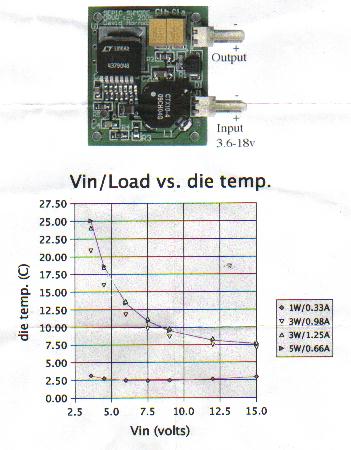
I am using a Luxeon Star III LXHL-LD3C with a SEPIC Switchmode Driver, The driver provides a constant current supply at up to 10 volts from an input supply voltage of 3.6 to 18 volts,SEPIC drivers are useful in that they can step the input voltage up or down to the required output voltage, When used to drive a LED the output voltage will settle at Vf, the LED forward voltage drop (typically 2.9 to 6.8 volts for high power LED's)

The total cost of this was $78 AU

 -
 
Posted by Bill Enos (Member # 440) on 08-10-2005, 12:20 AM:
 
Another advantage to these things over the over priced store bought is that you can make up extra ones using the white LEDs and install them in the bulb holders to have white light ready to go for the older prints and especially the variable density tracks.
 
Posted by John Pytlak (Member # 331) on 08-10-2005, 07:58 AM:
 
quote: Bill Enos
Another advantage to these things over the over priced store bought is that you can make up extra ones using the white LEDs and install them in the bulb holders to have white light ready to go for the older prints and especially the variable density tracks.

Not sure that a "white" LED will have the same cross-modulation optimization characteristics as a tungsten exciter lamp. How much output in the infrared region? Have you actually played old B&W and cyan+magenta+silver tracks using the white LED and found negligible XM distortion?

For cyan tracks, the red LED should ideally have a peak output near 660 nanometers:

http://www.kodak.com/global/images/en/motion/products/lab/f010_0294ac.gif
 
Posted by Sam D. Chavez (Member # 1841) on 08-10-2005, 01:29 PM:
 
John,

Thanks for pointing out that "white" light is not what you need for old prints. What you need is the infra-red portion of the spectrum.
 
Posted by Jeff Stricker (Member # 224) on 08-10-2005, 03:53 PM:
 
I'm happy to see folks tinkering with this design as a low cost approach to reading cyan tracks. Industry folks: bear in mind that I don't have test film, so I just relied on my "ears" to evaluate performance. This started out as an experiment just to see "what would happen if..." I was so pleased with the results, that I decided to share it on Film-Tech.

Mitchel, you would actually need a forward diode curve to know what the diode voltage is going to be at 300 mils. Gosh, you are wanting to run this thing right at the hairy edge ! Be sure its heat sinked! [Wink]

The best (safest) way to find the resistor value you need is experimentally. My gut feel is that 13.3 ohms will be too low. With 7.5 volt supply, I'd start at about 39 ohms and work down from there. (33, 27, 22, 18 ohms, etc.) Be sure to put an milliammeter in the circuit. Since your exciter voltage is variable, you can "fine tune" the final curent after you settle on a resistor value.

Forget Radio Shack junk. High power resistors available from Mouser. They sell small quantities...no problem...

http://www.mouser.com/

Super driver circuit you have there, Frank! [thumbsup]

But, I would still consider running this thing at a lower current than 300 mils.

BTW, I still need a a few hunks of cyan film for further experiments--- can anyone help me out?
 
Posted by John Hawkinson (Member # 1135) on 08-10-2005, 07:03 PM:
 
When you don't know the resistor value you need, consider using a potentiometer (variable resistor) and then you can fine-tune it in the field.

Radio Shack is probably a necessity if he really needs this working
A.S.A.P.

--jhawk
 
Posted by Bruce Hansen (Member # 281) on 08-10-2005, 07:17 PM:
 
Caution: a pot may not be able to handle the power dissipation in this case.
 
Posted by Phil Hill (Member # 371) on 08-10-2005, 07:19 PM:
 
That's not a very good suggestion Jhawk. There is too much room for damaging the LED.

Besides you'd need some humongous WW pot at the very least to dissipate all that heat.

Better to stick with the meter and the Ohms Law calcs.
 
Posted by Frank Jerkic (Member # 2446) on 08-10-2005, 08:45 PM:
 
Thought I would show you what my little LED looks like, I ran this for a month without any heatsink on the back and found it did not appear to run any hotter than the normal bulb, I decided to add the heat sink just to help it stay cool during the hot summer months that are on the way, I have had some tech bloke visit and look at it and rubbish it but I dont care it works very well thankyou lol [thumbsup]

 -
 
Posted by Mitchel Monger (Member # 2454) on 08-10-2005, 10:00 PM:
 
This is a very interesting thread. Yeah, Jeff, I agree, Radio Shack isn't the way to go. I just don't have any other options right now. I only need to get through the next few days. Then I'd like to build a better mousetrap. Thanks for the info about raising the Ohmage. I'll do my best to do that. I read somewhere that they're not much brighter if you push the amperage envelope, and that heat really effects the brightness of the red Luxeons. No time for better details, sorry.

I've got to go and finish this project. Nice work Frank! Tell the doubting tech guy to go piss up a rope! I'm looking forward to experimenting with my 4 LXHL-LD3Cs.
 
Posted by Bill Enos (Member # 440) on 08-11-2005, 12:40 AM:
 
Nope, we haven't used the white LED at all, if necessary to play an older track we still have exciter bulbs.

According to the mfgr specs, the output for the red LED is 635nm

So where are all the cyan prints??? We've gotten a few, but certainly not the avalanche that was said to be on the way. If they don't show up soon it's time for exhibitors to sue the bastards to recover the money wasted on yet another fiasco foisted on them to save somebody else a pile of money.
 
Posted by Monte L Fullmer (Member # 2797) on 08-11-2005, 12:44 AM:
 
intetresting. Homemade "Jaxlights" - hope they run better and cheaper than these goofball units.
 
Posted by Frank Jerkic (Member # 2446) on 08-11-2005, 05:37 AM:
 
Opps! forgot to post the front on view of the LED, I have screened the following cyan prints 'Herbie' 'Pacificier' 'Hitchhikers Guide' in my Drive in and also run them in my cinema, they sounded Gr8 and I am not sure if its my imagination but all other films just seem to sound more chrisper and clearer?

 -
 
Posted by Jeff Stricker (Member # 224) on 08-11-2005, 06:57 AM:
 
Good photos, Frank [thumbsup] You can't go wrong with some heatsinking.

If you don't have a commercial heatsink, folks can use a small chunk of aluminum or copper.

BTW: Comments about the techs poo-poo'ing this got a real chuckle out of me. It's hard to argue with something that works and is low cost.
 
Posted by John Pytlak (Member # 331) on 08-11-2005, 07:42 AM:
 
quote: Bill Enos
So where are all the cyan prints??? We've gotten a few, but certainly not the avalanche that was said to be on the way.
Some distributors (e.g., Disney) have made the conversion, others are still "testing the waters", sometimes with mixed inventories (after US release, the prints with silver+dye tracks are culled for release in less developed markets that have lower conversion rates to red LED readers). I note that Sony is now on board with "Bewitched".
 
Posted by Mitchel Monger (Member # 2454) on 08-12-2005, 01:17 AM:
 
Showing of "Howl's Moving Castle" a success. Had to use a 50 Ohm 10 Watt resistor (for Luxeon LXHL-MD1D) because other options weren't available. Volume had to be turned up all the way to be at good level. Sound was great except vocal range of the spectrum was a bit too quiet. I'll write more later. Going home and to bed.
 
Posted by Jeff Rodenkirch (Member # 2943) on 10-04-2005, 03:44 PM:
 
I have had four of the Luxeons running in a theatre in Tucson, AZ for serveral months. After a small mod to the Ultrastereo preamp (2 resistors) the gain is great and I actually get a little more top-end. I'm running them at about 325ma and we've had no problems.

 -
 -

The diode and the cap are there so they can run on the AC emergency supply if necessary
 
Posted by System Notices (Member # 2357) on 06-18-2007, 01:35 PM:
 

It has been 621 days since the last post.


Posted by Scott Norwood (Member # 30) on 06-18-2007, 01:35 PM:
 
Bump.

In case anyone cares, we never did build a homebrew LED upgrade for the Western Electric Universal Bases. At the suggestion of the NCS tech who services the theatre, the owner ended up getting Marble "LED Slit Lenses" (type "T") which appear to be an advanced version of the Jaxlight. The LED light source and slit lens come as a single unit and replaced the existing exciter bracket and slit lens. I hooked up an RTA last week and the system is flat to around 4kHz. Sound quality is about the same as it was with exciters on silver tracks, but is much improved with cyan tracks. Trailer reels that mix cyan and silver (and high-magenta) tracks can now be run without needing to adjust the fader between trailers and noise when playing cyan tracks is much reduced.

This is probably the most cost-effective solution in case anyone else on the planet is still using these soundheads. I've also seen Jaxlights fitted to these in another theatre (which closed last year), but I was not impressed with the sound quality in that installation.

(I can't take credit for either solution...I'm just passing along the info in case anyone is still using this stuff.)

I'm sure that Richard Fowler will be thrilled. [Smile]
 
Posted by Richard Fowler (Member # 893) on 06-18-2007, 06:32 PM:
 
I have used a few of those and found them to be sensitive to R.F. from some ignitors. It is a better fix than a Jaxlite since you are getting new optics as well. I know you are probably not having ignitor problems with the low intensity carbon arc lamps they brought with the Universal bases [evil]
 
Posted by Luciano Brigite (Member # 1104) on 06-18-2007, 09:56 PM:
 
I instaled many of those marble led slit lens, of T,X, and C types
and never had a problem with interference from ignitors with them and the response I got on the RTA was around the 6~7Khz with pink noise running on the sound reader.
The only problem I had with a few of them was hte power supply that came with them, putting a lot of hum in the system. replaced those with a switching power supply, ( properly grounded!) and it went ok.
Also made quite many mods on existing setups using these 3 and 5W red leds on readers using slit lens ( Simplex/century ,Zeiss/Ernemann and Bauers )and reverse readers ( as the Philips PF5/56 and some kalee readers) for the cost, those worked a lot more than expected.
 
Posted by Richard Fowler (Member # 893) on 06-19-2007, 07:58 AM:
 
We also went to Cosel type switchers + a couple of ferrites versus existing exciter power with "regulator" board + proper wire dressing for more reliable results.
 
Posted by Gordon McLeod (Member # 33) on 06-19-2007, 09:44 AM:
 
The problem with them is the uneven illumination across the width of the slit
 
Posted by Louis Bornwasser (Member # 3063) on 06-19-2007, 10:31 AM:
 
Uneven illumination equals THD (Total Harmonic Distortion) the same as exciter lamps. Louis


Powered by Infopop Corporation
UBB.classicTM 6.3.1.2