quote:Special jobs like DLP? You literally just walk to a console where it says PLAY and click on it. Oh yes, you also have to switch on the projector.
Special jobs like DLP, LF, dailies, premieres or double-system screenings here do get rates that are in that ballpark.
![[Smile]](smile.gif)
![[Frown]](frown.gif)
quote:How can you say that when you live in Boston, an incredibly expensive place to live. Are you living with your parents? <g>
What's the cost of living like in Chicago? I can easily see $27+/hour in the big houses and screening rooms in NYC (assuming that the operators are highly competent), but I wouldn't expect it to be common elsewhere. The small-town theatres could never afford anywhere near that, and the cost of living wouldn't justify it.
I'd be amazed if there's any regular commercial theatre (union or not) in Massachusetts that pays $20/hour or more.
![[Eek!]](eek.gif)
quote:I have paid more than that for professional services. Ummm... NO Brad! NOT ***that*** type of service!
I can't imagine any reason for that type of pay.
![[bs]](graemlins/bs.gif) about the person working the call.
about the person working the call. quote:Does anyone know if these even could be true given that UA is now part of Regal and Regal does not use unions? Are there any special circumstances that were in place with UA that Regal left in place when they took over?
I was at a United Artist and asked a manager about it. He said they started at $27.00 per hour, and you needed to take a test in order to become one.

quote:Regal currently has collective bargaining agreements in some IATSE jurisdictions. They are not totally non-union.
Does anyone know if these even could be true given that UA is now part of Regal and Regal does not use unions?
quote:Wasn't there a change in this law? I thought that was why I had to start dealing with manager/operators in the smaller theaters in NYC.
Because what other job has a law that says there MUST be a licensed projectionist in the booth at all times?
quote:From what I have been told, the chains have applied for and gained variances for some of these regs in a few locations, mostly in new builds, but the laws remain on the books. In any event, even when the chains were fighting to change and eliminate the regs, like when they petitioned the city council to recind the licensing requirement so they could send their managers into the booth, it was almost as if the union didn't notice -- hardly raised an eyebrow over it. I know some here don't agree that there needs to a license to run a booth, but that's not the issue. The issue is that these were regulations that almost guaranteed a postion of legal power for the union, and they basically ignored it. It was in the union's best interest to insure that the chains not win the political battle, but the effort they made to block the attempt was pathetic, and indicative of a succession of blunders that weakened and emasculated the union bringing it to the position it is in now....prone and moaning, "that's right, give it to me."
Wasn't there a change in this law? I thought that was why I had to start dealing with manager/operators in the smaller theaters in NYC.
quote:Maybe, but if you consider that in NYC, barbers, hair stylists, masseuses, cab drivers, elevator operators and amusement ride operators must be licensed, it doesn't sound like such a bad idea for projectionists to be licensed either, even though it would be hard for a projectionist to do anything that would actually be physically dangerous to the audience.
"I do not believe there is much justification for licensing projectionists."
quote:When UA led two other chains in a union-busting refusal to renew contracts, the members wanted to strike but realized they needed a strike fund. The union leaders promised they would receive a one million dollar pledge from the International if the local would match it. The local business "consultant" demanded an additional 1.5% assessmant of wages in additional to previous assessments added to basic union dues--I think it would amount to 5% of wages. The members refused by referendum three times, probably because they didn't trust the union administration in the handling of these funds, and because they were tired of having additional % sliced off their decreasing wages plus other contractual give-backs.
As for the union, didn't the membership have to vote on the contract? How did the membership vote for a contract that eliminated their jobs?
quote:Not exactly. The business manager was proud of his Fortune Society program, in which he helped released offenders who had served their prison time, to become rehabilitated as trained, licensed union projectionists. When one of these men had a dispute with him an felt he was buing "dissed", he hit the manager in an eye which had previously undergone surgery. The injury resulted in the loss of his eye. The perpetrator was arrested and returned to prison.
In fact, in what can only be reminiscent of the Wild West, a union member got up during a meeting, pulled a gun and shot him in the eye.
![[Mad]](mad.gif)
![[Big Grin]](biggrin.gif)
quote:The minimum wage argument is ridiculous. I don't know of any company that pays their employees minimum wage and never gives raises. Don't make these general statements about minimum wage and imply that so many people struggle to live off of minimum wage. If a person actually stays at a job only paying minimum wage, then they need help. There are plenty of places that start employees off with wages several dollars above the minimum. Also, the argument that people can support a family with minimum wage is absurd. Of course you can't support a family with that kind of money, but that is something these people should have thought about before having kids. Not everyone can make a good living. There will always be those who lack the motivation to go through school and get a well paying job. Its a fact of life. Stop crying about the minumum wage. Most of the people that are being paid the minimum are 14-16 year olds at their first job. If you are not happy with your pay, get a new job or start your own business and then you can pay your employees as much as you want. I'm sure if you were the founder and CEO of a successful company, you would love to just give all your employees huge wages so that they could benefit from your hard work.
You cannot raise a family or build a future on minimum wage...you can barely raise a family on double that.
Fortunately Nevada is a right-to-work state, so non-union status doesn't mean much here--in fact it has been a plus when doing those occasional freelance sports TV gigs.![[evil]](graemlins/evil.gif) I'm sure it would have been spectacular to watch, but as fate would have it the guys couldn't get the thing to start that night. I think all sides came away very lucky for that--they all got to live to fight another day.
I'm sure it would have been spectacular to watch, but as fate would have it the guys couldn't get the thing to start that night. I think all sides came away very lucky for that--they all got to live to fight another day.
quote:I disagree. The "opportunity for advancement" counter-argument has merit, but ultimately the fact remains that as long as there are a large number of minimum-paying (or minimal-paying) jobs, a large number of people are going to be stuck with them. I would guess that there are many more low-paying jobs than there are teenagers who need a little extra spending money and the instillation of a work ethic in lieu of decent wages. In this sort of system, a big winner necessarily implies one (or likely many more) losers.
The minimum wage argument is ridiculous.
but regular gas was around $0.50/gallon here in 1973, before the gas crisis that December. $5.00 would fill my '68 VW Type 1 back then!
 (would be $23.55 today )
quote:That is correct. In some situations they have both non and union affiliates working the same booth. A lot goes in to deciding who runs the booth, at least in my theater and area. You must be 18 years old read the booth guidelines and take the test that comes with it before you touch anything in the booth. You also must have and show that you can handle the situations of a booth. That's determind when I train the person. If I see they can't grasp what I am teaching or handle certain situations in three days of training with me, then they fail and they will not work the booth. If they do show promise then they are closely trained even further over a course of time through me. I don't try to force it on them all at once to avoid confusion. The booth is to important to me to allow a bunch of mistakes or problems to occure. A lot of times I have people come to me from other cinemark locations to learn more about the booth and I am always willing to teach them what they need to know.
Cinemark does have collective bargaining agreements in some IATSE Local jurisdictions.
quote:
News : Cinema Labor Pains : Union files complaints against local theater chain
By Amy Starnes
Wednesday, June 09, 2004
Reel Trouble
The Cedar Lee, target of union complaints.
A UNION REPRESENTING movie projectionists claims its workers have been locked out of their jobs at four theaters owned or operated by Cleveland Cinemas. The International Alliance of Theatrical Stage Employees Local 160 has filed two complaints with the National Labor Relations Board over the treatment of workers by Cleveland Cinemas and owner Jonathan Forman. Forman declined to comment for this story.
The first blow to the union came in early April when Chagrin Cinemas owner Larry Dolan, also owner of the Cleveland Indians, hired Cleveland Cinemas to operate his facility.
John Galinac, business agent for Local 160, said he wasn't much concerned about the transaction at first, because in the past Dolan had hired a cinema operator who had worked well with the union, and the union already had workers at Cleveland Cinemas' Cedar Lee, Shaker Square and Tower City properties.
Galinac says Forman told all employees they would be rehired if they filled out applications for Cleveland Cinemas, but when he dropped off the forms, the union projectionists were never told. Galinac said all the workers in the front of the movie house had an opportunity to apply, but only one projectionist managed to find a form and submit it.
“We should have been able to apply, but we weren't offered [the opportunity] to apply. We were not even given the opportunity because of our union affiliation,” Galinac claims.
That employee showed up for work on April 9, but Galinac says he was turned away by a Cleveland Cinemas employee and told, “Didn't the union tell you that the union doesn't represent anyone anymore, and there are no more union positions here anymore?”
Galinac says that when the employee was allowed to go to his booth and collect his personal belongings, he noticed non-union employees running the projection equipment.
The union projectionists were making about $18.25 per hour, while other similar non-supervisory, non-union positions at the theaters make about half that wage, and most don't have benefits, Galinac says.
Then on April 26, Galinac says, Forman's lawyer sent him a letter indicating that on June 1, Cleveland Cinemas was eliminating all dedicated projectionist positions at the Shaker Square, Cedar Lee and Tower City theaters, effectively laying off the employees.
Galinac acknowledges that there has been a trend in the industry to move away from dedicated projectionist positions to employing non-union workers who do a variety of work. But, he says, the union is open to renegotiating the contract in order to retain the number of positions and number of hours the workers had, and is willing to continue to change work rules to allow the employees to handle other duties rather than solely operate projection equipment during their shifts.
The union and Cleveland Cinemas negotiated during three meetings in May, moderated by a representative from the Federal Mediation and Conciliation Service. Galinac says that Forman wanted to reduce the workload from 160 hours a week split by several people to just 40 hours a week for one full-time and one part-time service technician, who would drive among all the theaters repairing equipment. Galinac would not agree to such a switch.
“The end result is that as of Tuesday (June 1), we are locked out of Tower City, Shaker and Cedar Lee, and we are continuing to be locked out of Chagrin Cinemas,” he says.
Allen Binstock, a field attorney for the National Labor Relations Board, is investigating Local 160's complaint about the actions at Chagrin Cinemas. A separate investigator is handling the complaint against Cleveland Cinemas. Binstock says he has met with the union and interviewed witnesses but is waiting for the company to respond to the charge.
At the end of his investigation, Binstock will make a recommendation to the NLRB's regional director in Cleveland, who will determine whether there is probable cause that the National Labor Relations Act was violated, and will decide whether to issue a complaint against the employer, unless the company is willing to settle the matter.
If not, a hearing will be scheduled before an administrative law judge, who will rule on the merits of the allegations and order a remedy if needed.
quote:
ENTERTAINMENT
Movie projectionists plan protest today
The union representing projectionists at four local theaters plans to protest this afternoon outside the Cedar Lee Theater in Cleveland Heights. The projectionists - represented by the International Alliance of Theatrical Stage Employees Local 160 - say they were locked out of Cedar Lee, Shaker Square Cinemas and Tower City Cinemas on June 1, and out of Chagrin Cinemas on April 9. They say theater owner Jon Foreman has replaced them with lower-paid employees. Foreman declined to discuss the dispute because of a pending National Labor Relations Board review.
- Plain Dealer reporter Alison Grant
© 2004 The Plain Dealer.
quote: Joe SchmidtJoe,
On the national, Congressional level, the Republicans represent the upper strata of the richest 1% and THAT IS ALL.
quote:Reading political spam like this always burns me out. Go to the Sean Hannity forums and try your theory over there. PLENTY of well-educated debate-artists will clean your clock on that one.
I see a lot of young people in these forums, and you had better all get politically active and be voting next year. If Bush is re-elected, and if the Rich Republicans capture more than 60 seats in the Senate, plus controlling the House, we are going to see an escalating disaster which will make today's events seem like a church picnic. On the national, Congressional level, the Republicans represent the upper strata of the richest 1% and THAT IS ALL.
quote:
Thomas Mulready, proprietor of CoolCleveland.com, likes to tout his website as the place for all that's "edgy, innovative and eye-opening in Cleveland." But this description apparently doesn't include giant rats.
At a Cool Cleveland bash on Coventry last Thursday, wannabe hipsters flocked to the neighborhood anchored by the venerable Cedar Lee Theater, which shows movies with no explosions or car chases, which means they're art.
But there are problems afoot at the Cedar Lee. Owner Jon Forman fired all his union employees in April. He claimed he no longer had any employees, since everyone who works for him is now officially a "manager." The punk selling you popcorn? He's a "concessions manager." The pimply kid taking tickets? That's the "floor manager."
Forman's company, Cleveland Cinemas, also manages the theaters at Tower City and Shaker Square, as well as Chagrin Cinemas, where all the unionized projectionists were fired, too. The move allowed Forman to cut wages from $15 an hour to between $7 and $10, says John Galinac, business agent for Local 160.
The union has filed two complaints with the National Labor Relations Board, and the case looks pretty open-and-shut. "You cannot fire people for being in a union," says Patricia Gilbert, spokeswoman for the board.
But as the cases languish in the federal bureaucracy, the union decided to run a little street protest. So they broke out the giant inflatable rat, a key accessory to any stylish labor action.
Alas, it seems that Cool Clevelanders aren't big on livable wages -- at least for anybody but themselves. They told Galinac they were offended by the presence of a 12-foot rodent parked in the middle of their party, which was soooo inappropriate.
"Some people thought it was over the top," Galinac says. "It looked like Godzilla. It was taller than the marquee."
Even business owners on the block thought the Cool Clevelanders were getting upset over nothing. "It didn't bother me," says Kevin Needham, owner of the Pub on Lee.
quote: Jeffry L. JohnsonMy experience has been with regard to the NLRB and quite a number of projectionists complaints brought before its august commissioners by the union, what seems to be "open and shut" to the reasonable eye of ordinary folk who are usually pretty good at understanding what is fair and what is not, the decisions handed down many times seem completely unfair, and usually against the worker. The NLRB seems to have been emmasculated as have many regulatory agencies under certain administrations. Its power, or let's say its propensity to use its power to protect labor, seems to ebb and flow; if you happen to be seeking help when it is ebbing, you may find that your barking up the NLRB tree will gain you nada.
The union has filed two complaints with the National Labor Relations Board, and the case looks pretty open-and-shut.
quote:
STAGE EMPLOYEES (IATSE)
Chicago Boss Gets Heavy Sentence for Obstruction
U.S. Dist. Judge Suzanne B. Conlon (N.D. IL, Reagan) slapped a 6-1/2 yr. prison sentence on Albin Brenkus on May 3. Brenkus was convicted on March 5 for his part in a multi-state campaign of violence, vandalism and arson in retaliation against three major theater companies in the midst of collective bargaining disputes. Brenkus was the secy.-treasurer of Local 110 of the Intl. Alliance of Theatrical & Stage Employees (IATSE) when he orchestrated the planting of smoke bombs in AMC, Cinemark and Loews theatres in 10 states. The multi-state vandalism was apparently aimed at forcing the theatres' corporate owners into using Local 110 projectionists in their Chicago theatres.
Jurors apparently believed the assertion of Brenkus' lawyer that he did not know that the bombs' combination of chlorine and brake fluid could burst into flames if left unattended. Brenkus was acquitted of arson and racketeering charges, but was convicted obstructing justice by instructing a Local 110 member to lie to FBI agents about the beating of a Chi.-area theater mgr.
Brenkus himself was not charged in that beating, but Judge Conlon clearly took it and the arsons into account for her sentencing of Brenkus -- an unusually stiff sentence for obstruction of justice. "The whole [beating] plot was Mr. Brenkus' idea," Conlon said as she rejected a lawyer's claim that Brenkus didn't know that a baseball bat would be used in the beating. Brenkus must also pay a $100,000 fine. [Chicago Daily Herald, 5/4/04]
quote:
You missed the real controversy surrounding the showing of Fahrenheit 9/11 in Cleveland. How will the people who have been waiting for months to see this film deal with the fact that the Cedar-Lee has locked out its union projectionists and hired lesser-paid part-timers in their place? I won't cross the picket line, and I doubt that Michael Moore himself would if he were in town. We'll have to hope it's showing at some other theater, even another chain that gave up union contracts long ago, or wait for the DVD.
Jonathan Forman has done his best to ruin the Cleveland filmgoers' experience for years, holding films that have shown months before in other cities for the Festival, only to give them a short run after the Festival closes, showing good films in the most ridiculously small “theaters,” etc. Now he has to wring a few more dollars out of the business from his employees. Not with my money, he won't. Sorry, Michael, unless the film is showing somewhere else in town or I take a road trip, the big opening night numbers will be less one or two.
William Kennedy
Newbury
quote:Sorry to disappoint you, Mark, but I'm uncomfortable doing that. I don't do it on Usenet or other email lists on which I occasionally participate (CML, MEL-L, AMIA-L).
Get Real
Teens should tear tickets for less: I was amazed to read your article on the recent picketing by union members outside the Cedar Lee Theater ["Rat Bastards," First Punch, June 23]. Although I realize that some unions have done a great deal for the American worker, doesn't everyone agree that they may be a little out of touch?
Cleveland Cinemas was able to cut the average wage from $15 an hour down to between $7 and $10 an hour. That seems a fair wage for someone to make for tearing ticket stubs in half or making popcorn. These jobs are typically held by high school students. I can't help but wonder how much of my $8.50 ticket goes to the extreme wages some of these cinemas have to pay. Let's get real here.
Michael Yopko
Columbus
quote: Jeffry L. JohnsonThis person should get real, and do some research. They would find out that very little of that $8.50 ticket goes to the theater itself. It pays for the movie, that many of us work hard to put on screen for them, so they can have some form of entertainment.
can't help but wonder how much of my $8.50 ticket goes to the extreme wages some of these cinemas have to pay. Let's get real here.
quote: Jeffry L. JohnsonI barely make that much, and I am an assistant manager and run the booth. And these people have the nerve to complain.
$7 and $10 an hour. That seems a fair wage for someone to make for tearing ticket stubs in half or making popcorn.
![[Confused]](confused.gif)
quote: Jeffry L. Johnsoni.e. people exist who will work for peanuts. that's fine. just don't be surprised when they slack off, sass back to customers, and scratch films. low motivation and high turnover. it's what you're paying for.
These jobs are typically held by high school students.
quote:With the exception of 1999, I have been a projectionist during the film festival every year since 1984.
Festival of scabs
The latté and turtleneck crowd is hoping to redeem its spotty history of labor oppression.
Since 1977, the Cleveland Film Society has used union projectionists for its annual film festival. But this year the society got caught up in a larger fight between the projectionists' union and Jonathan Forman, owner of Cleveland Cinemas, which manages Tower City and other theaters around town.
Last year, Forman locked the union out of his theaters. A loophole in the contract said that projectionists could be replaced only by "managers." So Forman decided to make everyone a manager, from the ticket taker to the popcorn kid. The projectionists have been protesting at Forman's Cedar Lee ever since.
Now the bossman is returning fire. "Forman told the film society in no uncertain terms that if they negotiate with us, he'll lock them out of Tower City so they can't have their film festival there," says union chief John Galinac.
At first blush, the society would seem to have no choice but to side with the union. Union leaders raised money for the festival, and last year Galinac coaxed a $10,000 donation from Paul Newman. But when Galinac called to discuss a contract for this year, he was routed to the society's lawyer. "I was told they can't negotiate with us this year," he says.
Society director Marcie Goodman dodges the issue: "Our focus is on providing the best film festival we can," which is French for "We sell out our friends."
Meanwhile, the county commissioners are pissed. They gave the society a $15,000 grant last year. But now that union guys won't be showing the movies, commissioners won't be sending their dough. "We told them we can't be part of the festival until you fix this," says Kathy Doyle, chief of staff for Commissioner Tim Hagan. "So fix it."
"We're not happy about it," adds Commissioner Jimmy Dimora.
Forman defends his record. "We've created hundreds of jobs over the last 28 years, both union and non-union," he says. "We've restored buildings all over Northeast Ohio, using union and non-union help. We've contributed to the quality of life throughout Northeast Ohio."
Somehow, Punch can't quite understand how union-busting enhances our quality of life.

quote: John WalshJohn,
The projectionists I worked with were so good, they would actually be considered technicians at most other chains. So, a big thumbs up to Lou, Steve, Brenda and Carlos. I had a great time working with you, and would suggest Local 110 to any theater owner desiring a first-rate operation.
quote: Gordon McLeodYeah, I feel the same way about non-union manager operators. There are thousands out there that care about what they are doing and strive to give the best presentations. So we are all in the same boat here. There is always someone out there dragging us down because of stupidity and or lack of teaching in training someone. I mean come on non of us popped out of the womb perfect and capable in doing our jobs today. Someone had to help show us the way.
I am getting realy tired of listening to the same complaint chicago chicago... there are thousands of IATSE members all over north america who go about there jobs in a competent and law abiding manner and they do not deserve the constant in your face attitude that seems to permiate some peoples mind set What happened there was wrong but to continually brand every other person is even more wrong
quote: John WalshWhat you call bad behavior the FBI called "an act of domestic terrorism using a weapon of mass destruction" Amazing... Tell me, which group of rouge cops or doctors were out pulling terrorist attacks?
I would agree with Gordon. Look into ANY organization and you can find bad behavior, be it doctors, cops, or whatever. Reasonable people know there will always be a few bad apples, and not to condemn the other 99% who do an honest day's work.
quote: Gordon McLeodKind of like that same complaint you hear in the USA.. 9/11, 9/11.
I am getting realy tired of listening to the same complaint chicago chicago... there are
quote: Gordon McLeodWere the perps thown out fo the IATSE? Was the local shut down? Did the IATSE do ANYTHING to assist the victims of the attacks carried out by its members? So you claim that to distrust an organization who, from everything I have seen, stands silent at the conduct of some of its members, is more wrong than the TERRORIST acts committed by some of its members? Amazing...
thousands of IATSE members all over north america who go about there jobs in a competent and law abiding manner and they do not deserve the constant in your face attitude that seems to permiate some peoples mind set What happened there was wrong but to continually brand every other person is even more wrong
quote: Mark GulbrandsenI must agree Mark. I read your post that you made after I posted this one. I guess that is how I feel about the way I work. My technician asked me if I could be cloned once. Guess that sums it up.
I pretty much agree Richard but there are a few really good manager/operators out in this area... and I mean really just a few! Perhaps one or two per state on my service runs.
quote:Thats what I've been saying in my posts if you read between the lines..... I'm only bringing up 110 because I have direct experience with them.
So, my point is: not all unions, union locals, and union workers are evil and bad!
quote: Mark GulbrandsenYes.
Now I could tell you about the one armed projectionist that 110 sent to a theatre I maintained at the time to run 70mm if you want to hear about it.
quote:And lets not forget that many of the benefits won by organized labor are passed on to management. Many companies see this as necessary to keep managers at least par with the rank and file. Think about it, would you continue to be a manager, with the headaches and hassles, if your employees were making substantially better wages and benefits than you?
Steve Guttag: ...unions are not bad, just a necessary evil if you don't want a world of subsitance level wages.
![[thumbsup]](graemlins/thumbsup.gif)
quote:
Voices of Cleveland and beyond
IATSE Local 160 VS Forman, battle is on
ENOUGH IS ENOUGH!"
For 28 years members of the Projectionists' Union here in Cleveland have proudly worked the Cleveland Film Festival - showing the films and providing festival-goers with a quality experience to rival any big-name festival out there.
But this year, Cleveland Cinemas CEO and Cedar Lee Theater owner Jon Forman has decided the union has no place working the Cleveland Film Festival. After 28 years of proud participation in one of Cleveland's premier cultural events, what appears to be one man's personal vendetta has left a foul odor hanging over this year's festivities.
Forman has been involved in a labor dispute with the union for over a year now - purging his theaters of union workers and giving their positions to "managers." The union fought back last holiday season with a boycott campaign of the popular Cedar Lee Theater - asking folks to not support a union buster like Jon Forman, who was named Cleveland's 2004 "Scrooge of the Year" by Cleveland Jobs with Justice. The National Labor Relations Board has also been drawn into the fight, as the union continues to pursue unfair labor practice charges against Forman.
Not satisfied with violating workers' rights in his own facilities, Jon Forman used his clout in the Cleveland arts community to keep the union out of this year's festival as well. "Forman made it known that in order for the festival to use his facilities at Tower City, there would be no union labor used," says IATSE Local 160 business agent John Galinac. Rather than siding with the union - which in past years has helped raise generous amounts of money for the festival, including a $10,000 donation from actor Paul Newman - the festival organizers have decided to cast their lot with a man who has done everything in his power to destroy organized labor in his industry.
Cleveland should be so proud.
It seems that being named "Most Impoverished City in the Nation" has driven some in Cleveland to go out of their way to prove how worthy the city is of this title. As the high-paying manufacturing jobs of days past continue to disappear, employers like Jon Forman are also doing their part to wipe out the good jobs that remain - jobs like those held by the union projectionists in his theaters, which paid well and provided good benefits and pensions. But some Clevelanders are tiring of this race to the bottom.
The county commissioners, for one, have withdrawn their financial support of this year's festival. After giving $15,000 last year to support the festival and it's use of union labor, the commissioners are less than happy about this recent turn of events. For a festival that is already in financial straits, this kind of snubbing really hurts.
The union is attempting to provide an alternate location for filmmakers that would agree to pull their films from the festival at Tower City. "We want Cleveland to see these films, but we want to offer both the filmmakers and the filmgoers a socially responsible opportunity to enjoy them. We think many of this year's participants and attendees will have quite a problem with being in any way connected to a union buster like Jon Forman," says Galinac. The union is currently reaching out to the filmmakers to encourage them to withdraw their work from this year's festival.
Cleveland Jobs with Justice will be helping the union organize specific actions throughout the festival, to draw attention to the labor dispute and encourage socially conscious festival attendees to spend their money elsewhere.
Anyone interested in receiving more information about the campaign should contact Cleveland Jobs with Justice at 440-333-7007.
quote: John WalshOr they could do a better job training the people who will do and have been doing the job for half the pay that union workers receive. If you mention "for half the pay" to an owner, I'm sure that'll help them lean toward non-union. But never having been involved with a union work environment, maybe I dont know what I'm talking about and I'm just a dumb kid.
if an owner has a large complex in an area where the public are less tolerant of poor presentations, a union sould be considered.
quote: Darryl SpicerI am not willing to train just anyone on all aspects of the booths while I am performing booth maintainance even if a customer asks me to train them in a certain thing. I will of course help them achieve the goal of a perfect projected show and teach them what they need to know to do it but if an every day operator that still has not learned the proper names of the parts of a projector I would certainly NOT teach them to change a movement or shutter drive gear..... I am generally being paid to maintain the booth not interfer or give instructions other than what the chain has already taught their personel... Its not really my place to tell them what to do and how they should run their buisness. When it comes to sound thay may take a great interest in the technical aspects but then not one of our customers also posesses the correct test equipemnt to peoperly service their own equipment.
That's why you ask your technician questions and be there to learn from them.
quote: Mark GulbrandsenNor would I expect you to. but I think if you have someone asking questions about something an answer should be given to best explain it so then they will gain the knowledge. Best thing to do is direct them to the manuals and tell them to learn the parts and understand what they do. I learned a lot from in house and out of house technicians. It all boiled down to asking the right questions and understanding the equipment I worked with.
but if an every day operator that still has not learned the proper names of the parts of a projector I would certainly NOT teach them to change a movement or shutter drive gear.....
quote: Mark GulbrandsenBrother, do I agree with this one!
I am not willing to train just anyone on all aspects of the booths while I am performing booth maintainance even if a customer asks me to train them in a certain thing.
quote: Darryl SpicerI didn't say that I wasn't willing to train anyone at all in any aspect... just that alot of the booth mongers out there shouldn't know some of the more technical stuff... that can lead to really big problems at times...... IN one location I actually had a manager that was incredibly mechanically inclined. He was able to change a shutter gear in a Brenkert just with my help over the phone. There are those that should know because they can do the work.... but most cannot.
But when you go to someone who is your superior and they can't answer the questions who else can you turn to. In my case it was the technicians around me.
quote: Steve GuttagI am not equating unions with crime. What I am saying is that the IATSE - AS AN ORGANIZATION - appears, by its silence, to endorse such activities. The fact that the 110 still exists in its current form demonstrates a tolerance of its activites by the IATSE leadership. Several people have pointed out that most of the negative things that are said about the IATSE are a result of the actions of Chicago. Seems to me that the best way for the union to clear its name would be to hold Chicago accountable.
As to Local #110...it is easy to pick on...it is the most notorious, as is the entire city of Chicago and unions in general. However, the concept of Unions should not be associated with crime. Crime need not have a union card. Most every worthwhile worker protection that the government likes to take credit for came from organized labor, not the government...unions are not bad, just a necessary evil if you don't want a world of subsitance level wages.
quote: John WalshRealize I am not blaming the rank and file union members for the actiosn of Chicago. However, I do hold the organization and the leadership responsible because they have not, publically anyway, done anything about it.
How long do we blame Italian people for Al Capone? It’s pretty well known Mayor Daly (Sr.) was supported by organized crime; do we say his son or even the general government of Chicago is no good? If my dad robbed a bank, is it OK for people to say to me, “Your whole family is no good” for the next 50 years?
quote: Jeremy FuentesWhen I was working for Cinemark, most of my operators made more than the IATSE operator Cinemark had in Omaha. Also, union training, as others have mentioned, can be hit or miss. The guy in Omaha had a lower skill level than most of my operators as well.
Or they could do a better job training the people who will do and have been doing the job for half the pay that union workers receive. If you mention "for half the pay" to an owner, I'm sure that'll help them lean toward non-union.
quote:It was written on my paycheck from Cinemark. My pay was $5.80 an hour during the short time I was working in the booth. $12 an hour is more that twice that amount. I doubt I would have ever been able to make more that $6.50 an hour, if I would have stayed. The Cinemark here has had many capable operators , and I doubt any were paid $12 an hour.
Jeremy, where is it written union operators always get twice the rate as non-union? I know several union contracts where the operators get $12 an hour;
quote: Mark Gulbrandsen(..my apologies to Daryl and Mark on me seeming to be a little testy on this topic....)
I will of course help them achieve the goal of a perfect projected show and teach them....
quote: Tim ReedYes, it can be done but you just have to pray that he doesn't think he's now become a real technician and changes the next movement(or shutter bearing!) without aso seeking your help
It took about five hours (okay, look below and slightly behind of where you frame the film, and you'll see a round piece of metal with a flat slot in it; that's called a screw), but by gosh, we did it.
!!quote: Jim ZieglerJim, Actually they exist in quite a different form than when I was part of it. The past secretary retired(the highest paid union official in the country at that time) and when the Cineplex/GC contracts expired and the lockouts occured many members were no longer members. I do certainly agree they would have a better face today if they had recently condoned the stuff that happened in past years. Because of the fact that they never did this has caused them to loose much face today and its doubtful they will ever gain that face back...... I have to wonder.... do they really care if they do get it back????
The fact that the 110 still exists in its current form demonstrates a tolerance of its activites by the IATSE leadership.
quote: Richard MayWhat do you consider as qualified?
This does not mean that he or she is qualified to run the booth.
quote: Mark GulbrandsenMark, the answer is they probably don't care! It is overly obvious that IATSE had defaulted on the projectionists trade years ago. While there may be some IATSE locals led by workers who still hold the "craft" in regard, IATSE as a whole seems to hold it in DIS regard, preferring to promote the union for the convention center/concert build-up and tear down businesses. Regardless of what happened in Chicago, IATSE as a whole makes it difficult for those of us who support organized workers' rights because IATSE (like a lot of labor organizations today) seems to be a union in name only.
I have to wonder.... do they really care if they do get it back????
quote:I fully agree here. It's definitely a dying art and craft for sure. Too bad, as we are actually running the theatre, we projectionists get the worst respect from the "white collar" world.
The best thing projectionists can do if they are of a technical bent is to use the job to transition to a career as a tech where you can get a little respect for your efforts and dedication.
quote: Tim ReedTwo questions Tim: 1) Can I have your telephone number and 2) Did you charge him service time?
I once talked a Carmike manager through changing an intermittent! I was on the phone from the Texas panhandle, and he was in east Oklahoma.
![[Wink]](wink.gif)
quote: Mitchell Dvoskin was the last to postOne of the big starts of it all was the oil embargo of 1974. When these resources became on the "orange alert" situation in that fall, suddenly there was a huge demand for conserving energy, and electricity was the main one, next to fuel.
Xenons, platters and automations.
quote: Rick Raskin..and that was the "death knell", for if this would have gone through, jobs would have been more secured due to the cross training that would have been done and kept up the quality as it should have been. But "Noooooo!" - pride got in the way, and sometimes pride can destroy. Sometimes, we have to "suck it up" with our pride and take whatever comes to our way to keep our sanity and our survival rate.
I remember our business agent (RIP) telling the theatre owners "...no thanks, we work with our hands not with our heads". ...
![[Cool]](cool.gif)
![[Roll Eyes]](rolleyes.gif)
quote:
Cuyahoga officials boycott film festival over union
Wednesday, March 02, 2005
Clint O'Connor
Plain Dealer Reporter
The 29th Cleveland International Film Festival could draw nearly 40,000 movie fans starting next week.
The Cuyahoga County commissioners won't be among them.
A protest by a local union representing projectionists has caused the three commissioners - Jimmy Dimora, Tim Hagan and Peter Lawson Jones - to boycott the festival.
"We can't go," said Dimora on Tuesday. "We're not going to cross a picket line or offend the union leadership and the union members."
Jones agreed, but said, "The film festival should not be punished. They don't have a lot of options on where they can show this. Downtown is an appropriate place for this event." Hagan did not return messages.
The festival runs March 10-20 at Tower City Cinemas.
The International Alliance of Theatrical Stage Employees Local 160 plans to protest the festival because of a labor dispute with the theater's owner, Cleveland Cinemas. The company, which also operates five other area theaters, employed Local 160 members as projectionists until last year when it consolidated positions. Projection duties are now handled by nonunion managers.
Local 160, which represents about 50 projectionist/video technicians and 80 front-of-the-house employees in Northeast Ohio, filed a complaint that is still pending with the National Labor Relations Board. The new conflict arose when the union was told its members would not work at the film festival.
"We had worked the festival for 28 years," said John Galinac, business agent for Local 160. Galinac filed a new charge of unfair labor practices against Cleveland Cinemas and the Cleveland Film Society, which runs the festival, with the NLRB, but withdrew it on Monday. He said he wanted to wait to see who works at the festival.
"We've been operating Tower City for the past year without dedicated projectionists," said Jon Forman, head of Cleveland Cinemas. "Loews, Magic Johnson, AMC, and most Regal Cinemas also operate without dedicated projectionists."
Galinac said Local 160 members work for Atlas, Cinemark and some Regal theaters.
Galinac said the union is trying to contact filmmakers and distributors to get them to pull their movies from the festival.
Forman said the matter is between his company and Local 160 and that "the film society is being needlessly dragged into a labor dispute. I founded the film festival; I would never do anything to hurt that organization."
The society rents theater space from Cleveland Cinemas. "We're stuck in the middle," said the society's executive director, Marcie Goodman, on Tuesday. "This has nothing to do with us."
Dimora said the commissioners are sending a letter to Forman today to urge him to reach some sort of temporary agreement with the union.
The kicker is the county gave the film society $15,000 last fall, a grant that allowed the festival to expand from four to five theaters for the first time. Dimora said the dispute won't affect the grant. "We are not going to pull the plug on them in the 11th hour."
What does that tell you? I'm tired of going over the same things here over and over.
quote: Richard MayTo me, from the way I am taking it, is you are saying that anyone here on Film-Tech that is non-union is automatically not a qualified operator. Thats what it sounds like to me.
unqualified operators
quote: Richard MayThey just hope that every house in the world would go DLP digital, but we know that isn't feasible, in solving this problem. Yet the premieres are probably run by professional booth personnel.
Hopefully the filmmakers care enough about their prints to step in and do something
quote: Mitchell DvoskinWow.. That sounds just like the kind of organization I want in my building...
By the late 1970's, the IA (at least here in Northern NJ) was arrogant, somewhat corrupt, and rife with nepotism, while excluding talented individuals who wanted to be projectionst but did not have the right connections or were not willing to pay large bribes to get in.
quote: Richard MayRichard, in 10 years in the business, I have never scratched a print.. Nor have I ever had a union card. Frankly, I am just as qualified as you are.
In my experience, that has happened. I do not think that I am wrong in stating that. You are going to have more problems with unqualified operators. We have been through this already.
quote: Sam D. ChavezIs this a common problem?
Was this member abused by a union organizer at an early age?
quote: Mike SpaethOh PLEEZE Mike.... if you are an area manager with ANY experience at all you would have already kown what Brad pointed out above... But I will refresh your memory.
I happen to be the area manager for my chain.
quote: Richard MayIt's now the common, lowered expectation of theatrical presentation. I read a message from a film archivist perplexing about being contacted by some company for a clip of an archival "old movie" title to be used in a presentation, they got a nice clip to them, & saw when used it had scratches, dust, etc. added to make it look like it was film.
Another problem today is that most customers don't care so much about a perfect presentation. I have gone on many service calls, and while being there, went in to check on other screens. The maskings are not set right. The print is scratched. It's out of focus. Do the customers complain? Mostly no.
quote: William HooperThat's happened to me, too. Even worse, the producer in question took some lovely 1943 Kodachrome and removed the colour from it for transmission, believing that the public expect footage from World War II to be b/w.
they got a nice clip to them, & saw when used it had scratches, dust, etc. added to make it look like it was film.
quote: Leo EnticknapOn my personal status with the unions, there were no requirements. Just the willing to join, pay the dues and be "protected" by the union contracts of the rewards of better wages, which were a lot more than the regular staff's salaries (and our salaries sometimes even matched the managers salaries, in which some of the managers were greatly offended..) and other conditions and benefits that the union of our certain local offered that was signed in the contracts between the theatre (chain) and the IATSE & the MPMO.
in the US, is membership the equivalent of a professional qualification? Do you have to take an exam or test in order to join, or are there other membership requirements (e.g. you have to have X amount of work experience before you can join)?
quote:Boy, did I find this out in the hard way!
Any projectionist caught leaving the booth or theatre in any conventional house will be subject to a trail and a fine by Local xxx's Executive Board.
quote: Mitchell DvoskinMitchell: I suspect that the "head projectionist" (in Monte's example) was not saying what he did in "arrogance" but rather in the interest of Monte and all other booth operators at that theatre...to preserve their jobs and their workloads. Let me elaborate...and I won't even have to use an example in a union-setting!
And then they wondered why the rest of their theatre's staff thought they were arrogant and were all to happy to help the owners boot them out. They exuded this "I work for the union, not the theatre team" attitude.
quote: Richard MayJust because customers don't complain doesn't mean they're happy. Theatre owners are committing suicide by cheaping out in the booth. Within five years, they'll be selling HDTV at mass-market prices and customers will simply stay home and watch Hi-Def. Customers may not know the specifics of what's wrong with the presentation, but they just won't feel the desire to see a movie in a theatre as often as they have in the past.
Another problem today is that most customers don't care so much about a perfect presentation. I have gone on many service calls, and while being there, went in to check on other screens. The maskings are not set right. The print is scratched. It's out of focus. Do the customers complain? Mostly no. Theater owners know this. If someone does actually complain, they give them a free pass. The theaters don't care. They know the people will come back and buy more at the concession stand. There are few, if any theaters in this area, that care about a perfect presentation. It's all about the money.
quote: Mitchell Dvoskin..and some employees wonder why earlier theatres (and even some of the new ones being built) have "water closets" upstairs - we were just confined up in the booth! We didn't need to leave the area. It was our "second home" up there. (LOL)
Every time someone went up to the booth, the guy seemed to be stretched out on the recliner watching HBO.
quote: Martin BrooksWhat if the projectionist is a student working part time? The amount of technical knowledge required of the average operator is not overwhelming, nor is it worth $30 an hour.
It’s one thing to pay minimum wage to a student who is working part time and serving Coke. It’s quite another to pay that to a projectionist who is working 10-20 screens and requires technical knowledge.
quote: Martin BrooksWhy should they? If YOU don't like the pay scale, work somewhere else.
If you can’t afford to pay someone $11 to show a movie, close the damned theatre.
quote: Richard May..and that's for one person. Can you imagine for a family of 5 or more and what they want at the snakbar? There goes a Franklin to the theatre easy. - Monte
They are the one paying nine bucks at the door to get in and then another 12 bucks for food.
quote: Martin BrooksWell said. The other day I had to make airline reservations. Guess what, the call center is now in INDIA. I don't think many of the displaced workers took a transfer.
Without unions, we are going to become a third-world country, where most citizens have jobs that cannot support a decent life.
quote: Mike SpaethMy observations have been the reverse.
In most Manager/Operator situations that I have seen ... no positions are actually eliminated
quote: Justin WestJust a thought - if the concessionists unionized, who would carry the bags of popcorn seed? Union projectionists seemed to be fond of getting a contract that said that the concession staff had to carry their prints, so, who are the concessionists going to make do their heavy lifting?
I have a suggestion for anyone who shares this thought...just because the IA has moved away from MPMOs and theatres-in-general does NOT mean that a NEW union movement could not be started, one that WOULD take a theatre-wide effort into account, an avenue for theatre-workers to have both DIGNITY and a VOICE on the job.
quote: Jim ZieglerWhy those lazy ass managers who sit in their office all day long eating bon bons and stealing money from the concessionist's registers, of course!
who are the concessionists going to make do their heavy lifting?
quote: Brad MillerTrue, please look at this fairly in the observer's eyes, not your own.
Seriously guys, stand back and look at the situation fairly.
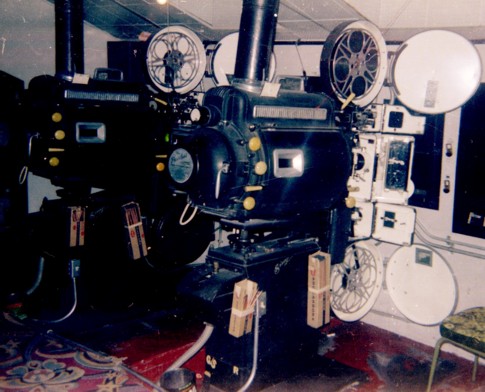
quote: Brad MillerBrad, I never said that all union operators were bad. I do know quite a few union or former union members that are now engineers that are quite sharp and helpful. I also know a few union and former union engineers who are dumb as a post. Its not the union card that makes anyone good or bad, its the quaility of the person themselves and the quality of the training they have recieved.
Mike this is a waste of everyone's time. No matter what anyone says I don't expect for you or Jim to let up on the anti-union stance and realize that there ARE bad union guys just like there there ARE bad non-union guys. (Just remember not every manager is worth a smelly pile of warm dog shit either. Fact of the matter is I have known at many times over the quantity of lousy managers than I have known bad union projectionists.) Just because someone is union does NOT mean they are a bad person or bad at their profession.
quote: Brad MillerActually, Mike made a very valid point. One of the "talking points" of a few of the guys here is that a manager/operator cannot possibly do a good job because they are too busy paying attention to the floor. How is that different than watching TV?
Your insinuations are probably getting borderline offensive to some of the union members here who do quality work and take pride in their jobs.
quote: Monte L FullmerAt the last theatre I was at I had a salaried booth manager. This guy was one of the best projectionists I have had and had total control of his booth. He did his own hiring, scheduling, etc. Did I care what he was doing between shows? No, because his presentations were excellent, his booth was immaculate, and he was always on top of everything.
3)- I wasn't, and didn't have to be a "team player", but instead a skilled specialist within the building AND didn't have to be told what to do, I did what I wanted to do, and come and go as I please during intermissions.
quote: Brad MillerWhen I said "wearing his manager's hat" that was a figurative statement. In that booth, all staff were casual. When he was on the floor the customers didn't know he was staff. However, if he saw something wrong, he got it corrected (and woe to any floor staff who gave him attitude).
Still though, your idea that a projectionist should put on a uniform is a horrible idea. Let's take someone who knows how to run the booth and has no particular training downstairs and let's make him LOOK like a floor employee to the customers so they will come up and ask him questions. Oh yeah, brilliant! Then even when he tries to be a "team player" and happens to answer the question wrong, the manager has to deal with "your employee told me this". It's just dumb. Projectionists should look like other customers when doing auditorium walks.
quote: Jim ZieglerNow a big question on this: (do you work at the EDW's in Fresno?) When I was booth manager at my EDW's 21 in charge of 5 guys, I wasn't even allowed to intervene with the downstairs situations at all (which didn't bother me a bit-didn't want to take that kind of responsibility, plus wear "monkey suits" - just look clean and present myself as a Manager of sorts), for anything downstairs was in the Operations end of the spectrum whereas I was in the Engineering end of the spectrum. The two never mixed, even though I did help out as a "team player" at times with the staff, but was recommended that I keep my distance, for if the staff see any of the projection people helping out, then the staff will be expecting me and my guys to help them out, and this is what Operations didn't want to happen.
.... he was also "wearing his manager hat" and correcting whatever problems he came across. By doing so, he made himself a more valuable member of the team than he would have been had he ignored whatever non-booth items he saw.
quote: Monte L FullmerNope.. I work for an independant right now.
Now a big question on this: (do you work at the EDW's in Fresno?) When I was booth manager
quote: Monte L FullmerThis particular manager was a salaried manager and "out ranked" any hourly staff or management. I try to install defined chains of command in my theatres. Regardless of department, ranks are to be respected. There were many times when he was on duty in the booth and an hourly manager was the manager on duty - however, the hourly was expected to follow any instructions the salaried booth manager might give them..
Thus, the question is: If this booth manager has this much freedom, does he draw contention from the floor staff, saying "why is he telling me what to do, whereas I DO have a supervisor to answer to" type of thing, knowing that his assigned department is really booth manager, than if it was the manager, assistant manager, floor supervisior, concessions supervisor, et.al. giving the orders. Or has this been presented to the staff of his title and his title also extends to the floor?
in that booth!
quote:Why would a customer be in the booth?
I always wear a uniform when I work in the booth. Any customer who walks through the booth will know that I mean business because of my nifty uniform!
quote:Spare the Film Festival
29TH CLEVELAND INTERNATIONAL FILM FESTIVAL
Ready to roll: Film festival back in black
Sunday, March 06, 2005
Clint O'Connor
Plain Dealer Reporter
Funny thing about film festival movies: They linger.
Long after multiplex moments or video rentals have fast-forwarded from your brain, it's the sweet, low-budget Swedish movie you saw at the festival four years ago that still stakes out space near your heart.
The 29th Cleveland International Film Festival lands at Tower City Cinemas Thursday and runs through March 20. The Cleveland Film Society will present 100 feature films and 80 short subjects from more than 40 countries.
It kicks off with an opening-night gala featuring Steve Buscemi's "Lonesome Jim," a comedy starring Casey Affleck and Liv Tyler, and winds up with French director Francois Ozon's "5 x 2," the story of a marriage told in reverse: from divorce to first date.
The festival offers a slew of American-made documentaries, quirky shorts, forums and films with local ties. But it often shines brightest with its selection of foreign films that bounce from the bizarre to the heartbreaking.
Having a festival every year is not a given, however.
In 2003, when many arts organizations were already suffering from depressed post-Sept. 11 corporate support, the festival coincided with the invasion of Iraq and a crummy economy.
Ticket sales suffered. That year, the nonprofit Cleveland Film Society found itself about $110,000 in the hole, according to its financial records. An operating deficit meant changes were needed.
"A mistake many nonprofits make is they take the attitude, 'We'll tough it out and things will get better,' " said Mark Smith, a film festival board member who also works with the venture-capital firm Jumpstart.
The film festival took a more proactive approach.
It cut its staff in half (from six full-timers to three), launched a major fund-raising campaign, added 18 new board members, and decided to focus exclusively on the film festival, dropping its filmmakers series and other educational programs.
"The toughest decision was cutting our staff in half," said Anna Vedouras, a labor lawyer for the Department of Defense and 12-year film fest board member. "We really had to get down to the down-and-dirty. That also meant telling board members, 'If you can't help at this time you need to step back from the board."
New board members were brought in under the banner of "Give or Get."
"We gave ourselves two years to turn things around," said festival Executive Director Marcie Goodman. "But it only took us nine months." By the end of its fiscal year last September, the society had a cash reserve of about $55,000.
Goodman credits Development Director Patrick Shepherd, Director of Programming Bill Guentzler, her 32-member board, and strong support from Cleveland's corporations and foundations. The additional money also allowed the society to add a full-time office and membership manager.
Today about half the society's money comes from contributions and half from festival income, mostly ticket sales. Its annual budget is $807,000.
Substantial help also came from the Cleveland Foundation's Arts Advancement Program ($85,000 a year for three years), and a $15,000 Arts and Culture as Economic Development, or ACE, grant from Cuyahoga County.
The film festival was one of the few organizations chosen for the program. After a highly competitive application process, it stood out for its "board commitment and staff ability," said Kathleen Cerveny, program director for arts and cultural initiatives at the Cleveland Foundation.
The $15,000 ACE grant allowed the festival to expand from four theaters to five, which means it can show about 25 movies a day instead of 20. "We funded it because it is something good for the town," said Cuyahoga County Commissioner Jimmy Dimora.
Although they supported the festival with the grant, the Cuyahoga County commissioners announced last week that they would boycott the festival because of a labor dispute between a projectionists' union and Cleveland Cinemas, owner of the Tower City theaters.
Despite that, Goodman said the film society enjoys good relationships with elected officials "all around - the city, county, state and nationally." Cleveland Mayor Jane Campbell has been honorary chair of the festival, and Cleveland Councilman Joe Cimperman held the post last year.
The recovery does not mean long-term solvency. The society is still actively raising money, and this year introduces something new: a silent auction and raffle running the entire 11 days.
In the meantime, the staff - about 50 seasonal workers and 200 volunteers - have four days to get it done. Goodman will psyche up the troops this week with inspirational quotes that everyone's sick of hearing. Perhaps most apt is one from "Saturday Night Live" creator Lorne Michaels who said his crazed comedy show "doesn't go on because it's ready; it goes on because it's 11:30."
"We don't start the festival because we're ready," said Goodman. "We start because it's opening night."
quote:
Spare the Film Festival
Tuesday, March 08, 2005
The 29th Cleveland International Film Festival is in a bind it did not create and does not deserve.
Just days before it is set to open, this jewel of the city's downtown arts scene finds itself trapped in no-man's land between Jonathan Forman, the godfather of independent film exhibitors in Cleveland, and the union that represents projectionists and other entertainment-venue employees. The festival is supposed to begin its 10-day run on Thursday, but flak from the dispute threatens to damage what ought to be a happy occasion for both film buffs and those who care about downtown.
For 15 years, the festival's home base has been the multiscreen theater at Tower City that is operated by Forman's Cleveland Cinemas group. It brings upwards of 40,000 people and $1 million downtown each year. That's an important boost for our city's struggling core.
In recent years, Forman has chosen to operate his five theaters without union projectionists. He contends this is a simple matter of doing what most of his national chain competitors have already done to hold down costs and take advantage of technological change. Supporters of the International Alliance of Theatrical Stage Employees Local 160 call him a union-buster and picket his theaters.
Until this year, the festival hired some separate staff, including union projectionists. But its new contract calls for Cleveland Cinemas to supply all staff for the five screens the festival will use. This outrages the union, which has been contacting filmmakers, urging them to withdraw their movies from the festival; none has. The union hints that it may take some public action before the festival opens. It has asked the Cuyahoga County commissioners, who gave the festival a $15,000 grant, to boycott the event; Jimmy Dimora and Peter Lawson Jones say they will. New Commissioner Tim Hagan is trying to mediate the dispute.
We do not take sides in the battle between Forman and Local 160, except to note that it involves a handful of jobs, and that once digital technology takes hold in theaters, there will be no need for traditional projectionists. But what really matters today is that this dispute do no further damage to the festival and its organizer, the nonprofit Cleveland Film Society.
Clearly, the union sees embarrassing the festival as a way to embarrass one of its founders, Forman. But if it wants to make a political statement there's got to be a better way. Hey, here's an idea: Make a film.
© 2005 The Plain Dealer.
quote:IATSE Local 160 has collective bargaining agreements with three of the four national theater chains in the Cleveland area.
[snip]
MARCIE GOODMAN
“Only three theater chains in Cleveland use union workers.”
IN ADDITION TO the compelling and intellectually challenging programmatic elements of the 29th CIFF, patrons will also notice that the festival has expanded to a fifth theater at Tower City Cinemas. The CIFF has not expanded since 1997, when it occupied four theaters. The increase in theaters allows for a total of 106 feature films and 80 short films from 50 countries.
CIFF attendees may also witness another first this year: picketing outside the theater by members of the Projectionists' Union. Cleveland Cinemas owner John Forman, has been at odds with the union for more than a year since he replaced union projectionists with nonunion “managers” who operate the projectors.
While Goodman contends that the Cleveland Film Society is caught in the crossfire of this heated dispute, workers' rights organizations such as Jobs With Justice are releasing statements urging people to “think twice before they attend the Cleveland Film Festival this year.” Jobs With Justice believes that by acquiescing to Forman's directive that no union labor could be used in the Tower City facility, CFS is, in effect, supporting Forman's anti-union position.
Goodman maintains that the union controversy is “not a Film Society issue, because we are simply leasing the theaters from Cleveland Cinemas.” While this is a somewhat dubious position, she points out that Forman is an easy target for union leaders and worker's rights activists, as Cleveland Cinemas is a locally owned and operated company. “Only three theater chains in Cleveland use union workers,” she explains, “and the unions aren't going to go up against a more powerful national chain over the projectionist issue.” The union controversy may work its way into the theaters during the CIFF, as the Projectionists' Union has urged filmmakers and film distributors to pull their films from the Festival. However, as of last Saturday, Goodman reported that no films had been pulled.
However the union debacle plays out, one thing is clear to Goodman and the staff and board of the CFS — the weeks leading up to the CIFF are never boring or without controversy. And it may be advantageous for both sides of the debate to have the labor battle waged within Cleveland's cultural milieu, where creative problem solving is de rigueur . Ultimately, however, a cultural tradition that brings to light issues like the inhumanity of factory farming, the inequities involved in being born in a wealthy versus a poor and overtly repressive country, and both the fallibility and potential of the human condition is crucial, especially in the midst of a particularly gloomy point in our city's history.
quote:In a television news story yesterday Cleveland Cinemas representatives said all you do is push a button and projectionists are like elevator operators and typesetters.
Show goes on at film festival
The Cleveland International Film Festival will show all of its films. A local projectionists union spent the last week trying to get filmmakers and distributors to withdraw their movies from the festival as part of an ongoing labor dispute. None did. "We're no longer pushing for any films to be pulled," said John Galinac, business agent for the International Alliance of Theatrical Stage Employees Local 160. The festival had its opening gala events Thursday night at Tower City Cinemas. Local 160 is protesting Cleveland Cinemas, owner of the Tower City theaters, over jobs that were cut or consolidated last year. Seven members of Local 160 set up a brief informational picket Thursday on a sidewalk in front of Tower City. As for protesting the rest of the festival, which runs through March 20, Galinac said, "We're going to play it by ear as things develop."
quote: Brad MillerThat would be awesome. Not only do I have to wear full uniform downstairs during walks, but I also have to wear full uniform in the booth as well. Its very uncomfortable and very hot to wear it, but hey, at least I look like the rest of the staff...
Projectionists should look like other customers when doing auditorium walks.
quote: John T. Hendrickson, JrSeems to me that it would be prudent to have all hands available in case of an emergency.
They are not responsible for evacuations, fire drills, or for that matter, any concerns that patrons may have. That is the job of the floor personnel.
quote: Sam D. ChavezShoot...and I carry a "Handyman" kit on my belt as well. Does that count? (LOL)
There's an old saying in Hollywood "They'll never forgive you for carrying a screwdriver".
quote: Jim ZieglerIt is the management's responsibility to ensure that the theater is appropriately staffed and trained to be able to handle the customers with the available staff on the floor. It is quite possible something could happen upstairs and the projectionist needs to be doing whatever he can to put out a fire while the management and floor staff gets the customers outside. Regardless of whether anyone is going to nitpick that quick example, management shouldn't be relying on that one extra person (the projectionist) to make their emergency procedures successful.
Seems to me that it would be prudent to have all hands available in case of an emergency.
quote: Brad MillerAnd what if floor staff are busy with trying to put out a fire downstairs? Ideally, everyone should know each part of the emergancy plan so that they can be sent where they are needed. A prudent emergency plan will make maximum use of all available resources, irregardless of a person's job title.
It is quite possible something could happen upstairs and the projectionist needs to be doing whatever he can to put out a fire while the management and floor staff gets the customers outside. Regardless of whether anyone is going to nitpick that quick example, management shouldn't be relying on that one extra person (the projectionist) to make their emergency procedures successful.
quote: Jim ZieglerThe odds are that the projectionist will be busy stopping movies, bringing house lights up and making announcements over the sound system (if so equipped). Other duties may include things such as physically running around and looking out the port windows to make SURE all of the customers are out of the auditoriums, thus greatly helping the staff downstairs by radioing to them "auditorium 2 is clear", etc.
And what if floor staff are busy with trying to put out a fire downstairs?
quote: Brad MillerAll of which should happen automatically if the fire alram is set off in a typical megaplex.
The odds are that the projectionist will be busy stopping movies, bringing house lights up and making announcements over the sound system (if so equipped).
quote: Brad MillerYou cannot tell if an auditorium is 100% clear from the booth. You would have to do this from the floor, which is why projection staff must be versed in the entire emergency plan. To try and clear auditoriums from the booth is reckless and will subject the theatre to severe civil liablities, and probably charges of criminal negligence.
Other duties may include things such as physically running around and looking out the port windows to make SURE all of the customers are out of the auditoriums, thus greatly helping the staff downstairs by radioing to them "auditorium 2 is clear", etc.
quote: Brad MillerSame here. The licence which a cinema needs in order to legally admit members of the public to see films is issued by the local authority. As part of the application process the premises is inspected by an employee of the fire brigade (the fire officer), and if he's satisfied that your alarm, other safety equipment and evacuation procedures are up to scratch, you get the licence. There are some statutory minimums, but the bottom line is that (s)he has to be convinced that you're operating safely.
Fire regulations and such do vary quite a bit from state to state and even town to town.
quote:A message from Projectionists Union Local 160
March 11 2005
A message from Jon Forman, Cleveland Cinemas
The following was sent to subscribers of SPROCKETS, http://www.clevelandcinemas.com/index.asp
Cleveland Cinemas online newsletter. We are sharing it with you to be informed about the projectionists' union dispute with them:
A SPECIAL MESSAGE FROM JON FORMAN
President of Cleveland Cinemas
Dear Sprockets Subscriber,
Thanks for subscribing to our newsletter. We hope that you find the information provided helpful and that you choose to see a film at one of our theaters. As you may be aware, members of Local 160, the Projectionists Union, have attempted to disrupt the Cleveland International Film Festival and have on occasion, tried to discourage the public from attending movies at our theaters. By their actions, these individuals have placed one of Cleveland's great cultural institutions - the Film Festival - at risk. Their efforts to discourage patrons from coming to our theaters may have an impact on our business.
The protest has nothing to do with the Cleveland Film Festival or Cleveland Cinemas. Instead, it has to do with changes in the movie theater industry. Many years ago, when most theaters had a single screen, a dedicated projectionist was usually employed, since the method by which films were shown was significantly different than it is today. Showing a film required two projectors, since films were shown using 20-minute reels and someone had to "change-over" or switch between projectors so that as one reel of film was ending, the next reel on the other projector would begin. Also, the light source for each projector was a dangerous carbon arc needing constant adjustment. And film stock was highly flammable, requiring special handling.
Today, technology has made the position of the dedicated projectionist unnecessary, just as it has eliminated the need for elevator operators and typesetters. With the changes that the industry has made, theaters now operate more efficiently, so that a theater manager can operate 20 screens at the push of a button, like they do at Loews' Theaters at Richmond Mall, Regal Cinemas' 16 screen theaters in Willoughby and Medina and Magic Johnson's 12 screen theater in Randall Park Mall. Currently, the only theaters in Greater Cleveland operated exclusively by a dedicated projectionist are those that are part of the Science Center, the Rock Hall and the Cleveland Museum of Art. Virtually all movie theaters in Greater Cleveland and across the United States now operate without dedicated projectionists. You may find the theater information at the end of this letter to be of interest.
Motion picture theater companies do not employ projectionists, simply because the jobs no longer exist. Managers and supervisors at our theaters are professionals, who operate projection equipment as part of their duties, and receive competitive wages and benefits. The National Labor Relations Board has, on several occasions, confirmed that Cleveland Cinemas bargained in good faith and acted properly as we upgraded our operations to keep pace with others in the industry.
Cleveland Cinemas is committed to its customers and to Cleveland. For 27 years, we have created jobs, restored historic buildings and helped revitalize the neighborhoods where our theaters are located. And we have consistently supported the Cleveland International Film Festival. We hope you will agree that our theaters are part of what makes Cleveland special.
We also hope you will agree that, while there is a time and place for labor and management to debate their issues, that place is not the Cleveland International Film Festival. We appreciate your patronage and we hope that you found this information helpful. If you have any questions or concerns, I can be reached at [snip].
Sincerely,
Jonathan R. Forman, President
MOTION PICTURE THEATERS NO LONGER USING DEDICATED PROJECTIONISTS:
LOEWS 20 ~ 20 SCREENS
MAGIC JOHNSON ~ 12 SCREENS
MARQUEE CINEMAS ~ BARRINGTON 10
THE CLEVELAND CINEMATHEQUE ~ 1 SCREEN
AMC
RIDGE PARK SQUARE ~ 8 SCREENS
WESTGATE MALL ~ 6 SCREENS
WESTWOOD TOWN CENTER ~ 6 SCREENS
REGAL CINEMAS
COBBLESTONE SQUARE ~ 20
HUDSON CINEMA ~ 10
MEDINA ~ 16
WILLOUGHBY COMMONS ~ 16
MOTION PICTURE THEATERS EXCLUSIVELY USING FULL TIME DEDICATED UNION PROJECTIONISTS:
GREAT LAKES SCIENCE CENTER ~ 1 SCREEN
THE ROCK AND ROLL HALL OF FAME ~ 1 SCREEN
THE CLEVELAND MUSEUM OF ART ~ 1 SCREEN
CLEVELAND INSTITUE OF ART ~ 1 SCREEN
quote:Union projectionists absent from this marquee
A message from Projectionists Union Local 160
by John A. Galinac Friday, Mar. 11, 2005 at 3:17 PM
[snip]
A reply to Jon Forman's Special Message in his SPROCKETS NEWSLETTER
A message from Projectionists Union Local 160 John A. Galinac Business Agent Thank you for allowing me to respond to the “Special Message” from Jon Forman, President of Cleveland Cinemas. After reading the “Special Message” you might conclude that Mr. Forman states a reasonable and sympathetic position and that it is unfortunate that the Projectionists Union refuses to accept the technological inevitability of being relegated to the fate of the dinosaurs. Nothing could be farther from the truth. This is not about technology; this is about Mr. Forman’s greed and his willingness to sacrifice the Cleveland International Film Festival for his own narrow, selfish interests. I would like to respond to a few of the points in Mr. Forman’s message.
? The largest movie theater in the Greater Cleveland area is staffed 100% by union projectionists. Cinemark Theater in Valley View, with 24 screens, is the largest theater in this area and uses only union projectionists. Mr. Forman’s claim that union projectionists only remain at anachronistic, single screen theaters is simply a lie. Indeed, union projectionists are even employed at some of the theaters on his list of supposedly non-union theaters.
? The Cleveland International Film Festival has been put “at risk” by Jon Forman, not the Projectionists Union. The Film Festival has used only union projectionists for the last 28 years. In fact, last year when the Film Festival was having financial troubles, I personally requested and the Film Festival received a $10,000 grant from Paul Newman so that union projectionists could be used. This year, when the Film Festival applied to Cuyahoga County for a $15,000 grant, it expressly included funding for projectionists. It was Jon Forman who would not allow the Film Festival to continue to employ its own union projectionists and instead is requiring the Film Festival to use Mr. Forman’s non-union employees if the Film Festival wants to use the theaters Mr. Forman controls at Tower City. But for Mr. Forman’s intransigence, the Film Festival would have continued to use union projectionists as it has done for 28 years.
? Mr. Forman complained that the Union’s efforts to discourage patrons from coming to his theaters “may” have had an impact on his business, but he fails to mention the impact on the lives of union projectionists who he has systematically fired from their jobs at every single theater that is part of Mr. Forman’s growing empire. Those dedicated employees and their families have suffered from a loss of wages, health care, and contributions to their pension.
? The average wage of the dedicated union projectionists that used to work for Cleveland Cinemas was $15/hour. The projectionists have been replaced by lower-paid, so-called “managers” and “supervisors”. Although Mr. Forman’s Special Message talked about “upgrading” his operations, Mr. Forman has refused to hire any of his former projectionist employees into these lower-paid, upgraded positions. In fact, the National Labor Relations Board has issued a Complaint against Cleveland Cinema, and will be prosecuting them at a trial scheduled to start in June, over Cleveland Cinema’s refusal to even consider re-hiring union members into these “upgraded” positions.
? Finally, Jon Forman’s disdain for the Union and his own employees was best illustrated after one of his long-term employees died of a heart attack while at work, only hours after complaining to a fellow employee about his working conditions. When the Union tried to discuss health and safety issues with Mr. Forman, he stormed out of the meeting and refused to negotiate. I hope that these comments give you a better idea of what we have been up against. We ask for your support and understanding.
quote:Live, on film
Union projectionists absent from this marquee
Saturday, March 12, 2005
Chuck W. Ackerman
Cleveland
Ihave been going to the Cleveland International Film Festival since it was held at the Cedar Lee Theater many years ago. I love the movies, and the festival is a great event for the city. I am disappointed and angry, however, that union projectionists will not be used in this year's festival. The fact that the festival is good for Cleveland does not give its organizers a pass on making sure that those who serve the festival are paid decent benefits.
Jonathan Forman of Cleveland Cinemas says he is only doing what the national chains are doing. This is not consistent with the fact that many other Cleveland-area theaters continue to use union projectionists, including Regal, Cinemark and AMC.
I was not privy to the negotiations between the festival organizers and Forman, but the use of union projectionists should have been insisted upon. The Cleveland Film Society is not solely to blame for this situation, but it should take its share.
Isn't it ironic that many films that will be shown this year and have been shown in past years explore social-justice issues, yet festival organizers choose to ignore one in their own back yard?
Chuck W. Ackerman
Cleveland
Ive been paying close atten tion to the dispute between Jonathan Forman and the International Alliance of Theatrical Stage Employees Local 160. All I have to say to Forman is, "Thank you."
Before the Cedar Lee Theater got rid of union projectionists, nearly all of my experiences there were terrible: The film would snap; the print would be put in the projector backwards, causing subtitles to be reversed; house lights would be turned on in mid-screening. It seems that members of Local 160 feel that as long as they pay their monthly dues, they are untouchable - no matter how poorly they do their jobs.
Now that Cleveland Cinemas is rid of union projectionists, screenings at the Cedar Lee have gone off without a hitch. Coincidence?
Jared McGrath
Akron
quote:
Live, on film:
When a crossed wire in theater No. 4 silenced the beginning of "Lonesome Jim" during Thursday's opening night of the Cleveland International Film Festival, director Steve Buscemi wowed the crowd by narrating the flick as if it were a DVD director's cut. Then, along with producer Galt Niederhoffer and writer James C. Strouse, he provided dialogue voice-overs. Patrons loved it, and a few groaned when the sound was restored a few minutes later.
quote:Wow, that's a bold statement! To claim that theaters no longer need union projectionists is one thing, but to say that theaters do not employ projectionists at all is pure bullshit. Even a minimum wage 16 year old with no real training is STILL filling the job of "projectionist". Same thing with Cinemark's "Usher-Bs". They can change the title of the job, but in the end they are STILL projectionists. (That whole silly "Usher-B" thing came about as a union-busting tactic anyway.)
Motion picture theater companies do not employ projectionists, simply because the jobs no longer exist.
quote: Joe RediferNot saying that any form of technology is bad, but unfortuately, technology is pointing the finger at some, but not all people and saying that "you now are stupid and an idiot, and I'll do things for you so you don't have to think and use your brain, plus very little effort to accomplish a task at hand!"
Technology has only made it possible for a single person to run many more screens.
Let me tell my employer. I must have been here by mistake for the last 12 years. ASSHOLE ![[fu]](graemlins/fu.gif)
quote: Jeffry L. JohnsonThat bothers me. They have no right to post your picture as if you were some criminal. Who the hell do they think they are, the Post Office? Your Local need to contact an attourney.
At some locations our pictures are posted.
quote:Assuming it was an optical sound print the why didn't the jerk would also complain about no sound.
the print would be put in the projector backwards, causing subtitles to be reversed
![[Razz]](tongue.gif) . Then you can have the last laugh!
. Then you can have the last laugh!quote:
Skilled trades painfully fade to black
Technology puts the squeeze on workers, cities
Saturday, March 19, 2005
Chris Seper
Plain Dealer Reporter
Neil Klepetko first felt like an endangered species 15 years ago.
That's when his film projectionists union started suggesting he learn something new. The movie industry was changing, they said, and someday a single person would be able to do the work it took dozens to do.
That day is here -- not only for folks like Klepetko, but for other workers as well. Innovation and an emerging service-oriented economy have put Cleveland's principles in a crucible.
The projectionists' plight and labor issues like those surrounding Wal-Mart highlight the squeeze on both workers and the city, say local economists, union officials and workers feeling the crunch.
Technological advances have eroded better-paid trade jobs, making some talents obsolete.
And city leaders seem more likely than ever to break with their traditional union allies to lure jobs, even if they don't pay much.
"A lot of things . . . might be a second-best choice, like a non-unionized Wal-Mart and casino gambling," said Barbara Sherman-Rolleston, an economics professor at Baldwin-Wallace College. "But over time people's attitudes begin to change. They see other places doing it and see it as the wave of the future."
A half-century ago, film projection work was as complex as it was daring. A pair of workers would staff metal booths, deftly rotating projectors in mid-film as one ran out and the another started rolling. Sometimes, they were forced to flee when nitrate film ignited, spewing flames and toxic fumes.
But in today's air-conditioned projection rooms, giant silver platters benignly churn Hollywood hits. Some movies arrive on hard drives that slip into computerized projectors.
Multiplexes that used to need two dozen projectionists to manage their films now rely on only two. Plus, many theaters can train ushers to work alongside the traditionally better-paid projectionists.
Cleveland Cinemas, host of the Cleveland International Film Festival, consolidated projectionist jobs and gave the responsibility to nonunion employees. That triggered a protest by the International Alliance of Theatrical Stage Employees Local 160, which represents a dwindling number of projectionists: 50 today compared to 160 in 1982.
Sour economies have union strongholds like Cleveland particularly under siege, said Andy Welki, an assistant economics professor at John Carroll University. Labor's influence continues to wane since so many businesses can easily take jobs to other cities and states - and in some cases, countries - with fewer labor regulations.
Recent political back-and-forth over Wal-Mart moving into the near West Side highlights developers' leverage over the city and its work force, economists said.
Cleveland Mayor Jane Campbell wants Wal-Mart executives to reconsider abandoning a store in Steelyard Commons, the new retail development near Ohio 176. Wal-Mart announced earlier this month that it wouldn't open there. Wal-Mart is one of the state's largest employers, yet it is also criticized for low pay that pushes many workers onto state safety-net programs.
But when it comes to retail development, many businesses won't move into a neighborhood unless a larger retailer steps in first, Welki said. So cities need Wal-Mart-like anchors in new developments.
"You need Wal-Mart more than Wal-Mart needs you," Welki said.
Jun Koo, an assistant professor in the Maxine Goodman Levin College of Urban Affairs at Cleveland State University, said lower-paid service jobs are the only short-term option for a region "too seriously behind to make such a smooth transition from a traditional manufacturing economy to a knowledge economy."
"Some people criticize this approach because these are usually low-paying jobs," Koo wrote in an e-mail. "However, you have to consider that, for many Clevelanders who lost their jobs, the option might be either no job or low-paying jobs unless a serious retraining process is involved.
"When you are sick, you need to take some pain killers," he said, noting, however, that "we can't take pain killers forever."
Projectionists have seen the writing on the wall for some time. The union's national office for years has said workers should learn more about the movie houses where they worked. It spent money to retrain projectionists on cutting-edge equipment.
Fifteen years ago when Klepetko was first warned, the union talked about learning HVAC - better known as heating, ventilation and air conditioning.
"I didn't even know what HVAC was," Klepetko said. "I had to look it up."
But soon after that he opened Neil's Refrigeration. He now services some of the theaters where he works as a projectionist and does some janitorial work.
"You've got to become the most valuable guy in the theater," Klepetko said. "Or else they may not need you."
quote: Richard MayConsider this . . .
It's a different business now compared to years ago.
quote: Aaron Mehocic~THAT, is illegal!
As far as the IATSE is concerned, membership is forbidden at my theatre and termination assured.
quote: Aaron Mehocic~SO, there IS something beneficial to this "union" thing after all, eh?
Although, I lost the ability to contribute to a pension fund, my salary is set by a collective bargaining team of unionized full-time professors. This fall semester, I'll earn $24.00 more per credit hour, amounting to about a $216.00 raise for 10 weeks of work.
![[thumbsdown]](graemlins/thumbsdown.gif)
quote: Steve GuttagAs usual, Steve is absolutely on the money here. I was approached by a union which offered me less (MUCH less) in every area than what I already had been able to negotiate with my employer on my own. My employer treated me in a way that I considered fair and decent. In such an instance, a union is superfulous. Why would I need a union to bargain for me? Plus, right from the very first conversation with them, they were boorish, antagonistic and disrespectiful....not qualities that would prompt me to join their ranks.
A business needn't worry about unions if they would just treat their employees fairly. If people feel cheated, abused, overworked or paid unfairly...you will get union talk...that is why unions and collective barganing came about.
quote: SteveYes, sir. I've said this all along. It's not too much of a stretch to imagine the pencil-pushers jumping at a chance to plonk down $100K+ per screen for DC... to get rid of a couple of $18,000/yr. operators for good!
Some of these exhibitors would rather pay for DCinema than pay $.25 more an hour but with a union contract in there!
quote:...and the bigger they get, the harder they'll fall. And when it does... - it'll be like the "Fall of the Roman Empire.. - destruction from within, not from the outside...
They believe in rolling over all opposition to the conglomerate corporate agenda. They will cut your pay to finance their launch of satellites which will then beam motion picture content into their theaters. Everything seems to be about CONTROL!
quote: Sam D. ChavezSam, I think you just proved my point about unions seeking to control - and demonizing, belittling and terrorizing those who disagree.
But I forget, I'm probably addressing a belligerent child.
quote: Steve Guttag....yet, unfortunately there are some business who would still love to have that power of slavery to be somewhat legal by having their employees as their "property" - not trusting them at all when they get hired and keeping them in a certain frame of mind like if they were rats in a cage. Just pay them as little as possible for as much as they can get out of them. And the results of this operation is a dead end business that doesn't allow any employee to be trusted, not to gain any knowledge, not to gain pride and respect, and succed in in their repective departments....just to be a "slave" in the company doing that one certain task that they have been assigned to and be micromanaged as such.
...but people are not property (now that slavery is gone)
quote: Mitchell DvoskinYou must be referring to major chain employers, and independent owners who are worthless. I feel my employer looks out for me and my interest the best he can and the union has nothing to do with it. Am I delusional or just a beligerent child as Sam so politely put it, towards someone who disagreed with him?
anyone who thinks employers are looking out for their employees best interests is delusional
quote: Jeremy FuentesMy vote is Delusional.
Am I delusional or just a beligerent child as Sam so politely put it
quote: Sam D. ChavezSam, I became hostile to the IA the day that IA members detonated two chemical weapons in my theatre. I became closed minded to the IA when people connected to it followed a Cinemark manager home and nearly killed him. Frankly Sam, I was offended by silence of the IA when one of their locals was carrying out this activity. You claim your union is trying to look out for workers. Tell me, was it looking out for the 60 employees on duty at my theatre when chlorine gas started spewing into the air? Was it looking out for its fellow union members - auto workers, tradesmen, etc - who were in the sold out 600 seat auditorium when they put a chemical weapon right by the fire escape?
All we have is your writing and its tone which is decidedly hostile, closed minded and offensive.
We are a union booth. We get payed well, get treated well, treat everyone here well and put on a quality presentation down to the minor details. Because of all that, this theater does well. As long as it continues to use qualified union operators it will continue to do well.
quote: Gordon McLeodI couldn't agree more Gord!!! That is very true. All the locations I servce without a dedicated projectionist(s) have presentation quality that is beyond poor. These booths are ALWAYS a mess, ALWAYS take more time to maintain, and ALWAYS cost the owners more $$ to have service done. Booths with dedicated operators union on non-union are ALWAYS giving excellent presentations, are ALWAYS clean, and the equipment ALWAYS costs less to do the maintainance on.
Bottom line if a circuit theatre can't afford a dedicated projectionist and a decent income for them they shouldn't be in business
quote: Gordon McLeodGord, My theatre can't afford a 50k a year operator. Granted, we are an indy, but does that mean you think I should shut it down right now? Even without that 50k a year operator, I still have great presntations, and the audience for this small town theatre do constantly give us high marks on our film presentation. But you are telling me I have no right to be in business because this small town doesn't do the leve of business necessary to meet your income standards for projectionists?
Bottom line if a circuit theatre can't afford a dedicated projectionist and a decent income for them they shouldn't be in business
quote: Richard MayI think you will do well as long as you have qualified, quality minded people, regardless of whether or not they have a card in their pocket... That is, until AMC builds a 30 plex across the street..
As long as it continues to use qualified union operators it will continue to do well.
quote: Steve GuttagActually, I'm not.. There are three things I emphasize around the theatre - Quality Presentation, Clean Facilities and Quality Customer Service.
Aw come on people...Jim here is defending the "just give em a pass" policy...I don't know
quote: Steve GuttagActually, I am running a good operation here. Do we have areas in which we need to approve? Of course. At the same time my theatre is in a town of 20,000 and is a 6 screen slope house. The next town over, there is an all staduim 6 screen. 15 minutes from me in Fresno is a Regal 16. 25 minutes from me is a Regal 21 that is the 20th highest grossing theatre in the U.S. All that, and not only are we holding our own, but we are building attendance.
Perhaps, the "quality" of the theatre he is used is such that a proper operation, that is quite profitable, is just something he has not seen.
quote: Steve GuttagDid I ever advocate firing people because of union membership? I also never said that all chains are innocent as well. What I have said, however, is that I can see how, for many theatres, operating under union contracts with union wage scales can severly damage an operations profitability. I also am a firm believer that I can take a college student and turn them into one hell of an operator without the presance of a union or union training.
Nobody here is condoning direct threats or act of personal harm but to say that the theatre owners are clean as a whistle in the big picture is just plain absurd too. Taking away one's livelihood due to union affiliation poses just as real a threat to ones family and future.
quote: Steve GuttagXenon bulbs.. Automation.. Platters.. Non-Nitrate film stocks.. Those were some pretty big innovations that made the operation of a booth simplier and much less dangerous.
As to technology negating the need of projectionists in the modern projection booth...what a silly statement. Technology has done quite little in truth to the showing of movies.
quote: Steve GuttagActually, labor per screen has been reduced. One operator could not run 10 2k changover screens, but can run 10 platter screens.
There is very little technology indeed that has been added to the projection booth that one could say has improved quality while reducing labor.
quote: Steve GuttagThe point I was trying to make is that projection has moved away from being a dangerous job to one that is not dangerous and that, while technical, is one that can be taught to a quality minded college student, or even a mature high school student, in a shorter period of time than in the past.
Come on where is this big technology that has suplanted the need of the projectionist? Only if you lower your standards to think that readmits are okay since not all shows have to go on or that theatres need not show the film in the manner in which it was made. But that really puts someone in the "You suck" thread not this one.
quote: Sam D. ChavezI wouldn't say I was scarred.. I don't cringe when an engineer with an IA card in his wallet showed up..
It is clear you were scarred from the experience you went through. If you continue to be bitter and closed minded, you should seek some kind of help. Hate eats up your insides.
quote: Sam D. ChavezThats the thing Sam, it wasn't a strike, as Cinemark never had a contract with them to begin with. This was retaliation for Cinemark using their own people. Second, the local in question was in Chicago, the attack was on my theatre in Kansas City - 8 hours away. Union members also attacked several other Cinemarks as far away as Dallas.
I could even make the case that management is treating people in your position like cannon fodder and are not ensuring you are protected in the middle of a strike action.
quote: Sam D. ChavezSuch behavior is beyond the bounds of what is acceptable. Hopefully, those responsible were brought to justice.
I was directly involved in the lockout by UA and Syufy Theatres in 1976. Guess what? Our business agent received documented and recorded death threats on himself and his parents down to knowing where they lived all th way across the country.
quote: Sam D. ChavezI would say that has much more to do with the culture of Southwest than the fact that their people are unionized. I am a firm beleiver in treating your personnel well.
I've flown all the airlines, and you can almost smell bad labor-management relations. Southwest is almost all union, morale is very high and it seems to be the only airline making money and not asking for givebacks from its employees.
quote: Sam D. ChavezHonestly, I would say you have to look at the theatre as a whole. Right now, I am running an indy theatre for the first time - my prior experiece was in circuits. When I got here, no one knew much at all about running a booth - includig the owners. At oen point, they had some sharp people, but attrition took its toll, training of new people slipped, and a lot of knowledge was lost. The owners, while they don't know projection, recoginzed the problem they had, which is a large part of why did a nationwide search for a GM. I got this job in large part due to my booth skills. Since then, I have been trying to kick the entire operation into shape, but have made the most progress in the booth. I still have a ways to go to hit perfection, but the difference is now night and day..
Back to specifics, the only thing I want from a theatre is a good experience. Theatres charge pretty much the same whether there is a professional in the booth or the snack bar attendant. How come?
quote: Jim ZieglerHow many managers do you have on staff, and what are they paid? Often I see theaters with an abundance of managers, yet without a professional in the booth.
Gord, My theatre can't afford a 50k a year operator.
quote: Jim ZieglerYes you are correct. So assuming we did not have these specific 4 advances in the booth, a 15 plex would require 15 projectionists! Yet because the technology IS there, you can now hire one professional to run all 15. What's the problem? I can guarantee you that one guy running 15 fully automated platter auditoriums will work HARDER than one guy running a single screen booth from the 40s.
Xenon bulbs.. Automation.. Platters.. Non-Nitrate film stocks.. Those were some pretty big innovations that made the operation of a booth simplier and much less dangerous.
quote: Brad MillerBesides myself, there is one salaried maanger and three hourly. We are overstaffed on hourlys, but they have been taking over staff shifts to make up hours. The salaried was a new additon to my staff - he was brought on for a number of reasons, not the least of which was to free me up so I can have more time to tweak the booth operations. Also, the guy we brought in is very strong on teaching sales skills to concessionists (something I am bad at), so I expect him to more than pay his salary by the uptick in sales.
How many managers do you have on staff, and what are they paid? Often I see theaters with an abundance of managers, yet without a professional in the booth.
quote: Brad MillerBut is that operator running the 15 screens worth 50k a year? Really that depends on their level of skill, the payroll abilities of the theatre, cost of living in the area, etc.. IF we are talking about a 15 screen in New York City that does 1.5 million people a year, then 50k is not unreasonable for a knowledgeable head projectionist. If we are talking a 15 screen in a mid size city that does 300,000 a year in attendance, then 50k is probably beyond what the theatre can pay. The same restrictions also apply to GMs. If you are the GM of a high level theatre you will make more than the GM of a similar size but low volume theatre.
Yes you are correct. So assuming we did not have these specific 4 advances in the booth, a 15 plex would require 15 projectionists! Yet because the technology IS there, you can now hire one professional to run all 15. What's the problem? I can guarantee you that one guy running 15 fully automated platter auditoriums will work HARDER than one guy running a single screen booth from the 40s.
quote: Sam D. ChavezI never said you could not have a good company culture with a union in place. I think what we are seeing with Southwest is a committment on the part of the company's leadership to provide a positive working environment for their staff - environments that always lead to higher productivity, higher customer satisfaction and higher profitibility.
At last we totally agree on something. Regarding Sounthwest Airlines; Here is a situation where a company has a thriving culture in spite of having to negotiate with a union advocating for working condtions and wages.
quote: Charlie FrisbyIt's impossible. This is a country in a big deregultating trend. Ask the trucking companies if they'd like to go back to the limited permit days. lol
With the way that things are going, the only hope a union has is to have the backing of the studios. Perhaps only releasing some films onpening week if they have a union member or at least a licensed projectionist in the booth. However this is very unlikely.
quote: Charlie FrisbyIt's not really the grosses that are declining, it's the expenses rising. Some of that is our fault (Exhibition side) and some is thier fault (distribution side.)
I kinda got off subject but yeah, if grosses keep diclining like they are, the future looks bad.
quote: Mike SpaethThat rocks. I've never read of anything like that. I guess though that when you are researching things, everything is generalized.
My 8-screen first-run had 44% film rental last year ...
quote: Mike SpaethWhich mean you paid, what, $75 bucks in film rental last year?
My 8-screen first-run had 44% film rental last year ...
quote: Jim ZieglerI know Brad just made a satement on those but here is my take...
Xenon bulbs.. Automation.. Platters.. Non-Nitrate film stocks.. Those were some pretty big innovations that made the operation of a booth simplier and much less dangerous.
quote: Jim ZieglerYou are correct...but your arguement is wrong. The difference there is automation and reel size, not method of film transport. One operator can easily run a 10-plex changeover with automation and 6K reels.
Actually, labor per screen has been reduced. One operator could not run 10 2k changover screens, but can run 10 platter screens.
quote: Jim ZieglerLong ago, it moved away from being a dangerous job. You are completely wrong about the time it takes though...the time is the same or longer if quality is your goal. Quality is quality, knowledge is knowledge...again...the difference in flipping a motor switch versus pushing the start button is not so great as to provide any savings in time. In fact it is worse...often this level of operator can not run their theatre if the automation stops working correctly...they can't run the motor by themselves or switch the sound system (I've taken those calls...)...heck if even the hand douser is left closed...that seems to baffle the modern quickly "trained" operator.
The point I was trying to make is that projection has moved away from being a dangerous job to one that is not dangerous and that, while technical, is one that can be taught to a quality minded college student, or even a mature high school student, in a shorter period of time than in the past.
quote: Jim ZieglerI don't think a specific dollar amount should be stated as minimums...it does depend (as you pointed out in another response) that it depends on the area one reside. $50K goes much further in the middle of nowhere than in a big metropolitian area.
My theatre can't afford a 50k a year operator.
quote: Steve GuttagAin't that the blessed truth!
Carbon arc still provides the best light.
quote: Monte L FullmerWhere was this at Monte? You also have to realize that Xenon mirror technology wasn't as good back then as it is today!! You're right, I can't think of a xenon made today excepting the large 15/70 lamphouses that can hold a match to a Super Cinex or equivelent... let alone a Jet-Arc.
For example: When "Raiders of the Lost Ark" came out in '81, I saw it at a 70mm house.
quote: Mark GulbrandsenThe Grand Palace on Highland Ave in SLC ... the Villa.
Where was this at Monte?
quote: Steve GuttagVery well Steve, in light of your statement, I have to revise my views. If running a changeover booth is just as easy as running a platter booth, then I can't see a reason why a union would EVER have been justified.
So in the big inovation department...you are still reaching back 1/2 a century or so and while one is big in the safety department, I'll only give you one in the simpler department (xenon) though it certainly is not better.
quote: Steve GuttagSteve, I have, personally, trained high school and college kids to be damn fine operators. Running a booth is not something that requires a 2 year apprenticeship. Training a quality operator takes a matter of weeks for the basics, with continuing training after the basics are mastered. Maybe I am just better at training than you are...
Long ago, it moved away from being a dangerous job. You are completely wrong about the time it takes though...the time is the same or longer if quality is your goal. Quality is quality, knowledge is knowledge...again...the difference in flipping a motor switch versus pushing the start button is not so great as to provide any savings in time. In fact it is worse...often this level of operator can not run their theatre if the automation stops working correctly...they can't run the motor by themselves or switch the sound system (I've taken those calls...)...heck if even the hand douser is left closed...that seems to baffle the modern quickly "trained" operator.
quote: Steve GuttagSteve, an operators job is not worth that in the modern labor market. Why would I pay $12 an hour (more than the managers get paid) when I can get someone to do the same job for much less. Ultimately, I am going to have to train them either way (after all, the IA does not maintain a huge presance in my little town of 20,000 people). Some jobs Steve are not worth $12 an hour, or $25 an hour, etc. If someone is desiring to make that kind of money, they need to go to college and obtain skills that are worth that kind of money.
However...even a $20/hour operator would not be making $50K...more like $41.6K. At the Uptown, it was $12/hour or just about $25K/year in a major metropolitian city. A person showing films for a living should be able to support themselves in the region they work.
quote: Steve GuttagAhh, I see.. So in order to protect the booth workers, we should close and put them all out of work? That makes a lot of sense there Steve. Is my town overscreened? No, we are the only player in this town of 20,000... However I am up against some megas in Fresno. The fact that I am holding my own with a 6 screen slope vs the 20th busiest theatre in the nation 25 minutes away seems to say that my place is not the piece of pooh you are trying to make it out to be. Or perhaps you think that all these small town folks are undeserving of a theatre, and they all should have to drive.
If a theatre can't afford a projection staff that meet that sort of minimal condition (and others...provide a clean and well run theatre in other respects too), then yes it should close...it is a failing business that is on the edge. Either the community is not supporting the business because they have other forms of entertainment they value more or perhaps the area is overscreened and is hurting all players.
quote: Steve GuttagAnd I have those people Steve... And, oddly enough, I don't have to pay them more than I make. Why don't they need the money? Probably because they are college kids who live with their parents...
The business is showing movies...thats why they are called movie theatres and not cafes. The minimum level of quality such a business should provide with a medium like film is someone to make sure the product is presented properly.
quote: Jim ZieglerThis is a difference of opinion, specifically being how high your standards are. I have met tons of people and of those people the vast majority will babble to no end about how incredible the condition of their prints are and this and that, yet there have only been a few theaters (I could count them on one hand) that I was TRULY impressed with. The rest I just smiled and waited until I was out in the car to roll my eyes and wonder why they think that having those dirt specs (and even occasional scratches) are acceptable in ANY form.
Steve, I have, personally, trained high school and college kids to be damn fine operators. Running a booth is not something that requires a 2 year apprenticeship. Training a quality operator takes a matter of weeks for the basics, with continuing training after the basics are mastered. Maybe I am just better at training than you are...
quote: Brad Miller2 week trainees? More like 6 weeks before they are turned loose on thier own. I have a three tiered training standard. Tier one must be complete before an operator can work alone. Tier 2 is intermediate level items, and training on those start as soon as tier 1 is complete. Tier 3 are advanced items that are, in many chains, items that engineers would be called out for.
You may *think* your 2 week trainees are putting on a fabulous show, but odds are you just don't know any better. One has to SEE film done TRULY right before they can see the difference in what they *think* is film done right, and I guarandamntee you that you will never see that at ANY Cinemark (which is if I remember correctly where you were trained as to what a good presentation is).
quote: Steve GuttagI've looked for the FP30E-R but only find FP30E. The pictures of the projector with the reel to reel setup have always intrigued me. I've often wondered if that concept of large reel to reel on the same collumn the projector is mounted on would be better than platters anyway(has the ever been a movie that didn't fit on the 12000' reel? God's and Generals I recall fit on one if you didn't have any trailers.
With the current "state-of-the-art" one operator can now run a changeover theatre of even larger plexes than with platter and less chance of film damage (for reference, check out the Kinoton FP30E-R).
quote: Steve GuttagI have seen this. It was a nine screen all reel to reel 6K balentyne with the rewinds on the projectors. THey did have one guy that would float around and catch changeovers if needed.
One operator can easily run a 10-plex changeover with automation and 6K reels.
) Sure made aspect ratio changes nice for making sure vertical hold was right on the scope lenses.
quote: Kevin WaleI have this posted in the "best/worst projector" topic, but here it is again. This is a Cinemeccanica V8 machine which is actually a V18 unit-with the big reel tower behind the machine.
Also, in my other post... I said 12000' reels since Kinoton says that setup will support up to that. I may have rather incorrectly assumed that equates to one of the 40+" diameter reels. a 6K' reel is the 26 ish" diameter reel right?
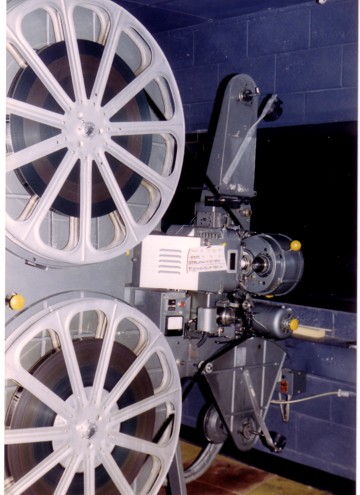
quote:6 weeks covers basic threading, splicing, theory of operation, etc. Level 2 covers things such as more advanced trouble shooting and maintenance, changing bulbs, print build up, etc. Estimated time to completion of Level 2 is 4-8 months. Level 3 is advanced maintenance and trouble shooting. It will probably be well over a year before someone has mastered that level.
I would LOVE to see your 6 week trainee be able to trouble shoot and repair ANY type of sound, mechanical or electrical problem that may arise...ESPECIALLY if it would mean a dark screen for several days until a repair tech could get on site! [Wink] [Big Grin]
quote: Peter KerchinskyPeter, I have 2 people on staff who are not currently living with their parents. Myself and by second in command. Both of us are making a decent living. Why don't I pay people $12 an hour? Because that does not make business sense. No one working on my staff is trying to make a living, pay rent, etc. They are looking for spending money. Not every job is worth $12 an hour. If you want a $12 an hour job, then find one that an employeer feels is worth $12 an hour.
Why the hell are you and your company dead set on paying someone a decent wage. That's what it sounds like in your last post. You guys must have a really low cost-of-living status there. $12.00 an hour here doesn't get you squat. No decent place to live, no decent food, no way to get around etc.
quote: Peter KerchinskyThe last emergency call I had was to fix a lamp house that had a contactor burn out and trash all the wiring going in to it. We gave refunds to both of the customers who had come to see that show (the 10:00 show on a Tuesday of week 3 of Because of Winn Dixie), gave them passes for their trouble, and had an electrician out the next day. Tell me, would having a 50k a year projectionist have been able to prevent the failure of a 7 year old contactor?
Like mentioned earlier, once that person has a failure who do you call. A tech who can charge $50 to $75 or more an hour to open a hand-douser, change a lamp, repair a downed sound system etc. Do you people care if a house goes down for the night with lost revenues and pissed off customers.
quote: Peter KerchinskyThat would be 6 weeks to get down threading, splicing and how to work the automations.. Anyone that can't grasp those functions in that amount of time needs to look for picking fruit...
Yes, it'all in training, but 2-6 weeks. C'mon.
quote: Monte L FullmerMonte, I doubt that matters all that much to most employees. I am also an at will employee, and I don't worry about it - and I have much more to lose with unemployment than a kid living at home.
"at will" - meaning that you can let an employee go without cause. To the employee, this means insecurity in an actual sense. They could lose their job without cause at any time for any reason.
quote: Monte L FullmerAnd what do you do if thir perfomance tanks?
Unions came along and "protected" the employees with a guarantee that their job will be secure and with a wage contract to keep them there as long as they want.
quote:Those machihes are still there and running! Albiet with a platter system now.
For Mark: At the Valley Fair 9 in SLC, it used to be the Valley Fair 4. Two of the houses had these V-18's, which had a cable hoist system to hunker these big reels up to that upper spindle. The other two smaller houses each had a pair of V4-E's with 6k reels and changovers. ... and this was a full-union booth, and what an elaborate booth this was!
quote: Jim ZieglerJim,
Tell me, would having a 50k a year projectionist have been able to prevent the failure of a 7 year old contactor?
. As a tech I always check both the AC and DC wiring of every lamphouse/console at every service visit. Compression set which causes heavy connections to loosen up is a very common thing to happen with larger gauge wiring.
quote: Brad MillerOf the people I have trained, we have lost one who was terminated for misconduct. In my first month there, I also termed 2 others, but hadn't invested any time in them. One also was promoted to management.
What's your turnover rate in the booth? It does no good to pay people less if they aren't going to stick around because the mere act of training requires someone else there on the payroll to train the next guy, plus that guy's rate.
quote: Brad MillerBrad, I was just thinking about this comment.. There are still several Cinemarks out there with union guys - do you apply this statement equally to them? The only union Cinemark booth I was staffed by a guy who was severely lacking in training. You know, a visiting AM (me) should not have to show a union operator with Buzztrack is and how to use it.
One has to SEE film done TRULY right before they can see the difference in what they *think* is film done right, and I guarandamntee you that you will never see that at ANY Cinemark
quote: Richard MayNothing is wrong with that if the theatre can afford to do so. When I was at Cinemark, I had 2 dedicated operators on each shift for 20 screens. At the 14 I ran, we had one dedicated operator on each shift - that booth was run by a salaried booth manager who had nearly total autonomy. Right now I am running an indy 6 screen. I can't afford a dedicated operator, especially on weekdays when I am lucky to have 100 people come through the door.
what is so wrong with paying a dedicated operator to stay in the booth at all times. You have to have a better running booth and presentation compared to multitasking operator/managers or concessionists or whoever.
quote:I don't know what caused this to burn up. When it went down it was too late to get a part, and the next morning our dealer called Strong, who was out of stock on them, so we just called an electrician, who had the same part on his truck to fix it. Cost us around $200 for the repair. Even if the 50k operator could have prevented this, the total cost to us was less than $300. At this theatre, we have to shell out about $1000 to get an engineer down from the bay. So, say we have 4 emergencies a year, that is about $4000 in fees. Say a 50k operator will prevent that. That still makes no economic sense for us to have one on staff.
Probably in all likelyhood yes! Checking lamphouse wiring every 90 days is one thing most experienced operators will do [Smile] . As a tech I always check both the AC and DC wiring of every lamphouse/console at every service visit. Compression set which causes heavy connections to loosen up is a very common thing to happen with larger gauge wiring.
quote:The down side was one show.. At 10:00.. On a Tuesday.. Tell me, would that union operator have been able to pull that contactor out of his arse? You give me someone that can make parts magically appear on demand and I will pay them $50k...
BAH HA HA! And you needed to hire an outside electrician for a job that a qualified Union Projectionist would handle with ease and a minimal amount of down-time! Been there, done that!
quote:Yet another reason to call an electrician. Even so, I would have probably fixed it myself if I could have gotten the part...
And I also attempted to convey to them that one should not play around with major electircal components, especially if one is clueless, as electricity can kill! [Wink]
quote: Richard MayHell, my 20 screen with the 2 dedicated operators on each shift required a ton of mainenance.. But that had to do with the fact that all that equipment was green and had "Christie" painted on the side..
the ones with dedicated operators had better presentations and required less repairs and maintenance.
quote: Jim ZieglerI have had contactors go out do to thunderstorms causing brief power failures and quick power returns or partial returns taking out the contactor. I was able to get the show back on screen by turning the power off at the main breaker and pulling the wires from the contactor and tieing each wire with it's associated wire on the other side of the contactor. Either using the contactor lugs on the oposite side if enough room permits or using large wire twist cap lugs to secure them together. THen turn the main breaker back on to power system back up. you then must use that breaker to turn power on and off or the individual breakers on the console. Keeps the show on the screen till I can spend more time getting the contactor off and replaced or while I wait on the part.
The down side was one show.. At 10:00.. On a Tuesday.. Tell me, would that union operator have been able to pull that contactor out of his arse? You give me someone that can make parts magically appear on demand and I will pay them $50k...
quote: Darryl SpicerExactly Darryl! But you can't expect a narrow minded person to be that intellegent. That repair would take about 15 to 20 min to accomplish by someone with a little experience. His 10 PM show woulda happened had you or I been there.
I have had contactors go out do to thunderstorms causing brief power failures and quick power returns or partial returns taking out the contactor. I was able to get the show back on screen by turning the power off at the main breaker and pulling the wires from the contactor and tieing each wire with it's associated wire on the other side of the contactor. Either using the contactor lugs on the oposite side if enough room permits or using large wire twist cap lugs to secure them together. THen turn the main breaker back on to power system back up. you then must use that breaker to turn power on and off or the individual breakers on the console. Keeps the show on the screen till I can spend more time getting the contactor off and replaced or while I wait on the part.
quote: Jim Ziegler..if a performance started to wain and would cause problems, the proper chain of command was that the theatre owner/manager would make contact with the head projectionist of that theatre to settle the matter for re-training or removal. If this didn't work or no head projectionist, then the union rep would be contacted with this complaint, which the union rep would handle the matter in either retraining that individual, or remove him from the premises under a probation, or on a permanent basis.
And what do you do if thir perfomance tanks?
quote:Then quite possibly you have one of those RARE situations where you don't treat your staff like warm droppings of cow shit. Far too many management teams out there see their workers as nothing more than a number and give little respect to them. I've said it before, respect is often worth more than $$$.
What's your turnover rate in the booth?
Of the people I have trained, we have lost one who was terminated for misconduct. In my first month there, I also termed 2 others, but hadn't invested any time in them. One also was promoted to management.
quote:Again as has been said before, that would all depend on the particular local. As has been stated many times before, some locals are fantastic beyond words (such as local 249) and others aren't worth a flip. I always forget Cinemark has union houses, since they so dearly hate unions and will do any form of union busting they can to get rid of them whether they are one of the good locals or not.
"One has to SEE film done TRULY right before they can see the difference in what they *think* is film done right, and I guarandamntee you that you will never see that at ANY Cinemark.
Brad, I was just thinking about this comment.. There are still several Cinemarks out there with union guys - do you apply this statement equally to them? The only union Cinemark booth I was staffed by a guy who was severely lacking in training. You know, a visiting AM (me) should not have to show a union operator with Buzztrack is and how to use it.
quote: Louis BornwasserIncompetence will always prevail without proper training and a respectable pay. It's just not going to happen.
This is not really a Union versus NON arguement, but an arguement of competence vs. incompetence.
quote:This was 10:00 at night. I would be hard pressed to find a McDonalds open in Fresno at 10:00 at night, let alone Granger or a Hardware store. The most I have in this town is a Home Depot, which closes at 9:00. As for on hand parts, obviously I can't keep everything, and that is one of the things we did not have on the shelf.
Usually, you should have a spare part cabinet in your booth for just this kind of occasion. But if you do not, ah well, Granger or your local electrical supply store should have a contactor relay as well as the diodes in stock. And of course your local ACE Hardware will have the needed wire and connector terminals, and that means wiring with the correct OEM safety ratings for that application!
quote: Darryl SpicerUnfortunately, this contractor, when it went, destroyed a great deal of the wiring going into it, along with about 20% of the contactor. Bypassing it really wasn't an option due to the destroyed wiring, lack of any slack in the system, and every hardware store being closed.
I have had contactors go out do to thunderstorms causing brief power failures and quick power returns or partial returns taking out the contactor. I was able to get the show back on screen by turning the power off at the main breaker and pulling the wires from the contactor and tieing each wire with it's associated wire on the other side of the contactor.
quote: Mark GulbrandsenWhatever Mark...
This is really a hopeless argument with a hopeless stooge. Unfortunately Jim is the type that assists in lowering the overall quality we see constantly falling in theatres day in and day out by not having the insight to pay for quality help.... that btw doesn't
quote: Brad MillerI have quite a bit of respect for my people and will spend a ton of time developing the ones that show promise. At one point, at the Cinemark 20 screen I was at, every depeartment head in the building had come out of the ranks of my staff. From that organization alone, 4 people have moved on to become General Managers, one has become a booth engineer and one is now my second in command here. I am still in contact with quite a few of them.
Then quite possibly you have one of those RARE situations where you don't treat your staff like warm droppings of cow shit. Far too many management teams out there see their workers as nothing more than a number and give little respect to them. I've said it before, respect is often worth more than $$$.
quote: Brad MillerIf I were in a chain situation, I would encourage them to move up the ladder to positions of greater responsibility. I don't view running a 6 screen booth as a career possibility. Realize Brad, of my booth staff, all are students. Additionally, being an independant with one location, career positions here are limited. Each of them should endevor to something greater than this. My goal is to make them the best they can be during the few years I will have them why they are still in school.
Still though the attitude that "they're living with their parents so they don't need to make a livable wage" is bullshit. Just how exactly do you expect for them to GET OUT OF THE HOUSE???
quote: Brad MillerNo, I have students that will move on when their education is done. Most will probably leave the business, but, a few may stay in it, and obtain positions at bigger complexes. Really, the same applies to me as well. I am not going to spend the rest of my career at a 6 screen. I am hopeful that we will add locations, but, the chances of that are not real good as the owners are appraoching retirement age and their willingness to take risks is shrinking. Odds are, in the future, I will probably be moving on myself to something bigger and better.
It sounds like in this particular instance you have guys who don't aspire to stop being a wart on their parent's asses. That's sad.
quote: Brad MillerI have seen good and bad with Cinemark techs. The one in place when I left, Mike Hartman, seemed to know his stuff. The one I had before him usually broke more than he fixed. I am remided of a situation where he was called in to fix two down SRD units with Christie basment readers. The readers only needed minor adjustments. When he left, 5 SRDs were down, two of them with shorted out CCD boards in the basement readers. To fix this, this particular engineer ordered 2 *complete* soundheads. He then left, leaving me to explain it to the RL...
Let's look at this seriously for a minute, who are their techs? They are "booth managers" promoted to being a "tech" just so that they don't have to hire out NCS or whomever was handling their contracts. From the horror stories I get in emails about all the time, I'm not sure if they currently have even ONE truly qualified "tech" in their chain. (I think they got pretty lucky in one or two situations in the past such as Mr.Stankey, but that's certainly not the norm.) You can figure out how the rest plummets from there.
quote: Gordon McLeodAnd you guys think I'm an asshole.. Seriously, I don't know what caused it. It is clear there was a small electrical fire until the breaker tripped. It very well could have been caused by a loose connection, or the contactor may just have failed. Either way, I don't really want my crew poking around in the wiring. I would rather lose a show to a contactor getting toasted than having one of my staff getting hurt because they missed a breaker.
If the wireing around it was destroyed it indicates that the were loose connections for an extended period of time which I I serviced the theatre would be considered neglegance on the part of teh booth staff to have not checked it monthly as they are required to do and would probably been the termination of the staff responsible
quote: Brad Miller..and once again, "ain't that the blessed truth."
Far too many management teams out there see their workers as nothing more than a number and give little respect to them. I've said it before, respect is often worth more than $$$.
quote: Mark GulbrandsenI'm not in Fresno, I'm in a small town about 20 minutes south. But, Fresno is hooterville... I have never seen a city board up and shut down at 9pm - until I moved to Fresno (which is really bad considering I grew up in Kansas)...
Its not that I am villifying I am just reading your general attitude that clearly speaks for itself. I wouldn't exactly consider Fresno a small town "Hooterville" either. Been there quite a few times over the last decade.
quote: Sam D. ChavezThat seems to be the general concensus.. I'll open up the others when I am in doing maintenance this week and see if anything is getting loose.
Regarding the contactor wiring that burned up; this was most certainly caused by loose connections over time. Whether anyone would have found them in time to save the show is open to question.
quote: Sam D. ChavezI'm not pig headed, just determined..
I find myself feeling some sympathy for Jim. While he does appear to be pig headed (and I know from pig headed) he has answered all questions put to him, and his situation is not all that different from a lot of small town movie house scenarios.
quote: Sam D. ChavezTell me about it.. My attedance is a whopping 350 right now.. On a good Sunday I am pushing twice that, but the product over the last several weeks hasn't been all that big for my crowd. Luckily for us, our market is growing and we are starting to pull some folks down from Fresno, which has been quite a trick since Regal has us majorly outgunned in the media.
The audience just is not there in abundance. I have a friend who runs a small hand built 4-plex/video rental store with video arcade. His presentation standards are pretty good with a CP500, 650 with EX and a CP50.
quote: Sam D. ChavezWhen I was at EDWs, I had to replace 3 contactors due to some form of wiring issues in these CHR SLC/H consoles. It became a monthly routine to check the wiring on these contactors and tighten if necessary.
Regarding the contactor wiring that burned up; this was most certainly caused by loose connections over time...
quote: Jim ZieglerBwahahahah
I have never seen a city board up and shut down at 9pm - until I moved to Fresno (which is really bad considering I grew up in Kansas)...
, You ought to come here! They even roll up the sidewalks past 6 p.m. . Theatres, even the mom ang pop places do pretty well overall though with none going out of buismness in the 8 years I've been here.quote: Jim ZieglerAs seems to be a trend with you...again you get it wrong...a union is an employee choice, not an employer...what you should have said to make your point was that a projectionist was never needed....wrong but seemingly your position on the job.
Very well Steve, in light of your statement, I have to revise my views. If running a changeover booth is just as easy as running a platter booth, then I can't see a reason why a union would EVER have been justified.
quote: Jim ZieglerWhile it is certainly possible...it is quite unlikely. I've trained operators too that have been in HS and college or of college age. It is more likely that you don't know what a "fine" operator is. More likely, I have higher standards than you do.
Steve, I have, personally, trained high school and college kids to be damn fine operators. Running a booth is not something that requires a 2 year apprenticeship. Training a quality operator takes a matter of weeks for the basics, with continuing training after the basics are mastered. Maybe I am just better at training than you are...
quote: Jim ZieglerJim, you are certainly entitled to your opinion and have expressed it many times. Why would you pay $12/hour when you don't have to (nor find its value)...because your employees have not unionized to bargain for reasonable wages and working conditions. The fact you abuse your managers by also not paying them a living wage does not make it right to not pay others properly.
Steve, an operators job is not worth that in the modern labor market. Why would I pay $12 an hour (more than the managers get paid) when I can get someone to do the same job for much less.
quote: Jim ZieglerJim, no arguement there on the value of some jobs. I would not go to college to obtain such a low wage as $12/hour though nor would it be wise for others...college trained jobs tend to command a much higher pay. $12/hour jobs are "blue-collar" and not terribly high paying.
Some jobs Steve are not worth $12 an hour, or $25 an hour, etc. If someone is desiring to make that kind of money, they need to go to college and obtain skills that are worth that kind of money.
quote: Jim ZieglerSnappy comeback...but a bit beneith you. The point is not a business to support a particular job but a business that is so finacially insolvent that it has to undercut its staff in order to make it. Taking that a bit further...pay everyone, including yourself, the minimum wage required by law...eventually the business will find someone that will take the position becase they are desparate enough...it is absurd to think that it will be providing a service worth paying for though.
Ahh, I see.. So in order to protect the booth workers, we should close and put them all out of work?
quote: Jim ZieglerWhere as I tend to service small town theatres...I wouldn't think of telling them they are not deserving of a theatre...but, then again, if the town doesn't support the business to the point of providing a living wage for the service rendered...then the business is not holding its own, persay...it is doing it by undercutting its workers with a take it or leave it attitude. I've seen theatres hold their own when a mega moves in...but if the indy theatre ran their place like they were the only show in town (provide the minimum to get by) then they often close after the new theatre opens.
However I am up against some megas in Fresno. The fact that I am holding my own with a 6 screen slope vs the 20th busiest theatre in the nation 25 minutes away seems to say that my place is not the piece of pooh you are trying to make it out to be. Or perhaps you think that all these small town folks are undeserving of a theatre, and they all should have to drive.
quote: Jim ZieglerFace it Jim...you don't know what you are talking about. Who here was talking about a projectionist living a life of luxuary...just a living wage that can provide for their family...there is a difference...we were talking about $12/hour job yet you jump to the $50K wage again...why are you harping on that? Believe it or not...the single screen changeover houses tend to be the ones with the operators since what the single screen has to offer is quality over their competition or they are screening rooms where perfection is expected from its projection.
Face it Steve, some jobs out there will not allow you to get your 2 story house in the suburbs with a ski boat and matching SUVs. Certainly you won't find that running a single screen changeover - no matter how much you gripe about it.
quote: Jim ZieglerThat is a possibiliy but it is also none of your business as to their status in life. You don't have to pay them more because they have not unionized for a better wage.
And I have those people Steve... And, oddly enough, I don't have to pay them more than I make. Why don't they need the money? Probably because they are college kids who live with their parents...
quote:
PROJECT THIS … Ever since Cleveland Cinema’s president Jon Forman laid off his projectionists last year, their union has been a thorn in his side. Members occasionally erect a giant inflatable rat outside the box office.
Forman claims he offered the union a service agreement to maintain the projectors but they passed on it. Union reps claim the offer was made when they were still running the projectors; if they had known they’d be kicked out, they would have taken the service contract. After the layoffs, Forman wouldn’t bring the service agreement back to the table, saying it was an illegal contract.
Last week the battle came to a head when the National Labor Relations Board passed down a ruling in favor of the union. In his opinion, Judge Martin Linsky did not miss the irony when he stated: “Having proposed [the service agreement] and now saying it would be illegal would be similar to a person to be sentenced for killing his parents throwing himself on the mercy of the court because he is an orphan.”
John Galinac, business agent for Local 160, calls it a victory. “It forces [Forman] to sit with me and bargain in good faith,” says Galinac. “There may be some back wages involved. We’ll negotiate. I’m just waiting for his phone call.”
In the meantime, Forman didn’t return ours.
The loser, ultimately, could be the Cedar Lee audience. Theaters don’t make money off the price of admission. Since studios charge outrageous fees to rent their movies, the only way to turn a profit is to charge $3.50 for a small popcorn. Union wages cut into that black ink even more.
The real negotiation should be with the studios. If they charged Forman what the prints were actually worth, union wages could be paid and customers wouldn’t have to take out a loan for a snack.
Don’t hate the player. Hate the game.
quote:
Letters : Published December 7th, 2005 News & Opinion
YOU LEFT BEFORE THE ENDING
In an article that appeared in your Nov. 23 edition (“Project This,” City Chatter), James Renner reported on only a portion of a recent ruling that the National Labor Relations Board made in a matter between Local 160, the union that represents projectionists, and several theaters operated by Cleveland Cinemas. What was not reported in the article was that the NLRB ruled in favor of Cleveland Cinemas and its decision to eliminate the position of “dedicated projectionist.”
We are very pleased that the judge recognized that our decision to eliminate all of the outmoded dedicated projectionist positions at Chagrin Cinemas, the Cedar Lee Theatre, Shaker Square Cinemas and Tower City Cinemas was based upon legitimate business reasons and entirely lawful. As the judge himself noted, there was no evidence that our elimination of the dedicated projectionists had any negative impact on the quality or timeliness of our presentations. We are certain our loyal patrons would agree.
We also find it ironic that the only thing for which the judge criticized us was for failing to unilaterally impose our alternative service technician proposal on the union over the union’s strenuous objection. Had the union been willing to accept our service technician proposal when we first proposed it during our negotiations (as the union had with one of our major competitors), this whole case would never have been necessary. In that regard, we respectfully disagree with the judge’s ruling and intend to exercise our right to seek review before the full National Labor Relations Board. We remain confident that, in the end, our position will be fully vindicated.
In the meantime, we look forward to continuing to serve the Greater Cleveland area by showcasing the best in motion picture entertainment, including films from around the world that you won’t find at other local movie theaters
Jonathan R. Forman
Cleveland Cinemas
quote:
...outmoded dedicated projectionist positions...
quote: John Pytlak..Now, the next big question: How do one get this message across to this and future generations and make it stick?
and certainly presentation quality needs the "human touch" regardless of the technology being used.
quote:That's total BS. If he had noticed a difference, would it have made a difference in his ruling? I doubt it. It appears his ruling was based only on whether or not the termination was lawful.
As the judge himself noted, there was no evidence that our elimination of the dedicated projectionists had any negative impact on the quality or timeliness of our presentations.
quote:
NOTICE: This opinion is subject to formal revision before publication in the bound volumes of NLRB decisions. Readers are requested to notify the Executive Secretary, National Labor Relations Board, Washington, D.C. 20570, of any typographical or other formal errors so that corrections can be included in the bound volumes.
Cleveland Cinemas Management Company, Ltd. and International Alliance of Theatrical Stage Employees of the United States and Canada, Local 160
Cleveland Cinemas Management Company, Ltd., Cleveland Cinemas, LLC, Shaker Square Cinemas LLC, and Cedar-Lee Theatre Company, Single Employer and International Alliance of Theatrical Stage Employees of the United States and Canada, Local 160. Cases 8-CA-34971-1 and 8-CA-35072-1
March 31, 2006
DECISION AND ORDER
By Chairman Battista and Members Liebman
and Walsh
On November 10, 2005, Administrative Law Judge Martin J. Linsky issued the attached decision. The Respondent filed exceptions and a supporting brief, the General Counsel filed an answering brief, and the Respondent filed a reply brief.
The National Labor Relations Board has delegated its authority in this proceeding to a three-member panel.
The Board has considered the decision and the record in light of the exceptions1 and briefs and has decided to affirm the judge’s rulings, findings,2 and conclusions and to adopt the recommended Order as modified and set forth in full below.3
ORDER
The National Labor Relations Board orders that the Respondent, Cleveland Cinemas Management Company, Ltd., Cleveland Cinemas, LLC, Shaker Square Cinemas LLC, and Cedar-Lee Theatre Company, a single employer, Cleveland, Ohio, its officers, agents, successors, and assigns, shall
1. Cease and desist from
(a) Failing to bargain in good faith with the Union, International Alliance of Theatrical Stage Employees of the United States and Canada, Local 160, as the representative of the employees in the appropriate unit described below, by unilaterally implementing a proposal at impasse that is different from its last, best offer to the Union.
(b) In any like or related manner interfering with, restraining, or coercing employees in the exercise of the rights guaranteed them by Section 7 of the Act.
2. Take the following affirmative action necessary to effectuate the policies of the Act.
(a) On the Union's request, bargain in good faith with the Union as the exclusive representative of employees in the following appropriate unit:
All employees employed by the Respondent at its Tower City, Shaker Square and Cedar Lee motion picture theaters as moving picture machine operators and projectionists, but excluding managers, assistant managers, chiefs-of-staff, chief ushers, concession attendants, ushers, doormen, ticket sellers, maintenance crews, cleaners, guards, supervisors and all other employees.
(b) Within 14 days from the date of the Board's Order, offer the projectionists whose jobs were eliminated on June 1, 2004, full reinstatement to their former jobs or, if those jobs no longer exist, to substantially equivalent positions, without prejudice to their seniority or any other rights or privileges previously enjoyed.
(c) Make the projectionists whole, with interest, for any loss of earnings and other benefits resulting from the Respondent’s unlawful implementation of the elimination of their positions. Backpay shall be computed in the manner prescribed in F.W. Woolworth Co., 90 NLRB 289 (1950), with interest to be computed in the manner set forth in New Horizons for the Retarded, 283 NLRB 1173 (1987).
(d) Within 14 days from the date of the Board's Order, remove from its files any reference to the unlawful elimination of the projectionist positions, and within 3 days thereafter, notify the projectionists, in writing, that it has done so and that it will not use the elimination of the projectionists’ positions against them in any way.
(e) Preserve and, within 14 days of a request, or such additional time as the Regional Director may allow for good cause shown, provide at a reasonable place designated by the Board or its agents, all payroll records, social security payment records, timecards, personnel records and reports, and all other records, including an electronic copy of such records if stored in electronic form, necessary to analyze the amount of backpay due under the terms of this Order.
(f) Within 14 days after service by the Region, post at its facilities in Cleveland, Ohio, copies of the attached notice marked “Appendix.”4 Copies of the notice, on forms provided by the Regional Director for Region 8, after being signed by the Respondent’s authorized representative, shall be posted by the Respondent and maintained for 60 consecutive days in conspicuous places including all places where notices to employees are customarily posted. Reasonable steps shall be taken by the Respondent to ensure that the notices are not altered, defaced, or covered by any other material. In the event that, during the pendency of these proceedings, the Respondent has gone out of business or closed the facility involved in these proceedings, the Respondent shall duplicate and mail, at its own expense, a
copy of the notice to all current employees and former employees employed by the Respondent at any time since June 1, 2004.
(g) Within 21 days after service by the Region, file with the Regional Director a sworn certification of a responsible official on a form provided by the Region attesting to the steps that the Respondent has taken to comply with this Order.
Dated, Washington, D.C. March 31, 2006
quote:Does anyone know if this is the same Forman of the West coast's "Pacific Theatres", and Washington's former "United Drive-In's)?
including films from around the world that you won’t find at other local movie theaters
Jonathan R. Forman
Cleveland Cinemas
quote:Cleveland Cinemas
Until the mid-1970s, Cleveland was something of a wasteland for people interested in film. Foreign films played in just one commercial theater, the Heights Art Theater. But things changed in 1976 when Jonathan Forman decided to put together a film festival. Forman had come to Cleveland to study architecture at Case Western Reserve University. He changed his major to speech and communications and began working at the student-run CWRU Film Society. A friend, who owned an ad agency, suggested that Forman do what he loved and put on a festival. By the third year, the festival had grant money from both the Cleveland and the Gund foundations, and a full-time staff of three, plus Forman and lots of volunteers. They mounted a 30-day festival. Eventually the festival settled down to its current span of 10 days, and in 1991 it moved from the Cedar Lee to the Tower City theaters. Soon the Cleveland Film Society board, uncomfortable with Forman's dual role as a theater businessman and director of a nonprofit arts organization, named David Wittkowsky executive director.
Today, he says, "I'm just the founding director, and all I do is answer the occasional question from David."
"Just" the founder is hardly the way most film lovers in Cleveland would put it. The Cleveland Film Society offers education and outreach programs in addition to the annual festival. "As much credit as I will be happy to take for founding the festival, there were an awful lot of people who worked together to get it going," Forman said. "We have created this monster, but it's a nice monster."
quote:Cleveland Film Society history
Cleveland Cinemas was created in 1977 when founder and current president Jonathan Forman purchased the Cedar Lee Theatre.
First opening its doors in 1926 as an 1,100 seat, single-screen theater, the Cedar Lee Theatre was transformed into a twin-screen theater in 1983 to compete with the increasing number of multiplexes and to meet the demand to play an ever growing number of specialty films. Two Hollywood-style screening rooms were added in 1991 - allowing guests to the theater to enjoy truly specialized films. Finally in 1994 two modern stadium-style theaters were added to bring the current screen count to six.
For more than two decades the words "Cedar Lee Theatre" and "specialty film" have been synonymous in Cleveland. Ushering in an era when specialty film would transcend art-house appeal, and coupled with its unique concession stand -- the first to offer baked goods, sandwiches, specialty coffee drinks, and imported beer and wine -- the Cedar Lee Theatre continues to be the movie theater of choice for many Greater Clevelanders.
From 1985 to 1995, Cleveland Cinemas operated the Center Mayfield Theater, also located in Cleveland Heights. The Center Mayfield Theater -- the first discount theater in Cleveland where guests could see a relatively recent release for a just $1 -- thrived for many years prior to the advent of video rentals and cable television. In addition, Cleveland Cinemas operated the Berea Theatre which flourished for five years, offering west-side residents a revitalized neighborhood theater as well as innovative programming.
In 1998, Cleveland Cinemas undertook operations and management of Tower City Cinemas, located at Tower City Center. The only multiplex in downtown Cleveland, this eleven-screen theater opened in 1990, as part of the major redevelopment of Tower City Center by Forest City Enterprises. Tower City Cinemas offers guests the opportunity to see all of the latest Hollywood releases, as well as signature specialty films. With first class projection and presentation Tower City Cinemas is the current site of the Cleveland International Film Festival.
In December 2000, Cleveland Cinemas opened the new Shaker Square Cinemas located at the historic Shaker Square in Cleveland. Meticulous renovation of the former Colony Theatre features six new state-of-the art theaters feature stadium seating, ergonomically engineered Australian high back chairs with moveable armrests with cupholders, and digital sound for a satisfying movie-going experience. The restored lobby includes a new concession stand complete with all of the "usual suspects", specialty coffee, food, and beverages.
The growth continued into 2002. Cleveland Cinemas was asked to take on management and operations of a first-run theater in Brunswick. Hickory Ridge Cinemas is a popular neighborhood theater with 8 screens, and continues to show first-run Hollywood films.
In 2004, Cleveland Cinemas added two more locations to their theater family. In April, Cleveland Cinemas took over the management of Chagrin Cinemas, a 14-screen movie theater located east of Chagrin Falls on route 422 in Bainbridge. The area on East Washington street is an entertainment center in Bainbridge, with the multiplex nestled in between an enclosed golf dome with miniature golf and a popular family restaurant. Chagrin Cinemas even boasts a party room available to rent for birthday parties and other special events. Arcade games and a concession stand stocked with every moviegoer’s favorite snacks round out the offerings at this friendly movie theater.
The second addition came in October of 2004 when Cleveland Cinemas took over management of Solon Commons Cinema 16, previously managed by Regal Cinemas since 1991. With 16 screens and a new name, Solon Cinemas becomes the largest multiplex in the Cleveland Cinemas theater chain. Located off of Aurora Road near the Harper Road exit on 422, Solon Cinemas will see some new additions to the concession stand, which will feature all of the usual favorites plus fresh baked pastries and cookies, specialty coffee drinks, juices and bottled waters. Other changes under consideration include a new concession stand, improved seating and the installation of several digital projection systems.
quote:CWRU Film Society
The first Cleveland International Film Festival (CIFF) was organized by Jonathan Forman and presented April 13 – June 2, 1977. Eight films from seven countries were shown at the Cedar Lee Theatre in Cleveland Heights over an eight-week period. Presented as a subscription series, the first CIFF received substantial media attention, and attendance indicated that Clevelanders wanted a broader schedule.
By its third year, the CIFF had grown to include feature films from around the world, children’s films, retrospectives, and short subjects. A Board of Trustees — consisting of community leaders, film scholars, and film enthusiasts — was assembled to oversee the mission, funding, and growth of the CIFF.
By its fifth year, the CIFF had developed a network of screening locations, establishing itself within the Greater Cleveland arts community as an eagerly awaited annual event. Fund raising was enhanced through the generosity of The George Gund Foundation and The Cleveland Foundation, and educational efforts were strengthened as a result.
In 1986 the CIFF moved its Opening Night to the Ohio Theatre in Playhouse Square, adding to the excitement and appeal of the event. Guest filmmakers regularly attended the Film Festival to introduce their films and answer audience questions. And a fall program of international films became an annual part of the organization’s presentations for a number of years.
In January 1991, the Board of Trustees voted unanimously to move the Film Festival from the Cedar Lee Theatre in Cleveland Heights to Tower City Cinemas in downtown Cleveland, making the event more accessible to film lovers from throughout the region. During its first year downtown, the Festival’s attendance (14,000) fell slightly. But by 1995 attendance had grown to 23,000. And in 1998 the Festival experienced its greatest one-year increase in attendance: a jump of 16% resulted in 32,000 admissions. At the 28th CIFF in March 2004, there were more than 39,000 admissions.
At its meeting in January 1991, the Board of Trustees of the Cleveland International Film Festival also voted to change the name of the organization to the Cleveland Film Society (CFS). The purpose of the change was to reflect the evolution of the organization’s mission.
Today the Cleveland International Film Festival is the flagship event of the organization, though certainly not its sole function. Year-round programs and services include Film Feasts (mini-fundraising events), film appreciation classes, and membership activities.
quote:
Union Buster
Theater owner cited for felonious lack of imagination.
By First Punch
Article Published Jun 28, 2006
Cleveland Cinemas owner Jon Forman isn't the sharpest knife in the drawer. In 2004, he decided to get rid of union projectionists at three of the theaters he runs -- Shaker Square, Tower City, and the Cedar Lee. But a clause in the contract said projectionists could only be replaced by "managers." So Forman made everyone a "manager," including that 16-year-old stoner who butters your popcorn.
Since the scam entailed a felonious lack of imagination, it wasn't likely to have a long shelf-life. But at least it allowed Forman to cut wages in half -- for the time being.
Two years later, however, the union-busting maneuver has boomeranged. And it's coming back to smack Forman.
Last November, an administrative judge ruled that Forman acted illegally. So he appealed to the National Labor Relations Board in Washington, D.C. In March, the three-member panel brought the hammer down on Forman. They ordered him to reinstate all fired employees and provide them back pay and benefits, plus interest. Union chief John Galinac estimates that Forman's final tab will surpass $270,000.
Still, Forman insists on throwing good money after bad. Three months after the decision, he still refuses to sit down with Galinac at the bargaining table, and his lawyers have filed yet another motion to contest the ruling. (He also ignored calls from Punch.)
"He's the kind of guy that keeps hiring lawyers until he gets the right decision," says Galinac. Meanwhile, his tab just keeps getting bigger.
quote:
Movie Maven
July 25, 2006
This summer, we're beginning an occasional series about Ohioans and their work. To kick it off, we'll spend a little time with the man who has been bringing movies to the masses in Cleveland for almost three decades.
quote:
Cleveland Cinema, projectionists agree to settle dispute
Saturday, May 12, 2007
Patrick O'Donnell
Plain Dealer Reporter
A three-year fight between a local chain of movie theaters and a projectionists union has ended with them agreeing that Cleveland Cinemas does not need to use professional projectionists in its theaters.
The theaters also have paid $115,000 to the projectionists and the union to settle the dispute.
Cleveland Cinemas and the International Alliance of Theatrical Stage Employees have fought since the chain laid off five projectionists from its Cedar-Lee, Shaker Square and Tower City movie theaters in 2004.
Theater management now has other employees run the projectors in addition to other duties, a practice the company says is more efficient and saves money given the ease of using today's projectors. The chain's other three theaters also do not use projectionists.
Union officials say the company is anti-union, was not dealing with them in good faith and is still unfairly trying to exclude jobs from union protection.
After the union filed complaints with the National Labor Relations Board in 2004, an administrative judge ordered the theater to hire the projectionists to repair and maintain the equipment if they are no longer needed as projectionists. Last March, the NLRB told the chain to rehire the projectionists in their old jobs or equivalent ones.
Last month, the union and theaters, through negotiations with the NLRB, agreed that the union would drop the case in return for Cleveland Cinemas paying the five projectionists $95,000 in back wages and paying $10,000 each to the union's pension and welfare funds. The theaters do not have to rehire the employees.
Cleveland Cinemas lawyer Stephen Markus said eliminating projectionists was a needed step - much like eliminating elevator operators years ago - that the company wanted to maintain. He said Cinemas president Jon Foreman chose to pay the workers to end the case instead of paying more legal fees.
John Galinak, business agent for Local 160, said the union wanted benefits for the five employees and will now focus on including more theater employees in the union.
It has been 1142 days since the last post.
quote: Jonathan SmithI am not sure I understand this question. What do the employees work down in Guest Services have to do with the union and 2K DLP 3D, etc?
So, has the failure of the unions and subsequent failure of employees in guest services' failure to unionize hastened the race to mediocrity that 2K DLP and 3D are now actively starting to bring to this industry?
quote: Frank AngelDitto here... I have a friend in Brooklyn...
I spoke with a 30 year union veteran of the New York's Local 306 who told me that the NY Union for all intent and purpose is dead.
quote:
Martin,
My problem with unions is that I have run into some real assholes on jobsites and they have an attitude because they are "union". We did an install near Chicago, and all of the trades were "non-union". After the theater opened, almost every night there were screens that were slashed, Toilets that had socks filled with concrete mix dropped in them, and even a pipe bomb. All the pissed off union workers, angry because we hired non union hard working workers.
Like I said in an earlier post, I was doing a job that I had done for years. The factory workers went on strike, and I had to cross the picket line every morning to do my job. My so called "friends", even older ladies would yell and spit at me and call me a "fucking scab". All because I wasn't a part of their little club
quote: Michael MariniIt's as if you didn't read the following:
Hey Chris its ok with you that randy calls IA people monkeys.All i can say is there most be a lot of Rush fans on this site
quote: Chris SlycordWhen a person says "I had [X] happen with [Y] union chapter and see them as a bunch of monkeys" that isn't saying that all unions are bad or that all chapters are bad. Like when topics similar to this have come up, several different people mentioned having good experiences dealing with whichever chapter was [edit](I mean is)[/edit] in Seattle (and some of the same people mentioned having bad experiences elsewhere).
people posting here on both sides of the discussion have agreed that it isn't black-and-white and can depend on the union in question, company working with them, and any negotiations.
quote: Michael MariniWTF? Please explain this comment. It makes no sense whatsoever.
All i can say is there most be a lot of Rush fans on this site
quote: Richard HamiltonI'm all too happy to be offended by your comments!
Seriously, I hope I don't offend anyone, except maybe Joe...
quote: Richard HamiltonRichard.
Did you post that finger on Union time?
quote: Monte L FullmerExactly...you just did the bare requirements to earn the larger wage
My buddy and I were in Local 463 (a pretty pathetic union with members who did nothing for putting on a good show, but just push start buttons, watched TV, slept on cots between shows, had their GF's, wives, family upstairs, smoked silly where you couldn't even breathe up there since the air in the booth was turned into a smog cloud, used yellow tape for splices.. et.al. - just the bare requirements to earn that much larger wage than even what the managers were making..)
![[beer]](graemlins/beer.gif)
quote: Sean McKinnonHehe...give me a half hour, I'll join you
I am going to go take my smoke break now
quote: Sean McKinnonFunny you should talk about half-hour smoke breaks. Never happened here. In fact, that comment about never being allowed out of the booth during your shift rang true here. If you wanted to smoke, you had to smoke IN the booth. God help you if you were downstairs and something happened, too.
I am going to go take my smoke break now
quote: Jonathan Smithhuh????
GAMEFULLY EMPLOY
quote: Jonathan SmithI get it now. He meant Rush the soft, fat guy and not Rush the band. I didn't know Rush the man was still even relevant.
It's funny, I assume by "love Rush" you guys mean "Republican."
quote: Joe RediferWell -- right or wrong, he probably has more "pull" these days than Rush the band ever did, so maybe he is still relevant.
I didn't know Rush the man was still even relevant.
quote: Rick RaskinAnd that is as it should be, union or no union.
that allowed theater management to have a poorly performing operator replaced.
quote: Rick RaskinI remember there were a few operators who were banned from almost every chain. We in the local knew who they were and wished we could get rid of them. Alas, unions are not legally allowed to fire people. Which is how it should be, unions are required to represent their members just as corporations are required to represent their shareholders. Nonetheless, the bozos make the good guys look bad and give management ammo for going non-union.
When I worked for KB there were a few operators who were not allowed in KB booths.
quote: Michael Marini was the last to postThere also was a time where lots of people didn't care about getting a car that was beyond their means. See, people can buy cars in cash. They just have to be reasonable about what they can afford.
To think, once upon a time in the US (not too long ago even) the average worker could support their familiy on a single income where they paid cash for their car (not financed it 5-7 years).
quote: Michael Marini was the last to postSome people said things against specific unions or even specific dealings with specific unions, then you say "Since you hate unions altogether and think they did nothing good ever, look at the good things they did." That's a strawman argument.
Most concepts that the government feels the need to try and legislate really started with the labor movement and the benefits they bargained for...even restrictions on child labor were born with the labor movement. Minimum wage...again a labor idea.
quote: Michael Marini was the last to postGeneralize much? Not all businesses have owners that behave badly.
It is about control...business owners want all of it
Sorry for the run-on sentence. quote:That is it, in a nutshell. All of the rest of the BS discussed here, is just that, BS. Everyone can come up with anecdotal evidence about a good or bad experience (from just about every angle).
What a union truely [sic] does is to allow workers to speak with a greater voice than just the single person, to bargain for superior working conditions and benefits and for a better life.
quote: Michael Marini was the last to postAnother quote from Mr. Marini on page 35 that is right on target. That is the law. This applies to ANY worker that is not excluded by the NLRB. If the front of the house wants to unionized...so be it...even if they are just "kids." You may not like it or think it is foolish or resent it as a business owner or operator...but that is their right, under the law and it should also be a wake up call that people are feeling particularly oppressed. It isn't easy or free to form a union so something has a bug up their butt. And it isn't the "fat cat union looking for dues" because that rarely is it.
Remember, worker's right to unionize is guaranteed, an employer's desire to not have union workers is not legally protected...it isn't the employer's choice in the USA
quote: Randy StankeyPolitical power? Or do you mean control over the work environment? There isn't political power on the job site...there is political power within the union or with making laws. If you mean the "take what I say or get out" mentality changes...well yes...one thing that a union will do is legally define rules that EVERYONE has to play by. You don't get to arbitrarily change ones job description or rules. Every one knows what the rules are (they are spelled out if they are covered by a contract).
My problem is that, regardless of what union organizes the shop or what local chapter of the union has jurisdiction, the goal of the workers changes from getting the job done to maintaining political power.
I would not give even one cent of my money to an organization that doesn't look out for my interests.
quote: Richard HamiltonI'm sure the feeling is mutual. Just read all of the crap you have spewed...you are way too hostel.
I haven't worked in an operating union booth, but I've done enough installs that I can say union people can kiss my ass.
quote: Richard HamiltonAnd no one will disagree with you there.
A card in your pocket doesn't make you any smarter.
quote: Richard HamiltonThere we go...when a contract is signed...it set up the rules for everybody...you know when the breaks are coming. There is nothing wrong with breaks...in fact, they are often legislated. If you don't want to play by the established rules, that is your fault, not theirs...it isn't arbitrary. You may want to get to the work place faster by driving 70 in a 35 zone...it doesn't make it right. Your complaint is pointless.
When I want to finish an install and have to wait because the Union electrions have to take a 30 minute smoke break because they are intitled to it really pisses me off.
quote: Richard HamiltonThey quit because the work day is over. Their life does not revolve around 1 specific job. They also probably started around 6:00am too. They have also probably been on the job site many months longer than you...it is far easier for a specialty trade to put on the afterburners and work 12-14 hour days for 2-weeks than to keep that up for months...they also, probably being family folk have kids to pick up, groceries to buy...etc...again your complaint is stupid.
I usually try to work after 3 PM when the union guys just drop their tools and walk out the door because it is their union quitting time. Thats when I terminate wires and double check shit
quote: Randy StankeyI dunno...all of the break times I've been involved with were in the contract...not arbitrary at all. If your complaint is that they all happened at the same time...it was because it was in the contract that way. If you don't like it...change the language in the contract before you sign it. You don't seem like you have a problem with the break concept so there shouldn't be a problem of making it more conclusive to what environment you are in.
The problem is the sense of universal entitlement that people develop. They start to think that because they are allowed to have a break that they are the arbiters of when and where the break shall be taken.
quote: Randy StankeyIt really depends on the type of job, doesn't it? As a projectionist, union or non...I've never had a "diner break." I have been expected to be in the booth at all times when equipment is running. In singles, one could go out for some "carry out" if the timing worked out. If the job environment is conducive...you can write the method of break any way you want, so long as it is evenly applied and agreed.
At any job I have worked, people had to spell each other for breaks and lunch/dinner times. This includes retail stores, hotels, theaters and other places. Not everybody could go on break at the same time.
quote: Randy StankeyAgreed.
The actual procedure is inconsequential. It is more important that there is an agreed-upon way to dole out lunch times that is fair and orderly.
quote: Randy StankeyOkay...this statement is WAY beneath you, Randy! I'm still amazed you said it. Unions have PACs because companies do. The goal is for favorable legislation that DOES benefit you. The laws are perpetually against unions/workers...don't believe me...go to an NLRB hearing. About the only group working in the worker's best interest is the union and those PACs. As for deciding how it is spent...those contributions are indeed voted upon by the membership and/or their duly elected representatives. In a community, one does not get to have a say over each and every item...it would ensure that NOTHING gets done...just like we have a representational form of government, we have a representational form of unions. You may not agree with how every penny is spent but most of the dollars are going to benefit you. And like before, there are many things that you are spending money on that you don't get a complete say on how it is spent.
I don't care if union dues are $19.00 or 19¢. I do not want any of my union dues money used as campaign contributions or special interest donations towards candidates or causes that I do not believe in. I don't care what your political affiliation is. The fact remains that the UNION decides how to spend that money, not ME.
quote: Richard HamiltonWho appointed you king of the job site? Because YOU show up people should say "fuck my family and life"...I'll work 24-hour to ensure Rick gets to get to another job site? Your statement is very self-serving and speaks not one nit to the worker who is merely taking a break. If you want to work crazy hours to get the job done...great. There is nothing legally or morally wrong for a worker to take a break and work a standard day (typically 8-hours). Sam summed it up pretty well.
When I am on site and am trying to meet a deadline so that i can be somewhere else, and some fuck demands a "smoke break" fuck em, they can go to hell.
quote: Tony Bandiera JrActually no. They changed the landscape, not the job. The better projectionist will be notably better (even from the theatre perspective) than the caveman projectionist.
The advent of xenon bulbs. platters and automations pretty much made the job so easy, a caveman can do it, and the unions, rather than enforcing quality of persons, had the territorial rights reaction that Sam was referring to.
quote: Sean McKinnonOkay...you bring up a specific case but it can be applied to any case of an employee that does not fulfill their obligations as an employee (showing up on time...following established company procedures, conduct...etc).
The idea of having recourse against abusive management is great. The idea that you can have someone on your side if you are being unfairly targeted or singled out is great. However, again, I have seen it perverted. If someone is supposed to be a highly skilled professional and supposed to be worth a wage substantially higher than a non represented worker they should act as such. I understand that everyone has bad days and everyone get's stuck in traffic but when you are more than an hour and a half late for work I don't think one should hide behind their union for their wrong it gives the whole union a bad name. Case in point a projectionist I once had was 1 and 1/2 hours late for work (which we almost had to cancel some shows and would have if another manager had been opening as I was the only one who could run the projectors) and instead of owning up to it refused to even acknowledge my existance or take a copy of his "write-up" because he did not have a union witness. He was asked to call someone to come in as a witness but he would not do it. In the end the write-up still stood but come on he knew he was wrong, he knew he deserved it every single employee in the building including myself would have been treated exactly the same way if they were 1 and 1/2 hours late for work but this person tried to shirk his responsibility by hiding behind the local.
quote: Lyle RomerFrom experience...the union has to be as strong (financially) and as large as the entity that it is up against if it is to obtain a "fair" contract (the same applies to the business). If the "GM UNION" were to go up against GM...particularly in its heyday...it would have been given a "take it or leave it" contract that would have sucked or killed the union.
For instance, if General Motors factory workers want to collectively bargain, they should form a union and elect representatives from within thier ranks. They should not join the UAW that represents workers from other companies. All the UAW really cares about is getting as many workers unionized and collecting dues. An internal GM union could accomplish the same goals for the workers while significantly cutting down the expense. They can just collect enough dues to pay for attorney's to handle negotiations when necessary.
quote: Lyle Romer
The other problem I have with unions is striking. If you don't like your job/pay/benefits then quit but it is ridiculous to hold a business hostage, force them to lose money and then return to your job.
<smack>quote: Lyle RomerA misconception that pay is based on service time...pay is based on the contract and schedule. It is normally a non-union environment where pay is tied to length of employment. The only times I've seen specific worker pay in an IA contract I was involved with was relating to management wanting to lower the pay of new-hires but not wanting to penalize the existing worker. The management argument being that "why should I pay the same for a "green" projectionist as the seasoned veteran? The reason is they are doing the same job. The better operators, if they want to make more, can gravitate towards the better paying positions. There can be some room for a few tiers of "merit" based pay increases in a contract schedule...but it does get into a slippery slope of how this merit was earned. The incentive for doing a good job is to get a new contract with wage increases (or benefits) for all. Generally speaking, the best paid positions in projection are not in the mainstream theatres but in places where "the show must go one" and the show quality is considered paramount...(i.e. screening rooms). Normally, these rooms also have a bit of control over who will work there as they demand the highest quality...again...it is all in how you word the contract and most anything can be on the table.
Also, the concept of collective bargaining works much better in jobs where it is very difficult to measure the quality of work. This is not the case with projectionists. If it is possible to assess the quality of an individual's work then why should pay be based on nothing more than service time?
quote: Martin McCafferyYeah, but thankfully, one of the bad apples migrated to Alabama!
I remember there were a few operators who were banned from almost every chain. We in the local knew who they were and wished we could get rid of them. Alas, unions are not legally allowed to fire people.
quote: Martin McCafferyI have no doubt of that. Then again, I know in the early '80s...K-B's non-union operators stood toe-to-toe with the union operators in terms of quality of show, print damage, missed shows...and so forth. In fact, I would say, as a whole, K-B was notably better. The commotion over any show interruption at K-B in the early '80s was so huge (and I mean even if an exciter lamp burnt out and was replaced immediately...required a fully detailed report, supervisors being paged and an answer for why the lamp was allowed to burn out...it was expected that things like exciter lamps were cleaned and inspected weekly and changed BEFORE they blew out).
Though, I was still there when KB made the transition to non-union, and the bozos they put in the booths at some places were the worst I have ever run across. There are some particularly lovely horror stories from that period.
quote: Michael Marini was the last to postMike is spot on here. What many folks think of as normal working conditions started with unions fighting, striking, and working for. Doing even the most basic of research will find out ugly things have been.
Most concepts that the government feels the need to try and legislate really started with the labor movement and the benefits they bargained for...even restrictions on child labor were born with the labor movement. Minimum wage...again a labor idea. In the state of Maryland, the legislative body has pass a bill to require large corporations to spend at least 8% of payroll on health insurance to all employees. Personally, I don't think that is the right place for government but that is something that unions have baragined for and without them...employers are going to increasingly be told what they have to do by law.
It is about control...business owners want all of it...but people are not property (now that slavery is gone) so absolute control is not nor should not be condoned. "Take it or leave it" is a 3rd world concept, not one that the USA should strive for.
quote: Edward HavensMis-read and mis-representation of Michael's last post. Your statement is as silly as anyone that would post that the world is so rosy now that no unions are needed. The grass is brown everywhere...it is a matter of what degree.
I wish I could live in Michael's world, where everything is black and white, where all unions and union members are good, and where the world never changed after the election of Eisenhower.
quote: Chris SlycordWhile your statement is true...it misses the point. Though I'm not sure how Mike's statement relates to unions in this case except people's buying power has NOT kept up with inflation. If you take the price of a typical "family" card and look at the typtical middle-class worker of the past...they could buy it cash-out right (and do so about every 6-years or so)...today...the average middle class worker can no longer do that. That is more of a general economic discussion than a union one. A discussion that would get way off topic. I see Mr. Spaeth hit upon a chief reason I think the buying power of most has shrunk.
There also was a time where lots of people didn't care about getting a car that was beyond their means. See, people can buy cars in cash. They just have to be reasonable about what they can afford.
quote: Chris SlycordThat comment would been applicable to an earlier post of Mike's, but not this one...this one is right on target and legitimate. Too many folks provide a couple cases and try to make a generalization. Mike's statement above is a fact of labor history. Many, if not most legislated "minimums" and worker laws came from unions.
Some people said things against specific unions or even specific dealings with specific unions, then you say "Since you hate unions altogether and think they did nothing good ever, look at the good things they did." That's a strawman argument.
quote: Chris SlycordA business owner wanting control is not "behaving badly" it is natural. If I create and own something...I tend to want to control it. Your post, however mis-characterizes Mike's statement. Regardless if the business owner (or more likely manager) is power crazy or not, a union is a powerful means for the worker to have a say in their work environment when it comes to conditions and rules.
Generalize much? Not all businesses have owners that behave badly
quote: Michael GoucherThere is some truth in this but it has more to do with how the laws currently stand. There is this distinction between laborer and supervisor that has, in more recently history, been one of semantics. What unions should be doing is applying all the pressure they can with Randy's dues (if he were paying them) is trying to get the labor laws changed to allow a much higher level of employee to be represented by a union. That is, in our industry...theatre managers on down should have the option of unionizing. Imagine if this whole "supervisor" argument went out the window of who can/can't be in a/the union? Management effectively used the rules for unions to prevent management from taking control of a union (by stuffing the union with managers) and redefined employees to exclude quasi-supervisors from the unit by mere semantics. It has been very effective and goes against the spirit of the law.
...courts and judges have fallen over themselves to create "supervisors" who cannot join unions, who are vaguely defined, and maybe get to wear a white shirt instead of a blue one and are no more supervisors than the lowest person on the staff...
quote: Steve GuttagJust because YOU want to have absolute dominant control over every aspect of a business you create doesn't mean that all business owners are like that. Hence, why I said his statement was a complete generalization. And I wasn't trying to mischaracterize; I actually consider implementing total domination over your workforce to be "behaving badly."
A business owner wanting control is not "behaving badly" it is natural. If I create and own something...I tend to want to control it. Your post, however mis-characterizes Mike's statement. Regardless if the business owner (or more likely manager) is power crazy or not, a union is a powerful means for the worker to have a say in their work environment when it comes to conditions and rules.
quote: Steve GuttagI was considering both statements together even though I only quoted this one. My bad.
That comment would been applicable to an earlier post of Mike's, but not this one...this one is right on target and legitimate. Too many folks provide a couple cases and try to make a generalization. Mike's statement above is a fact of labor history. Many, if not most legislated "minimums" and worker laws came from unions.
quote:My mother was with the CWA union for "Ma Bell" union for all of her time with that company -up right before the big split in 1984 when she retired. The CWA definitely took care of her and all of the employees.
What a union truely [sic] does is to allow workers to speak with a greater voice than just the single person, to bargain for superior working conditions and benefits and for a better life.
quote: Steve GuttagThat couldn't be more true. If you are someone that has had a union formed (or attempted to form) under your command, the problem is YOU.
If you don't want a union, don't create the environment that causes one to form.
quote: Steve GuttagThe part that Brad quoted above echos this. If employees are treated fairly and employers are getting good results and making money, then all is good and there is no need for anyone to be upset. However, treating employees unfairly (usually but not limited to extremely low pay for the job being done) is not a good way to maximize profits.
If an employer treats their workers fairly...they need not worry about unions.
quote: Steve Guttag..yet, can we repeat that even though the employer treat their workers fairly, shouldn't the managers of their certain companies follow the same rule?
If an employer treats their workers fairly
quote:Although this is how it would work in an ideal world it is far from true. Delta Airlines is among the least unionized airlines in the world and they have always been known for treating their non-union workers extremely well, compensating them as well if not better than fully unionized airlines. However, a couple of weeks ago, the IAM started the process of trying to unionize Delta's customer service and ramp workers. The workers did not start this process, the union did. It isn't because of poorly treated workers, it's just because the IAM wants to get into another airline and add more people to their ranks.
--------------------------------------------------------------------------------
Even though the projectionist union is effectively dead, Steve's post is right on the money.
For corporate and management reading this thread, regardless of projectionist or floor staff, I must quote one thing Steve said...
quote: Steve Guttag
--------------------------------------------------------------------------------
If you don't want a union, don't create the environment that causes one to form.
--------------------------------------------------------------------------------
That couldn't be more true. If you are someone that has had a union formed (or attempted to form) under your command, the problem is YOU.
quote: Chris SlycordBut be that as it may...I ask you to poll some business OWNERS and ask what they think they should be in charge/control of when it comes to their business. I'd think more than 99% will feel they should have 100% say on all aspects...even if they choose to delegate, the final say would be with them...this includes who and how much to pay folks and what benefits to offer.
...total domination over your workforce...
quote: Chris SlycordAgain, a jump on your part...it is a fact that they have done good in the past and, clearly, it is a matter of opinion as to what good they are doing today. Depending on the circumstance, they are doing quite good!
Still, I don't really buy the idea that because unions have done past good that this means that they must be doing good today.
quote: Lyle RomerLets get some facts...a UNION CAN NOT UNIONIZE A WORKPLACE WITHOUT THE WORKERS AGREEING TO IT! There is a whole process to unionization...it starts with pledge cards...if enough workers sign on with pledge cards (majority), the union will then submit said cards to the NLRB seeking recognition. There will then need to be a vote to form a union at said work place...again, if they don't get a majority, the union doesn't form. Thus, the only way Delta or any other employer gets a union is if the workers vote for it...very fair, you would have to admit.
Although this is how it would work in an ideal world it is far from true. Delta Airlines is among the least unionized airlines in the world and they have always been known for treating their non-union workers extremely well, compensating them as well if not better than fully unionized airlines. However, a couple of weeks ago, the IAM started the process of trying to unionize Delta's customer service and ramp workers. The workers did not start this process, the union did. It isn't because of poorly treated workers, it's just because the IAM wants to get into another airline and add more people to their ranks.
quote: Lyle RomerThat is what negotiations are for...to define what is fair to both parties...typically, if there is no union...it is a take it or leave it proposition that often leads to less for the worker...especially when one looks at the entire job class.
In general the issue with unions and what they do is how you define "fair" wages and work rules.
quote: Lyle RomerYes that is how it is supposed to work...and if this was a class in economics we could go on...and any real study of economics and the "free market" system will lead one to find substance level living. The free market will self-correct to the point it always finds the lowest price for the demand...the point where supply/demand truly find their equilibrium is at the point where all are at subsistence. But really this is another discussion in economic theory...I went with it to point out:
The way the free market economy is supposed to work is that companies compete for the best workers while also competing for customers.
quote: Lyle RomerWhile that may be your perception... The goal of a union to increase membership is not to pay for the bureaucracy but to increase the strength of the union in order to obtain more favorable results from their negotiations. It is true, the larger the union, the larger the overhead to run said union but that is true of most entities. As a percentage of dues, as the union increases in size, the portion of the dues that goes to the overhead becomes less and less. In fact, many locals don't pay their executive board...which I can state from personal experience.
a big goal of the union is to increase membership to thus increase dues and pay for the union bureaucracy.
quote: Lyle RomerWhy do you think those campaign contributions are not for the purpose of benefiting the workers? They contribute to to politicians in an attempt to obtain more favorable labor legislation which should benefit the workers. It is part of the overhead. Personally, I'm all for banning campaign contributions from ALL entities. However, if big business entities have their lobbyists, then all the legislature will hear are about the needs/wants of big business...not surprisingly, that is how the laws will form.
They don't just use the dues for the benefit of the workers. Millions of dollars of union dues are used for political contributions to candidates of the union's choosing.
quote: Lyle RomerWhile I don't know this specific case...if it is like any negotiation I've heard...it would be at the conclusion of the contract and it is renegotiation. You make it sound like they are in the middle of a contract term and are wanting to change the rules. It sounds more like to me that they are back at the table at the end of a contract and are asking for a pay raise. If the company is crying "poor" for the reason not to grant said pay raise, they will point out the profits to prove why that is not a valid reason. Who knows, neither of us are in those meetings. You also don't discuss if the pilots took pay cuts during less profitable time or if there was a clause that allowed a fluctuating pay based on company profits. There is nothing inherently sinister your "point." The workers want more compensation...it is part of negotiation.
All you heard from the Pilots was "The airline made $80 Million profit last year so they should be paying us more." Well, why? The purpose of the existence of the company is to earn profit but the union decides they are making too much. When the pilots took their job they agreed to the pay they received.
quote: Mark J. MarshallSimple...decertify the union. Again, that has to be worker based...if you don't want the union, vote to decertify. Note...workers can even change union affiliations (switch unions entirely yet remain the same workforce working for the same employer). A union represents employees.
Once a union forms, and the owners who were real butt heads in the first place have moved on, and all of the original employees have moved on, and there are new people working there from top to bottom and everyone is happy, how do they get rid of the union?
quote: Steve GuttagThat is absolutely not what the original statement said.
Come on Chris...this is unbecoming of you. You turned "wanting to control ones business" into
quote: Steve GuttagThat's exactly my point. I'm not arguing that unions haven't done good things in the past. I'm arguing that those past good things have no bearing on a discussion on whether unions serve their purpose today. And I'm *not* arguing that unions *aren't* doing good. I'm arguing that it depends.
Again, a jump on your part...it is a fact that they have done good in the past and, clearly, it is a matter of opinion as to what good they are doing today.
quote:You say this as if I'm arguing otherwise. Strange, considering that I've explicitly stated here that unions can be good depending on circumstances.
Depending on the circumstance, they are doing quite good!
quote: Steve GuttagSeems easy. But not neccessarily so. For instance (and I know this is anectdotal), I recall my grandfather telling us that several times they went on strike against Maytag were where the workers consistently voted against striking and the union representatives started helping new people get hired who supported them and eventually they got enough votes to strike.
Simple...decertify the union. Again, that has to be worker based...if you don't want the union, vote to decertify. Note...workers can even change union affiliations (switch unions entirely yet remain the same workforce working for the same employer). A union represents employees.
quote: Chris SlycordOkay...I think you are playing into semantics but go ahead...ask business owners if they want absolute total control of their business and see what kind of answers you get. If they don't want absolute total control...ask them for an example of what they don't want control over.
This is implying that the business owners want absolute, total control. And it's just not true for lots of owners.
quote: Chris SlycordIt is valid to discuss the past as it give understanding as to what is happening into the present. It also serves as a reminder on what to avoid (so as not to repeat).
That's exactly my point. I'm not arguing that unions haven't done good things in the past. I'm arguing that those past good things have no bearing on a discussion on whether unions serve their purpose today.
quote: Chris SlycordI don't get your argument since you even state they are doing good in at least some places in the present.
You say this as if I'm arguing otherwise. Strange, considering that I've explicitly stated here that unions can be good depending on circumstances.
quote: Steve GuttagThen I guess you didn't follow the conversation. A union supporter portrayed it as if unions are the greatest thing ever, only good comes from unions, and anyone giving examples of bad union experiences are just full of shit. I disagreed with this assessment. Just because you or I have had some good experiences with unions doesn't make them inherently good and just because someone else has had bad experiences doesn't make them inherently bad. It completely depends on all sorts of things.
I don't get your argument since you even state they are doing good in at least some places in the present.
quote: Steve GuttagI didn't realize decertifying was a government function. I assumed you were just referring to dissolving their chapter of the union or something similar.
So...what does your example of calling a strike vote (of which we have no knowledge of the issues) that is purely within the governance of the employee/employer relationship have to do with decertification...which brings about a government overseen activity?
quote: Steve GuttagIt's called "You scratch my back I scratch yours." The newly hired people that support the boss just might be helped out a bit by the boss, thereby keeping them off the streets.
1) What is the lure of a person to join a union for the purpose of striking? As soon as they get their shiny new job, they are out on the street again.
quote: Steve GuttagOver time, people quit and then they get new hires because they need positions filled.
2) If an employer has a staff that has chosen not to strike, why would they be wanting to get all of these new-hires, which are unknowns?
quote: Steve GuttagDidn't claim it was representative. You said "all you have to do is X" and I said it wasn't neccessarily as easy as you said and gave an example of a possible outcome.
I'm not saying it didn't happen (again I have none of the issues that may or may not have caused the incident) but this isolated example is hardly representative and likely has more to it that has been presented here.
quote: Chris SlycordYeah...I did and you clearly didn't follow mine. You are now jumping from disallowing past gains as an example of a positive union position and even positive union outcomes today to someone posted something idiotic about everything unions do/did is great. It was a given and stated as such there have been good and bad on both sides.
Then I guess you didn't follow the conversation.
quote: Chris SlycordIt is an interesting concept but the union does not have a guarantee to get back their jobs if they go on strike...thus promising a laborer a job, if and when they successfully strike and get their jobs back is an odd proposition, to say the least.
And looking at it another way, if I don't have a job and am on the street, taking a job specifically to go on strike for a certain amount of time is not all that different than being on the streets with a guaranteed job coming up
quote: Chris SlycordIn your example...these are hard times...and people don't tend to give up paying jobs during those. Furthermore...there is not a very long period of time from when a contract comes up to when a strike can/will be called to force a position on a new contract...just what is the turnover in this business that you could "pack" such a strike vote in such a short amount of time. Again...your story is inconsistent with how I've seen things function. I can guarantee you have left details out.
Over time, people quit and then they get new hires because they need positions filled.
quote: Steve Guttag1) I think if you're going to refer to people's comments as "idiotic" you've gone beyond the point of behaving in a civil, professional manner. Maybe that's just me.
You are now jumping from disallowing past gains as an example of a positive union position and even positive union outcomes today to someone posted something idiotic about everything unions do/did is great. It was a given and stated as such there have been good and bad on both sides.
quote: Steve GuttagMaybe I'm biased by thinking that nearly all the time the strikes result in the union not being let go by the owners.
It is an interesting concept but the union does not have a guarantee to get back their jobs if they go on strike...thus promising a laborer a job, if and when they successfully strike and get their jobs back is an odd proposition, to say the least.
quote: Steve GuttagI'm also admittedly going on memory from a short conversation that happened nearly 2 decades ago. There's definitely information I don't remember/know. And I can't exactly ask him to clarify the parts I'm forgetting or missing.
I can guarantee you have left details out.
quote: Steve GuttagYou make it sound easier than it is practically. The employees (not the employer) have to petition the labor board for de-certification, and they also have to foot any legal fees in order to pursue it. Do you think the unions would really help the employees de-certify? You say they work for the employees. I submit that the unionized employees provide a revenue stream for the unions and that they would fight the employees' de-certification process. We have a union buster guy that consults for us who has seen it over and over again. Once the union is there, it's almost impossible to get rid of it. THAT is something that needs to change.
Simple...decertify the union. Again, that has to be worker based...if you don't want the union, vote to decertify. Note...workers can even change union affiliations (switch unions entirely yet remain the same workforce working for the same employer). A union represents employees.
quote: Mark J. MarshallI'm just saying that if a large part of my career was working to bust unions, I might have a more jaded view of them in general (and I know some here think it's already jaded
No, he's just a guy who is very familiar with what it takes for employees to get a union OUT of a company. In those cases, the unions do not work for the employees, they work for themselves.
).
quote:In 1978, on PBS stations, in a NOVA episode which was titled, "The Road To Happiness: Henry Ford" .. and in this episode was a segment of the story above on Ford's hatred to the unions..
Labor unions
Ford was adamantly against labor unions. He explained his views on unions in Chapter 18 of "My Life and Work". He thought they were too heavily influenced by some leaders who, despite their ostensible good motives, would end up doing more harm than good for workers. Most wanted to restrict productivity as a means to foster employment, but Ford saw this as self-defeating because, in his view, productivity was necessary for any economic prosperity to exist.
He believed that productivity gains that obviated certain jobs would nevertheless stimulate the larger economy and thus grow new jobs elsewhere, whether within the same corporation or in others. Ford also believed that union leaders (particularly Leninist-leaning ones) had a perverse incentive to foment perpetual socio-economic crisis as a way to maintain their own power. Meanwhile, he believed that smart managers had an incentive to do right by their workers, because doing so would maximize their own profits. (Ford did acknowledge, however, that many managers were basically too bad at managing to understand this fact.) But Ford believed that eventually, if good managers such as he could fend off the attacks of misguided people from both left and right (i.e., both socialists and bad-manager reactionaries), the good managers would create a socio-economic system wherein neither bad management nor bad unions could find enough support to continue existing.
To forestall union activity, Ford promoted Harry Bennett, a former Navy boxer, to head the Service Department. Bennett employed various intimidation tactics to squash union organizing. The most famous incident, in 1937, was a bloody brawl between company security men and organizers that became known as 'The Battle of the Overpass'.
In the late 1930s and early 1940s, Edsel (who was president of the company) thought Ford had to come to some sort of collective bargaining agreement with the unions, because the violence, work disruptions, and bitter stalemates could not go on forever. But Henry (who still had the final veto in the company on a de facto basis even if not an official one) refused to cooperate. For several years, he kept Bennett in charge of talking to the unions that were trying to organize the Ford company. Sorensen's memoir makes clear that Henry's purpose in putting Bennett in charge was to make sure no agreements were ever reached.
The Ford company was the last Detroit automaker to recognize the United Auto Workers union (UAW). A sit-down strike by the UAW union in April 1941 closed the River Rouge Plant. Sorensen recounted that a distraught Henry Ford was very close to following through with a threat to break up the company rather than cooperate but that his wife Clara told him she would leave him if he destroyed the family business. She wanted to see their son and grandsons lead it into the future. Henry complied with his wife's ultimatum. Overnight the Ford Co. went from the most stubborn holdout among automakers to the one with the most favorable UAW contract terms. The contract was signed in June 1941.
quote: Monte L FullmerEmployees must be careful not to speak of organizing while on Company time or on Company premises. Other than that, dismissal for such is blatantly illegal.
And if any mention of organizing, that employee is dismissed quickly so not to disturb the workforce.
quote: Monte L FullmerMonte... It would be more the employees fault for working for that type of person in the first place. Once you find out your employer is that way why would any one stay there. There are other jobs and other places to work that are not that way.
First, it was doing favors with your boss/employer who gave you no respect
quote:So, in Ford's defense, his life was about creating new products, a new industry and new techniques about which history had little to say. Other quotes attributed to Ford include...
"History is more or less bunk. It's tradition. We don't want tradition. We want to live in the present, and the only history that is worth a tinker's damn is the history that we make today." (Chicago Tribune, 1916).
quote:We can use the "History is bunk" quote out of context and decide that Ford was a fool. That would be an ill-informed assessment and, ironically, would require us to ignore the history of Henry Ford.
"You can't build a reputation on what you are going to do."
"If you think you can, you can. And if you think you can't, you're right."
quote: Mark GulbrandsenBecause everyone wants to be in SHOW BIZ!!
Once you find out your employer is that way why would any one stay there. There are other jobs and other places to work that are not that way.
quote:Which is true why some employees, who have to put up with the guff from some of these employers, have a hard time reaching the point that a choice really has to take place at that time in their lives since they really do love being in this biz, plus what they do and will actually fight for what they love doing.
Because everyone wants to be in SHOW BIZ!!
quote: Jonathan SmithI'm not a labor atty, but I don't think even a union contract can make you work for under minimum wage. If you are paid by the hour and not salaried and not management. Are you getting 40hrs a week?
This brings my pay, sometimes, BELOW minimum wage.
quote:Well, I realize that Martin but there are a plethora of theaters to choose to work at... This is just one aspect of show buisness.
Because everyone wants to be in SHOW BIZ!!
quote: David KilderryGood to see that the US brethren are so well represented. I wasn't about to comment until I came about Davids comments above.
As someone who has worked as both a union and non-union projectionist, I always thought somewhere in the middle would have been best. Unfortunately neither side ever found that middle ground.
Some of the stop-work meetings (mini-strikes) we had were over crazy non-issues, they were just examples of muscle flexing. When working without any union protection, some companies simply would not pay for work done or comply with conditions agreed to.