This is topic Rolling loop VistaVision? in forum Film Handlers' Forum at Film-Tech Forum ARCHIVE.
To visit this topic, use this URL:
https://ft-forum.com/ft/cgi-bin/ubb/ultimatebb.cgi?ubb=get_topic;f=1;t=005804
Posted by Stewart Anderson (Member # 1809) on 01-30-2004, 01:10 PM:
I once heard that rolling loop was originally made in 35mm (I assume this meant 8 perf 35mm (VistaVision ![[Smile]](smile.gif) )). Does anyone know where to find pictures of this machine?
)). Does anyone know where to find pictures of this machine? ![[Confused]](confused.gif)
Posted by Jeff Taylor (Member # 443) on 01-30-2004, 01:19 PM:
The best selection is a complete section in the American Widescreen Museum describing every aspect of VistaVision--for my money probably the best quasi-widescreen/high res film system ever devised. There's also a picture of one Mark G. built here on Film Tech.
Posted by Gordon McLeod (Member # 33) on 01-30-2004, 01:38 PM:
No it was built for four 4perf verticle pull down
Posted by John Pytlak (Member # 331) on 01-30-2004, 03:27 PM:
The original paper is "The Rolling Loop -- A New Concept of Film Transport" by P.R.W. Jones, SMPTE Journal, January 1968, Volume 77, pages 21-23.
Bill Shaw's (IMAX) papers are in the September 1970 SMPTE Journal, Volume 79.
Posted by Stewart Anderson (Member # 1809) on 01-30-2004, 03:51 PM:
So it used regular 35mm (4 perf vertical), but was it really rolling loop (with a vertical rotor)? Or was it linear (vertical) loop?
In any case, it sounds very interesting, do any of you have a picture of this machine
Posted by John Pytlak (Member # 331) on 01-30-2004, 04:00 PM:
As Gordon notes, Jones' original paper discusses 35mm 4-perf, and speaks as if the film is moving in a downward direction. The paper had drawings, but no photos. The paper clearly leave open the application to other film formats and frame rates, for both cameras and projectors.
The pages of the SMPTE Journal are full of motion picture and television history being made!
http://www.smpte.org/membership/individual/
http://www.smpte.org/smpte_store/journals/
A student membership is only $35 per year:
http://www.smpte.org/membership/individual/join_now/
Posted by Mark Gulbrandsen (Member # 72) on 01-30-2004, 05:28 PM:
I also heard there was one built but who knows by who.....Perhaps Pukesfilm didm theyn did convert one of the original "Production VV" machines to electronic intermittent. Stewart, you could be the first to build one now that the basic patent has expired. Neil could offer a Poor Mans horizontal format!
My machine runs fine as does the camera which I drag out now and then when I can afford to run some Eastman stock through it. If you want to see mine in action stop by the shop sometime. I leave it setup just off the screening room. I have an original reel of dailies of some takes of the "Ten Commandments" and some dailies from a Martin And Lewis film. Contrary to how other VV machines behave mine is extremely gentle on film due to the use of 32 tooth Positrol sprockets and a loop stabilizer on the intermittent. I've run these old dailies for people hundreds of times and the film is still in perfect shape and runs fine in spite of its being very brittle. Perhaps its time to Filmguard it for posterity.
Mark @ CLACO
Posted by Gordon McLeod (Member # 33) on 01-30-2004, 07:25 PM:
Bill Shaw had the original 4 perf vertical hand cranked rolling loop prototype around for years don't know where it went
Posted by Steve Kraus (Member # 476) on 01-30-2004, 07:34 PM:
Rolling loop for 35mm was a solution looking for a problem. Given the number of runs that can be had via conventional equipment (look at the mileage Disney gets at the theme parks) there really isn't much point.
Lest anyone be confused by Mark's post, his VistaVision projector is not a rolling loop but a conventional machine ingeniously converted from a regular Century including overcoming the major problem that simply turning a machine on its side and making it do 8-perf has the film running the wrong way for the VV format--the intermittent would have to push the film through the gate. There are machines out there like that and, frankly, they suck. Mark's runs film the right way.
Posted by Bob Brown (Member # 1205) on 01-30-2004, 07:40 PM:
[ 02-02-2004, 03:04 PM: Message edited by: Bob Brown ]
Posted by Bob Brown (Member # 1205) on 02-02-2004, 12:47 AM:
[ 02-02-2004, 02:10 PM: Message edited by: Bob Brown ]
Posted by Dick Vaughan (Member # 540) on 02-02-2004, 04:02 AM:
Bob
The photo you posted isn't of the prototype its the "polished" second model.
The prototype was on display for many years at the IMAX offices.
It is considerably smaller and looked less finished
It was returned to be put on display in Ron Jones' native land about 10 years ago as I recall.
Posted by Stewart Anderson (Member # 1809) on 02-03-2004, 11:57 AM:
Hey Bob, I would still like to see that picture...if you still have it handy...
Posted by Mark Gulbrandsen (Member # 72) on 02-03-2004, 06:45 PM:
So where did the picture go? Did Imax threaten him for posting it?
Mark
Posted by Daryl C. W. O'Shea (Member # 1303) on 02-03-2004, 07:35 PM:
Like anyone at IMAX Corp these days would care.
Posted by Adam Martin (Member # 641) on 02-04-2004, 01:33 PM:
I think Bob was having problems uploading the image.

Posted by Steve Kraus (Member # 476) on 02-04-2004, 07:32 PM:
Is there Quicktime (or other format) of a rolling loop somewhere?
Posted by Adam Martin (Member # 641) on 02-04-2004, 08:40 PM:
I posted an animated gif in the Imax Basics thread a couple of years ago.
Posted by Dave Macaulay (Member # 813) on 02-07-2004, 03:33 PM:
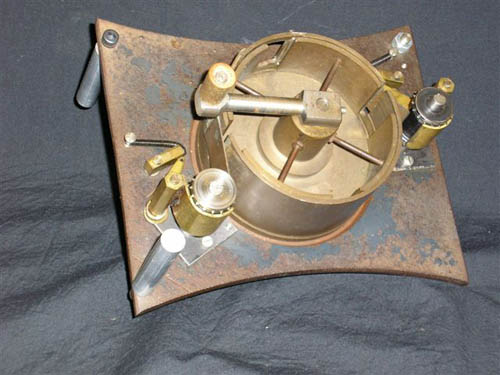
The Jones prototype was made of whatever was found in his shop that day and a bit of Meccano for luck. The one presumably in the disappeared picture was much nicer, with purpose-made parts. As I recall there was also one that could be used as a camera, also 4-35. Either of the two mentioned might have done that though, not necessarily a third model.
I think Ron's even had a sort of framing system, that would rotate the entire mechanism relative to the aperture and lens mount with about 6 perfs worth of image actually available. Tough luck if you got 2 perfs out of frame?
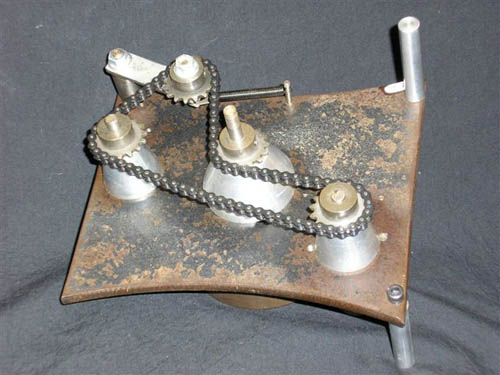
More amusing were the early 15-70 prototypes, one with a chain system instead of a solid rotor. Bill Shaw said although it never got close to 24fps the chain unit made the most impressive noises of them all.
Posted by Gordon McLeod (Member # 33) on 02-07-2004, 09:42 PM:
"More amusing were the early 15-70 prototypes, one with a chain system instead of a solid rotor. Bill Shaw said although it never got close to 24fps the chain unit made the most impressive noises of them all."
Well considering Bill was one of the engineers at CCm bicycles for years no wonder
Posted by Dick Vaughan (Member # 540) on 02-09-2004, 02:47 AM:
Hi Dave
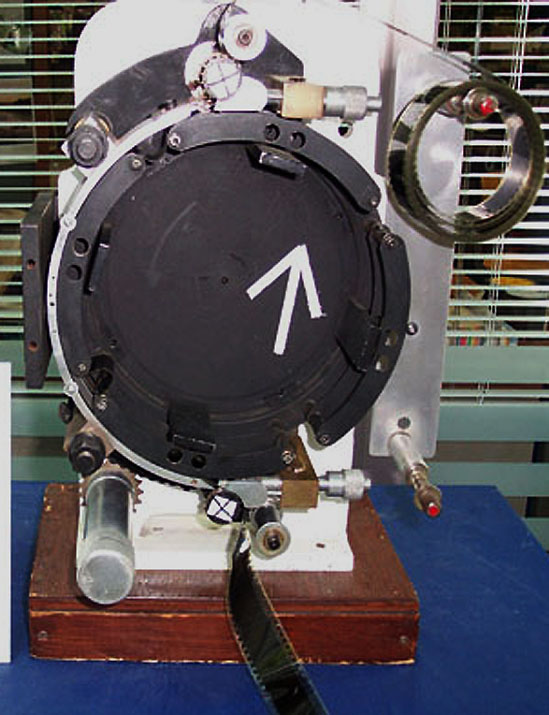
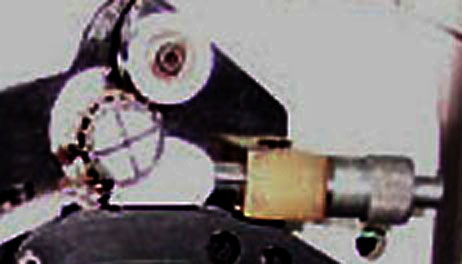
The silver knob at bottom left of the mechanism is the framing adjustment. You can see the cog meshing with I think a section of chain on the rotor mount.
We actually had this version on display outside the booth in Bradford for over a year in the mid to late 80's.
The engineering drawing shop at the Science Museum made plans for us as of course none existed back in Oakville. Unfortunately these have gone missing in the shake up in London.
Posted by System Notices (Member # 2357) on 12-31-2005, 03:47 AM:
It has been 691 days since the last post.
Posted by Paul Trimboli (Member # 1509) on 12-31-2005, 03:47 AM:
Sorry to bring this old thread back up but I have a question. Are you sure the above picture of the Ron Jones rolling loop is not for 8 perf? Its my understanding that between the rotor gaps represents one frame shown twice. So there should be 4 perf opening, flicker shutter 4 perfs wide, 4 perf opening and then the next rotor gap comes in to disengage the frame and the process starts over. Look at that picture using the sprocket as a scale it does not look like 4 perfs spacing in the rotor, although the flicker shutter look about right?
Posted by Christopher Seo (Member # 7) on 12-31-2005, 11:51 AM:
Paul,
The actual width of the shutter opening does not depend on the size of the film, but on the size of the rotor. If a rotor of length x cm represents the projection of one frame of film (i.e., we know that x centimeters' worth of rotor will pass the aperture block during the projection of one frame), then the two portions of open-shutter space in the rotor will each be of length x*E/2 where E represents the light efficiency in percent.
Disclaimer: I haven't threaded an IMAX projector in four years, much less a 4-perf one!
Posted by Paul Trimboli (Member # 1509) on 01-02-2006, 06:10 AM:
Thanks Christopher! There is going to be limitation due to travel ghost of just how large the opening can be (meaning you can't have a projector 100% light efficent), any idea on they work that out?
Posted by Gordon McLeod (Member # 33) on 01-02-2006, 10:26 AM:
Travel ghost on a rolling loop is virtually impossible aslong as the pocket for the loop to form in is holds one frame
Posted by Christopher Seo (Member # 7) on 01-02-2006, 08:00 PM:
Right, the film transport function (i.e. the pockets) is so tightly integrated with the shutter function (i.e. the openings) in the rotors that they are sort of mutually exclusive... you couldn't really produce travel ghost if you tried. The light efficiency still depends on how fast the frame-change can be accomplished, as with conventional movements, only you can't "cheat" on a rolling loop by introducing some travel ghost to improve the light efficiency like you can on regular projectors where the shutter is an entirely separate piece.
It's got me thinking though... what if ya backed the pockets with glass? As the film gets peeled off the field flattener it'll go way out of focus, so maybe it won't be very noticeable... but I assume if that idea worked it would have been implemented.
Posted by David Kilderry (Member # 142) on 01-03-2006, 05:13 AM:
Not a bad effort for an Australian projectionist/engineer fooling around in his Brisbane backyard workshop! Ron Jones apparently spent several years in the 1960's working on the rolling loop before presenting a paper on the subject.
Ron was a self-trained engineer and cinema technician, who rebuilt and repaired projection equipment. He ran tests with the rolling loop mechanism at the Eldorado Cinemas in Brisbane; today this cinema still operates and has been enlarged to an 8-plex.
Posted by Dick Vaughan (Member # 540) on 01-04-2006, 09:21 AM:
![[Big Grin]](biggrin.gif) .
.