This is topic How much tape to use to secure the end of a print? in forum Film Handlers' Forum at Film-Tech Forum ARCHIVE.


To visit this topic, use this URL:
https://ft-forum.com/ft/cgi-bin/ubb/ultimatebb.cgi?ubb=get_topic;f=1;t=006054

Posted by Jon Miller (Member # 163) on 04-12-2004, 09:11 AM:
 
Regarding the discussion on the "Technicolor to stop using reel bands" thread......

I'm curious...what could be considered the minumum acceptable length of tape to secure the end of a film before shipping?

When I personally break down film-festival prints (typically shipped on cores), I secure the print with a fresh seven or eight inch (about 18 to 20 cm) length of Artist's Tape. Do I feel like I'm wasting tape? Sometimes. Is it worth it? Absolutely! It's only about 50 cents or so (US) per print, but I get the impression that even fifty cents of cheap insurance is too much for some people. I'd be interested in what the consensus is.

Thanks!
 
Posted by Richard Greco (Member # 2032) on 04-12-2004, 09:25 AM:
 
I only use about an inch when I'm breaking down a print
 
Posted by Jeremy Fuentes (Member # 2135) on 04-12-2004, 09:34 AM:
 
A few inches is what I use. 3 or 4 seems to be enough, but the person who receives it might not think so. It would be nice to know if the next theater received the print in the same condition as I sent it out. I guess the only way I'll find out if I put enough, is if my theater comes up on the Outing Bad Film Handlers thread.
 
Posted by Mark J. Marshall (Member # 1409) on 04-12-2004, 10:17 AM:
 
I use probably nine or ten inches of permacel tape to secure the film.
 
Posted by Frank Angel (Member # 248) on 04-12-2004, 10:55 AM:
 
I have been using artist tape forever. What is this permacel tape? Is it a common tape used in other settings? Where do you get it?
 
Posted by Mark J. Marshall (Member # 1409) on 04-12-2004, 11:02 AM:
 
Permacel Tape
 
Posted by Bruce Hansen (Member # 281) on 04-12-2004, 11:18 AM:
 
If you want to be nice to the next person who receives the print, leave a pull tab. Bend over the last 1/4 inch of tape so that the sticky sides stick to each other. This makes it easier to remove the tape from the film. I like to have the pull tab on the loose end of the film, so that as you pull the tape off the film, it comes off the loose end, then off the "turn" of the film still on the reel. That way you do not have to fight to get the tape off the loose end of the film.

I find that 3 to 4 inches of tape is enough.
 
Posted by Bill Gabel (Member # 1105) on 04-12-2004, 12:36 PM:
 
I use about 3-4 inches of new artist tape. If you use just an inch of tape you are asking for trouble. Its like using a piece of used tape. With those cans bouncing along in hot trucks going back to the depot. The ends are going to come loose to the next theatre. Film Handling Done Wrong [thumbsdown]
 
Posted by Mike Blakesley (Member # 26) on 04-12-2004, 12:36 PM:
 
The pull tab, while it is polite, just encourages re-use of the tape, which is bad. When opening a print, I remove the tape and toss it. When the film is shipped out, it gets a NEW piece of tape.

If the print is going to be shipped, one inch of tape is NOT enough unless you are using prime quality tape, and maybe not even then. If you're using the cheapest tape you can buy, three or four inches is needed.
 
Posted by Brad Miller (Member # 2) on 04-12-2004, 12:37 PM:
 
The problem is too many people don't give a flip about what happens to the print after it leaves their theater and have no concept of just how much banging around happens once the cans leave their premesis. This is why rolls of film that are not perfectly tightwound from shitty platters (Strong, etc) end up getting edge-damaged and cinch scratched in transit back to the depot. Also super cheap people who only put an inch or two of tape (or worse REUSE the tape) are also causing damage because the tape DOES come loose!

Minimum 4 inches, 6 preferred, 8 is excellent. Anyone who uses 2 inches or less should be packed in a shipping can and shipped across the country on an Airborne truck to see how well they hold together.

Edit - I always put a pull tab on the tape not only for convenience for the next guy, but also because I see most people when there is not a pull tab simply grab the film and break the tape. While this isn't always necessarily bad, I have received prints before that had tape on tape where the tape "underneath" that wasn't removed came loose. Let's face it, if the next guy doesn't care, he is going to reuse that tape anyway. And by all means the pull tab goes on the end of the film, not one wrap around the reel! When the pull tab is pulled, the tape should pull completely off of the film, not halfway pull off leaving the tape still attached to the tip end. [Mad]
 
Posted by Ken Lackner (Member # 1002) on 04-12-2004, 12:45 PM:
 
Damn, Brad! A little harsh there, are we? [Smile]

Seriously, I DO care about what happens to the film after it leaves the theater, but I guess I don't have any concept of how badly they are banged around. I have always used an inch or two. Why exactly is it necessary to use four to eight inches? I guess what I'm not understanding here is if you use new tape (which I do), why is it in danger of coming loose if you use less that four inches?
 
Posted by Brad Miller (Member # 2) on 04-12-2004, 12:47 PM:
 
I'm not being harsh at all. Either do the job right or get the hell out of the booth.

I've seen prints get shipped across the country only to arrive as spaghetti because the tape came loose...good tape, not cheap masking tape either. In talking to the depots, this is a VERY COMMON problem.
 
Posted by Jeremy Fuentes (Member # 2135) on 04-12-2004, 12:50 PM:
 
I'm guessing Ken has never received a print that the tape came off, or never had any to begin with.
 
Posted by Ken Lackner (Member # 1002) on 04-12-2004, 12:53 PM:
 
That guess is correct! [Big Grin]
 
Posted by Brad Miller (Member # 2) on 04-12-2004, 01:25 PM:
 
Ok Ken, fair enough. You'll just have to trust us. From now on please use a fresh piece of tape no less than 4 inches long. [Wink]
 
Posted by Mike Blakesley (Member # 26) on 04-12-2004, 06:23 PM:
 
To find out what happens to cans of film being shipped across the country:

1. Fill up two reels full of old trailers - use 1" of old tape to tape down the ends. (Be sure to use reels that are falling apart for best realism.)

2. Put the two reels in a 3-reel TES can (to simulate the trailers that have been removed by the first-run theatre)

3. Close the can

4. To simulate handling by DHL/Airborne, toss the can down a long flight of concrete stairs

5. Repeat step 4

6. Repeat step 4 again

7. Open can (use pliers, wrench, screwdriver or blowtorch if necessary). Check results.
 
Posted by Christopher Seo (Member # 7) on 04-12-2004, 07:10 PM:
 
I can definitely attest to the fact that tiny 1-inch bits of tape will come loose and allow rolls of film to form spaghetti.

Good tape tends to have weaker adhesion than garden-variety stuff, so more must be used. Also, the tape can (and certainly will) be reused a few times, so again more is better. I use about 5-inch-long pieces of 3M Scotch 2090, which is a medium-adhesion tape. It's nice, except for the blue color. Available at places like Home Depot and paint stores.

Pull-tabs not only make it easier to remove the tape, they make it easier to remove the tape cleanly. I put tabs on both ends because I'm a nice guy. [Razz]
 
Posted by Joe Redifer (Member # 3) on 04-12-2004, 07:33 PM:
 
I usually do about 8 or 9 inches (never measured.... honest!) of white permacel tape (the best!) with a courtesy tab (or "pull tab"). I like it when others start using the pull tabs as well, but what really chaps my ass is when they put it on the wrong side. It should be on the side where the leader is closest to its end, not the other. If you put it on the other side and pull, the leader still remains attached to the tape. I hate that! With the tab on the other side, the tape comes off completely. That may be what Brad was trying to say, but I said it better. Hmmmm...(looks at my own explanation)... maybe pictures are needed.[av=v]
 
Posted by Chris Hipp (Member # 1788) on 04-12-2004, 07:56 PM:
 
You should put the tab on in the oppisite direction of the tail. you should pull the tape forward over the tail. That way it just comes off. I guess it is kinda hard to explain [Smile]
 
Posted by Joe Redifer (Member # 3) on 04-12-2004, 09:34 PM:
 
But what if my reel is heads out?[av=k]
 
Posted by Phil Hill (Member # 371) on 04-12-2004, 11:46 PM:
 
Joe, sometimes your are sooo damn dense! You NEED to rewind the film 1st before you can remove the tape...

>>> Phil
 
Posted by Mark J. Marshall (Member # 1409) on 04-13-2004, 12:15 AM:
 
quote:
This is why rolls of film that are not perfectly tightwound from shitty platters (Strong, etc) end up getting edge-damaged and cinch scratched in transit back to the depot.
[Confused]

All of my Strong Alpha platters produce a perfect tight wind.
 
Posted by Carl Martin (Member # 1146) on 04-13-2004, 05:21 AM:
 
i'd say i use about 4". i put the "friendly tab" on the wrong side apparently... just to chap joe's ass. well actually, i figure there are instances when you want to check something on the leader, or see if heads are out or whatever, and then re-secure the end. not for shipping, but just until you're ready to deal with the reel. and frankly, it's not a big deal to completely remove the tape after that.

but what i want to know is, what width tape do y'all use? i use 3/4", which is great for labeling things with lots of information. it seems like most people use narrower tape, though.

carl

correction: i use 15/16" tape. rulers are neat.

[ 04-19-2004, 12:40 AM: Message edited by: Carl Martin ]
 
Posted by Frank Angel (Member # 248) on 04-13-2004, 03:31 PM:
 
In the Cantor booth at the Brooklyn Museum, there is a policy sheet posted on the wall and in the SOP book that explains that because we get lots of foreign prints that come in every manner of packaging, the majority of which rarely have the kind of protection we are used to here in the US, it behoves us to add as much protection as we can when sending out prints. The policy goes on to state to use rolled hand towel paper to make a collar around film rolls that are sloushing around in the 2000ft metal cans so as not to have them hitting the metal sides (usually badly bent) and to apply hold-down (artists) tape a full 4 inches on either side of the film end, IOW, 8 full inches across the film end. I follow this to the T.

Uh..oh...I forgot....I wrote the policy.
 
Posted by Matt Zeiner (Member # 1914) on 04-13-2004, 05:44 PM:
 
I got a print of "Pirates" last summer that was held down with 8" of real cheap clear splicing tape. Double layered. Reel 5 (I think) was a shorty - impossible to get off without scratching the film . Oh yeah - the heads and tails were loose in the bottm of the can. It's that kind of total lack of common sence that necessitates this kind of conversation.
 
Posted by Bill Enos (Member # 440) on 04-13-2004, 06:08 PM:
 
My print of "Monster" must have come from the same theatre as Matts copy of Pirates. It also had about a foot of splicing tape. Heads and tails were on though. I get a lot of prints that were not secured at all. I send 'em all out with 5.2347 inches of tape with a pull tab for the convenience of the next user.
 
Posted by David M. Dorn (Member # 2298) on 04-13-2004, 06:51 PM:
 
Why not put a pull tab on each end....the the next person would have a choice! Couln't take more than 30 secs. more.
 
Posted by Brad Miller (Member # 2) on 04-13-2004, 07:09 PM:
 
I'd rather get a print with a pull tab on each end than no pull tab at all, but you asked why. The reason is because if I have a print with two pull tabs, then I have to look closely at which one to pull. Yeah it's super anal and nitpicky, but it's no worse than getting a print with a reel band on backwards of the rotation of the reel. You know what I'm talking about. You pull the reel from the can, see which way the reel band is placed on the reel and mount it to the shaft accordingly. Then after removing the band you see the dunce who mounted that band put it on backwards, so you have to flip the reel around.

Nitpicky of me, sure. Super annoying on a busy night, absolutely.
 
Posted by Pete Wolla (Member # 1581) on 04-13-2004, 09:44 PM:
 
i use at least 6 inches of tape but i put the tab so the tape stays on the head . i like to use the tape to hold the head as i roll it up to put in the reel.
 
Posted by Mark Gulbrandsen (Member # 72) on 04-13-2004, 09:50 PM:
 
Working as a tech I don't make up up or tear dowe very much film but if I did and taking into consideration to all the grief I read on this site about Technicolor I think I'd use a whole roll of duct tape per reel!!!
Mark
 
Posted by Pete Wolla (Member # 1581) on 04-13-2004, 09:57 PM:
 
the next theatre would just have to deal with it . the duct tape that is
 
Posted by Jeremy Fuentes (Member # 2135) on 04-13-2004, 10:25 PM:
 
quote:
the next theatre would just have to deal with it . the duct tape that is
Please tell me youre kidding!
 
Posted by Matt Zeiner (Member # 1914) on 04-14-2004, 06:55 AM:
 
Stick it to the man, Mark!
 
Posted by System Notices (Member # 2357) on 07-21-2010, 08:03 PM:
 

It has been 2289 days since the last post.
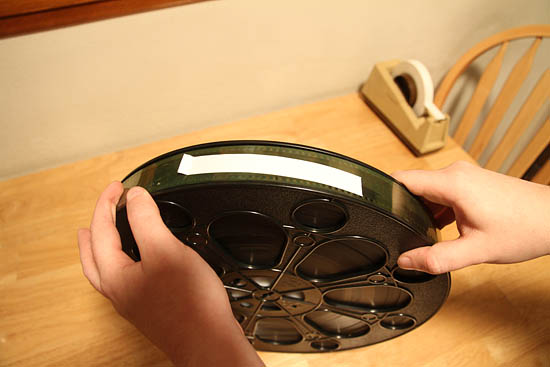

 
Posted by Bill Slaughter (Member # 5722) on 07-21-2010, 08:03 PM:
 
We don't get that many used prints but we have been getting a lot of them using masking tape at the joint of the header and the film. I hate that because masking tape leaves residue on the film. I try to clean them up so they are in better shape for the next guy than they were when I got them.
 
Posted by Joe Redifer (Member # 3) on 07-21-2010, 10:08 PM:
 
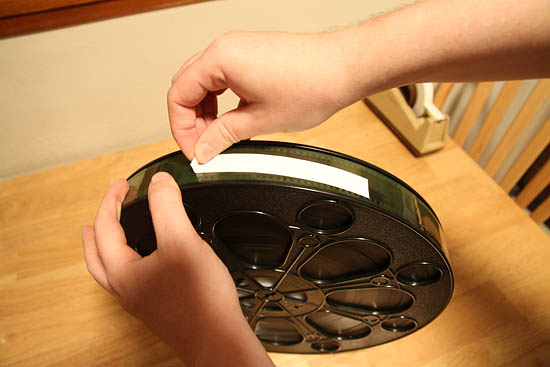
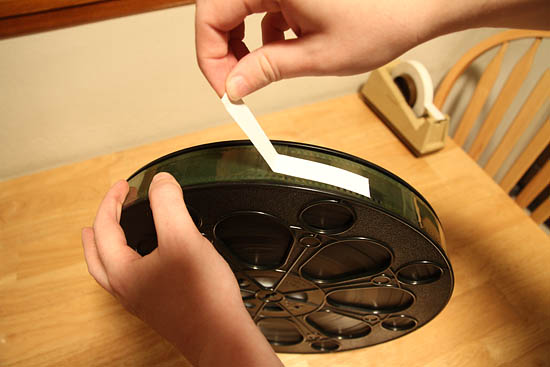
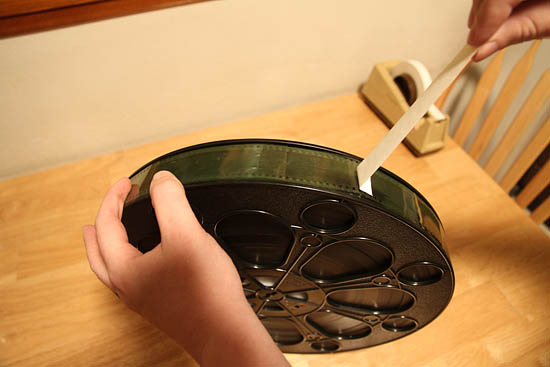
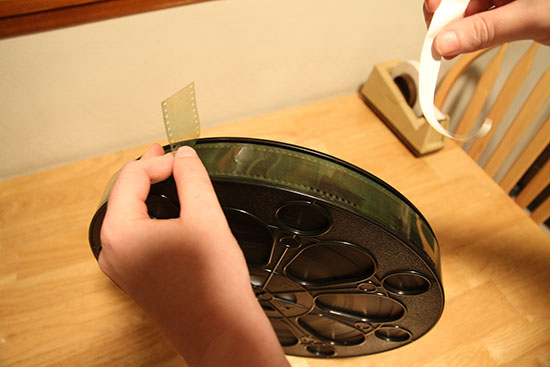
I still use a decently generous amount of tape. I never keep the existing tape when a used print comes in. And I still use a pull tab. The pictures below should demonstrate which side the tab needs to be on. I used one of the shorter reels from Inception for this demonstration:

For this demonstration, the soundtrack is away from you, even though you cannot see it. That means the reel is properly wound emulsion-out. Those who do not wind emulsion-out are retards unless they have a very specific reason for that specific print.
 -
The pull tab is on the left. Look how inviting it is. No picking at the base of the tape will be needed to remove it.

 -
OK I'm going to try it. Let's see, I just grab the tab and start to pull!

 -
Oh wow, this is easy!

 -
I'm almost done and none of the film is coming off with the tape. How considerate of the person who applied it.

 -
I did it! I'm done! You can see where the film starts and it goes to the left, so that is the side the pull tab must be on. PROTIP: This even works for taping the tail when you move prints!

[av=v]
 
Posted by John Wilson (Member # 269) on 07-21-2010, 10:39 PM:
 
quote: Joe Redifer
I used one of the shorter reels from Inception for this demonstration
 -  -  -  -
 
Posted by Brad Miller (Member # 2) on 07-22-2010, 04:35 AM:
 
If only everyone would apply tape in the fashion of Joe's pictures above, life would be much better.

Its sad though that Joe had to point out the winding direction of the film, but I know why, because there are some dips out there that intentionally put the tape the OTHER direction with a pull-tab. Ugh! No silly, that takes more time to remove because once you pull on the tab, you now have to stop and separate the tape from the film. Why, why, why do some people do that?

We should actually make this a formal submission in the TIPS section, as this should be mandatory reading for anyone handling film.
 
Posted by John Wilson (Member # 269) on 07-22-2010, 06:37 AM:
 
I had one guy who used to apply the tape with the 'courtesy fold' the wrong way. He simply couldn't be told otherwise.

He gone now. [Razz]
 
Posted by Ottilie Young (Member # 4195) on 08-09-2010, 11:51 AM:
 
Here at Doc Films we use at least 6" with a courtesy tab in the correct orientation.

I have a question: why emulsion out? Emulsion orientation depends on whether the reel is heads or tails out. We rewind in an under to over S-Curve (to mimic the path through our Simplex XL projector, changeover system) always with the soundtrack toward the operator. Most films come in to us tails-out. If the film is tails out, the emulsion side is inside while if the film is heads out the emulsion side is out. Since we're a changeover house, films coming in heads out are the bomb. Sometimes we receive instructions "Do Not Rewind" which to me says leave it as the film was taken-up at the projector, i.e. tails out and the emulsion side is "inside."

Thanks,

Ottilie Young
Equipment Chair
Doc Films
University of Chicago
 
Posted by Mitchell Dvoskin (Member # 751) on 08-09-2010, 12:00 PM:
 
Years ago, Kodak did a study in regards to storing old acetate film emulsion in or out. They came to the conclusion that storing emulsion in (or was it out?) caused less film curling and a more even focus from the beginning to the end of the reel.

Personally, my experience from years of working with archival prints is that it really does not make much difference. For Polyester prints, the whole issue is mute.
 
Posted by Stephen Furley (Member # 1277) on 08-09-2010, 01:45 PM:
 
quote: Ottilie Young
Emulsion orientation depends on whether the reel is heads or tails out.
No it doesn't, all four windings are possible, and not uncommon. I've actually had all four possibilities with different reels of the same print.
 
Posted by Jeffry L. Johnson (Member # 453) on 08-09-2010, 02:10 PM:
 
"Effect of Winding on the Projection Performance of 35mm Motion-Picture Film", SMPTE Journal, 1965 June.

SMPTE Recommended Practice RP-39,
Specifications for Maintaining an Emulsion-In Orientation on Theatrical Release Prints

IMAX recommends emulsion-in for optimal focus. IMAX prints have always been on polyester stock.
 
Posted by Chris Slycord (Member # 4239) on 08-09-2010, 03:22 PM:
 
Before Brad jumps in on this:
quote: John Pytlak
Although SMPTE Recommended Practice RP39 specifies emulsion-in winding for optimum focus performance, it is based on Kodak tests with TRIACETATE prints on reels having small hubs. There is not enough data to specify the optimum winding orientation for polyester prints, and with the large hub diameter used on platters, the focus performance shouldn't vary too much with winding orientation anyway.


Powered by Infopop Corporation
UBB.classicTM 6.3.1.2