This is topic Carbon Arcs Still Available? in forum Film Handlers' Forum at Film-Tech Forum ARCHIVE.
To visit this topic, use this URL:
https://ft-forum.com/ft/cgi-bin/ubb/ultimatebb.cgi?ubb=get_topic;f=1;t=006295
Posted by Andrew McCrea (Member # 674) on 06-23-2004, 03:09 PM:
Hey everyone...
I didn't know Carbon Arcs were still availble. This small theatre that just burnt down outside of Winnipeg was using them up until the fire in May. The owner said in the paper that they'd go through $15 worth a night... That doesn't sound like a lot considering the cost of a Xenon.
Can any of you help me out: I want to know people who still make them, how they work and the benefits/disadvantages, etc.
Thank-you!
Posted by John Walsh (Member # 168) on 06-23-2004, 05:25 PM:
They are generally not avaiable. Usually, theaters that had them installed long ago continue using them.
At $15 a day, that's $450 a month. A 3K xenon bulb costs a bit more than that, but lasts several months, so xenons are cheaper to operate. When you add in the cost of cleaning a carbon arc lamp, it really doesn't make sense.
Many like the warmer 'look' of carbon arc, but for a regular theater running every day, I don't think it's worth it.
Since this has been covered before, you might want to check out the topic "Carbon Vs Xenon" from 02-08-2002.
Posted by Andrew McCrea (Member # 674) on 06-30-2004, 12:13 PM:
In this theatre, they had 134 seats and are in a small town of about 5,000-8,000. Do you think you'd be able to determine what size xenon would be needed for an upgrade? I thought a 1.6KW would do the trick. Do you think the booth has single or three phase power?
Posted by Scott Norwood (Member # 30) on 06-30-2004, 12:20 PM:
Depends on the screen size (we'd need to know the sizes for all formats), the lenses being used, and the screen material. The lamphouse itself will also make a difference.
What size carbons are they using now and how bright is the picture?
And, yes, carbons are available through Marble and others. I don't believe that carbon-arc lamphouses have been manufactured for cinema use for many years, although there are other applications where carbons are used. There might be some third-world country that still makes the lamphouses, though. Anyone?
Posted by John Pytlak (Member # 331) on 06-30-2004, 12:22 PM:
With a matte white (gain=1) screen, the general "rule of thumb" is about 5 watts per square foot of scope screen area. So for a small 10 x 24 foot matte screen, a 1600 watt xenon lamp should easily provide enough light, as at least 1200 watts would be the "rule of thumb".
Posted by Andrew McCrea (Member # 674) on 06-30-2004, 01:36 PM:
Here's more information:
-Booth package has been in theatre since the 1930s.
-Upgrade with Super Lume-X.
-Interested in operation of the theatre after some business college education.
-Is three phase or single phase better/cheaper when running a lamp of 1.6KW?
-10'x24'... Is that maximized in scope? I bet in a small theatre from the 20s/30s with 134 seats, the screen would be a little bigger han that.
Posted by Aaron Sisemore (Member # 145) on 06-30-2004, 08:19 PM:
deleted double post
Posted by Aaron Sisemore (Member # 145) on 06-30-2004, 08:19 PM:
-Booth package has been in theatre since the 1930s.
What type of projector(s) are they?
-Upgrade with Super Lume-X.
Good call. My all-time favorite xenon lamphouse.
-Is three phase or single phase better/cheaper when running a lamp of 1.6KW?
If using reactance-type supplies, three-phase is better because it is easier to filter (less ripple in the DC output with 3-phase, requiring less capacitance to accomplish the filtering). With switchers, it doesn't really matter whether you have single or 3-phase as far as the nearly-pure DC goes.
-10'x24'... Is that maximized in scope? I bet in a small theatre from the 20s/30s with 134 seats, the screen would be a little bigger han that.
That's a 2.40:1 aspect ratio, should be fine for scope- You may not be able to put a larger (width) screen in a place that old, especially if has a stage/proscenium that pre-dates CinemaScope.
-Aaron
Posted by Stephen Furley (Member # 1277) on 07-04-2004, 04:51 AM:
Andrew, as far as I know, carbon arcs have not been made for projection for many years. A trade magazine whiich I was reading a few years ago carried an advert for the Autoarc; I think the magazine was dated either 1970, or 1971. This was probably the last carbon arc lamphouse to be manufactured, and I suspect that it was discontinued soon after this. Xenons have been available since the '50s, but were not very widely used at that time.
Early xenons had a number of problems, including high initial cost, poor colour and tendancy to explode. Many early installations had problems with inadequate or incorrect cooling airflow, or excessive a.c. ripple from the rectifiers.
Another problem was that although xenons were introduced just after the demise of nitrate, when the fire regulations started to be relaxed to permit larger spools, most cinemas still ran film on 2000 foot reels at that time. Large spools, holding an entire film were introduced in the '60s, and platters in the early '70s. Xenons are not ideal for running 20 minute changeovers; you have to either leave both lamps running all the time, wasting power and lamp hours, or re-striike a lamp for each reel, shortening lamp life. I know of just four conversiions from xenon to carbon, three of them in public cinemas. One of these was a place that had two machines, one ran the feature from large spools on a tower, the other ran just the adverts and trailers on a 2000 foot spool. This machine was converted back to carbon for this reason; it only ran for a few minutes every 2-3 hours. This place has since closed.
Sereral changes from the 1960s favoured the conversion to xenon lamps. The use of long reels or platters made them almost essential, and at about the same time, large cinemas were being split up into several, usually three, smaller auditoria. This led to a requirement for one projectionist to operate several screens, to reduce costs. This would be difficult to do with carbons.
Carbon arcs are very expensive to operate today. The carbons themselves are expensive, and good quality ones can be difficult to obtain. Carbon arc lamps are more complex, with moving parts to feed, and in some designs rotate, the carbons; they also require frequent cleaning. Many of them also require water cooling, which xenons do not, except in the largest sizes. Carbon arcs therefore also have higher maintenance costs.
A carbon arc with a good operator, good carbons and a good rectifier or generator can produce a very steady light, but it does need looking after. Moving both carbons together, in the same direction, keeping the arc length constant, but moving it relative to the mirror by just a milimetre or two can result in a drastiic change in the brightness, colour and uniformity of the illumination on streen.
I am old enough to remember when the carbon arc was almost universal for projection; it was certainly used in all of my local cinemas. One by one, the all either converted, or closed. I could always tell as soon as the picture hit the screen that a conversion had been made, the light was different. It wasn't just that the colour temperature was higher with xenons, it was just a 'different' light. I'm not even sure what that difference is. High intensity carbon arcs emit a complex spectrum, it is a combination of a continous spectrum, and a large number of lines, from various elements in the core.
Three years ago I knew of four public cinema in England running carbons; one of those had two screens. Today, only one of those is left, I've never been there, it's a long way from where I live, and I doubt that it will last much longer.
In the U.S.A. there still seem to be just a few places running carbon, but they are converting too. The Byrd in Richmond converted not too long ago, and in the last couple of weeks, somebody here (sorry, I can't remember who it was) announced their last carbon show. There will soon be none left.
Have you ever met a steam engine enthusiast? They will talk about the difference between a steam engine and a Diesel, or an electric motor. They will tell you that a steam engine needs more looking after, but it is somehow almost 'alive', more like working with a horse than with a Diesel engine. I suppose that a carbon arc is something like a steam engine.
If you have never seen, or operated, carbon arcs, try to do so at least once, while you have the chance; they won't be there much longer, and a preserved steam engine is probably going to be easier to find than an operating preserved carbon arc.
[ 07-04-2004, 02:30 PM: Message edited by: Stephen Furley ]
Posted by Ken Layton (Member # 133) on 07-04-2004, 12:05 PM:
Carbons are still made at www.cinemacarbons.com
Posted by Andrew McCrea (Member # 674) on 07-05-2004, 03:14 PM:
Thanks everyone for the help!
If you were running a 1.6 KW Xenon on single phase, would it be cheaper than three phase?
Also, how do you pronounce XENON? I've always pronounced it ZEE-NIN, but do you pronounce it ZEE-NON?
Also- How do they rate carbons? Would they do it 1.6KW like a Xenon?
Thank-you once again! I've been learning so much lately
Posted by Stephen Furley (Member # 1277) on 07-05-2004, 04:05 PM:
Andrew, the carbons themselves are measured by diameter and length. For some reason, the diameter is usually measured in milmetres, and the length in inches. Rather than giving the power of the lamp, in Watts, it is normal to specify the current, in Amperes. My Bell and Howell 609 16mm projector burns 5.5 x 6 inch and 6.5mm x 9 inch carbons, the larger size is the positive, at 30 Amperes. This is about as small as it gets. The equivilent of a 1600W xenon might be 7mm negative and 8mm positive, at about 50-60 Amperes. The Loew's Jersey, if I remember correctly, burns 13.6mm positives, and about 9 or 10mm negatives, at about 165 Amperes. Some drive-ins went higher, I think to about 220 Amperes.
These are all 'modern' high intensity arcs, the older low intensity type used larger carbons. There were many different types of arc lamps, the most common in later days was very similar to a horizontal xenon, with a parabolic mirror wiith a hole through which the negative was fed, with the positiive poiinting towards the mirror. The length of the arc gap was typically about 6-8mm.
The 'National Carbon Buletins' are available for download somewhere in the manuals section. They give lots of information.
Here in England we pronounce xenon zen-on, while in the U.S, it tends to be zee-non. I don't know about elsewhere in the world.
Edit.
If you look at my post on the 'Seeking info on the FP-20' thread thread thread there is a picture of a machine with a typical large, water cooled, rotating positive carbon arc lamphouse.
[ 07-06-2004, 01:44 PM: Message edited by: Stephen Furley ]
Posted by Andrew McCrea (Member # 674) on 07-07-2004, 08:19 PM:
If you were running a 1.6 KW Xenon on single phase, would it be cheaper than three phase?
Would it be smarter to do single pahse with a phase converter?
Posted by Aaron Sisemore (Member # 145) on 07-08-2004, 02:20 AM:
quote: Andrew McCrea was the last to post
If you were running a 1.6 KW Xenon on single phase, would it be cheaper than three phase?
Price of power supplies notwithstanding, AFAIK, power is power, 1600 watts is the same whether it be single or three phase.
quote: Andrew McCrea
Would it be smarter to do single pahse with a phase converter?
If it was the motor/generator type phase converter you are wasting energy to convert the phases due to the load of the motor.
A solid-state phase converter (if such a beast actually exists) might save a few watts here and there.
-Aaron
Posted by John Hawkinson (Member # 1135) on 07-10-2004, 12:07 AM:
"AFAIK, power is power, 1600 watts is the same whether it be single or three phase."
Well, 1600W of output is not 1600W of input; the efficiency of the AC/DC conversion matters, and varies. I expect it depends mostly on the age of the rectifier. We all know that 3-phase rectifiers produce cleaner DC than single-phase rectifiers, but I don't know about efficiency. Anyone?
"A solid-state phase converter (if such a beast actually exists) might save a few watts here and there."
Well, such a beast would be an inverter, which certainly exists, but is probably not energy-efficient or cost-effective in the kW range...
--jhawk
Posted by Gordon McLeod (Member # 33) on 07-10-2004, 09:04 AM:
The total KVA consumption of a modern solid state rectifier is about the same for single or three phase and with electronic rectifiers the quality of the DC is the same
Posted by Andrew McCrea (Member # 674) on 08-28-2004, 12:25 AM:
Ok, it has Super Simplexes as I've recently found out, with a Ballantyne M6 something soundhead.
A romour as to how the fire was caused says that the projectionist threw a hot carbon on the floor.
Posted by Steve Kraus (Member # 476) on 08-28-2004, 08:46 AM:
For Andrew:
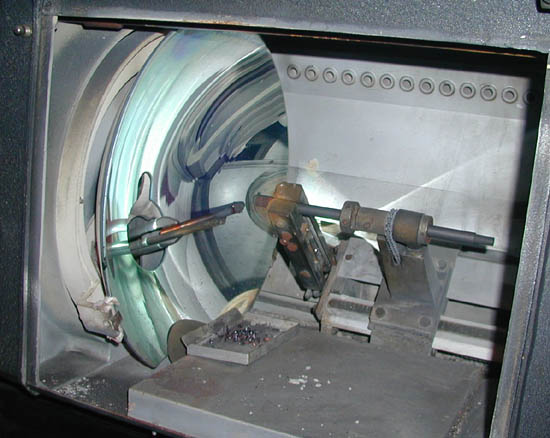
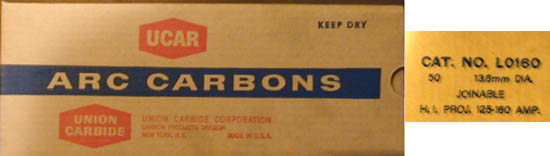
Ashcraft Super Corelight interior (copper coated negative, rotating bare positive--in this instance they are of the joinable type. Current introduced into the positive via the jaws seen just to the right of the burning tip
Box of positives:
Box of negatives:
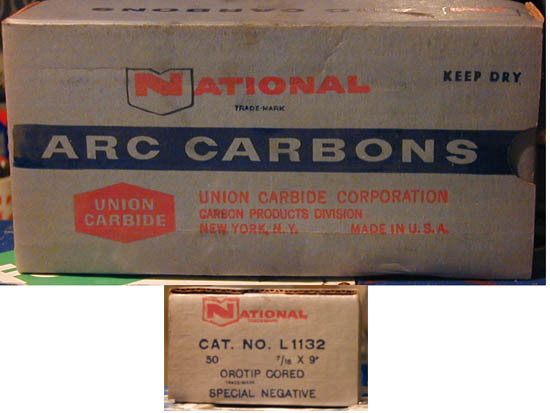
The two boxes are not shown to the same scale. The negatives are 7/16" (diameter) x 9". The positives are 13.6mm (diameter). Not sure of the length; maybe 12" or so. But these are the joinables. The regular one piece positives would be 18" or 20".
Posted by Mark Gulbrandsen (Member # 72) on 08-28-2004, 10:06 AM:
"Well, such a beast would be an inverter, which certainly exists, but is probably not energy-efficient or cost-effective in the kW range..."
Actually an invertor can be made to approach 95% efficiency today. So yes thay can be made more efficient. The cost effectiveness factor would have to be calculated over the life span of use of the invertor. Compare the purchase price to power consumed to length of life span of the unit. The amount of power an invertor generates has no relation to its efficiency either. An invertor that generates 100 watts of power can easily be made to run as efficiently as one that generates 10kw. A really good example are the big motors of 10 hp and up that are now typically invertor driven and are at least 40% to 50% more efficient than the majority of older motors of past years. Over 20 years its possible for these motors to actually pay for them selves in power savings alone! The main advantages are that they(motors, rectifiers, power supplies, etc) are generally pulse width modulated, run at higher and hence more efficient frequencies. The transformers involved are also more efficient because of the high modulating frequencies and are sometimes even the toroid type. There is less chance, sometimes no chance, of extreme core saturation because of the regulation possibilities when pulse width is used to drive an invertor. There is also ALOT less heat loss associated.
One point that Gord says above is that the "quality of the DC is the same".... I would have to disagree somewhat with that because any ripple that gets through to the output... and some alsways does... is going to be low frequency in natuire on an iron core rectifer whilst in an inverttor type its going to be high frequency(which is much easier to filter out to begin with). To many circuits the hf ripple doesn't even matter but many circuits are very sensitive to low frequency ripple, Xenon lamps for example.
Mark @ CLACO
Posted by Steve Kraus (Member # 476) on 08-28-2004, 10:22 AM:
Inverter? For motor drives yes but for lamps? Do you mean a switching supply? Are you calling that an inverter?
Posted by Mark Gulbrandsen (Member # 72) on 08-28-2004, 12:14 PM:
Websters.......
Main Entry: in·vert·er
Pronunciation: in-'v&r-t&r
Function: noun
1 : one that inverts
2 : a device for converting direct current into alternating current
In reality a switching supply really is an inverter and can be made to work either way. The difference is that you are just rectifing the inverters output to provide DC to something instead of using the amplifiers output directly as in the case of a motor drive inverter. Its also possible to use a feed back loop to control any type of electrical inverting process.
Mark
Posted by Steve Kraus (Member # 476) on 08-28-2004, 12:33 PM:
I thought the way a switching supply works is to rapidly switch on and off, varying the duty cycle so the voltage across an output cap is maintained to whatever is desired. Where is alternating current being created? Isn't just high frequency pulsating DC?
Posted by Mark Gulbrandsen (Member # 72) on 08-28-2004, 01:28 PM:
I can show you the blueprints for some of the Strong Switchers if you happen to find your way to the airport. Remember that I am an industrial spy I actually have a number of them. It is a pulse width(AC) driven amplifier and then the output of the amplifiers is rectified by large stud mounted high speed diodesprobably Shottkys or something similar(this explanation is very simplified of course). If you fed a pulse width modulated aquare wave into a capacitor you are essentially feeding high duty cycle AC into a capacitor which is what a square wave really is. It has to be rectified, converted to DC first. The square wave would eventually cause the capacitor to explode or blow its relief valve because a high level square wave can cause ALOT of current flow through a capacitor which would generate a huge amount of heat really fast.
Also I don't know of a switching supply that uses the actual 60 hz incomming for anything. They all have independent waveform generators as the refrence. This refrence is sometime whats actually being modulated and then amplified, others do it differently.I found this on the web. Since sometimes I have a hard time explaining my thoughts.... perhaps it explains it better than I can.....
____________________________________
"They convert the 60-Hertz (Hz, or cycles per second) current to a much higher frequency, meaning more cycles per second. This conversion enables a small, lightweight transformer in the power supply to do the actual voltage step-down from 110 volts (or 220 in certain countries) to the voltage needed by the particular computer component. The higher-frequency AC current provided by a switcher supply is also easier to rectify and filter compared to the original 60-Hz AC line voltage, reducing the variances in voltage for the sensitive electronic components in the computer.
A switcher power supply draws only the power it needs from the AC line. The typical voltages and current provided by a power supply are shown on the label on a power supply.
Switcher technology is also used to make AC from DC, as found in many of the automobile power inverters used to run AC appliances in an automobile and in uninterruptible power supplies. Switcher technology in automotive power inverters changes the direct current from the auto battery into alternating current. The transformer uses alternating current to make the transformer in the inverter step the voltage up to that of household appliances (120 VAC)."
__________________________________________
Mark
Posted by Howard Johnson (Member # 62) on 08-29-2004, 02:19 PM:
We still have a working Simplex E9 with Peerless Magnarc at the Dome Cinema in Worthing. We use a FP20 with a tower for the usual shows but can run a 2000 foot spool on the Simplex. We have a reel of old adverts we sometimes run. The Simplex is equipped with a Dolby soundhead! We have 2 spare Peerless arcs from the Plaza Oxted when they converted to Xenon which was done to save running costs as discussed earlier. The Plaza Oxted used to have the distinction of running 2 Westars on changeover with 6000 ft spoolboxes carbon arcs and DTS sound!
Posted by Steve Kraus (Member # 476) on 08-29-2004, 02:41 PM:
Awesome. Now if only we can find someone providing state-of-the-art picture and sound via something really ancient like a Simplex Standard.
Powered by Infopop Corporation
UBB.classicTM
6.3.1.2