This is topic Telecines in forum Film Handlers' Forum at Film-Tech Forum ARCHIVE.
To visit this topic, use this URL:
https://ft-forum.com/ft/cgi-bin/ubb/ultimatebb.cgi?ubb=get_topic;f=1;t=006429
Posted by Michael Schaffer (Member # 1204) on 08-02-2004, 04:45 AM:
How exactly do they work to transfer film to analog and digital video signals?
Posted by John Pytlak (Member # 331) on 08-02-2004, 05:30 AM:
Telecines used to be based on studio video camera technology, using vidicon or plumbicon tubes (e.g., RCA TK27).
Rank (Cintel) and Kodak pioneered the use of flying spot scanner technology for high-end telecines, which allowed continuous-motion gentle handling of film negatives. The Thomson Spirit DataCines use Kodak technology for their illumination and scanning system, using special line-array CCDs. Sony and Imagica have area array CCD telecines.
http://www.thomsongrassvalley.com/news/2003/20030912-sortzz-IBC_Spirt_4K.html
quote:
The new Grass Valley Spirit 4K high-performance film scanner specifically targets the rapidly growing digital intermediate market by improving scanning technology in a number of key areas. Its new dual-mode high-speed scanning capability offers RGB 2K scanning at up to 30 frames per second (fps) and 4K scanning—which is seen by many as the future of high-quality digital film post—at up to almost 8 fps. Both 16mm and 35mm film gauges and a wide variety of formats are supported. Support for 65mm, 70mm, and Super 8mm will be released in the near future...
As with the acclaimed Grass Valley Spirit DataCine, the optical and imaging subsystems have been developed with Thomson by Eastman Kodak. This provides diffuse illumination to minimize the effects of surface scratches and dust. Optical film matching and optical gain control are also included, and the lens gates include filter drawers for "in-camera" effects.
Image capture is by custom-designed, dual-array CCDs, offering native 2K and 4K resolution. The CCD output is converted to 16-bit digital signal processing for unmatched quality. Facilities include RGB color correction, with the ability to connect third-party secondary color processors into the internal signal path. The internal scaling engine provides a 4K-for-2K mode which benefits from 4K oversampling to eliminate aliasing and other artifacts. The data outputs use the Gigabyte System Network (GSN) interface which comfortably supports real-time 2K transfers.
Posted by Michael Schaffer (Member # 1204) on 08-02-2004, 11:06 AM:
Thanks!
Posted by Stephen Furley (Member # 1277) on 08-17-2004, 06:52 AM:
In PAL-land, where there is no need for the 3:2 pulldown, intermittant projector style telecine equipment went out for broadcast use long ago. The only place I ever actually saw it was at the studios of the Innner London Education Authority, for whom I worked at the time. I had to visit their studios once. They had bought a lot of ex. broadcast black and white equipment when they set up their television service. They were also the only people I know who used the half speed option on 2" Quad tape, on Ampex VR2000 I think it was. I can't remember what cameras they were using.
Flying spot machines were the standard for many years; take a look at the Cintel section on this site: http://www.bbctv-ap.co.uk/bbctvp1.htm Scroll down to 'Contents', and then select item 3. Anybody who has seen the 'Elephant's foot' version of the Kalee 21 projector will recognise the top spool box on this thing. Also, the general styling is rather similar.
Michael, are you familiar with the Mechau projector? The BBC at one time used machines based on this for both telecine and film recording. There's a lot of interesting stuff on this site.
The original 1936 studios at Alexandra Palace still exist, the BBC finally moved out in the '80s, and most of that area is now derelict, and unsafe, though one of the studios is sometimes opened to visitors, it's tiny.
Posted by Greg Routenburg (Member # 1742) on 08-17-2004, 08:06 PM:
What about going in the other direction, i.e. from TV source to Film. All those wonderful advertisments that play before the previews in most large theatre chains. God I hate those things.
Posted by Ron Lacheur (Member # 1126) on 08-17-2004, 09:13 PM:
Video to Film, I'd imagine they are printed to film using the ArriLaser process.
Posted by Steve Kraus (Member # 476) on 08-17-2004, 10:02 PM:
The older style system for telecine like was used in tv stations airing film directly usually had several projectors beaming into the camera with selection made via a mirror multiplexer which had first-surface mirrors that could flip up or down quickly for on air changes between machines or slide to film etc. The camera didn't look anything like a regular camera, more like a large square cabinet with a hole in the side where the image beamed in. Internally it was just like a standard camera just not as crammed together. Lens. Color separating prism. Three camera tubes with deflection yokes.
The modern telecine systems are generally of two types: Flying spot scanners or CCD. From the outside they look similar, like this Rank which, IIRC is a flying spot canner.
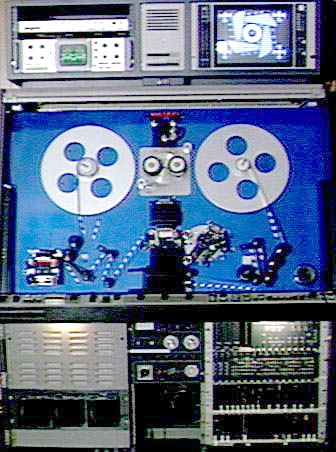
A flying spot scanner contains a little monochrome CRT (picture tube). A raster is scanned on the tube. That is, a scanning pattern without any picture, just white. This is focused onto the film via an optical system. The flying spot refers to the spot of light the electron beam paints onto the CRT phosphor screen...it's only one tiny point at any given time...thus the film is being scanned with light. After the film it's no longer an image...just varying levels of light and an optical system relays this to a color disecting prism and photomultipliers or other light pickup.
By changing the size or shape of the raster on the CRT it is possible to zoom into the film, de-anamorphose Scope images, pan & scan etc. with no loss of resolution, at least not on the electronic side.
The other system uses CCD chips like you have in a camera except these are typically a single line with the second dimension coming from the motion of the film. Scan the film into a frame store memory as it rolls by then at the other end crank out the data in whatever arrangement you need (such as 2:1 interlaced normal video). Light source. Film. Optics. Prism. CCD chips for red, blue, green. Just like a camera except for the one dimension aspect.
Bosch once experimented with adding an extra CCD for infra-red. It would pick up little to no image on color film (the dyes being transparent to IR). Any spots seen would have to be dirt and therefore it would know to conceal it by replacing with an average of adjacent pixels. I don't know if it was ever marketed.
Posted by Dominic Case (Member # 1830) on 08-17-2004, 11:35 PM:
quote: Ron Lacheur
Video to Film, I'd imagine they are printed to film using the ArriLaser process.
The Arri laser is regarded as the best way to do this (digital to film transfer - or film recording). This is also the final stage of the Digital Intermediate process, used by an increasing number of feature productions, and invariably used for digital effects if not the entire film.
However there are other systems: Celco and others use the slightly older CRT process where each frame of the image is scanned out on a monchrome CRT in very high resolution, very slowly (to minimise the size of the dot), one colour at a time (exposing through R, G & B filters in succession).
These are both used for high resolution digital recording and can also be used for transferring from standard TV resolution - such as for the pre-show commercials mentioned. Usually some digital enhancement and improvements are often used.
Other "kine" processes are more like a camera pointing straight at a real-time high resolution monitor displaying a video image. These systems are only for transfer from SD video.
Posted by John Hawkinson (Member # 1135) on 08-18-2004, 01:20 AM:
And the magic word is...KINESCOPE!
--jhawk
Posted by Mark Gulbrandsen (Member # 72) on 08-18-2004, 08:24 AM:
JHawk......
Kinescopes are now considered to be obsolete by the electroics industry and you will see them disappear very rapidly over the next several years.
MArk
Posted by Steve Kraus (Member # 476) on 08-18-2004, 09:23 AM:
Let us be clear here: The word kinescope specifically refers to a CRT picture tube such as used for television and computer displays. Kinescopes (picture tubes) are a subset of CRT's which also include oscilloscope type displays, old style camera tubes, etc. Kinescope was originally a trademark.
Kinescope in J-Hawk's context refers to film shot off the face of a CRT. I suppose hypothetically output from a CELCO or similar film recorder could be called a kinescope but typically it refers to the old B&W footage shot in real time back in the days before videotape. I don't think anyone would want to use a conventional dot mask color CRT for kinescope filming (which is not to say it hasn't been done) but it is possible to use 3 monochrome CRT's (with appropriate color phosphor or color filters) and combine the images with mirrors so color can be shot real time.
I know NBC News and maybe the other US tv network news organizations preserved news footage even from the videotape / ENG era on film. Sometimes this footage is aired and has a peculiar video to film to video look. I wonder if this was tranferrred with some sort of real time kinescope arrangement.
Posted by Mark Gulbrandsen (Member # 72) on 08-18-2004, 09:44 AM:
Steve,
What you have seen is more than likely a direct kinescope recording. There were many of these eystems all over the world before the advent of video tape resorders. They do have a strange look to them and the cameras used were also strange.
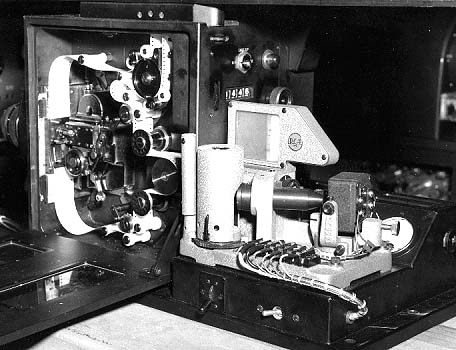
Some systems had the processing machine located right after the kinescope recorder(camera) and the films were immediately processed and the cameras re-loaded to record the next TV show or news footage. Large TV stations had entire Kinescope Recording departments. Many of the people in them were later trained to operate Video Tape machines.
Mark
Posted by Steve Kraus (Member # 476) on 08-18-2004, 01:19 PM:
You're talking about the old stuff; I'm talking about color footage that originated on tape and is preserved on film, presumably 16mm.
There was something in SMPTEJ once about a system, German I think, that kinescoped a live feed, reversal processed it, projected it, and washed off the emulsion and recoated it, all in a big endless loop.
Nice kinescope camera + sound recorder you show there. I wonder if that is a small sprocket after the lower loop but before the sound drum or just some sort of impedance roller. The sound part is probably standard Photophone with light source, mirror galvo over on the right and various optics.
Posted by Mark Gulbrandsen (Member # 72) on 08-18-2004, 02:22 PM:
Thats a 1940's Acme TV recording camera in the picture. Presumably that is also a standard VA RCA galvo on the back. They also did this in 35mm format as well.
While there may have been a system devised by the Germans like what you described(who else would do something so ludricous?) I doubt that it had any real market penetration, probably none over here at all. What you saw more likely would have been used for an early method of standards conversion. And it probably would be one of these films that you happened to see. Electronic standards convertors have existed since the early 70's although they were megabucks back then and the output quality was dubious at best. The film standards converter may have actually done a better job back then!!
Alot of old video tape was transfered to later video tape formats when it was deemed necessary to preserve it or for wide re-play again. But you'd be surprised how much 2" quad tape is still stored in temperature controled vaults that'll play back just fine on the right equipment. Today most of all important video tape has been digitized for posterity in some manner.
Mark @ CLACO
Posted by Stephen Furley (Member # 1277) on 08-18-2004, 03:44 PM:
In the '60s, the BBC still had some fairly ancient Cintel telecine equipment, though not as old as that on the site that I linked to. I also saw, disused in a museum, a machiine which had been converted to colour at some time during its life, with new solid state electronics replacing the original valves. don't know how common these conversions were. These machines must have also been converted to 625 lines, or been built as dual, or triple, or quad, standard, as they were certainly old enough to have been in use in 405 line days.
In 1974 (I think) visited the then newly opened studios of London Weekend television, on the South Bank in London. A lot of material was still being transmitted direct from film at that time. I don't know what make theiir equipment was, but they were vertical machines, bult into a 19" rack cabinet, or something of simlar size. They looked something like the studio versions of the Kinoton projectors. They had separate machines for 16mm and 35mm. On my next visit to the BBC, in the '80s, they were using Cintel Mk. 3 machines. They have an in-house built 9.5mm gate. By this time live transmission from telecine was on its way out. All of this equipment was flying spot.
Do television studios still have their own telecine departments, or is it all contracted out to facilities houses now?
As for film recordng, two early types of BBC equipment are shown on the site I linked to. The BBC were quite late getting iinto video tape, I think they bought their first Ampex Quad machines in 1962; most studio productions at that time went out live, and no recording was made of most of them. What recording there was was on film. Because the whole of Britain is in the same time zone, they didn't have the need to record for time-shifting purposes, as existed elsewhere. Before going for the Ampex machines thed did experiment with a system of their own, known as 'VERA'. It was a linear recording system wth large spools of tape.
In the '80s Rank had a laser reconding system for 16mm colour film. The results were quite good.
The BBC were making 16mm film recordings of their programmes for export purposes, for many years, but I don't know what technology was uses. Some of the 'lost' programmes have been restored from film copies whiich had been found in overseas vaults.
A couple of sites dealing with the Dr. Who restorations:
http://www.restoration-team.co.uk/
http://www.geocities.com/TelevisionCity/Lot/8256/landf.htm
Posted by Bruce McGee (Member # 131) on 08-18-2004, 04:10 PM:
None of the local TV stations in this market have any in-house telecine equipment anymore.
I have 2 RCA TP-66 telecine projectors in my garage. They weigh about 400 lbs each. Its so hard to believe that they cost $80,000 new. Both of these are in running condition, and have power cords attached. I run film on both of them sometimes.
Posted by Mark Gulbrandsen (Member # 72) on 08-18-2004, 05:25 PM:
I don't think RCA made anything that cost less than $80,000.00!
I used to service 4 of those at the station I worked for. They were a pain in the ass when something really broke on them which fortunately was not too often. They were much better and less of a pain in the ass then the converted LW Athenas(kodak Pagents) that the station had when I first started there. There were freon wet gate attachments called PIX something or other on them and I'll never forget the day that one of the hoses let go and there was over a gallon of freon all over the machine and floor. Everyone was higher than a kite.... not sure what the at home audience saw that day as the air switcher also got a good dose and the highs. But there was alot of laughing going on.
Mark
Posted by John Pytlak (Member # 331) on 08-18-2004, 09:40 PM:
quote: Mark Gulbrandsen
There were freon wet gate attachments called PIX something or other on them and I'll never forget the day that one of the hoses let go and there was over a gallon of freon all over the machine and floor. Everyone was higher than a kite.... not sure what the at home audience saw that day as the air switcher also got a good dose and the highs. But there was alot of laughing going on.
I think they were "Pic Clear". I doubt the solvent was a FREON, as it evaporated too fast. More likely methyl chloroform or perchloroethylene.
Posted by Bruce McGee (Member # 131) on 08-19-2004, 09:40 AM:
We had 2 LW Athena machines on the #2 telecine when I worked in Nashville. They were known for damaging film more than anything.
Both of our TP-66's used pic-clear. Our know-it-all engineer installed the unit in the wrong place in the film path and in doing this messed with the film back-tensioner adjustments. We lost many 400' reels of film due to the tension problems before we wised up and started threading up without the tension arms on the feed reel. Both of the TP's in my garage had pic-clear when I got them. I removed all of that.
The LW/Athena started too fast, IMHO. Film would break quickly.
Posted by Jack Ondracek (Member # 1466) on 08-19-2004, 06:47 PM:
That's strange.
We had a couple of them at a station I worked at in Eastern Washington. They never gave us any trouble at all.
The only gripe I ever had was with the garbled sound we (and every other station I recall) had during the couple of seconds or so after startup. Seems somebody could have figured out a way to hot-start the sound drum. Unless you had a healthy pre-roll, the sound always suffered until the drum came up to speed.
Posted by Mark Gulbrandsen (Member # 72) on 08-19-2004, 06:50 PM:
"I think they were "Pic Clear". I doubt the solvent was a FREON, as it evaporated too fast. More likely methyl chloroform or perchloroethylene."
What ever it was it sure put everyone into the laughter mode after a short exposure to its fumes. Our control room did not have air intake from the outside so the same air circulated and it took for ever to get rid of the funes. ALso everyone was always sick there passing one cold back and forth constantly.
Jack,
Our TP-66's sound drums had idler motor start ups to get them to soeed really fast. I assume that was another $50,000 dollar RCA option....
Mark @ CLACO
Posted by Rick Hunter (Member # 1606) on 08-19-2004, 08:49 PM:
Our TP66s had the fast start sound option & would get up to sound speed in under a second. Pic Clear was added just before they were replaced. Before them we ran Philips machines, can't remember the model number, which ran for years without a fault and with perfectly steady pictures.
Our first machines were EMI flying spot machines, they were first installed in 1955 and ran until about 1973. Whilst the Philips were traditional 16mm projectors, the EMIs were constant motion twin-lens machines which could run single & double system 16 and 35mm and in any combination. ie. 35mm picture with 16mm mag (or optical) sound. They could also show 35mm slides. A interesting death defying feature was that the scanning tube EHT of 27.5kV was generated by a 240V 50Hz mains transformer. The circuits for these machines were dated 1949.
All these were relpaced by Rank Cintel Mk 2 flying spot scanners (16mm), Fernseh fast pulldown machines (16mm) which sounded like a machine gun when runnning as pulldown was accomplished by a burst of compressed air, and a Frenseh constant motion 35mm machine with a Bauer head.
Posted by Phil Hill (Member # 371) on 08-19-2004, 10:18 PM:
Like Bruce, I have RCA TP-66s. I have a full island with 2 TP-66s shooting into the RCA optical multiplexer that feeds a RCA TK-27 4-vidicon color camera converted to plumbicons.
I doubt the sound drum accelerator was an option. I've never seen one without it. All my operator and service manuals, and even the original sales brochure, tout it.
They are a great workhorse no matter what the naysayers think they know. That projector system certainly has contributed much worldwide in the history of getting films and TV shows (Yes, and commercials) to the masses viewing that TV stuff.
Below are some pics of my 3rd TP-66, "parts machine", that has the "PICLEAR" horseshit. Note the damage to the paint from chemicals that dribbled out of the "applicator". Yeah! “Better living through chemistry”!
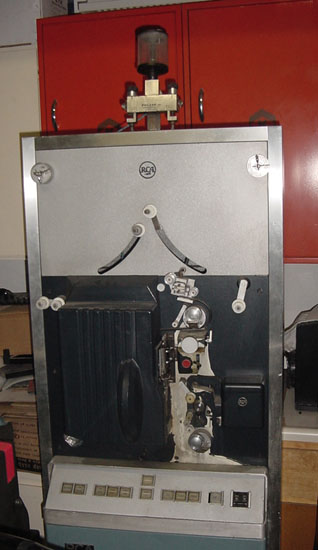
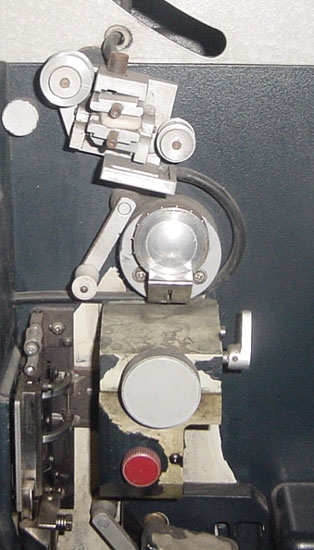
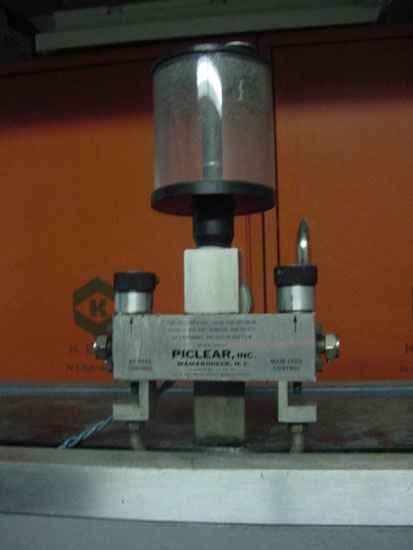
>>> Phil
(Edit by poster for typo)
[ 08-20-2004, 12:03 AM: Message edited by: Phil Hill ]
Posted by Mark Gulbrandsen (Member # 72) on 08-19-2004, 10:33 PM:
Yep! thats the dasterfly Pic Clear thing. The ones at the station I worled for had rigged in larger containers for the fluid though. Almost a full gallon of the stuff!
I wonder of Bruce McGee ever tried a shot of Pic Clear juice? And how does it taste compared to Film-Guard?
The TK-27 was a neat camera...4 tubes with the big 1.5 incher for luminance. Did you also get the big 500 lb. steel plate that it all sits on? Thats a hard one to move around!
Mark
Posted by Gordon McLeod (Member # 33) on 08-20-2004, 09:34 AM:
An interesting telecine machine was the RCA 35mm electronic machine that looked a lot like a FP20 but was all servo motor based They used to do a great job of shredding film when one of the servos would decide to start in the wrong direction
Posted by Bruce McGee (Member # 131) on 08-20-2004, 05:55 PM:
I DO wish that FG had been around when Pic-Clear was in use. I hated using Pic-Clear, because our film department strived to clean everything that came through our station, and I thought that PC was a waste of money. The station eventually stopped using the things, and just by-passed the applicators on the TP's.
Phil, I aquired a TK-28 about 2 years ago. I was told when I got it that it was ready to go. Powered it up, got a white image from the video out line, lots of smoke, fire, and death. Turns out that one of the PC boards inside had been broken by a hammer. I tried for almost 2 years to locate spare modules for this, but gave up. It is now residing in a TV museum near me. It looks good with a pair of Eastman 25's, and the original slide projector in place.
We used TK-27's in Nashville in TV. They were fine machines when they were tweeked right. The TP-6's that we had before the 66's were awful on film, but they did run for about 25 years before I got to them.
Posted by Mark Gulbrandsen (Member # 72) on 08-20-2004, 06:28 PM:
"We used TK-27's in Nashville in TV. They were fine machines when they were tweeked right."
You're dead right on that one. In spite of the large luminance vidicon in the 27 it was always a bit noisier in the RGB channels than the 28 was. Exact setup was the only way to good results. I guess thats why the TK-28 was brought out. Some 28's in Chicago actually had Plumbicons in them instead of vidicons. Those cameras looked really great but had a bit more lag in the image. The RCA servo driven 35mm machines were the same as the Westrex 35mm electronic projectors and were designed by some of the same engineers. There were two FR-35B's that I used to service in Chicago and I eventually ended up owning one of them.
Mark
Posted by Steve Kraus (Member # 476) on 08-21-2004, 12:36 AM:
Did the Pic Clear setup just wet the film or was the projection itself "underwater" so to speak?
Posted by Mark Gulbrandsen (Member # 72) on 08-21-2004, 12:56 AM:
"Did the Pic Clear setup just wet the film or was the projection itself "underwater" so to speak?"
_________________________________________________________________
Yes, It actually wet the film but was prety much evaporated by the time the film arrived at the sound drum. It was possible to over do it and put the entire film path under fluid so to say. If the applicator was not set for just the right flow(or it may have been the number of drips per second) the felt pads would be too dry and they would scratch the flim. Also if you got a piece of dirt taken in on one of the pads it would scratch film even if the pads were wet ![[Eek!]](eek.gif) .
.
Mark
Posted by Phil Hill (Member # 371) on 08-21-2004, 09:38 PM:
(So, as this dumbass puts his tail between his legs and runs...)
Based on some of the comments about the RCA TK-27 and TK-28, I just looked at my telecine camera and I guess I was on crack when I posted.
My camera is an Ikegami TKC-970. ![[Roll Eyes]](rolleyes.gif)
>>> Phil
Posted by Bruce McGee (Member # 131) on 08-22-2004, 07:50 AM:
When I'm on crack, I never talk about Ikegami cameras.
Funny. I recall a print of a film being scratched by dirt in the pic-clear pad. The distributor made the station PAY for a new print, as this was the only color print that they had. We fought this decision, because the print was really worn, and splicy. (We checked ALL splices in prints) The station paid for the thing, about $500. Next time the thing came back, there was one new reel, and 3 old splicy reels of the movie. I cant remember the title of the film, but I do remember the situation...even on crack. ![[beer]](graemlins/beer.gif)
Posted by Mark Gulbrandsen (Member # 72) on 08-22-2004, 01:16 PM:
Ikigami cameras rule and make RCA cameras look like a junk heap! The HL-79's that I maintained were absolutely the best and lokoed better than the bigger TK-45 did. ABC in Chicago had Iki film chains. They ran lots of film through them in the 60's and 70's on the 3:30 movie. Imagine Lawrence Of Arabia shown on TV with commercials before the 5PM news!
Mark @ CLACO
Posted by Steve Kraus (Member # 476) on 08-22-2004, 04:44 PM:
Lawrence they might have spread over two days. I know they did for Ryans' Daughter. But yes, the typical movie was cut to about an hour to fit the 90 minute timeslot. So Lawrence crammed into about two hours. It's good that Lean included so much unnecessary footage. ![[dlp]](graemlins/dlp.gif)
![[fu]](graemlins/fu.gif)
Posted by Mark Gulbrandsen (Member # 72) on 08-22-2004, 05:12 PM:
Yea and ya remember "Uncle Buck" Geri.... She used to edit(er chop up) all those films.
Mark
Posted by Gordon McLeod (Member # 33) on 09-03-2004, 11:23 AM:
here is a Bosch flying spot scanner unit on ebay
http://cgi.ebay.com/ws/eBayISAPI.dll?ViewItem&category=15257&item=3837368669&rd=1
Posted by Steve Kraus (Member # 476) on 09-03-2004, 06:05 PM:
The fact that he calls it a projector inspires confidence that he will be able accurately describe its condition and what's missing.
Powered by Infopop Corporation
UBB.classicTM
6.3.1.2