This is topic What is 'plate glass'? in forum Film Handlers' Forum at Film-Tech Forum ARCHIVE.


To visit this topic, use this URL:
https://ft-forum.com/ft/cgi-bin/ubb/ultimatebb.cgi?ubb=get_topic;f=1;t=006462

Posted by Nate Lehrke (Member # 1460) on 08-14-2004, 03:15 AM:
 
What is the difference between 'glass' and 'plate glass'?
What would you use the 'plate glass' for?
 
Posted by Joe Redifer (Member # 3) on 08-14-2004, 03:25 AM:
 
Making plates, obviously!

In the theater world, there is usually plate glass and then there is the more expensive optical glass. Optical glass is of a much higher quality and allows more light to pass though. This is used usually on projection port windows. Many theaters unfortunately use plate glass for this port though, because the money men simply don't care about the highest quality possible.
[av=n]
Click here and look at the 3rd picture down and you'll see the difference clearly.
 
Posted by Nate Lehrke (Member # 1460) on 08-14-2004, 03:38 AM:
 
Okay, wow, that picture certainly helps.

What is the price difference for a standard port window between optical glass & plate glass?

Does optical glass stay cleaner? Would my eye glasses have optical glass?
 
Posted by John Pytlak (Member # 331) on 08-14-2004, 07:21 AM:
 
Optical quality glass has fewer internal defects that might scatter light, reducing contrast. It is coated to tighter tolerances for thickness, so it is perfectly flat and won't distort the light going through it. It does not contain impurities that may give it coloration (cheaper glass is often slightly green in color). Glass used for projection ports should have anti-reflection coatings, that reduce the amount of light reflected at the surfaces -- less light reflected means less light "bouncing around" within the glass (less flare), and more light on the screen (less reflected back toward the projector).

You often see terms like "water white" (little coloration), the percentage of reflection (the lower the better) or the percentage transmission (the higher the better) in the specs.

Obviously, all these improvements add to the cost, but it is well worth it.

Contrast Killers

quote:
Contrast Killer 5: Poor Ports
The projection port is just as important as the lens in delivering high-quality
images. Plain window glass should not be used. Only optical quality glass with
anti-reflection coatings should be used. Port glass should never be installed
perpendicular to the projection beam, to avoid reflecting light back into the
projector lens. Likewise, if two panes of port glass are needed for sound
isolation, care should be taken to avoid internal re-reflection. Soundproof,
angled port glass frames are available from several vendors. Port glass should
be absolutely clean and scratch-free. As with the projection lenses, loose dust
should be gently brushed away with a camels-hair lens brush, and liquid lens
cleaner and lens tissue used for cleaning any haze. Ideally, the projected
image should be almost invisible on the port glass, with no detectable
scratches or haze.

http://www.cinemaequipmentsales.com/dolby9.html

quote:
Regardless of the wall structure, projector noise will escape through any single sheet of projection glass. port glasses should be angled to reduce lateral reflections; as a worst case example, internal reflections from a single port glass set at 900 to the line from lens to screen will result in numerous reflections leading to a soft screen image apparently out-of-focus. A good result will be a front glass set at perhaps 70 forward from the lens angle, and a rear (auditorium side) glass set at 150 backwards.

Care should be taken over the quality of glass used, and optimum projection requires coating to further avoid internal reflections. (3)


http://www.opticalcoatings.com/projection.htm

quote:
Our port window glass is called Water White. The transmission rate is between 98% and 99%. The glass transmits 99% < 3mm thick, 98% > 6mm thick of the visible spectrum. For more details on the specs see our Water White glass page. Standard port window glass thickenss is 6mm. We have 8mm and 10mm available as well, with 12mm available in the winter of 2001.
This glass is ideal for use in theater projection rooms, in what are called port windows. The dual A/R Coating increases the transmissivity to provide true color through the glass. This is the highest clarity port window glass, with no coloration. The port glass in the projection room is nearly invisible.

Regular glass absorbs the colors and brightness of projected light, thus dulling the screen image. Optical Coatings' specially coated glass transmits more light onto the projection screen. Movies are seen the way the Director and Cinematographer intended - with brighter, truer colors.

Our high transmission, two-sided antireflective coated clear glass is suitable for use in motion picture projection room construction. Our glass is especially suitable for multiple projectors, such as those in IMAX theaters, where every bit of light transmission is critical.


http://www.widescreenmuseum.com/widescreen/superpanatar-c.htm

quote:
By the same token that it is imperative to use only the finest objective lens in connection with the SUPER PANATAR, it is quite important that only the best grade of glass be used in the projection port. The glass should be water-white, optically flawless, coated, and should be treated with the same care as a lens. If these precautions are not taken, the port glass can introduce loss of definition, loss of light transmission, and a detrimental change of color in the projected image.
http://www.portwindowglass.com/

quote:
Water white, low iron, ultra clear glass transmits 98% to 99% of light, and is anti-glare and ant-reflective coated. This glass is preferred for all theater technology, and is necessary for digital equipment. Water White Glass allows lower intensity light to be passed through the port. Used as a theater glass, our water white glass outperforms other ultra clear products. We use a process that insures defect free glass.
American Computer Optic's OptiClear Water White Glass is the port window glass of choice for Christie Digital Labs and THX Labs. Thicknesses are available in 3mm, 6mm and 10mm. Water White Glass under 3mm thick transmits 99% of visible light, while over 3mm thick transmits 98% of visible light. Sheets are available up to 6ft X 8ft. Use our contact form to request a quote. Please include size and thickness specifications.

Water white glass is available as tempered product. Hydrophobic coating is also available to repel dust, dirt, water and oil build-up.


Posted by Steve Kraus (Member # 476) on 08-14-2004, 07:31 AM:
 
Ahem...now to answer the question that was actually asked.

Ordinary glass is (or was) simply extruded and rolled. Plate glass is polished and ground to be more perfectly flat. Float glass is made by floating the glass across liquid tin to achieve a very flat surface without the expense of grinding the surfaces. That may have replaced ground plate glass in many instances; perhaps it has superceded cheap rolled glass as well.

I presume optical quality glass, besides being a more transparent composition, is still ground for flatness and nowadays would be given coatings similar to that found on modern lenses.
 
Posted by Mike Blakesley (Member # 26) on 08-14-2004, 01:13 PM:
 
Plate glass would probably cost very little depending on the size. Our projector port is only 12x12" so it would be dirt cheap.

That port had plate glass in it originally, and we replaced it with optical glass several years ago. It cost around $50 for just the glass. It did make a big difference.
 
Posted by Frank Angel (Member # 248) on 08-14-2004, 01:50 PM:
 
Has anyone ever done any scientific testing/comparisons between coated optical (white water) glass and Lexan? Years ago an installer claimed that Lexan was cheaper because it was easier to cut to odd sizes (which our ports are) but, although it is not coated and does have some internal reflections (the edges light up brighter than optical glass showing that it has internal flare), it is pure in terms of color transmission and distortion free. We have been using it for years but it is time to replace -- the surfaces will eventually get very fine scratches in it no matter how careful one is about cleaning it.

But the same problem exists in that our ports are not sized to the standard port glass/frame assemblies so we have get our odd sizes custom framed and cut, and expensive proposition. Lexan just goes on a bandsaw and it's done.

Should we look into biting the nonprofit bullet and getting custom port windows made or go with the plastic? I could buy new pieces of Lexan every year until I retire and it won't cost as much as custom designed frames and glass. Plus, because of our steep angle, we also don't need any fancy angled frame -- we just drill four holes in the Lexan and it screws flat onto the port frame -- the angle of the lens-to-Lexan is already present by virtue of the projector angle.

Optical glass? Lexan?
 
Posted by Steve Guttag (Member # 268) on 08-14-2004, 06:43 PM:
 
Optical glass...I've never liked the look of the plastic stuff. Call your Schneider dealer...you have custom sized glass with optical coatings. Note too that Goldberg can also provide custom sized optical glass that is coated. It is normally more expensive than Schneider but it is also clearer.

PPG starfire is my favorite "clear" glass there is almost no hint of green (iron) in it.

Steve
 
Posted by Mark Gulbrandsen (Member # 72) on 08-14-2004, 09:50 PM:
 
Steve,
I thought I'd post this link and the correct spelling for this product for those that might be interested in using it...... This is probably the least expensive optical quality glass available and is stocked by many PPG dealers in most large cities.

http://www.ppg.com/gls_commercial/starphire/default.htm

Mark
 
Posted by Steve Kraus (Member # 476) on 08-14-2004, 11:37 PM:
 
Is it appropriate to call it optical quality if it's not ground? (Let alone coated.)
 
Posted by Mark Gulbrandsen (Member # 72) on 08-15-2004, 12:38 AM:
 
I've always thought of it as having superior optical qualities given the price of it. The main thing is to stick with the thinnest 2.5mm Starphire so refraction is kept to a minimum. Its certainly an inexpensive prefered alternative to plastic and plate glass. and it can be coated by any optical coating plant with large enough chambers if one wants to have that done, have also had it dip coated with excellent results. I used to stock it in the Midwest days in dip coated sheets of various standard porthole sizes and some of that was what was in the "Hughes booths" and many others we did. Today we generally sell the Schneider stuff because of the overall high quality of Schneider products in general and because its convenient.
Have had problems several times in the past with Goldberg slipping in plate glass where optical quality was ordered so I generally stay away from them all together for this important part.

I recently ran across some plastic port material in Nevada in which the auditorium side of the plastic had apparently been etched by something in the air over the seven years of its operation. The on screen images suffered as a result needless to say......
Mark @ CLACO
 
Posted by Bill Langfield (Member # 818) on 08-15-2004, 05:34 AM:
 
Hmm, all very interesting, so now I want to try and figure what port glass we are using.

How would I know the diffence between a 'slab of glass', 'rolled and polished glass', 'floated glass', 'optical glass', 'optical glass - coated in anti-reflect' Oh you get it,all those glass things that were mentioned.

The companies I work for would straight away change to best stuff if turns out the best is not place already.

The joint that fired me would not give a shit. They just cared about how many up-sized popcorn/cokes they could sell.
Bill.
 
Posted by Steve Guttag (Member # 268) on 08-15-2004, 08:05 AM:
 
Thanks for the correction on the spelling...I don't think I've seen a better glass than PPG Starphire that has anti-reflective coatings applied. I don't see any waves and the stuff is quite clear.

Steve
 
Posted by Matthew Peters (Member # 1495) on 08-15-2004, 09:47 AM:
 
quote: Bill Langfield
They just cared about how many up-sized popcorn/cokes they could sell.

Hoyts?
 
Posted by Steve Kraus (Member # 476) on 08-15-2004, 10:04 AM:
 
I don't know if Starphire is a plate glass product or float glass. Since they seem to be talking about an entirely different composition of the glass itself maybe it is available both ways although maybe if it's not a plate glass then perhaps the same material sold in that form is given a different name.

Then again, maybe they can make the float glass just as accurate as ground plate glass. Isn't there some way to test a glass for flatness...interferiometry or something like that?

Certainly the very best would be a plate glass made of material of Starphire clarity (or maybe Starphire is indeed plate) and given a good coating.

On the issue of clarity, for those who think ordinary glass is clear, just look at the edge and how opaque it is after even a short distance. Then consider fiber optic cable which must be clear enough for the signal to pass through thousands of meters of glass. So it should be no surprise that it is indeed possible to make glass much clearer than the common variety. Thus, Starphire and perhaps competitive products from other firms.
 
Posted by Mark Gulbrandsen (Member # 72) on 08-15-2004, 11:40 AM:
 
Steve,
It doesn't really much matter how they make the stuff, they might do it an other way entirely than plate or float. Why don't you write to PPG and find out and let us all know, but how its made wouldn't deter me from using it. Its the best alternative to ground optical glass you can get. If the application is really critical then the Schneider porthole glass would be the prefered choice. Its made from the same ground optical plate they use to make camera filters.

Mark
 
Posted by Steve Guttag (Member # 268) on 08-15-2004, 12:27 PM:
 
Schneider's glass is greener than PPG Starphire

Steve
 
Posted by Mark Gulbrandsen (Member # 72) on 08-15-2004, 01:54 PM:
 
Don't know... have never compared them side by side. I was told by Dwight that they used the same glass that was used for making photographic filters. It had better be clear stiuff as they'll eventually have many big time cinematographers using theor filters really pissed at them. If this is not the case I'd certainly like to know as I'll have more of the PPG stuff sent out for coating.

Mark @ CLACO
 
Posted by Mark Gulbrandsen (Member # 72) on 09-04-2004, 01:07 PM:
 
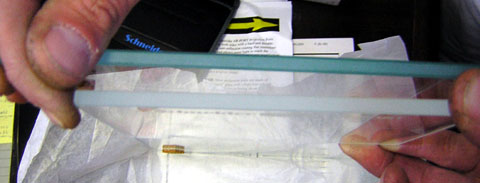
Here is a side by side photo of two pieces of two edge ground glass plates. Its actually easier to tell with edge ground which glass is the more transparent. A polished edge does not allow it to be as obvious so to say. The white edge is the Schneider port glass and the darker one is Diamante "starphire" glass which is the German equivelent to PPG Starphire. First off I would say thet the Diamante is no where near as clear as real PPG Starphire glass is and I am still awaiting a sample of actual Starphire from PPG. Our local distributer switched over to the Diamante glass very recently and claims that its clearer but I can tell you with out a doubt that he's lying. Its probably just cheaper or he has a greater profit margin. I also somewhat doubt Steve G's claim that PPG Starphire is clearer than the Schneider stuff. The Starphire is going to be a touch pale blue while the Schneider will remain white. A real side by side comparison is upcomming in a week or so as soon as the PPG sample arrives. When the PPG sample arrives I will compare four types of glass on edge in sunlight, all the same thickness. PPG Starphire, Diamante Starphire, Standard Plate and Schneider AR.

 -

Also here is a site with alot of interesting reading on various types of high end glass available.

http://www.pgo.com/

Mark @ CLACO
 
Posted by System Notices (Member # 2357) on 08-02-2010, 11:20 AM:
 

It has been 2157 days since the last post.


Posted by Eric Robinson (Member # 2966) on 08-02-2010, 11:20 AM:
 
I was doing some research on the topic and found some info to clarify the issue of ground or float for Starphire.

PPG Starphire by PGO

PPG - Starphire
Description:
Starphire float glass is a crystal clear soda-lime glass product. Its high visible light transmission and brilliant edge
are two characteristics unique to Starphire glass. This glass has a low iron composition with mechanical and
physical properties similar to ordinary clear soda-lime glass.

According to some optical measurement data I reviewed, the optical glass called Pilkington Optiwhite Float is even better.
 
Posted by Paul Gordon (Member # 3320) on 08-02-2010, 12:29 PM:
 
Can't you just use optical glass from an old computer scanner? Theres piles of them in used electronic stores and landfills
 
Posted by James Westbrook (Member # 3690) on 08-02-2010, 03:17 PM:
 
We just had some retrofit DCI compliant port windows installed in my building. The entire window is optical glass.
Oddly the new glass has a dark tint to it BUT the pictures on screen are noticeably sharper and brighter.
I am not sure who made them.


Powered by Infopop Corporation
UBB.classicTM 6.3.1.2