This is topic Drive In / Outdoor Screen Material in forum Film Handlers' Forum at Film-Tech Forum ARCHIVE.
To visit this topic, use this URL:
https://ft-forum.com/ft/cgi-bin/ubb/ultimatebb.cgi?ubb=get_topic;f=1;t=006478
Posted by Joshua Lott (Member # 240) on 08-18-2004, 08:18 PM:
What types of material are best for screens for outdoor showings?
The screens would have to stand up to some EXTREME conditions. Are there any screens that stand up to -20 F ? Rain/Snow ect...
Someone told me that he has seen drive ins with a metal or wood screen that was just painted white. Is this common place? Keep in mind that I have never been to a drive in.
Thanks.
Posted by David Kilderry (Member # 142) on 08-18-2004, 08:51 PM:
The only real option is steel. Flat zinc alum panels around 1mm thick are best for the surface, painted an all-weather flat white. If you introduce any gain into the paint eg silver or amuminium, due, rain or moisture will cause a mirror effect. Two good coats using a roller is best, spray goes on too thinly.
The structure should be designed to withstand winds of around 100mph before the panels blow off, hopefully leaving the perlons and tower in place. This type of screen has been proven best for decades both in North America and Australia.
There were drive-ins in Alaska, why not track down the owners or former projectionists and ask them about any special features given the conditions. All screens need repainting every few years. Wood was once used for both the tower and marine ply for the surface, but these options have long since been surpassed in recent years.
We've built 3 80ft plus screens in the last 2 years, so I speak from experience!
David Kilderry
Posted by Jack Ondracek (Member # 1466) on 08-18-2004, 09:55 PM:
You'll still find a lot of wooden screens in parts of the US. There's one about an hour from me that is built from plywood sheeting over a wooden frame. It's been there for 50 years, though it doesn't face very extreme weather. There's one in Florida that's made of concrete block (it's still standing, by the way).
As David says, a steel screen is probably the best way to go... unless you're trying to do it yourself. However, on the subject of reflections caused by moisture, my experience is that a flat surface that attracts moisture can be reflective, regardless of paint. One of my screens faces the prevailing winds, and is a real problem in that regard. The screen's angle to the viewing audience is also a major factor.
Jerry Selby (of the screen company) has said that the "wavey" type of corrugated roofing metal works well for screen surfaces that face this problem, because only a small part of the surface is directly in line with the audience at any given point. If rain does hit the screen, those parts of the corrugations that are not in direct line with the viewer will act as a diffuser of sorts, minimizing any reflective effect. This material also works well in wide viewing angle situations.
In practice, I also have such a screen. My original 1949 screen has been refaced with 2X24' strips of corrugated steel. You can't see the waves unless you're within 20 feet of the screen and the picture is bright and uncluttered. I use the same paint on that screen that I use on my "problem" one, yet the corrugated surface never exhibits any reflection issues.
So... there are several ways to skin the cat. Local conditions and how long you expect to be in the business are probably the major considerations when selecting materials.
[ 08-19-2004, 03:32 AM: Message edited by: Jack Ondracek ]
Posted by Daryl C. W. O'Shea (Member # 1303) on 08-19-2004, 01:24 AM:
Ditto on the corrugated steel. We've got it on four screens and it works good. It'll laugh at -20F too.
Posted by David Kilderry (Member # 142) on 08-19-2004, 03:14 AM:
At the company I used to work for, we did tests with corrugated screens. At Coburg Triple drive-in one is corrugated and two are flat sheet, the corrugated screen has more reflection trouble with moisture and less light! There are many variations of the type of corrugated sheet you can use, I'd always suggest small scale tests with a 16mm machine first. Spray it with water and see what happens.
The corrugatuions do deflect light at different angles and in ideal conditions you want it all right back at the audience. I agree that there are many considerations depending on location to be considered. We still have have nearly 50 year old wooden screens still standing too and one made of steel and cement panels!
David Kilderry
Posted by Jack Ondracek (Member # 1466) on 08-19-2004, 03:37 AM:
It would be interesting to study the differences between our screens, David, though I suspect the distance between us could be a problem ![[Smile]](smile.gif)
After we close for the Winter, I'm planning to test the corrugated steel on my "problem screen", as I have most of the scraps that were left over when the original crew sheared the steel for my main screen. I'm going to prime & paint a piece of it, attach it to the screen and wait for the next good rain.
If it performs like others say it should, I'll resurface both of my smaller screens with it. If not, I'll be looking for other causes!
Posted by Daryl C. W. O'Shea (Member # 1303) on 08-19-2004, 03:54 AM:
Given the long throws involved, light reflected back from a flat screen is reflected "straight back" at a fairly narrow angle. With a corrugated screen light is reflect back all over the place and will reflect less light straight back and will read lower on any meter aimed perpendicular to the screen.
From what I've seen (by eye) flat screens look brighter straight on, but darker when viewing from the ends of rows (45 degrees off perpendicular). Corrugated screens, however, look darker than a flat screen when viewed straight on, but the look brighter than a flat screen at the end of the rows -- which makes sense (to me anyway) give the corrugated surface.
I've been meaning to actually measure this for years... to see if the sides really are that much better. You'd never want a corrugated surface in an indoor where your audience is all sitting pretty much perpendicular to the screen, but at a drive-in where a third or more of the audience is outside the viewing angle you'd have in an indoor, it'd be worth knowing how much more even the corrugate surface may perform.
Then again I could be off my rocker again.
Come to think of it, I usually get fogged out by the time I start becoming concerned about the water building up on the screen!
The fun nights are doing changeovers when you can't see the screen but the audience still can.
Posted by Jack Ondracek (Member # 1466) on 08-19-2004, 02:05 PM:
You're right on about the corrugations making side viewing better. However, it doesn't really make direct viewing less than the sides... only redirects that light. In the end, the direct view looks as good as the side, though the direct is lower because there's no more reflection straight back than any other direction.
My flat screens are very definitely brighter straight on than off to the sides... though it's a lot like digital vs analog... many people don't pay attention, so they don't notice. I've got blowtorches for lamps anyway, so it's not that big a deal... the rain is a much bigger problem.
Posted by Daryl C. W. O'Shea (Member # 1303) on 08-19-2004, 05:51 PM:
That's what I meant to mean. Was a little tired and wordy... direct on looks as good, if not a little better, than the sides, but not as bright as a flat screen direct on.
Corrugated provides a more even picture brightness across the field.
Posted by Mark Gulbrandsen (Member # 72) on 08-21-2004, 03:05 PM:
There is a screen at a Drive In near Powell Woming that has a reflective type of powder coated surface. This screen is nearing 30 yeaers old and still looks like brand new. It originally did cost a furtune to install but the owner says it was worth it as he's never re-coated it at all.
Mark @ CLACO
Posted by Jack Ondracek (Member # 1466) on 08-21-2004, 10:30 PM:
I have something like that on my corrugated screen, Mark... though I wouldn't know if it was a powder coat (probably not) or some baked-on surface. I could probably get away with just pressure washing it every couple of years. However, my screen paint is noticeably whiter (probably due to the screen's age). If nothing else, what's under the paint on that screen makes a very good base.
Posted by Joshua Lott (Member # 240) on 08-22-2004, 01:50 AM:
Are there any drive in's that also have a grassy area up front to sit down and "picnic"?
If so what would you do for the sound? If you have a metal screen (that I assume is solid) then where would you place the speakers? If you wanted to place the speakers behind the screen, could you cut out and replace that section only with a perforated metal painted white?
How would that affect the image? would there be a noticeable difference between the perforated and non-perforated sections?
Posted by Stephen Furley (Member # 1277) on 08-22-2004, 03:18 AM:
I've never seen I drive in, I don't think we ever had a permanent one here, but I do have a Super-8 print of an old Pathe Pictorial about one in Rome. There was a mention of being able to sit outsde, I think it was at tables rather than on the ground, to watch the film, but "you can only hear it from the comfort of your car" Not much point in that then, is there. When I first bought the film, at a collectors' fair, I actually had to watch it without sound, as it has an optical track, and I only had a magnetic projector at the time.
Sound, mono of course, was from small speakers hung on columns by each car, that you unhooked, and brought into the car, along wth a heater, if required.
What possible advantage any of this could have over a normal cinema, I cannot imagine. The narrator was very enthusiastic about it all, and predicted that, hopefully, one will be openiing near you very soon. Well, something over forty years later, there still hasn't been one anywhere near me.
We have had outdoor film shows here from time to time, Crystal Palace Park in South London is one place I can think of, but these are rare events, and are sit down on the grass, or deck chairs, not for cars. I've never been to one of these, but I did once see one being set up. The screen had not been errected, so I don't know what type it was, there was a large pile of speakers at each side, but no sign of anything in the centre. I think the projectiion was from inside a truck.
The Pathe Pictorial is quite an interesting little film. I've no idea who holds the rights to it now, I wonder if it would be possible to reproduce it for a reasonable fee.
Posted by Jack Ondracek (Member # 1466) on 08-22-2004, 03:55 AM:
Josh:
Many early drive-ins were built with playgrounds in front of the screen. It gave the kids something to do while waiting for the show to start. As drive-ins pretty much all had a fair amount of unused land in front of their screens, playgrounds were common. In many of the drive-ins left today, that area is a popular picnic spot. Insurance requirements and the fear of general liability has resulted in a lot of that equipment being removed in the drive-ins that remain in this country.
Drive-ins never had speakers behind their screens... as far as I know. The very first ones did have speakers under them however, making the theatres very poor neighbors. Some drive-ins installed speakers under the ramps... which didn't work all that well, either. Until the mid '80's, sound was transmitted to cars by way of speakers mounted on poles next to the cars. Eventually, AM radio... then FM stereo became commonly available to drive-ins, which was a good thing, because most people had better sound systems in their cars than they had in their homes.
This comes back to your question about sound in front of the screen for pic-nickers. As many drive-ins now have radio sound, all they need is their own car or portable radio.
Stephen:
It's not surprising you haven't run into a drive-in. They're mainly an American phenomenon, and something of a curiosity in other countries. After WWII, America literally fell in love with their cars. We had a new interstate freeway system in place... or in construction, and people started going everywhere in their cars... including an eventual move away from travel by train. Many businesses catered to this popularity, including drive-up restaurants... and drive-in theatres. Some sources say we had well 6,000 of them at one time.
Posted by John Hegel (Member # 628) on 08-22-2004, 03:56 AM:
The advantage of a drive in is the atmosphere. During the summer I would much rather be outdoors enjoying the weather with my friends then being stuck in some boring box.
Where else can you see a movie on the big screen and also be cooking burgers on the grill? I'm not sure how common it is to allow tail-gating, but they used to do it here, before is closed.
Posted by Jack Ondracek (Member # 1466) on 08-22-2004, 04:05 AM:
It's not very common, John.
Drive-ins all have their own concession outlets, and depend on them to help pay the bills. It's bad enough that people bring in their own food (tradition!) without seeing them cooking it in the fields, too!
We don't allow it because it's too darned blatant... not to mention the hazard of charcoal briquettes, carelessly dumped on the ground... or weekend warriors blowing 3 foot flames out of their gas-fired stoves!
Some drive-ins have gone to a "no outside food" policy, only allowing it after purchase of a "permit"... something like $4 to $7. Their rationale is that you can't (officially) bring your own stuff into an indoor theatre, why should you be allowed to do the same in a drive-in?
At other drive-ins, including mine, we prefer to rely on attracting food sales by having great products... not grossly overpriced. We find that this policy competes well enough with outside food that our snack bar does very good business.
To each his own, I guess!
Posted by John Hegel (Member # 628) on 08-22-2004, 04:25 AM:
Good point that might be part of why out drive-in is not longer around.
Well that and no one wanted to go through the troubles of finding a staff every year.
On the same note anyone know of any abandoned drive-ins left in Iowa that are in fair condition?
Posted by Stephen Furley (Member # 1277) on 08-22-2004, 03:29 PM:
Jack,
I know that Australia had drive-ins, I'll come back to that one later, and the one on my Pathe Pictorial film is in Rome, Italy, not Rome, New York!
I thnk there are several reasons why they never caught on in England. I beleve there has been the odd temporary one.
Firstly, our weather is not really right for it, too wet, too unpredictable. Sitting in a drive-in in the middle of Manchester, in the pouring rain would not attract many people.
Secondly, they seem to have been mainly a '50s and '60s thing; Most people in Britain in those days did not own a car. There were a number of reasons for this, most journies were short, public transport systems were well-developed, and cheap, and parking space in major city centres, particularly in London, was in short supply. Also, many parts of Britain suffered major damage during the war, a great deal of reconstruction was needed, which had a higher priority than building cars and motorways. It was really in the later '60s, and early '70s that car ownership expanded rapidly. There were a number of reasons for this, some practical, and some political.
Even today, there are many families in London who do not own a car. Few people who work in the centre of London drive to work. Even if they own a car, congestion on the roads, and lack of parking space mean that most people make the journey by public transport, unless they need the car as part of their job. This is in spite of the fact that public transport fares here, especially on the railways in the peak hours, are now very high.
Thirdly, and probably the most important reason, because of our small size, and high population density, land values here are very high. To build a drive-in in a major city, even on the outskirts, would be extremely expensive. Drive-ins make very inefficient use of space, you need a large area per person or per ticket sold, I think it would be very difficult to make it pay here.
Coming back to Australia, when I left school I became an Audio-Visual technician, for which I had to do a four year course, in the first year this was in six week blocks attending College, and working in a school. The other three years were working six month blocks at various schools, with day release to College.
During that first year they sent me to work at a girls school in South London; one of the things they specialised in was gymnastics. One of the 'inmates', who had left a year or two previously, was called Elaine Willett, she had been in the British Gymnastics team at the 1972 Olympics. She was still active as a gymnast, and often used to come back to the school in the evenings to edit 8mm film which she had shot in various exotic parts of the World where this had taken her. There was another girl who was still at the school who was on the team at the 1980 Olympics, she later became a children's television presenter for a few years. This was the era of Olga Korbut, when gymgastics became very popular among young women, and major events drew large crowds. Quite often the Headmistress would come to see me just before I went home on a Friday evening. "Elaine and Suzanne are at the Albert Hall/Wembley/some other venue, on Sunday" she would say, "Go and take some pictures of them" There were plenty of other things which I would far rather have been doing on my Sunday. They always wanted the pictures in colour, the lighting wasn't very bright by photographic standards, we had to use fairly high shutter speeds and in those days 400 ASA was very fast for a colour film. We had to push it two stops to 1600. Anyway, one of the teachers had gone to Australia on holiday, and she sent us a postcard saying that the previous evening the had been to a drive-in cinema, and what should come up on the huge screen than the face of Elaine Willett; about as far from home as she could possibly get!
Posted by Jack Ondracek (Member # 1466) on 08-22-2004, 10:15 PM:
Good points... and a great story, Stephen!
I'm sorry if my comments indicated I didn't think there were drive-ins anywhere but the States. I do know about some of them in Australia... a couple of good ones, actually. It seems they were most popular here though, having been "invented" here, and taking advantage of the proliferation of cars.
Just after the Soviet Union imploded, a drive-in was built in Russia... somewhere. I don't know if it's still around, but somebody gave it a try! Seems it would be a bit on the chilly side...
Posted by David Kilderry (Member # 142) on 08-24-2004, 08:37 PM:
OK, for the record.... I know of only one country in the world that had more drive-ins than Australia, and that was the USA. I have never seen figures for Canada, but I'm sure if they had more than the 340 that Australia had at their peak, it would not be too many more.
One state, Western Australia, had 110! Here in Melbourne we had 23 and in the state of Victoria, 61. They pretty much copied their American cousins with snack bars selling hot food like hamburgers and hot dogs most had playgrounds and large screens.
Ours, Lunar 3 screen Dandenong, even still has its original "walk-in". As the theatre was built in 1956, many surrounding residents did not own cars but still wanted to enjoy the drive-in experience. A walk-in was a large room with theatre seats and speakers, but with a large window at the front so the patrons could view the drive-in screen.
Ours is now used as a maintenance shed, but is the only survivor I know of. Any left in the US?
David Kilderry
Posted by Jack Ondracek (Member # 1466) on 08-24-2004, 10:29 PM:
quote: David Kilderry
Ours is now used as a maintenance shed, but is the only survivor I know of. Any left in the US?
There are a couple, David... but not many. It's seen as a huge waste of space nowadays.
One I'm most familiar with is the one I grew up working at. Pictures are here.
It doesn't show much, but the left side of the building is the size of the projection booth on the far right. The concessions is in the middle.
The Left section is a room with about 50 indoor theatre seats and a ceiling speaker. People can walk in and watch the show in that room. However, this particular drive-in is 5 miles from anywhere, so nobody would ever walk to the place. If they really wanted to watch the show from inside, they'd have to leave their cars. However, when it rains, the room actually does get some use, so some good there... I suppose.
Posted by Frank Jerkic (Member # 2446) on 08-27-2004, 08:35 PM:
In reply to Joshua Lott inquiry about the pinic area playground, well with my drive in I had to remove all the playground equipment from it as there seems to be this great risk of someone injuring themselves and suing. When the drive in was first built in 64 we used to have pony rides and a stable that went in the 70's, now all the swings, monkey bars,seasaw etc have had to removed or I could spend $6,000 on sum rubber matting to stop people hurting themselves, as far as a do it yourself Barbie-B-Q at the drive in its a big NONO as they might blow themselves up and its my fault failing in my duty of care or sum garbage. just offer people great food at a afforable price and change the menu monthly so they dont complain about SOS (Same old Sh**t)
Combos work great here
thats all I wrote
Frank ![[Eek!]](eek.gif)
Posted by Webster Colcord (Member # 1955) on 08-30-2004, 03:27 PM:
I took these pictures during a trip up to Oregon a few years ago. This drive-in is right next to interstate 5 near Roseburg, and has been defunct for at least 25 years (I remember seeing it from the window of the car during a family trip when I was a kid, so I think it was still operating in the late 70's.)
Keep in mind that these photos were taken from a moving car. In the first picture the building which housed the concession stand/projection booth is on the left:
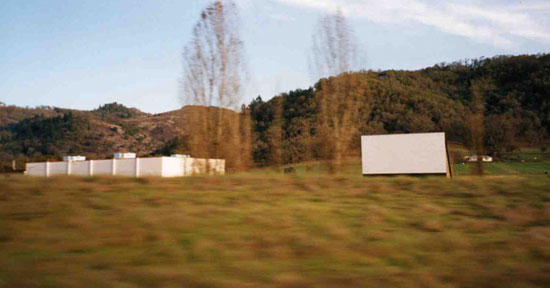
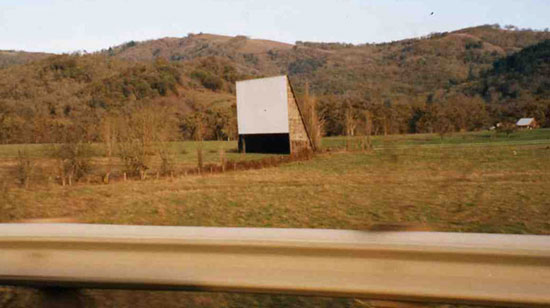
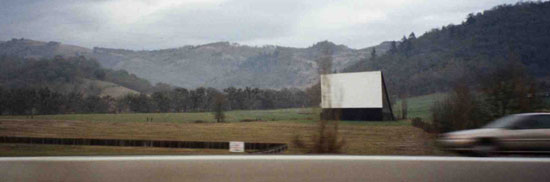
From a distance, the screen seems to have held up very well, considering that it's been standing in the damp Oregon weather for at least 30 years. It's made of wood, built like a barn, but I can't tell you what the screen is made of.
I live in the San Francisco Bay area now, and one of only two drive-ins in this area was torn down at the peak of the internet boom ('99), to make space for some kind of office park/ mall. Well, now that commercial real estate is readily available, the construction project hasn't moved forward and in place of the Burlingame Drive-In's three screens and Dome-shaped concession stand is a big muddy hole.
It took them awhile to tear down though, as the screen supports were constructed from solid steel, built to withstand the winds coming off of the bay.
Posted by Jack Ondracek (Member # 1466) on 08-31-2004, 11:31 AM:
Webster,
That's the old "Starlight" indoor/outdoor. It was closed in 1994 or 1995... somewhat less than 25 years ago! ![[Wink]](wink.gif)
It was an independent operation until Tom Moyer's "Luxury Theatres" moved into town. At the time, it was just a drive-in. After a local indoor house was destroyed by fire, Moyer added a single indoor auditorium, which shared the drive-in's large concession. Ownership followed the Act III/Regal changes. Not being particularly adept at drive-in operations (not to mention being 'out-booked' by a new 7-plex in town), Regal closed the operation and eventually sold the property to the local (Cow Creek) Indian tribe. I've been expecting them to level the place and turn it into parking for their casino (a very successful one). My wife (who grew up there) reminds me that the drive-in is a handy 20-mile jaunt from there, though... so who knows what they'll do with it. She also says the Indians are just hoarding land... which takes it off the local tax roles and makes the county just "love-em more"!
Posted by Webster Colcord (Member # 1955) on 08-31-2004, 06:39 PM:
Jack,
Thanks for setting me straight. I guess I made the foolish error of assuming that it had been out of business since the last time I saw the theater during the drive between Eugene and San Fran, which would have been 20 some years ago. It had appeared to be out of business then, but it could have been the off-season.
It's very disorienting to be driving through the country and turn the corner to suddenly see that huge casino, looking like some kind of gawdy spaceship that just flew in from Las Vegas.
Posted by Jack Ondracek (Member # 1466) on 08-31-2004, 06:50 PM:
Chances are it could have been off-season. Most drive-ins in this part of the country are seasonal operations (most... now there's a good one... lessee... 10?) . That casino is quite a place. With the demise of the nickel smelting and the logging industries down there, the owners have become major players in the local economy.
Posted by Webster Colcord (Member # 1955) on 08-31-2004, 08:08 PM:
Jack,
Once while driving through the apple-growing country up above the town of Hood River, Oregon- overlooking the Columbia River- I happened upon a really terrific-looking single screen drive-in, have you ever seen that one? Up the mountain from Hood River on the way to "Lost Lake", surrounded by orchards if memory serves me correctly.
Also, the Beaverton drive-in is still going strong, as far as I know (we moved to out of Oregon in '97), showing first-run movies. The Springfield drive-in closed long ago, that's the one my dad took us to as kids (usually with two of the four kids hiding under a blanket in the back of the car, getting in for free).
Posted by Aaron Sisemore (Member # 145) on 08-31-2004, 09:23 PM:
I was on the Starlight D/I site in April 2003. I believe Jack is right, it hasn't been closed for very long (there were 'current' (within 5-7 years) 'Movie Cash' notices on the wall of the box office)
Amazingly, the place is still powered and fully equipped!!!
I have pics around here somewhere, I'll post them soon as I find them.
-Aaron
Posted by Phil Blake (Member # 2012) on 09-01-2004, 11:22 AM:
Both the drive ins I was associated with in western australia had screens made of the same materials.
The stand made from steel pipe with steel "C" channel with 6" x 4" wood frame work attached. The Screen surface was asbestos sheeting , nailled onto the wood and painted flat white.
They stood fast with all sorts of wild weather for over 20 years with no problems.The larger on being almost 100' x 70' high.
Although asbestos is now outlawed , I guess "Hardie plank" cement sheets would be the modern day equivilant.
Posted by Daryl C. W. O'Shea (Member # 1303) on 09-26-2004, 04:30 AM:
quote: David Kilderry
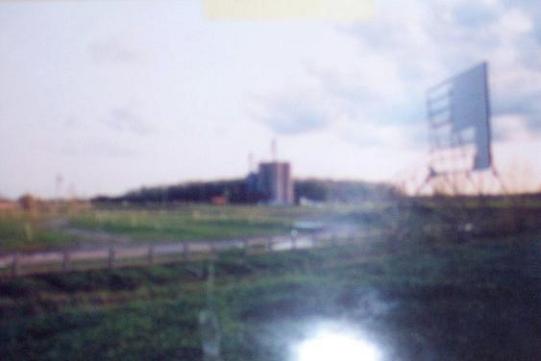
The structure should be designed to withstand winds of around 100mph before the panels blow off, hopefully leaving the perlons and tower in place.
Like this?
Posted by David Kilderry (Member # 142) on 09-26-2004, 08:43 AM:
That's it Daryl! It is certainly not what you want to see when you roll up for work one evening however. Several drive-ins here in Melbourne have lost panels over the years, a few around the state have blown down completely, but these were wooden structures built in the 1950's.
I have seen a couple purposely cut down, it was like watching a book fall over on a table.......... in slow motion.
David Kilderry
Posted by Leo Enticknap (Member # 534) on 09-27-2004, 07:57 AM:
quote: Stephen Furley
The Pathe Pictorial is quite an interesting little film. I've no idea who holds the rights to it now, I wonder if it would be possible to reproduce it for a reasonable fee.
ITN Archive bought the rights to British Pathe's entire output in 2002. The person you'd need to speak to is Linda Reeve on 020 7430 4480.
Posted by Daryl C. W. O'Shea (Member # 1303) on 09-27-2004, 04:03 PM:
quote: David Kilderry
That's it Daryl! It is certainly not what you want to see when you roll up for work one evening however.
Better to find it on the ground when you arrive than have if come down during a show!
Powered by Infopop Corporation
UBB.classicTM
6.3.1.2