This is topic Stupid "features" of cinema equipment in forum Film Handlers' Forum at Film-Tech Forum ARCHIVE.
To visit this topic, use this URL:
https://ft-forum.com/ft/cgi-bin/ubb/ultimatebb.cgi?ubb=get_topic;f=1;t=006532
Posted by Brad Miller (Member # 2) on 09-04-2004, 07:14 PM:
Let's start a list of stupid "features" found on various pieces of booth equipment. By "feature", I mean a design flaw, or an intentionally stupid design, whichever you prefer to call it.
Let's make this clear. You must mention a specific manufacturer and model of equipment. You may not make blanket statements such as "brain wraps from platters", since that is an operator error on "platters" as a whole. Now if you wanted to say "X brand of platters like to sling prints like frisbees", that is fine.
One "feature" per post. Be sure and explain WHY. Posts without an explanation will be deleted.
----------------------------------------------------------------
CIR splicer with the stupid "spring loaded feature" of the cutter blade.
Why would anyone want this? Granted the cutter blade isn't as sharp as a kitchen knife, but do you routinely keep your knives stored sharp end up? Plus if the splicer gets dropped, the cutter blade is shot. Stupid, stupid, stupid.
Posted by Manny Knowles (Member # 1171) on 09-04-2004, 07:51 PM:
ORC makeup table has two spindles -- one side for buildup and the other for teardown.
There is no backtension on the "buildup" side and no way to change directions on-the-fly.
Posted by Antonio Marcheselli (Member # 373) on 09-04-2004, 08:37 PM:
Cinemeccanica's Vector 1000 automation system: when you open the windows to select the appropriate program for the screen, the cursor starts always from the first program and not from the last one. If you have to create multiple shows for the day you have always to scroll the list to find the correct program. And the entire software is sooooooooooo slow!!!
Bye
A
Posted by Jon Miller (Member # 163) on 09-04-2004, 08:43 PM:
How 'bout the older Xetron consoles with the lamp cooling blowers wired to the LAMP switch and automation control circuit; the power supply contactor turned on and off by an airflow vane switch?
That design never gave the lamp the proper fan-forced cooldown. Worse, I shudder to think about the ensuing catastrophe should the vane switch stick in the "on" postion after automation shuts the "lamp" off and nobody is nearby to kill the power to the console? ![[Eek!]](eek.gif)
Posted by Darryl Spicer (Member # 711) on 09-05-2004, 12:05 AM:
CFS consoles, take your pick, that have the lamphouse blower fan mounted in upside down so as to make it impossible to add any oil into the lubrication holes. I have lost count on how many of these I have replaced over the years.
Posted by Pete Naples (Member # 761) on 09-05-2004, 03:50 AM:
Strong X90 has the blower motor mounted that way too. As part of install I strip the blower and turn the motor round.
Posted by Michael Schaffer (Member # 1204) on 09-05-2004, 04:24 AM:
CFS consoles have been mentioned by Darryl, but they really are a bad idea in many more respects. I also hate the power supply compartment design. There is very little room to work in there, and the ventilation concept is lacking too - but more than half of the console is actually empty in the back. I have more points, but Brad said only one per post...
Posted by Mark Gulbrandsen (Member # 72) on 09-05-2004, 07:57 AM:
Boy don't get me started on how bad CFS consoles are.... lets just all agree that CFS itself was a bad idea. I've got to wonder if LIT isn't just following on the heels of CFS.... anyone know?
Mark @ CLACO
Posted by Tim Reed (Member # 137) on 09-05-2004, 11:00 AM:
The Auto/Manual switch on the back of Strong lamphouses. The only possible benefit of this would be if the automation latched and held the lamphouse on, and you couldn't make it release... but how many times has that ever happened?! Otherwise, why not just parallel automation connections to the stinkin' ON/OFF switch and be done with it?
Posted by Scott Norwood (Member # 30) on 09-05-2004, 01:07 PM:
The single switch on the Kinoton FP-30 to operate both the motor and the lamp is pretty dumb, as it makes it impossible to motor the film through the machine without also shortening the useful life of the lamp. This especially bad for changeover installations, where the lamp will be struck for 20 minutes at a time and then killed.
(Insert Steve Guttag's comment here about how the machine doesn't need to be installed this way. Fine, but the product shouldn't do this sort of thing in the "standard" installation.)
Posted by Michael Schaffer (Member # 1204) on 09-05-2004, 03:16 PM:
>>> There is an on/off switch on the lamphouse. If you don't want the lamp to come on with the motor, simply flip that to off. On any machine, you have 2 separate switches for motor and lamp/lamphouse, the only difference is that the default setup on the Kinoton is different, but it does the same. The switch is on the back of the lamphouse next to the amp meter.
Posted by Brad Miller (Member # 2) on 09-05-2004, 03:59 PM:
On the Kinoton "standard" setup, there should be a MOTOR button and a RUN button as "factory standard". In this instance, the MOTOR button would not fire the lamp for cueing purposes.
Strong/Potts platters have that stupid "feature" of not having enough elevator travel distance on takeup. I see more rollers bent out of position in Strong platter booths than with any other make of platter.
Posted by Steve Guttag (Member # 268) on 09-05-2004, 06:15 PM:
I feel the need to point out misinformation here...
On Kionton...the motor/lamp thing is strictly an installation issue...the lamphouse stands on its own and has its own terminal block inside...if you don't want to wire it the factory suggested way, you don't have to. The Factory gives you the cable, use it or don't...I guess it is easier to use it for some...I don't
The main switch next to the ammeter is NOT the same thing Michael as a traditional on/off switch on the lamphouse. Turning that switch off also kills the blower(s)...note the Kinton America mod eliminates that oversite so I would call that switch the "feature" being consistant with this thread.
As to Aaron's commment on Strong lamphouses...many a time in a multiplex I've been requested to start a show with the lamp off to run the film and to only strike the lamp if someone shows in the first 20-minutes...the On/Off Auto/Manual switch combination allows the operator to set the lamphouse exactly how they need it to be regardless of automated or manual show. For Kinoton lamphouses, we often install an three position toggle swtich to replicate the great feature of Strong's lamphouse of On/Off/Auto. Just because it doesn't apply to your installations, doesn't mean it doesn't apply to others.
As to Brad's comments on the motor/run buttons. All but the high-end projectors have the POS button to motor down the film (at a slower speed) without striking the lamp or triggering Dolby Digital to perform a sound changeover. With the E-S versions of the machines, the POS button gives way to the REV button. I 100% agree with Brad that this should be available on ALL versions of the projectors. At ShowEast, we will have a device that will restore this valuable function to E-S versions of the Kinoton projector as well (just finished the PCB layout last night).
If you wanna really pick on Kinoton for something...how about...why does the audio LEDs come on with the changeover douser? This is a carry over from the exciter lamp days (remember them?). If you go with the factory way...you will guarantee a "THUMP" as the LED comes on with the sound and also guarantee that there will be a Dolby Digital drop out on each changeover since the buffer for the incoming soundtrack will not be ready. Now that is a dumb "feature" I would like to see fixed (let this be my single contribution to this thread...the other comments were refuting other peoples complaints).
Steve
Posted by Brad Miller (Member # 2) on 09-05-2004, 06:33 PM:
Steve, the fact that it was quote: Steve Guttag
the factory suggested way
means it is a "feature". Almost anything can be wired around to eliminate the manufacturer's "feature", such as the sound leds turning on with the changeover...but even that is still a manufacturer "feature", until corrected by a tech.
BTW on the POS speed, that still is terrible for when you need to motor down 30-40 feet of leader!
Posted by Steve Guttag (Member # 268) on 09-05-2004, 07:26 PM:
Brad,
The difference between the LEDs and how the lamphouse is wired is that the lamphouse is a self inflicted injury...the installer has to make those connections. The LEDs come prewired and one must make a modiification to undo the factory silliness (which can be difficult on multiformat machines like the FP38E and the FP75E
Steve
Posted by Wolff King Morrow (Member # 2226) on 09-05-2004, 08:54 PM:
Here's mine:
The analog 'amp & hours' display board on Strong Highlight II consoles relies on the wiring to be connected in order for the lamp to shut off. I just learned this wonderful design concept when one of our projector lamps decided to remain on with no way to shut it off other than the breakers. I had to examine the wires hooked into the display board and found it was a tiny gray wire not fully 'pierced' by a shoddy jaw-clamp.
Just plain stupid (and dangerous) design.
Posted by Aaron Sisemore (Member # 145) on 09-06-2004, 02:10 AM:
quote: Mark Gulbrandsen
I've got to wonder if LIT isn't just following on the heels of CFS.... anyone know?
LIT is building (with their name on it this time) the original CFS vertical console, the NSP and ESP Super Platters, the CFS automations, and an improved (in my opinion) version of the CFS dimmer systems.
They also are making an all-new horizontal lamphouse.
-Aaron
Posted by Leo Enticknap (Member # 534) on 09-06-2004, 03:27 AM:
My pet hate was the green plastic transit cases in which prints were shipped in Britain. I get the impression that they're gradually falling out of use now as they become knackered and are replaced with something more sensible, but they were still used for around 80% of print shipments when I left the business.
Reasons for hating them? Firstly, they are deliberately designed to be uncomfortable for one person to carry. This was apparently a health and safety measure to discourage people from injuring their backs lifting heavy loads; but these people really don't live in the real world and in reality these cases probably increased the possibility of workplace accidents rather than reducing them. Secondly, the recessed slots in these cases hold six reels in groups of two. So if your print has seven reels you need two of these massive boxes, and if there are an odd number of reels one of them is likely to be rattling around loose in the case. Those cases must have been responsible for thousands of shattered plastic film containers and dented steel cans. Thirdly, the clasps which held the lid shut got damaged very easily. And the list goes on.
Those f-----g green boxes must have caused a massive amount of print damage and strain/injury to be people who had to carry them over the years, I'd have thought. Whoever was responsible for designing them should be escorted to a cellar and introduced to The Gimp (or escorted up a hill and introduced to the wicker man; I'm not fussy).
Posted by Brad Miller (Member # 2) on 09-06-2004, 04:04 AM:
quote: Aaron Sisemore
LIT is building (with their name on it this time) the original CFS vertical console, the NSP and ESP Super Platters, the CFS automations, and an improved (in my opinion) version of the CFS dimmer systems.
Oh for fuck's sake. Please tell me you are kidding Aaron. Say it isn't so! We have enough shitty equipment on the market right now as it is. <insert graemlin of face shooting himself in the head>
That's my "feature" for this post...anything and everything CFS ever did!
Posted by Wolff King Morrow (Member # 2226) on 09-06-2004, 07:10 AM:
Just noticed:
quote: Brad Miller
Strong/Potts platters have that stupid "feature" of not having enough elevator travel distance on takeup. I see more rollers bent out of position in Strong platter booths than with any other make of platter.
Tell me about it! New employees in the booth I train end up going through a couple weeks of having to deal with the unforgiving nature on takeup, and I end up having to bend the rollers back into place.
Posted by Matthew Jaro (Member # 1786) on 09-06-2004, 08:53 AM:
I hate the fall-apart shipping reels (with the cores inside). The tabs are always breaking, leaving you with two half reels. I wonder how much film damage this causes? When the one piece plastic Plio-Magic type reels replaced the old aluminum shipping reels, I thought that was a big advance. The aluminum reels would always bend and crimp the film.
But of course ---- they had to change to cheap fall-apart reels, so things are worse than they were before. They now take the risk of damaging prints to save a few cents on each reel.
Posted by Gordon McLeod (Member # 33) on 09-06-2004, 09:51 AM:
I find it off that the lamp wouldn't shut off with the amp/hour meter board disconnected ince the contactor in the rectifier isn't connected to it
I would be tempted to fig a bit deeper they may be an underlieing wireing error somewhere
And as for travel distance if operated properly that is a non issue
I don't consider it a design flaw to expect it to be operated in a professional manner
My design beef the dousers in the Xenex Lamphouse always self closing and burnuing up
Posted by Mark Gulbrandsen (Member # 72) on 09-06-2004, 10:40 AM:
"Oh for fuck's sake. Please tell me you are kidding Aaron. Say it isn't so! We have enough shitty equipment on the market right now as it is. <insert graemlin of face shooting himself in the head>
That's my "feature" for this post...anything and everything CFS ever did!"
_________________________________________________________________
Brad,
Now that this is actually known it deserves to be put in the "Tips" section under "Warnings!"
Mark
Posted by Aaron Sisemore (Member # 145) on 09-06-2004, 01:48 PM:
quote:
Oh for fuck's sake. Please tell me you are kidding Aaron. Say it isn't so!
Unfortunately, it is very true.
LIT's product line: Be afraid....VERY afraid. ![[Frown]](frown.gif)
-Aaron
Posted by Brad Miller (Member # 2) on 09-06-2004, 01:54 PM:
I got brave and clicked on that link. Oh the horror to think these machines would go back into production...complete with PEAVEY sound equipment!!!
Cinemark will undoubtedly be dancing for joy, as that equipment package was a standard purchase for them.
Posted by Scott D. Neff (Member # 185) on 09-06-2004, 01:59 PM:
So is Cinema West equipping with all LIT equipment now???
Aaron, I enjoy how you now show such disdain for the equipment when you always seemed just fine with it until everybody started ragging on it. Honestly, until I heard Brad bitching about it, I never really knew there was anything wrong with the lamphouses or with Peavey.
Now the platters and the Monee projectors... I always knew were crap.
Posted by Brad Miller (Member # 2) on 09-06-2004, 02:03 PM:
Oh be honest Scott, it took you getting out of CFS world to see what better options there are out there. ![[Razz]](tongue.gif)
...and before anyone asks, I don't see Cinemark switching back to CFS products. They are currently yanking all of their CFS lamphouses out in favor of Christie. It's interesting (and as I always said)...pull a 7K CFS out for a 4.5K Christie. Likewise I think they are pulling 4K CFS units out for 2K Christies. In the end, they will probably have better light on screen too. ![[Cool]](cool.gif)
Posted by Frank Angel (Member # 248) on 09-06-2004, 02:49 PM:
Well, this is not a "feature" as much as a lack of one. The Kelmar rewind motor and control box uses an articulated arm to stop the motor when the wind is completed. It basically is just a shutoff switch. Yet there is no reason why that arm could not be shafted to a control pot that would control the motor speed, hence control the film tension and keep a constant tension from the beginning of the wind to the end. How beneficial it would be not to have all that godawful tension at the end of the wind, which is what happens as the diameter of the motored reel increases. To eliminate it, you have to manually decrease the rewind speed as the reel fills. This can be done, but even when you do, you can't be as accurate as a servo-feedback system would. Anyway, in the real world, hardly anyone stands there controlling the motor speed. In fact, the auto-shutoff encourages operators to leave the bench during the rewind. A simple servo control using the existing arm could go a long way to make repetitive rewinding in change-over houses less damaging to prints.
So to make it on topic, the auto-shutoff "feature" on the Kelmar rewind motor is a stupid feature because it doesn't go far enuf.
Posted by Per Hauberg (Member # 529) on 09-06-2004, 03:36 PM:
Monee ? I thought, those were allowed only in those parts of the world, where cows are allowed to walk in and out the cinemas
too ??
Posted by Aaron Sisemore (Member # 145) on 09-06-2004, 03:48 PM:
quote: Scott D. Neff
So is Cinema West equipping with all LIT equipment now???
NO. Some LIT dimmers here and there, and I am afraid we will probably be using the LIT horizontal consoles in Petaluma. (A review on the horizontal consoles will be forthcoming once they get installed) Projectors there will be Simplex 1050s on 5-Stars and platters will be AW3s, and if I get my way automations will be TA-10s.
quote: Scott D. Neff
Aaron, I enjoy how you now show such disdain for the equipment when you always seemed just fine with it until everybody started ragging on it. Honestly, until I heard Brad bitching about it, I never really knew there was anything wrong with the lamphouses or with Peavey.
Scotty, when did I ever say that equipment was 'just fine', especially the consoles? I always have been a critic of the CFS vertical consoles, because they just don't put out the light of a Kneisley, Strong, or later Christie... The problem we always had was that there were no options for upgrading since all of the theatres (prior to 1999 when we began installing Strong lamphouses) were all-CFS packages (read: cheap) Granted, I did tolerate the SPP (Blue) Super Platter for its ease of repair, but always had issues (as did Norm) with its brain design and microswitch reliability. As for the NSP Supers, IMO they were a very poor design to begin with (as witnessed to the three major retrofits I had to do to them to get them even close to as reliable as an SPP Super).
quote: Scott D. Neff
Now the platters and the Monee projectors... I always knew were crap.
See above re: the platters...
Of the three Monees we had in service, only one of them was a really good machine (it is now in the company screening room- another went on Ebay and the third is the parts machine for the one in the screening room)
The Cinecitas, on the other hand were 100% CRAP, and were replaced as soon as they died with 'real' Centurys ![[Smile]](smile.gif)
-Aaron
Posted by Leo Enticknap (Member # 534) on 09-06-2004, 03:52 PM:
I don't know if this is anything more than an urban legend, but I've been told an anecdote (by two separate people, and the basic facts tallied) about a multiplex that opened in England in the late '80s or early '90s. The building costs overran by quite a bit, so in order to claw back some of the outlay the operators opted to install the cheapest projectors they could find, which turned out to be Monees. Out of 9 screens, five projectors broke down on the cinema's opening night.
Posted by Gordon McLeod (Member # 33) on 09-06-2004, 04:11 PM:
Aaron said "Unfortunately, it is very true.
LIT's product line: Be afraid....VERY afraid. "
Be very afraid I see the maverick 1570 is there as well
Posted by Richard Fowler (Member # 893) on 09-06-2004, 04:18 PM:
The CFS Horizontal console is being built in India by Monee and being finished out in the USA. Generally Monee projectors require work on the intermittent, swap out of fastening screws to the gears, slow start kit to make it more reliable for our markets. Cinecita, as sold by ORC, had some issues with their castings. We had one in an install that we could not install the motor drive belt since a flaw in the casting was in the way ![[Roll Eyes]](rolleyes.gif) Citecita has been out of the projector business for a long while but has recently done some production. Unknown if it is being done directly by them or another source.
Citecita has been out of the projector business for a long while but has recently done some production. Unknown if it is being done directly by them or another source.
Posted by Frank Angel (Member # 248) on 09-06-2004, 05:55 PM:
Well, this is not a "feature" as much as a lack of one. The Kelmar rewind motor and control box uses an articulated arm to stop the motor when the wind is completed. It basically is just a shutoff switch. Yet there is no reason why that arm could not be shafted to a control pot that would control the motor speed, hence the control the film tension and keep a constant tension on the film from the beginning of the wind to the end. How beneficial it would be not to have that godawful tension at the end of the wind, which is what happens as the diameter of the motored reel increases. To eliminate it, you have to manually decrease the rewind speed. This can be done, but even when you do, you can't be as accurate as a servo-feedback system would, anyway in the real world, hardly anyone stands there controlling the motor speed. In fact, the auto-shutoff encourages operators to leave the bench during the rewind. A simple servo control using the existing arm could go a long way to make repetitive rewinding in change-over houses less damaging to prints.
So to make it on topic, the auto-shut-off "feature" on the Kelmar rewind motor is a stupid feature because it doesn't go far enuf.
Posted by Rick Raskin (Member # 1561) on 09-06-2004, 06:51 PM:
I don't know if any of these are still out there but the Norelco AA-II (DP70) originally had DC changeover solenoids. These tended over time, to become weak, resulting in a momentary blackout on changover. The DC versions were eventually replaced with AC changeovers, correcting the problem.
Posted by Brad Miller (Member # 2) on 09-06-2004, 07:45 PM:
Frank, you have some SERIOUS cacheing issues with your computer. I know it wasn't a glitch, because you made the same post 3 hours apart.
Posted by Mike Babb (Member # 1379) on 09-06-2004, 07:56 PM:
I never liked the way Entertainment Engineering automation (or Louismation) used the same piercing tone on the alarm to show startup. Sure, I can see it needing to be loud when the failsafe triggers but not when you're standing next to it.
Posted by Wolff King Morrow (Member # 2226) on 09-06-2004, 09:19 PM:
quote:
I find it odd that the lamp wouldn't shut off with the amp/hour meter board disconnected ince the contactor in the rectifier isn't connected to it
I would be tempted to fig a bit deeper they may be an underlieing wireing error somewhere
I called the company technician for help and he said the same thing happened to him as well. That's how I learned to fix the problem by checking to see if the wires were secure. Once I seated the gray wire more firmly into the jaw clamp, the lamp problem immediately fixed. I suspect the wire was jumping the clamp in short bursts, sending a false signal to strike the bulb somehow. In any case, I'm certain there's a better way to design such a system...
quote: Gordon McLeod
And as for travel distance if operated properly that is a non issue
I don't consider it a design flaw to expect it to be operated in a professional manner
I still have to agree with Brad. Look at it this way: You could design a projector & platter system to work properly, yet be unforgiving at every possible step of threading. There would be all sorts of issues and problems despite the fact that there is a "perfect" method to operating it. Not even an expert can pull the tension up with exactly the right touch every time, not to mention those rare cases when you have a brain-fart or got in a hurry. Humans aren't perfect, so there's some things that can be made more forgiving without compromising presentation.
Posted by Matthew Jaro (Member # 1786) on 09-06-2004, 10:23 PM:
Are the Monee projectors what LIT calls the M-series? Are these Indian knockoffs of the Simplex XLs? I think they did that in the past, but the M-series looks different. Also imagine a Peavey sound system and lamp stuff from the awful ORC!
Posted by Richard Fowler (Member # 893) on 09-06-2004, 10:28 PM:
M = Monee, a knock of Century SA / R3 soundhead, not Simplex XL. Dick Niccum of LIT ( and former co-founder of CFS )has had a license agreement for some time with Monee to build consoles and platters in India and shipping some of these components to be outfitted in this part of the world.
Posted by Jack Ondracek (Member # 1466) on 09-13-2004, 07:23 PM:
quote: Tim Reed
The Auto/Manual switch on the back of Strong lamphouses. The only possible benefit of this would be if the automation latched and held the lamphouse on, and you couldn't make it release
Sorry... just catching up here. Got a comment... and a gripe.
(Comment):
I use the manual switches on all of my lamphouses, 4kW and up. The "lamp" contacts in my automations are connected to motorized fire doors (doUsers) on the lamps. In this way, I leave my bulbs on through the business day. The manual switch is my main control for the lamphouse.
A local Regal house has 10 consoles that (last I heard) they leave hot all day. If not with the manual switch, I don't know how else they'd do it. ???
(Gripe):
Those manual switches are a total pain in the neck on any lamphouse that doesn't have motors on the doors. I can't count how many times I've caught someone "manualling" a lamp... trying to be efficient, because the downtime is only around 15 minutes. The thought is nice... but people will eventually forget, leave the darned thing in manual and slowly toast the projector. In those cases, I've disconnected the switches... on both the lamphouse AND their associated TA10s.
Good place for a "technician's key switch".
Posted by Mark Gulbrandsen (Member # 72) on 09-14-2004, 07:54 PM:
"Stupid features of theatre equipment"
Actually the stupidest feature is some of the manufacturers of some of the equipment out there.......
Mark
Posted by David Graham Rose (Member # 1450) on 09-15-2004, 02:38 PM:
Greetings All From an Autumnal Cambridge
My favorite item of equipment that was of no value whatsoever to the projection suite executive was the Ennio-Marconni International Automation system model B3. Each time a pulse was received, the cam-timer would turn and activate 2 switches. The first switch being a bell, and the second, a pause relay to the cam-timer!! The net result of this rather tiresome system was that each time a pulse was received a bell rang, alerting the projection suite executive to the pulse, forcing him/her to 'accept' the pulse as 'valid', restoring the second contact to allow the cam timer to continue on it's 360 degree journey. Very often,it was too late to 'accept' the cue, and the show would have been confounded.
Such happy days. I still have some drawings of the system as installed at the Friars Theatre, Canterbury.
With influenza,
Goodnight
David
Posted by Ian Joseph Parfrey (Member # 2682) on 09-15-2004, 05:33 PM:
I would say that my choice of the worst piece of excrement to sully any projection room in the world is undoubtedly the ORC 1600B Integrated Xenon Lamphouse and Power Supply.
How this unholy piece of crap ever left the drawing board is beyond me!
Now, where does one start? So much crap, so little space.
For those of you fortunate enough not to be blighted by this thing I have attached a sketch from the manual.
First off, any engineer with any amount of brains should realise that to crow-bar a 1600 watt xenon lamp AND its associated rectifier and power supply into such a small area will generate enough heat to cook a suckling pig. And not too many electronic components enjoy being cooked...... unless you're a mercury arc rectifier. Heat kills electronics and that is exactly what happens here, with monotonous regularity.
This abhorrant bit of ship anchor also decides to "support the xenon bulb by CATHODE END ONLY with the ANODE UNSUPPORTED and floating. Why? Well to allow for expansion of course! Anodes by their nature are heavy so you can't tell me that a quartz bulb running at 230 degrees C max won't deform the bulb. And deform the bulb this junk does. I have pulled a xenon from this lamphouse after a huge 756 hours and measured a 1/4" sag over the bulb's length. This from a 1K bulb!
Next point, bulb access.
Pull out bolt from the rear of lamphouse and spin lamphouse 90 degrees. Sorry mate but things get hairy when you try to balance 61 kgs on a beam 8" across. You have got to be kidding! That does wonders for lamphouse alignment.
Next point.
Bulk purchase diodes, SCR's, fans and spark gaps cause you're gunna need 'em. Time to go for another spin!
SPIN YOUR LAMPHOUSE ROUND AND ROUND.... sounds like a square dance.
Next point.
PVC cooling ducts. These things are standard pvc tubes and bends designed to get cooling air to the freewheeling anode of the hapless xenon.
Hmmm. PVC + ULTRA VIOLET LIGHT = BRITTLENESS = CRUMBLING PVC TUBE = NO ANODE COOLING = STUFFED BULB = SPINNING LAMPHOUSE = SOUP THROUGH A STRAW FOR PROJECTIONIST.
What can I say?
This thing is JUNK,
JUNK, JUNK.
If any projectionists out there have a manager trying to put one of these things in your bio-box, just remember one thing.
PEOPLE GET LESS FOR MURDER!
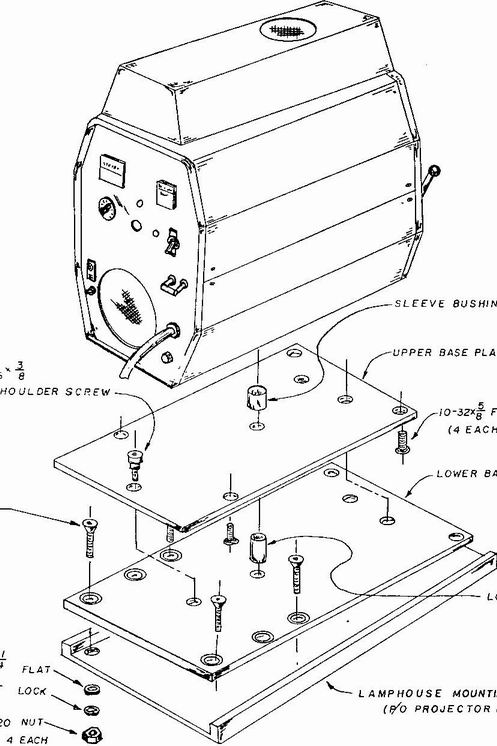
Posted by Matthew Jaro (Member # 1786) on 09-15-2004, 06:32 PM:
I had ORC 1000 integrated lamps. They were horrible. I had to have a stack of igniter boards which I went through like candies. I could never keep the thing going long enough. I also had to bypass the fan circuit because the idiots that designed this thought that once the lamp DC was off, the fan would no longer be needed. The dowsers would break constantly. What a winner. I now have Strong Super Lumex'es and they are great despite the manual switch.
Posted by Ian Joseph Parfrey (Member # 2682) on 09-15-2004, 07:19 PM:
Hi Matthew.
You...er.. ah..wouldn't want to swap..by any chance?????
Posted by Richard Fowler (Member # 893) on 09-16-2004, 09:08 AM:
The original ORC lamphouses where used as military helicopter searchlights hence the small size.
Posted by Mark Gulbrandsen (Member # 72) on 09-16-2004, 10:20 AM:
Actually I think Ian Joseph Parfrey just spelled out his ignorance of the beast. First off the ORC was a precedent setting lamphouse when it came out in the early 70's. It literally pushed the limits and envelope of available semiconductors at the time. Today any ORC integrated lamphouse can be made totally reliable by rebuilding with todays semiconductors, ripping out the top cooling fan and installing a proper external cooling system to it. I used them for years for portable work on over 30 dailies jobs and never had a problem with one once... they ran for days on end some times. New semi's and a large external cooling system, and some technical common sense is all it takes to make them a very reliable piece of equipment.
Mark @ CLACO
Posted by Steve Kraus (Member # 476) on 09-16-2004, 01:29 PM:
Were ORC1000's the standard for the Jerry Lewis cinemas (along with paired Ballantynes running big reels)?
Posted by Pete Naples (Member # 761) on 09-16-2004, 02:57 PM:
I'm with Mark, one has to look at them in their time. With a little modernisation they are good bits of kit, light output is good if they are well aligned and the mirror healthy.
Posted by Mark Gulbrandsen (Member # 72) on 09-16-2004, 05:47 PM:
Some Jerry Lewis cinemas were all Norelco equipped, some all Simplex, the latter ones were Ballantynes because of theor easy install plug together package.... and those are the dreaded Ballantynes too as they are among the first built and cost a fortune to bring up to date. They actually make better boat anchors. Alot of the cinemas used the 1000 because it was also plug in the wall item and allowed owners a way around both strict codes and unions.
Mark
Posted by Matthew Jaro (Member # 1786) on 09-16-2004, 07:02 PM:
All that is well and good --- but I am still happy to be rid of them. You can't get a silk purse out of a sow's ear.
--- Mark --- I bet the Super Lumexes with the Version 2 switching power supplies are lighter than the ORCs making it better for portable work.
Posted by Mark Gulbrandsen (Member # 72) on 09-16-2004, 08:53 PM:
quote:
--- Mark --- I bet the Super Lumexes with the Version 2 switching power supplies are lighter than the ORCs making it better for portable work.
According to t he Strong web site the Super Lumex weighs 85 lbs all by itself and the rectifier another 65 or so depending on which wattage unit you buy so thats quite a bit more than the model 1000's 80 or so pounds. I have a customer that bought several systems from me and he has the Supers with switchers. I like the color temperature of the light better from the ORC nickle reflector though.... While I didn't buy a silk purse my 1000's caused alot more dollars to be printed and deposited into my bank account from the rental jobs they were on. So lets say they at least came with a silver lining.
Mark
Posted by Thomas Jonsson (Member # 1902) on 09-17-2004, 02:50 PM:
I think the "pushers" above the Victoria 5 curved gate
is a stupid feature. I can´t really figure out what
they´re good for. All they do is causing extra-hard-to-
get-rid-off build up of dirt/wax. I took them off and that
was an improvement on all aspects.
Jerry Lewis theaters??? Now, that´s a guy I really love.
Does he own a chain of theaters or did someone name the
theaters after him?
Thomas
Posted by Steve Kraus (Member # 476) on 09-17-2004, 05:25 PM:
It was a franchised chain of theatres intended to run family-oriented films.
Posted by Mark Gulbrandsen (Member # 72) on 09-17-2004, 06:31 PM:
Ahhh Steven,
You kind of left off the majority of the story...... Thomas might not think too much of Jerry if he knew the whole story...
Most of those Jerry Lewis cinemas came and went within just a few years and eventually the Jerry Lewis Cinema Corporation went bankrupt taking most of the money and running so to say. Alot of people lost alot of money to him on those deals. Just a very few of those cinemas survived and just several out of the whole lot of them remain today.
Mark
Posted by John Pytlak (Member # 331) on 09-17-2004, 09:14 PM:
The Jerry Lewis Cinema in Rochester lasted only a year or two. The building is now an auto parts store.
Posted by Tony Bandiera Jr (Member # 2365) on 09-17-2004, 09:31 PM:
On my Kinotone FP-38D's there is a funky split guide roller just before the takeups. It is spring loaded and had a reed switch to kill the projectors' motor if it sprang together. The idea is for the film under tension to keep it spread apart. A really piss-poor design for a failsafe, if you even farted near the damn thing it would kill the machine. ![[thumbsdown]](graemlins/thumbsdown.gif)
It was connected only for the first ten minutes of the facility's first test screening and has been disconnected since!! ![[Big Grin]](biggrin.gif)
Posted by Gordon McLeod (Member # 33) on 09-17-2004, 10:13 PM:
Up here the Jerry Lewis theatres were all equiped with a Vic 4 package Also for what appears some uneducated rants on the ORC
the ORC M1000 was designed for a 700watt lamp not 1000 nor was the 1600 designed for anything greater than 1000watts
In fact if the uninformed took the time to look up the spect lamps in the old ORC catalogue you would see that in fact the M1000 used a 700 watter
The name was choosen because the light output of the M1000 with a 700watt lamp equalled the output of competeing 1000watt vertical systems
Posted by Jack Ondracek (Member # 1466) on 09-17-2004, 10:17 PM:
The Jerry Lewis people put a real strong-arm on the local theatre operator where I grew up. After a "reasonable" investment, they'd oversee construction of the theatre, then set up all operating systems and booking. Technically, the operator only needed to consult "the book" to address any situation. I don't recall... was it an upper limit of "M" back then? Thankfully, they went banko before anything got real serious. One can only imagine how much mileage they could have gotten out of old "Rat Pack" movies.
Interesting to hear that they also used the Ballantyne twin-VIP pre-wired package. Up 'til now, I was only aware of Oregon's (former) Tom Moyer chain (then Act III, now Regal). He LOVED those things!
quote: Gordon McLeod
The name was choosen because the light output of the M1000 with a 700watt lamp equalled the output of competeing 1000watt vertical systems
Uh-huh... and what were they? Those horrid vertical Christies with the 6 inch thick condensers? God, what nasty pieces of "design" those things were.
Posted by Steve Guttag (Member # 268) on 09-17-2004, 10:41 PM:
The spring loaded guide roller on the FP 20s we've sold and service never had any issues (exact same at the FP30's spring loaded roller). On the 16mm side of a FP-28 was another story.
Were you running reels (never a problem) or platter (could be a problem but shouldn't...depending on take up tension).
Not to fear...Kionton now uses IR film sensors instead of mechanical sensors.
Steve
Posted by Thomas Jonsson (Member # 1902) on 09-18-2004, 05:51 AM:
Thanks for the info about the Jerry Lewis cinemas.
I guess mr Lewis is/was as greedy as any other star.
I very much like the "actor" Jerry Lewis, but in
this case he was perhaps a "stupid feature" himself.
Did the Jerry Lewis Cinema Corp have special demands
on those theaters, regarding equipment etc, in the
same way THX has today?
Thomas
Posted by Richard Fowler (Member # 893) on 09-18-2004, 10:38 AM:
Jerry Lewis sold his name to the promotion group who developed the cinemas. They built or assisted the client in turn key cinema situations. The lack of proper training in the business and poor site locations doomed the company. Jerry Lewis personally received heat in the failures even though he had no control in the say of the operations. Later groups where formed such as TDI which did similar projects ( singles to "mega" 4 plexes ) but at least they made an attempt to train people. In the late 1970's I was involved in over a 100 of these cinemas....all using the same general blueprint and seven day install technic. All the cinemas where 196 seat, same equipment package. It was not unusual for us to re-route equipment shipments on the fly to another site if a location was not ready. I did so many of these that a couple of times I would walk into a projection booth and forget what town I was in ![[Confused]](confused.gif)
Posted by Will Kutler (Member # 770) on 09-18-2004, 11:22 AM:
The Jerry Lewis Cinema in Tucson survives to this day. It is now the site of "The Gaslight Theatre and Little Anthony's Diner".
The Gaslight Theatre is an emensly popular Vaudville style live theatre, and Little Anthony's is a '50s Style Diner. Bothe EXTREMELY popular Tucson landmarks!
Posted by Steve Kraus (Member # 476) on 09-18-2004, 10:05 PM:
Bio stuff about Lewis says he lost big time on the cinema chain or so he says.
ORC1000: The confusion may not be just from the model number. The manual itself refers to an "X1000" bulb. One might reasonably presume that's a 1000W bulb. But one would be wrong.
Posted by Patrick de Groot (Member # 858) on 09-19-2004, 05:14 AM:
quote:
On my Kinotone FP-38D's there is a funky split guide roller just before the takeup
We have both types (spring/no-spring) of fail safes. Never had a problem as you described (platters). The only thing you must pay attention to is that you pull the knob on the end out (stretch the spring) after lacing so the film is laying between the "guides".
There is also a switch on the other side of the projector to bypass the split/takeup protection.
Posted by Ian Joseph Parfrey (Member # 2682) on 09-19-2004, 05:51 AM:
I am sorry to hear that Mark Gulbrandson thinks I show ignorance in relation to the ORC Lamphouse. He suggests a virtual rebuild of the damn thing to get any reliability out of it. Well, I'm sorry Mark, but if it takes that much to get the things running reliably, then they're no good to start off with.
Whether they pushed the boundaries of semiconductor technology at the time makes no difference to me. I have to put up with the complaints when they stuff up. Its REAL hard to show ignorance with a piece equipment that you have worked with and repaired for the last 13 years!
Cheers.
Posted by Michael Schaffer (Member # 1204) on 09-19-2004, 08:22 AM:
quote:
On my Kinotone FP-38D's there is a funky split guide roller just before the takeups. It is spring loaded and had a reed switch to kill the projectors' motor if it sprang together. The idea is for the film under tension to keep it spread apart. A really piss-poor design for a failsafe, if you even farted near the damn thing it would kill the machine.
It was connected only for the first ten minutes of the facility's first test screening and has been disconnected since!!
We had those on many machines in multiplexes (with platters of course), never had a single problem. Maybe you should have invested more than 10 minutes learning how to thread them properly?
That reminds me of how I visited a location where the people who had installed the FP50Ds told me that the IR sensors didn't work, they stopped the film too often, so they had to disconnect them and install CE failsafes.
I told them that the failsafes often come from the factory set a little too sensitively, but that they could simply adjust the sensitivity with the little trimpot on top of the sensor.
Stunned silence.
Those aren't stupid features, but examples of how strange things people sometimes do simply they are not familiar with the equipment.
An actual stupid feature on older FP30s was a film break sensor above the gate whcih was a flimsy needle which sometimes got stuck and prevented the machine from starting. But they got rid of that.
Posted by Gordon McLeod (Member # 33) on 09-19-2004, 09:47 AM:
Steve said"The manual itself refers to an "X1000" bulb. One might reasonably presume that's a 1000W bulb. But one would be wrong."
Yes very wrong all one would have to do is read the bulbs specs and see it is a 700watt lamp
Ian said "I am sorry to hear that Mark Gulbrandson thinks I show ignorance in relation to the ORC Lamphouse. He suggests a virtual rebuild of the damn thing to get any reliability out of it. Well, I'm sorry Mark, but if it takes that much to get the things running reliably, then they're no good to start off with.
Whether they pushed the boundaries of semiconductor technology at the time makes no difference to me. I have to put up with the complaints when they stuff up. Its REAL hard to show ignorance with a piece equipment that you have worked with and repaired for the last 13 years!"
If oeprated with a 700watt lamp I have not had more than 10 board failures in many units installed up here with no extra venting or cooling
As soon as the bulb size was increased then the problems started
Posted by Mark Gulbrandsen (Member # 72) on 09-19-2004, 10:48 AM:
Well Ian, I don't know how you wold expect the caps in those things to last much past about 7 to 10 years and now many of those lamphouses are 30 plus years old! The older semis also had much more limited thermal cycling before failure as well.
Sorry Ian but its not much dam work to rebuild one! The main key to reliability with them are modern semis which are much hardier than they were 30 years ago and proper cooling which the internal top mounted blower never afforded. Its best to get rid of the air restricting top mounted blower and use a decent external exhaust system!
In my area there are a few 1000's still running and we have no problems with them at all. So for all the internal semis and caps it would cost you under 200.00 U.S. at list pricing! A total rebuild of one can be done in under 3 hours if you know how to approach it and have the necessary parts before hand. It just seems that you don't know how to approach it even after 13 years.... If you did yours wouldn't be giving you any trouble at all!
Mark @ CLACO
[ 09-19-2004, 01:03 PM: Message edited by: Mark Gulbrandsen ]
Posted by Pete Naples (Member # 761) on 09-19-2004, 04:00 PM:
Agreed, the 1000B's I see are running 5-700w. I've modded the circuitry so the fans run as long as there is input power, and on memory I think I've seen 2 board failure and 1 diode go in ten years, I don't think that's too bad given the age of the equipment and the duty cycle asked of them.
Posted by Tony Bandiera Jr (Member # 2365) on 09-19-2004, 04:15 PM:
quote: Michael Schaffer
We had those on many machines in multiplexes (with platters of course), never had a single problem. Maybe you should have invested more than 10 minutes learning how to thread them properly?
Maybe because we run 2k reels the takeups don't grab tension fast enough? The trouble was always at the start of a reel. And yes, I carefully set the proper takeup tension. And took the slack out of the film before starting. I think since platters have the additional length of film and the constant torque pulling fron the takeup platter you're not seeing this kind of problem.
Believe me, I went through every threading pattern possible and still had trouble with the things. The machines were test-run for a full day before opening night, both with test reels of trailers, etc. and a full feature (6 reels). The problem affected both machines.
And the ten minutes refers to the time into the test feature before I gave up on them. Even the original installer's tech didn't know how to thread them! (I had to show him.)
Posted by Ron Yost (Member # 1850) on 09-19-2004, 04:42 PM:
What about the wiring inside ORC 1000's? In mine (an early one-piece model, without a door in the front bulkhead) the insulation on the wiring is sooo dried-out and brittle-looking I'm afraid it's going to cause a fire. I can see thin cracks in the thick wires to the two big caps, but I don't see any bare wire through the insulation of the wires, or places where 'chunks' of it have fallen off or discolored too badly .. nothing 'burnt-looking' in other words. It just looks really dry and 'cooked', which it is, of course.
Is the wire 'safe', as long as one doesn't 'disturb' it too much? I haven't had to replace anything in it (except the bulb, of course), but it's getting harder to strike, so I fear the time is near for some attention. It had a set of diodes installed in 1989 .. from what I read on a service tag that's still inside.
It's in my personal 'screening room' and only sees very light use .. only a few hours a week or so.
Thank you!
Ron Yost
Posted by Ian Joseph Parfrey (Member # 2682) on 09-19-2004, 04:56 PM:
Mark.
You make many good points and I do agree with you on the life expectancy of electros and semis. But at your own admission you state that...
"The main key to reliability with them are modern semis which are much hardier than they were 30 years ago and proper cooling which the internal top mounted blower never afforded. Its best to get rid of the air restricting top mounted blower and use a decent external exhaust system!"
Design fault or what?
This lamphouse is the 1600B 240 volt / 50 hz. model which the manual states ...
"The system is equipped with an 8 foot (2.4m) long 3 wire power cord. It is designed to operate with both the ORCON X-L 1000W and X-L1600W xenon bulbs"
We run the 1ks. With the aforementioned problems. Gordon is right on the money here.
Any takers for a 1.6K trial?
I can understand the philosophy behind these things but as this topic heading is "Stupid Features of Cinema Equipment", then I think that inadequate lamp cooling in a lamphouse is a stupid feature.
Cheers and Beers
Posted by Richard Fowler (Member # 893) on 09-19-2004, 06:35 PM:
I had a problem with a client blowing bulbs in a ORC lamphouse....finally visited the cinema and found them connected to a 20 foot / 9.44 meter exhaust pipe with only the internal top blower in use For the period, the ORC's blew the pants off of the then common vertical lamphouses + early Christie horizontals. We rebuilt many for export with new silicone / glass jacket high temperature wiring, blowers and reflectors.
Posted by Steve Guttag (Member # 268) on 09-19-2004, 08:11 PM:
I think I see the problem with the Kinton split roller.
All of our FP-20 installations (the ones with the aforementioned rollers) were run with 20-minute reels and never a problem.
A couple of questions...what is the diameter of the hub you are running on your 20-minute reels....
The next question and probably the key to why we have never experienced the problem...we always ordered our FP-20s with "accelerated frictions"...which meant that the take-up gear was substantially smaller than the standard one. This was to ensure that cores would also take up on the units.
Kinoton is very fond of making common sense items extra-cost options (lamphouse dousers, controls facing the operator...accelerated frictions...etc).
If you tell me that your 20-minute reels have 5-inch (12.7cm) hubs are larger then I would grant you that this is a "stupid feature."
Steve
Posted by Michael Schaffer (Member # 1204) on 09-19-2004, 08:16 PM:
quote: Tony Bandiera Jr
Maybe because we run 2k reels the takeups don't grab tension fast enough? The trouble was always at the start of a reel. And yes, I carefully set the proper takeup tension. And took the slack out of the film before starting. I think since platters have the additional length of film and the constant torque pulling fron the takeup platter you're not seeing this kind of problem.
I never ran into these problems on changeover installation either. Did the installation technician have the proper tool for setting the friction axis? I don't know what it's called in English, but a special tool called "Friktionswaage" (roughly, "friction scales") was needed for that.
Posted by Gordon McLeod (Member # 33) on 09-19-2004, 08:46 PM:
The standard fp20 northamerican clutch was designed to take up with a 5" or larger core for a standard house reel
A exchange reel with a 4" core will have an issue
Posted by Michael Schaffer (Member # 1204) on 09-19-2004, 09:09 PM:
You're absolutely right. Now that you mention it I remember we always made sure to use a larger core for reel action.
Posted by Tony Bandiera Jr (Member # 2365) on 09-21-2004, 10:59 PM:
quote: Steve Guttag
A couple of questions...what is the diameter of the hub you are running on your 20-minute reels....
The next question and probably the key to why we have never experienced the problem...we always ordered our FP-20s with "accelerated frictions"...which meant that the take-up gear was substantially smaller than the standard one. This was to ensure that cores would also take up on the units.
Kinoton is very fond of making common sense items extra-cost options (lamphouse dousers, controls facing the operator...accelerated frictions...etc).
If you tell me that your 20-minute reels have 5-inch (12.7cm) hubs are larger then I would grant you that this is a "stupid feature."
We're using Goldberg Cast reels (15") with the standard hub which is 5" IIRC.
Bingo!! We most likely do not have the accelerated take-ups, the chain's sprocket for the takeup is something like 8" (!) in diameter!!
As for controls, yeah, another stupid feature. I built custom remote panels for Start/Stop and Dowser.
Michael: Is it possible you have the accelerated take-ups? If your purchaser/engineer was smarter that the one who did my booth it would explain a lot. I was brought into the fray 4 days before the gala grand opening.
Posted by Michael Wilkinson (Member # 2389) on 11-30-2004, 03:43 AM:
Hey Aaron...going back to page 2...
Wouldn't that be a YES? ![[puke]](graemlins/puke.gif)
Posted by Monte L Fullmer (Member # 2797) on 11-30-2004, 04:08 AM:
How about the manual turret version of the Mil-2K machine? With that stupid placement of the turret release catch lever - about the right height in line with the eyes when one has to look out of a small port window to check frame and focus in a theatre that doesn't have projectionist viewing port windows, just the main port. Many time I almost poked my eye out with that lever. Strong does it again...not thinking of safety features.
Yuk - LIT bought out PerkinElmer stuff .. definitely signs of a "stay-away" company.
Posted by Michael Wilkinson (Member # 2389) on 11-30-2004, 05:16 AM:
Thinking about great things such as Monee, CFS, and LIT brings me to Tokiwa...Has anyone seen the barrel shutters on the older TSR models? The shutter looks similar to a squirrel cage fan with two flaps that are spring loaded in the closed position. Once the projector gets to speed, the centrifugal force of the spinning barrel forces the flaps to open.
Another early Tokiwa issue is the film gate release knob. This knob is tiny enough as it is, but to make matters worse it is attached to a flimsy spring loaded threaded rod which will likely strip out the first time that you don't consciously remember to be gentle. Be sure to have some pliers readily available as the gate release knob substitute...
Other than that, from the two I have laying around, they seem to be pretty well built machines. I'm occasionally tempted to try one out, but haven't got up the nerve.
Posted by Richard Fowler (Member # 893) on 11-30-2004, 04:58 PM:
The Tokiwa with the built in spring loaded fire shutter in the main barrel shutter was stolen from earlier Ernemann designs and is also used by some Chinese projector manufacturers. LIT was started by key personel from ORC. ORC sold the bulb division to P & E and last spring sold the rights to ASL based in Illinois....keep your score card current
Posted by Steve Guttag (Member # 268) on 11-30-2004, 06:10 PM:
quote: Monte L Fullmer
How about the manual turret version of the Mil-2K machine? With that stupid placement of the turret release catch lever - about the right height in line with the eyes when one has to look out of a small port window to check frame and focus in a theatre that doesn't have projectionist viewing port windows, just the main port. Many time I almost poked my eye out with that lever. Strong does it again...not thinking of safety features.
Wait a minute...an incompetent theatre design (one without an adequate view port, which can be part of the main port, if necessary) is the the fault of the projector manufacturer? This is "professional" equipment to be operated by "professionals." The only way your eyes are in danger is from the poor theatre design. I suppose if you leaned in far enough to catch your hair on a sprocket that would be the manufacturer's fault too. Lets put the blaim where it belongs, bad theatre design. I'm sure you can find enough legitimate complaints though.
Now...by a show of hands, how many of you have impaled yourself on a Kelmar rewinder spindle whilst walking by the rewinder?
Steve
Posted by Matthew Jaro (Member # 1786) on 11-30-2004, 06:18 PM:
Steve --- I have. I got hit in the stomach (technically not being impaled). I must be careful to take the spindles off when I'm not using the rewinder.
Posted by Emma Tomiak (Member # 1862) on 11-30-2004, 09:09 PM:
I have. I got jabbed in the stomach as well. Left a nasty bruise, too.
Posted by Mark Gulbrandsen (Member # 72) on 11-30-2004, 10:12 PM:
quote: Michael Wilkinson
Once the projector gets to speed, the centrifugal force of the spinning barrel forces the flaps to open.
Actually that design was originated by Phillips in the FP 5, 6 and 7 projectors back in the 40's. A very good idea actually as its a no brainer for the operator of the equipment. If you don't want the fire shutter just remove the flaps. The barrel shutter is a good design in itself as it has two leading edges in effect a double shutter projector making it a tiny bit more light efficient than a single blade machine. With the faster cut off there is also less apparent flicker. The only downside is that a long focal length mirror is required in the lamphouse.
Benefits are:
1. Faster light cut off
2. Resulting in higher light efficiency.
3. Equivelent to a double blade mechanism without the gearing hassles.
4. Very quiet, almost noisless in operation.
5. Projector can be built motre compact.
6. Self cooling if properly designed.
quote: Steve Guttag
Now...by a show of hands, how many of you have impaled yourself on a Kelmar rewinder spindle whilst walking by the rewinder?
Its not the rewinders(Kelmars)fault.... its the operators for not removing the spindles and placing them in the rubber grommets that are there to retain them.
Mark
Posted by Dean Kollet (Member # 1789) on 11-30-2004, 11:00 PM:
I have run into one, we always keep them in. Our faults, but I've still gotten a mean ass bruise from one. And for some reason they bend all the time causing an unsafe work environment when you are rewinding at a decent speed.
Posted by Monte L Fullmer (Member # 2797) on 12-01-2004, 01:25 AM:
True, When I got my shirt ripped from forgetting to remove them spindles, and smaking an elbow into a 5/16" spindle, it's mandantory instructions for immediate removal when not in use and be stored in the grommet holes.
Hey, remember those Neumade rewind tables that when rewinding a 6k 1/2" spindle reel, and the reel had about 800 ft of film left, spinning about 2000rpm, and the clip flips off, digging two grooves from the mad spin of the flanges in the tile floor where it dropped, running down the length of the booth, smaking itself against the wall, spinning grooves in the brick in the process, thus bending the crap out of the aluminum flanges, and the manager runs upstairs wondering on what happened for he heard that thing hit the floor from downstairs.
I wasn't there, but the operator told me about this, and when I saw the results, it was quite impressive on how a reel can be a lethal weapon at times. -Monte
Posted by Steve Guttag (Member # 268) on 12-01-2004, 05:23 AM:
quote: Mark Gulbrandsen
Its not the rewinders(Kelmars)fault.... its the operators for not removing the spindles and placing them in the rubber grommets that are there to retain them.
Sure Mr. Fancy Pants...but some of us have more than just your basic spindles...there are the 5/16 with key, 1/2" with dog pin, 16mm square drive....whoops out of spindle holders and I haven't even gotten to the 70mm spindles and 9mm ones.
In truth, I wasn't trying to assign blame but I don't know anyone that has worked around such a table that hasn't been "touched" by one. Older, more home brew, type rewinders with the washing machine motor hanging off the edge to tension the V-belt also often had a knob on the large pulley to turn the reel...that bad boy could also be a lethal weapon!
Generally, when we set up a booth...I'll place two Neumade CAB2735s, if the booth is so equipped, under the rewind table...this inherently has the operator walk clear of the spindles. They also form nice shelf to store items to keep the work surface of the rewind/inspection table clear.
Steve
Posted by Mark Gulbrandsen (Member # 72) on 12-01-2004, 08:18 AM:
quote: Steve Guttag
Sure Mr. Fancy Pants...but some of us have more than just your basic spindles...there are the 5/16 with key, 1/2" with dog pin, 16mm square drive....whoops out of spindle holders and I haven't even gotten to the 70mm spindles and 9mm ones.
As long as they're stowed away in an organized fashion is all that really matters. How many types of spindles there is in a given location is irrelevant as long as all the correct spindles are present .
Mark
Posted by Steve Guttag (Member # 268) on 12-01-2004, 10:45 AM:
So storing the "active" spindles in the projectionist's rib-cage is not neat and organized for you?
Steve
Posted by Stephen Furley (Member # 1277) on 12-01-2004, 12:28 PM:
quote: Monte L Fullmer
Hey, remember those Neumade rewind tables that when rewinding a 6k 1/2" spindle reel, and the reel had about 800 ft of film left, spinning about 2000rpm, and the clip flips off, digging two grooves from the mad spin of the flanges in the tile floor where it dropped, running down the length of the booth, smaking itself against the wall, spinning grooves in the brick in the process, thus bending the crap out of the aluminum flanges, and the manager runs upstairs wondering on what happened for he heard that thing hit the floor from downstairs.
How fast do you rewind your film? I've never had a reel fall off a rewinder, though I did have one that came close to it once, but if it did happen, it wouldn't be spinning fast enough to do anything like that. I normally rewind at about 2-3 times running speed, about 20-30 minutes to rewind a 6k spool. even near the end of the reel it's not turning very fast.
When I first saw a Kinoton, an early FP-20, maybe 15 years ago, I thought they were very odd things, but, over the years, i've got to like them. I haven't run anything else in the last year or so. There are however some things that I really don't like about them. The split roller is one of them, I just couldn't start a machine reliably without tripping the thing. I ended up disabling the acop system by taking the relay out of the control box for the first few shows I ran with it. This was mainly with 6k spools for features, buy I also had problems with 2k spools for adverts and trailers. I now hold the red knob out with my left thumb and index finger while starting the motor with my right hand. Once the machine is up to speed I feel underneath the roller with my other fingers to make sure the film is running correctly in the roller and then slowly release the knob. I've then usually got about three seconds to the changeover.
Other things that I don't like are the lamp strike on motor start, and no manual douser, maybe ok for automatic setups, but absolutely hopeless with changeovers, the brightness and colour both change very noticeably at the changeover. Then there's the inching knob mounted on the top sprocket, not used as much as it used to be on the older machines, but still needed. The version where it was lower down, and much easier to turn, was better. Then there's the controls; I quite liked the old curved rocker, flick it forward to start, backward to stop, press it in to change over. I only ever used this on a single machine with a tower, so I never did a changeover with it. Then they went to buttons in roughly the same place, then buttons on the front of the column, front as in facing the front wall of the box, not facing the operator, what on Earth was the idea of that? My arms are not long enough to reach them while looking through the viewing ports, and I have to bend down and look through the projection port, trying not to get the reflected light in my eyes. It seems to me that you seldom see two Kinotons with the controls in the same place, there seem to have been many different versions.
The plastic gate parts don't worry me, they work well, seem to have quite a long life and are quick and easy to change. I like the lens holders, as many lenses as you like, or can afford the holders for , very quick to change, and hold the focus well between changes. They give a good steady picture, and are better than most machines with 'difficult' prints
Most of the things I don't like seem to have been later modifications, which ween't on the earlier versions.
I know that most of these things can be changed, but I don't own a cinema, I just get called in from time to time to work in them, so I have to use the machines as I find them.
Posted by Monte L Fullmer (Member # 2797) on 12-01-2004, 03:41 PM:
I wasn't the operator at this theatre. It was operated by high school kids were doing this booth work, for I knew one of the kids there and he called me up to show me this-they thought it was the most funniest thing they have seen(!!!!).
I would never spin a reel that fast to do a rewind (scratching the hell out of the print with the fast winding and the stronger tension the supply spindle has to have to ensure a even wind to the supply reel), and always, always make sure that those clips were on securely, for I worked at a 4screener who also had a Neumade table.
Posted by Mark Gulbrandsen (Member # 72) on 12-01-2004, 07:26 PM:
quote: Steve Guttag
So storing the "active" spindles in the projectionist's rib-cage is not neat and organized for you?
Its too bloody messy .
Mark
Posted by Michael Wilkinson (Member # 2389) on 12-04-2004, 10:15 PM:
Hi Mark,
You are the first person I've heard of who likes the machines.-Whoa maybe I just put words in your mouth...
I have four-two auto turret-2 manual in storage and now you've got me so excited I might just think about using them somewhere.
What type of lamphouse would work with a TSR???
Posted by Leo Enticknap (Member # 534) on 12-05-2004, 07:03 AM:
quote: Stephen Furley
It seems to me that you seldom see two Kinotons with the controls in the same place, there seem to have been many different versions.
Possibly because many versions shipped with the controls on the front face of the mech, which is about the worst possible place to have them. Even if you're not trying to do changeovers, having to put your arm in the way of the film path isn't good. So I guess that a large proportion of the FPs out there have been modified to put the motor and changeover shutter buttons somewhere more user friendly.
quote: Stephen Furley
The plastic gate parts don't worry me, they work well, seem to have quite a long life and are quick and easy to change.
They are also insanely gentle to shrunk, deformed or brittle film and can hold a steady picture with the smallest amount of gate pressure I've ever seen in any projector. FP-20s would be my projector of choice for any venue running 35mm archival prints regularly. The only drawback is that in some configurations it's not possible to lace up silent prints in a way which bypasses the optical reader altogether - in particular the weight of the scanning drum on a tinted and/or toned print can create an impressively nasty mess (not to mention inflicting unnecessary print wear).
Powered by Infopop Corporation
UBB.classicTM
6.3.1.2