This is topic BACP RSTR 2000 changeover operation with no Cinema Processor in forum Film Handlers' Forum at Film-Tech Forum ARCHIVE.
To visit this topic, use this URL:
https://ft-forum.com/ft/cgi-bin/ubb/ultimatebb.cgi?ubb=get_topic;f=1;t=006593
Posted by Daryl C. W. O'Shea (Member # 1303) on 09-21-2004, 08:58 PM:
What would be the best, err, most convenient yet acceptable, way to wire up two BACP RSTR 2000s in a changeover situation without a cinema processor?
Being a drive-in, they don't want to spend the money on a CP, which I can't say I blame them. Instead both channels from both readers are going to be attached to 4 XLR inputs on a very good mixer.
The current exciter lamp setup has a General Sound DC power supply that either runs the exciter at full voltage on the active projector, and dims it on the non-active projector. The outputs of both (mono) cells are currently tied together after their individual preamps. There's also a 20VDC power supply to run the preamps.
The easiest simplest way I currently see possible is to use the existing preamp power supply to pull-in or release a relay in each of the sound heads. Either the LED power lines, or the audio lines, would be connected or disconnected, depending on the active status. For obvious reasons I'd like to avoid splitting up the audio lines and instead shut off the LED. I'm assuming the GS exciter supplies wouldn't like to only have a relay as a load. Please correct me if I'm wrong (Gordon?), because using that supply (if I can turn the exciter warming voltage/current right down) would be the easier way to go and I could keep the existing changeover switches.
So, my questions would be...
1. Can anyone recommend a circuit to put in line with the LED and the BACP RSTR 2000 reader so that the LED ramps up, rather than goes to full current/voltage right away?
2. Does anyone (Sam?) know if there's a way I can just open/close some point of the BACP circuit, similar to the Kelmar or CE designs, to turn the LED on or off?
3. Not quite related -- these folks like to 'bump' the projector motor (Century CC on an R3) when threading up. If I were to wire the BACP power supply across the motor is it going to be a problem. Some supplies and ciruits will handle that sort of abuse, others won't. If it can't handle it, no big deal, at least they'll have one LED off at all times and don't have significant off screen time with the booth powered up, being a drive-in.
Keep in mind that I've never seen one of these BACP readers and only know what the manual says about them.
Thanks!
Posted by Mark Gulbrandsen (Member # 72) on 09-21-2004, 09:08 PM:
I would contact Sam and ask him if its ok to just put the C/O relay(s) in series with each LED's positive lead. I'm not sure that its ok for the LED's switching supply in there to operate with no load.... Sam can definately answer that though. If you switch DC to the reader you very definately will get a turn on thump. Does this D.I. still have a ramp speaker system??
Mark
Posted by Daryl C. W. O'Shea (Member # 1303) on 09-21-2004, 09:10 PM:
I was thinking it'd probably be a good idea to put a resistor on the other side of a double throw relay. Didn't want to provide to many of my hair brain ideas and throw people astray though. ![[Smile]](smile.gif)
I "merrily disconnected" the AM ramp system. It's an FM (antenna) system only.
Posted by Mark Gulbrandsen (Member # 72) on 09-21-2004, 09:13 PM:
Sorry, was thinking of something else and re-edited my response, but there are several DI's with DTS that I know of and its quite a sucess having it there.
Mark
Posted by Ron Yost (Member # 1850) on 09-21-2004, 10:12 PM:
Daryl,
I can't answer your questions, but I can send you a few clear pics of the RSTR2000 I took of it laying on my bench before I installed it in my RCA 9030 soundhead. If you want them (3 jpg's) just let me know. musik42@charter.net
Also, I had a low-level buzz after installing it that wouldn't go away using recommendations in the manual. I got rid of it by running a short ground wire from the GND terminal on the green Phonenix connector to one of the screws that used to attach the exciter lamp assembly. This in addition to the GND lead to my processor, of course. Perfectly clear sound after that. ![[Big Grin]](biggrin.gif)
This is probably entirely unique to my situation tho, and I've installed exactly one 2000.
Ron Yost
Posted by Steve Guttag (Member # 268) on 09-21-2004, 11:00 PM:
I believe SMART still offers the ModII-DIT that is drive-in specific. It will put out a stereo signal of Lt/Rt for the FM transmitter and a mono mix for speaker poles. It would also address your changeover issue.
Steve
Posted by Mark Gulbrandsen (Member # 72) on 09-21-2004, 11:52 PM:
quote: Ron Yost
I had a low-level buzz after installing it that wouldn't go away using recommendations in the manual. I got rid of it by running a short ground wire from the GND terminal on the green Phonenix connector to one of the screws that used to attach the exciter lamp assembly.
I experienced this same problem last Saturday while installing an RSTR 2000 in a Monee projector. A ground jumper to the frame cured this one too. This theatre was pretty darn ratty with the automation completely out and every inch of the projector swimming in oil and very filthy... the entire booth is badly neglected at any rate. And the customer ONLY wanted the red reader installed, nothing else done. I suspect there was some faulty, or missing ground somewhere else in the system..... especially knowing who did the original installation. These are the type of customers you wish were NOT your customers and would NEVER call you back.... ever! You can only pray they call the local competition the next time.
________________________________________________________________
Regarding Ramp Speakers......
Yea, thats why I asked if there were speakers still in use. With the Mod II DIT it is possible to add an EQ card to the mono output and actually EQ just the ramp speakers and I've done this on three occasions with great sucess. I did this with my Ivie analyzer and the mic and speaker mounted in an average size auto and adjusted EQ to approximate as much of the 2969 curve as was possible without using any low frequency boost... in other words this was done with just cut EQ and it always resulted in much more listenable sound from those crappy little speakers.
One other point to mention Daryl, If you use the old exciter instead of the wall worts that are supplied to power these scanners don't allow the NO LOAD of the exciter supply to go much greater than 12 VDC or you will blow out the on board power supply in the plug in card.
Mark @ CLACO
Posted by Daryl C. W. O'Shea (Member # 1303) on 09-22-2004, 12:16 AM:
Yeah, the ramp speakers are gone too. Way too much trouble opening up every spring after the frost moved everything around.
The few people that come without FM radios, they supply with one.
Do these readers become active fast enough that I could use the existing exciter power supply to turn the entire unit on and off?
If so, I could certainly ensure that the supply is always loaded adequately.
Thanks for the offer Ron, but as long as the manual is accurate, I've got a good idea of what they look like and what their stock control capabilities are.
Posted by Ron Yost (Member # 1850) on 09-22-2004, 12:58 AM:
Mine, operated by the same switch I used to use for the exciter lamp, 'snaps' on very rapidly. I'd say it's near-instantaneous, practically speaking, and there's no visible or audible delay, that I can discern. It's just 'there' the instant the switch is thrown. Is that what you mean, Daryl?
I'm using the wall-wart supplied with it, tho, if it matters.
This is in my home 'screening room', with only the one machine.
Technical answer, huh?? ![[Eek!]](eek.gif)
Ron Yost .. NotATech, Inc. is not responsible for this message.
Posted by David Buckley (Member # 2600) on 09-22-2004, 08:01 AM:
Lurking inside the 1970s "hifi" amplifier that is our "processor" I found this:
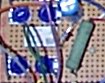
Its a relay that basically switches the stereo audio. There is also a preset for each channel of each projector, so they can be balanced up. Its controlled from a switch on the soundhouses, which looks an original switch from the mono days, thats been rewired.
It may be ugly, but it does work, and whoever built this thing selected a relay suitable for low level signal switching. It doesnt click, or miss changeovers.
The other components on the board are a simple regulator that drops the amplifiers 55v rail down to 24v for the optical preamps. Oh yes, they are home made, too.
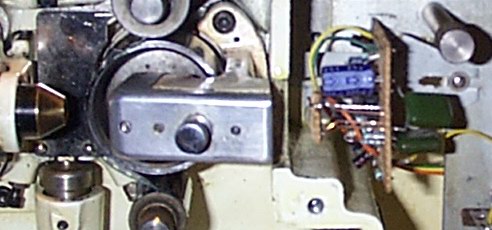
Its a comforting thought that with cyan upon us, in the summer break we'll be upgrading these readers to something resembling a commercial product.
Posted by Sam D. Chavez (Member # 1841) on 09-22-2004, 10:59 AM:
Regarding changeovers, they've been done any number of ways, with or without my "approval". Some folks switch the AC input to the wall wart without a thump and get away with it. I prefer switching the LED wiring. The LED supply could not care less. You do have to use a relay suited to switching small current as the 150 mA LED current can get lost in some honking relay meant for 20 Amps.
Posted by Daryl C. W. O'Shea (Member # 1303) on 09-22-2004, 04:04 PM:
Relays on the LEDs it is! I take it that since "the LED supply could not care less" I don't need to load the supply (using a resistor on the other side of a double throw relay) when the LED is disconnected, right?
Thanks Sam! The list of people I owe a round to grows! ![[beer]](graemlins/beer.gif)
Thanks for the pics too David, I'd considered doing something similar, but I usually prefer to avoid splitting apart audio lines if I can avoid it to prevent noise in the system.
Ron, that's what I meant. That was another last resort idea. Not soo bad in a screening room where they probably don't get turned on and off as often as a drive-in (sometimes 25+ changeovers a night), but if I set them up that way and they die next year, I'd probably know why.
Posted by Ron Yost (Member # 1850) on 09-22-2004, 05:09 PM:
Yeah, Daryl .. I think that's what Sam means. To see what would happen, I just this morning tried 'inerting' a little SPST switch (adequately rated, of course) in one of the LED's leads and switched it quite a few times. Left it off for a half hour or so, too. It worked just fine .. nothing made any sign it wasn't happy when the led was off. I'm going to use this newly-learned knowledge in my own little setup. Thanks, Sam!
I didn't have my processor on, tho, so I wasn't listening to anything.
I assume you're planning on using the supplied wall-wart, right? If so, it's the type (mine is, anyhow) that has two AC prongs on the wart itself .. it doesn't have a cord that plugs into AC. Normal, for a wart, but I have some that do have a cord. Just thought I'd tell you so you can do a little advance planning where you're going to put it, if you need to. Your's, for Century's, may be different as far as the wart goes. I know it's entirely different, as far as mechanical design goes.
Thanks for responding, Sam. Always good to know what those that make 'em recommend .. or, at least, what an 'amateur' like me can get away with.
Ron Yost
Posted by Daryl C. W. O'Shea (Member # 1303) on 09-22-2004, 05:15 PM:
Oh yeah! I forgot about my concern of switching the LED in the first place. I assume it's going to cause a thud, no? Should a small capacitor and paralleled resistor be put in line with the LED? What sort of values would you recommend, if so?
Posted by Ron Yost (Member # 1850) on 09-22-2004, 05:20 PM:
I KNEW you'd ask that! I should have turned the processor on.
I'll go down and put the switch back in and see .. I have a Dr. appt in a few, tho. Ok if I get back to you tonight, Daryl?
A quik thot .. a switch would be much more 'noisy' than a small relay. So my 'test' prolly wouldn't help ya, Daryl. I don't have any little relays to try, tho. Byeeee.
Or, better yet, maybe Sam will show up first.
Gottta jet!
Ron Yost
Posted by Paul Trimboli (Member # 1509) on 09-23-2004, 07:53 AM:
The reverse scan readers I have worked with had a switch inline with the LED. It never caused a thump.I read somewhere on here that you increase the life of the LEDs by switching them off. Just became a habit, close the dowser, change the sound to N/Sync and switch off the LED.
Posted by Peter Hall (Member # 695) on 09-25-2004, 03:47 AM:
Paul
The thump that you talk about is common when you switch the LED with the changeover shutter. Control it with the motor and this is eliminated. I dont know why but the newer Kiniton FP30s switch the LEDs with the changeover - we mod our ones to follow the motor relays.
Posted by Stan Gunn (Member # 554) on 09-25-2004, 04:28 AM:
Daryl
I have seen both lazer and led switched by relay and switch.
the change over is unnoticable, switch off and switch on is as good as in built electronic C/O systems.
Stan
Powered by Infopop Corporation
UBB.classicTM
6.3.1.2