This is topic Scope Aperture Plate question in forum Film Handlers' Forum at Film-Tech Forum ARCHIVE.
To visit this topic, use this URL:
https://ft-forum.com/ft/cgi-bin/ubb/ultimatebb.cgi?ubb=get_topic;f=1;t=006705
Posted by Ed Inman (Member # 2583) on 11-10-2004, 06:16 PM:
I have two different types of scope aperture plates. The bigger one is .715 x .715 and the smaller is .650 x .650 and marked "SuperScope."
Can someone tell me which (if either) of these is considered "standard" today for modern scope prints? Or, alternately, what the contemporary standard is if both of these are obsolete?
thanks in advance,
Ed
Posted by Gordon McLeod (Member # 33) on 11-10-2004, 07:50 PM:
650x650 is an undersized plate that is the basis for one that will be filled out
Posted by John Hawkinson (Member # 1135) on 11-10-2004, 08:39 PM:
Your aperture plates are square? (!)
As of August 1993, Scope is .690"x.825".
--jhawk
Posted by Ed Inman (Member # 2583) on 11-10-2004, 09:39 PM:
The 650 x 650 is what I got indirectly from Wolk when I ordered a "scope" plate. I didn't think it was right from the start but I seem to get nowhere fast trying to communicate with Wolk about anything.
Can anybody recommend a reliable company who can file it to the right size without ripping me off?
Ed
Posted by Gordon McLeod (Member # 33) on 11-10-2004, 10:08 PM:
The only proper way any plate is done is that it is filed to fit by a competent engineer
many people start with an undersized plate such as 650x650 to open up to a scope image
I usually start with a pinhole
Posted by John Hawkinson (Member # 1135) on 11-10-2004, 10:12 PM:
You're probably best off just buying the correct aperture plate. You have a Simplex, right? The .650"x.650" plate is G-2515. What you probably want is the .650"x.780" plate (G-2414), which is about .040" under on each side, so it can be cut to your screen. I don't know if you can order a spot-on 690x825 plate pre-cut for Simplexes.
You're probably better off going through a Wolk reseller. Support your local dealer. Also, www.rsem.com has a very comprehensive web site listing pretty much everything (note that Simplex apertures are available manufactured from Wolk as well as Simplex), and is a reasonable choice.
You could also use your .650 square for practice. Get yourself a flat file (and maybe a stone) and a caliper and carefully go to town. If you don't have a caliper, definitely pick one up, they're incredibly useful. Harbor Freight sells bottom-of-the-barrel CEN-TECH digital calipers for $16. They're actually remarkably good, and a steal at that price.
--jhawk
Posted by Brad Miller (Member # 2) on 11-10-2004, 10:43 PM:
Ok JHawk I'll bite, how many aperture plates have you cut using a caliper? I just have to know.
Strong's "undercut" plates are not undercut at all. The last dozen I ordered were cut right to the zero line on PA35. Morons! (I ended up having to return them for pinhole plates since they aren't smart enough to actually make undersized plates.) Kinoton did theirs right. Not only are their undercut plates able to work in literally any situation (even 2:1 auditoriums), they have markings to show where the zero line is, which is very helpful if you are using a nibbler.
Also, getting regular files (for example from Sears) is a terribly stupid idea. Files that have smooth sides so as to not cut into an adjacent "wall" are mandatory. Having a few different sizes and grades also makes things easier.
Posted by John Hawkinson (Member # 1135) on 11-10-2004, 10:59 PM:
How many? Only a handful, I guess. I think 5 pairs. You can't treat the caliper as gospel, because of shadowing and keystoning and soforth, but it can save you substantial trial and error and give you a good idea of where you want to cut to.
Agreed in re "safe files" for cornering.
--jhawk
Posted by Brad Miller (Member # 2) on 11-10-2004, 11:17 PM:
Wow, you're the first person I've ever heard of that uses a caliper to assist with cutting aperture plates. Any techs out there use one? Personally, I don't see the need.
Posted by Paul Mayer (Member # 355) on 11-11-2004, 12:06 AM:
I've never used a caliper during the filing process, but I have measured previously filed plates with one (a cheap plastic Sears one). For the actual filing I just go by what I see on screen, using a nibbler for the big first cuts. The file I use has milled sides and also comes from Sears (I think they sell it as an ignition point file).
Not that I get to file many plates these days. ![[Frown]](frown.gif)
Posted by Ed Inman (Member # 2583) on 11-11-2004, 01:09 AM:
You guys have great academic arguments but the simple question remains as to where I can easily order an accurate scope plate for my Simplex without a lot of unnecessary BS.
That's really all I want. Is that too much?
thanks in advance,
Ed
Posted by Manny Knowles (Member # 1171) on 11-11-2004, 01:17 AM:
If your screen has already been masked then you will most likely have to get an undersized plate and have it filed out. I have personally never used any aperture plate "right out of the box." They all needed some amount of filing. It's not really BS; that's just how it is.
Posted by Frank Angel (Member # 248) on 11-11-2004, 01:19 AM:
Wow, you guys who can cut from one of those pinhole plates...you RULE. I HATE cutting plates when they are just undersized; I can't imagine how much of a pain cutting all that area would be from a pinhole plate.
Thing is, if you are cutting plates to correct anything like keystoning or doing a perspective curve, what you've got is an uneven cut. I don't see how calipers could help you. The only time using an instrument to measure the plate numbers would be if the projector was sitting directly in the center of the screen with no tilt or yawh (OK, I don't know what yawh is...it just sounds good).
I've got a standard file set with very fine teeth, or whatever you call the surface, and I used a grind wheel to file off the teeth on the side edge of the file. Most consumer hardware store files have side teeth that will nick the adjacent plate wall. Thing is, the files in this set happen to have a rounded shaft on the end which is used to attach a plastic handle. With the handle removed, the shaft fits perfectly into the blade jaws of a reciprocal saw. Next plate that I have to cut, I will try attaching the file to the saw. The saw will cause a rapid back and forth motion to the file, just what's needed. It should prove to be very useful in allowing a much more even control of the cut and certainly easier on the guy doing the cutting. We shall see.
Posted by Ian Joseph Parfrey (Member # 2682) on 11-11-2004, 02:08 AM:
Hi Ed.
The "Superscope" plate you refer to was brought out when Cinemascope made it's debut as a potntial competitor, and the reasoning behind the square aperture shape was to keep the optical centre line central from lamp to lens as well as utilising as much of the light cone at the aperture as possible.
Hope this helps.
Posted by William Hooper (Member # 71) on 11-11-2004, 02:27 AM:
The SMPTE projection aperture assumes that the projector will be exactly perpendicular to the center of the screen. If it is slightly above or below, and/or to one side, you will get keystone. The keystone must be corrected by filing an undersized aperture plate for exactly that throw & screen.
We don't know your application. If this is a home or mobile setup & you don't intend to get rid of the keystone, then you can just put a vertically symmetrical plate in like Jayhawk is talking about.
Gordon is assuming you are going to correct the keystone, as in a regular theatre. You must get a plate with the opening too small, & file it out to the needs of the screen & angle.
Projectors are almost never dead on to the center of the screen, with no angle. They're usually above the center or the whole screen, & pointed down. This distorts the projected image. *Any* amount of angle distorts it.
When you get to extremities like this:
something which appears on the film like this:

will appear on the screen like this:

(Which, by the way, is the way ALL titles looked to kids sitting on the front row in a big house, due to foreshortening. It took me a long time to understand these people who were losing bladder control over the Star Wars Titles: they'd never sat in the front row in a big house. Lucas obviously had.)
So to get this all square again onscreen, an aperture plate is filed to the reverse of the keystone on that projector:

This blocks the image on the sides to form a rectangle again

Those illustrations aren't to any particular scale; they're just to show how it works. In actuality, more goes on: screen curve, horizontal keystone from being to the left or right, bear in mind that the aperture plate for scope is *before* the anamorphic adapter which spreads the picture horizontally, etc.
You run a loop of RP-40 (MAKE me say PA-35!) on the projector. Then you put in a plate with an undersized hole, look at the picture, pull the plate, file it out where it's needed, stick it back in, repeat. Don't file too far!
There's a picture of an aperture plate at
http://www.widescreenmuseum.com/widescreen/lbx.htm
Brad's gripe about Strong not understanding & offering plates already cut to the zero line vertically is due to the fact that lens sizes are not continuous - you get the closest lens size that projects a picture to the vertical size of the screen, but since it may not be right on it, the picture must not be slightly smaller, but larger than the masking, & a bit is cropped vertically via the aperture plate.
I'm glad Frank has owned to disliking cutting aperture plates. Me, too. Some folks can just spit them out.
An aperture plate file, which has teeth only on one side has been mentioned. Hobby shops also sell sets of miniature files which include some with teeth on only one side.
Posted by Brad Miller (Member # 2) on 11-11-2004, 03:15 AM:
Frank, you start with a pinhole and use a nibbler to get yourself in the ballpark. You can get "in the ballpark" within a couple of minutes using that nibbler. From there you have your own customized undercut plate. Pinhole plates are not literally "filed".
Posted by Phil Blake (Member # 2012) on 11-11-2004, 06:20 AM:
We had the opposite problem when installing the new Cinemaccanicas , the standard plates were too big , we had to hammer the edges with a parallel punch and hammmer to spread the metal , then file them back. (without warping the plate so it may stick when changing) not that Cinemaccanica aperture plates stick that much ![[Wink]](wink.gif)
Posted by Hugh McCullough (Member # 1542) on 11-11-2004, 07:50 AM:
quote: Ed Inman
smaller is .650 x .650 and marked "SuperScope
I remember projecting Superscope films in the 1960s.
The picture was squeezed, like Cinemascope, but had a black line down both sides. I think that this was to get over the problem of not paying Fox any royalties for using their scope system. They seemed to have the World Patents nicely tied up.
At the time there were quite a few weird scope ratios such as MGMscope, Megascope, and Hammerscope are some that I remember.
Kalee made a special anamorphic lens called a Varamorph. This had a knurled knob on the top. By turning this knob you altered the position of the two prisms inside the barrel to match the ratio of the print.
I think Delrama also made an adjustable scope lens.
As for cutting plates. Start with an undercut plate, and use a very fine brand new, and therfore sharp, flat file about an eight inch wide with two safe edges. Cut plate to a very small overlap on the screen masking.
When finished throw the file away. Use a new file for every plate you cut.
Posted by Gordon McLeod (Member # 33) on 11-11-2004, 09:36 AM:
I use a dremel tool and a dentist bur to open them up
Posted by Ed Inman (Member # 2583) on 11-11-2004, 10:52 AM:
I found the G-2414 plate at the rsem site. I think that will probably be my best bet. I wish that had been sent in the first place, but you live and learn. I don't have much faith in my ability to accurately file a 650 x 650. Thanks for all the info.
Ed
Posted by Ian Joseph Parfrey (Member # 2682) on 11-12-2004, 03:55 AM:
Hi Hugh.
Do you remember the old "Hi-Lux Fix" British prism 'scope lenses?
The pair I bought have a 70' mark on the front element. I gather that these weren't built with wide focus-ing range in mind. They do throw an o.k picture though.
Posted by John Hawkinson (Member # 1135) on 11-12-2004, 04:25 PM:
Wow. I was sure Mark G. would side with me and use a caliper. But it sounds like you're right, Brad, most people don't use them. So how do you know how far to cut?
It seems like a lot of effort to either keep the loop running in the projector and keep iterating between cutting and re-inserting the plate, or to restart the the projector each time. I realize cutting is iterative, but the difference between 20 iterations and 100 iterations is substantial...
I suppose you can eyeball the plate against a piece of RP40 as you are cutting it...
I guess, for me, using a caliper falls under "using the tools you know."
--jhawk
Posted by Paul Mayer (Member # 355) on 11-12-2004, 04:46 PM:
How do know when you're there? By looking at the screen. Yes, filing plates is an iterative process.
Posted by Gordon McLeod (Member # 33) on 11-12-2004, 05:16 PM:
I set the masking to the 35PA loop and then file the plate to the masking
A caliper will only tell you the size of the opening not its relative position
Posted by Chris Byrne (Member # 1563) on 11-13-2004, 07:56 PM:
I went looking for a nibbler at a couple of local hardware stores and they were all priced at around the AU$100+ mark.
I guess this would equate to about US$75+. Is this comparable to what you guys paid?
I have had to re-cut a couple of undercut apertures using a fine points file and RP40, however I only have pinhole style apertures left and no nibbler.
Posted by Pete Lawrence (Member # 130) on 11-13-2004, 09:39 PM:
That's an expensive nibbler!
They are typically $12 to $15 for a hand operated one. Available in the US from many sources including www.mouser.com.
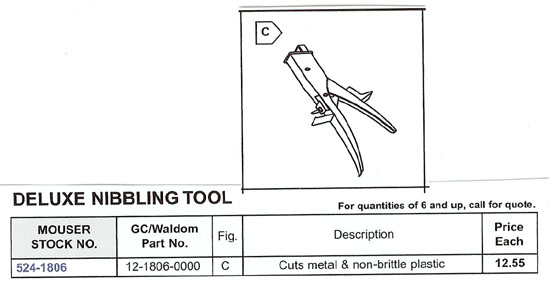
(Edited to replace link with JPG before I got yelled at.) ![[Big Grin]](biggrin.gif)
Posted by Gordon McLeod (Member # 33) on 11-13-2004, 11:36 PM:
be wary of cheap nibblers they tend to tear at the edges badly
Posted by Frank Angel (Member # 248) on 11-14-2004, 08:42 AM:
But John, I still don't understand how a caliper can help getting an accurately plate. If you cut the plate to an exact external number, how do compensate for keystoning or for the descrepancies between various formats were the lens steps will not give you an exact match when you are doing common height screens? I mean, the whole idea of filing a plate is to compensate for minute anomonolies that you CAN'T easily predict with numbers. How, for example, do you use the caliper to file for a curved screen or for a projector that is not dead center (which can never be the case in a change-over house)? But then, if the projector is dead on, the screen dimentions are exact, you would just use a precut plate and not have to file anything (then you wouldn't need a caliper at all).
Posted by Brad Miller (Member # 2) on 11-14-2004, 10:27 AM:
quote: Frank Angel
But John, I still don't understand how a caliper can help getting an accurately plate. If you cut the plate to an exact external number, how do compensate for keystoning or for the descrepancies between various formats were the lens steps will not give you an exact match when you are doing common height screens?
Oh geez, I can't believe this has gone on for so long. The answer is that it does not help. A caliper is completely useless in filing plates, except to possibly make the person cutting them look "more technical and sophisticated" or some such nonsense. That's why I was teasing jhawk about it earlier in the thread.
Posted by Gordon McLeod (Member # 33) on 11-14-2004, 10:48 AM:
"the screen dimentions are exact, you would just use a precut plate and not have to file anything (then you wouldn't need a caliper at all). "
That still assumes that ones lateral guides and lens mount are smack on
I have never seen a precut plate do an acurate job
Posted by John Hawkinson (Member # 1135) on 11-15-2004, 12:29 AM:
Let me be more clear how I use a caliper, since I've inadvertantly caused so much confusion. ![[uhoh]](graemlins/uhoh.gif)
For each of the 4 sides: - Run RP40 to see where to file the plate to. Remember that each square is .004125".
- Measure the current opening in your plate with the caliper.
- Open up plate (file, nibbler, etc.) to about .015" under the target value. This is where the caliper shines, since you know exactly how far you've gone.
- Test the plate, fine-tune with file.
Gordon says "A caliper will only tell you the size of the opening not its relative position." That's not quite true. If you know the offset from the outside edge of the plate to the optical center, then you know the relative position. And assuming you start out with an unfiled plate where the opening is centered (or are using a projector with symmetric plates, etc.), then you're all good. Just measure from the outside top of the plate to the inside of the aperture hole. But if you do one side at a time, keeping track of the relative position isn't so important anymore (or two adjacent sides around a corner from each other).
Frank asks how you use a caliper for keystone compensation. You can determine the correct numerical keystone compensation (by watching the RP40) and then file to that, or you can just do the keystone compensation with the usual slow iterative process (i.e. "you don't").
I think the key point here is that the caliper is a tool to let you get within the ballpark of the right size easily, without going too far. It is not a tool for fine-tuning the cut, because there are too many variables that are quite difficult to measure numerically. I didn't mean to imply otherwise, and I'm sorry if my sloppy wording initially lead people astray.
By the way, Bill Hooper, your sample aperture plate is upside down.
--jhawk
Posted by Monte L Fullmer (Member # 2797) on 11-30-2004, 03:52 AM:
True. Wasn't SuperScope (2.00/1) ratio where RKO and a small host of others had a bunch of features shot with the VistaVision horizontal film path process (prob used Mitchell "elephant ears" cameras), then the film was masked down and processed in the 2 to 1 squeezed anamporphic - so to keep the "depth of field" in a wide screen presentation that the actual anamporphic camera lens would lose?
Theatre I worked at years ago had a set of the .650 x.650 SuperScope apertures for our "XL's", and masking settings for the SuperScope presentations. thx-Monte
Posted by Stephen Furley (Member # 1277) on 11-30-2004, 04:21 AM:
Superscope was shot as normal 4-perf, and the frame was masked down to 2:1 and then given a 2x vertical stretch in the lab. Not unlike Super 35, but the negative frame did not extend into the track area, as it does with Super 35.
Posted by John Pytlak (Member # 331) on 11-30-2004, 07:56 AM:
Standard SMPTE 195-2000 "recognizes" the following aspect ratios in current use:
2.39:1
1.85:1
1.66:1
1.37:1
quote:
A.4 Typical aspect ratios for nonanamorphic theatrical projection
For aesthetic and practical reasons, theatrical projection
may present 35-mm images in such a manner that the full
width of the projectable area is shown but the projected
height is less than maximum. Photography designed primarily
for theatrical exhibition recognizes this and is composed
for the more elongated rectangles. Several aspect ratios for
the final projected picture are recognized through usage
(see table A.1).
Caring About Composition
quote:
SMPTE Standard 195 "Motion-Picture Prints--Projectable Image Area" specifies the film area intended for projection. The dimensions specified are as follows:
Aspect Ratio · Lens · Width (In.) · Height (In.) · Width (mm) · Height (mm)
2.39:1 · Anam · 0.825 · 0.690 · 20.96 · 17.53
1.85:1 · Flat · 0.825 · 0.446 · 20.96 · 11.33
1.66:1 · Flat · 0.825 · 0.497 · 20.96 · 12.62
1.37:1 · Flat · 0.825 · 0.602 · 20.96 · 15.29
Powered by Infopop Corporation
UBB.classicTM
6.3.1.2