This is topic The "Physics" of Motion Picture Projection. in forum Film Handlers' Forum at Film-Tech Forum ARCHIVE.
To visit this topic, use this URL:
https://ft-forum.com/ft/cgi-bin/ubb/ultimatebb.cgi?ubb=get_topic;f=1;t=006706
Posted by Will Kutler (Member # 770) on 11-10-2004, 06:36 PM:
One of my current college courses is Physics 112 (Basic Physics II). I would highly recommend this class to those of you who want to get a little better understanding of what makes projection equipment work. This is a generall education class offered at just about any community college or university.
Topics include basic electricity, magnetism, light, reflection (mirrors), lenses, etc.
However, this class does not delve deep into practical topics such as VOM/Multi-Meter usage, electrical component idetification, soldering, etc. A basic electronics course will cover these topics.
Posted by Manny Knowles (Member # 1171) on 11-11-2004, 01:18 AM:
I'll be right over. ![[Roll Eyes]](rolleyes.gif)
Posted by Steve Kraus (Member # 476) on 11-11-2004, 06:57 AM:
Well isn't that just cute. You can go to panty raids together.
Posted by Will Kutler (Member # 770) on 11-11-2004, 03:14 PM:
I think Manny needs to reread my origonal post. Physics 111 and 112 are the two basic "general ed" physics courses offered at all jr. colleges and universities. Just like freshman English, College Algebra, Trig. Calc., etc.
You can also find references and general help tutorials to these classes on the internet. One good source is WWW.PHYSICSCLASSROOM.COM (but I think this mostly deals with Physics 111).
And to further clarify myself, Physics 112 will help you understand how and why components like resistors and capicators work, the principles of Voltage, Amperage, Resistance and Wattage. How to calculate values in series, parallel and compound circuits. The principles of electromagnetism. What light is, different spectrums, how light bends, why and how mirrors and lenses work, etc.
Posted by Daniel Alt (Member # 2303) on 11-11-2004, 03:40 PM:
I have a M.S. in astrophysics from Yale. (No kidding) It has not helped me one little bit in keeping the fershluggener projectors working. Which is not to say physics isn't cool. Just that the theory isn't always relevant to the practice.
Posted by Dominic Case (Member # 1830) on 11-11-2004, 07:38 PM:
quote: Daniel Alt
I have a M.S. in astrophysics from Yale. (No kidding) It has not helped me one little bit in keeping the fershluggener projectors working.
I bet it has. Not in terms of what you know about the origins of the universe or relativity or black holes, but in terms of the discipline of logical thinking, analysis of problems etc.
quote: Daniel Alt
Just that the theory isn't always relevant to the practice.
Ah! The difference between theory and practice is that in theory there is no difference, whereas in practice there is a difference.
Posted by Steve Kraus (Member # 476) on 11-12-2004, 12:18 AM:
Or you can think of the business as a black hole that has sucked in many fine people who might otherwise have led productive lives, me included! ![[evil]](graemlins/evil.gif)
Posted by Edward Jurich (Member # 1787) on 11-12-2004, 09:12 AM:
I have a constant tit-for-tat with an old friend about film vs digital projection. His last email quoted some info on how everything including the universe is digital, a matter of matter if you will. So I reply that then, motion picture film is digital and actually more stable than DLP. No reply from him yet.
Posted by John Pytlak (Member # 331) on 11-12-2004, 12:44 PM:
Each silver halide grain in a film is either exposed or unexposed (1 or 0 state). So at the molecular level, film IS digital, and has been for over a century! ![[Cool]](cool.gif) Film's great latitude comes from having millions of grains, with a wide variety of sizes (sensitivities), producing a tone scale well beyond that of typical digital systems
Film's great latitude comes from having millions of grains, with a wide variety of sizes (sensitivities), producing a tone scale well beyond that of typical digital systems ![[thumbsup]](graemlins/thumbsup.gif) . The random distribution of grains also avoids aliasing artifacts
. The random distribution of grains also avoids aliasing artifacts ![[Smile]](smile.gif) , unlike the fixed pattern of pixels in digital imaging systems.
, unlike the fixed pattern of pixels in digital imaging systems. ![[dlp]](graemlins/dlp.gif)
So, Kodak has been a leader in Digital Cinema right from the start! ![[Big Grin]](biggrin.gif)
http://www.kodak.com/go/dcinema
quote:
ORLANDO, FLORIDA, (October 22, 2004) - Eastman Kodak Company announced today at the annual ShowEast Conference that the company is taking a major step forward in its goal of making high-quality digital cinema available for motion picture exhibitors around the world. The company is demonstrating the Kodak Digital Cinema Solution for Feature Presentations, a bundled package of hardware, software, and support services.
Posted by Mark Gulbrandsen (Member # 72) on 11-12-2004, 01:54 PM:
quote: John Pytlak
Each silver halide grain in a film is either exposed or unexposed (1 or 0 state).
But John,
Doesn't the intensity of the light at any certain grain actually determine how dense that actual grain is.....? So in effect you may actually have a range of 0.0 to 1.0 per grain which is how digital really should be but can't.
Mark
Posted by John Pytlak (Member # 331) on 11-12-2004, 01:59 PM:
Not really. Once the grain is hit by photons, it will develop. The way you get a range of tones is to have a variety of grain sizes that vary in sensitivity to light, either blended or in separate emulsion layers. If all the grains are exactly the same size and sensitivity, you get a very high contrast, low latitude film. A "lith" film is the most extreme example --- all or nothing, black or white, 1 or 0.
Posted by Steve Kraus (Member # 476) on 11-12-2004, 03:54 PM:
Perhaps you can explain why development must be limited and cannot just run to completion. If you do then all grains are developed whether exposed or not. So how does time (and temperature and concentration of developer) affect the process and the resulting gamma?
Posted by Mark Gulbrandsen (Member # 72) on 11-12-2004, 04:13 PM:
quote: Steve Kraus
Perhaps you can explain why development must be limited and cannot just run to completion.
Its not something that is really a limited time thing. All film should be fully developed to completion to yield proper contrast range and gamma curves if exposed normally based in its ASA rating. Sure, you can leave film in for shorter or longer time periods but if left in the soup for a shorter period you will get a thinner negative(or darker for positive process).... left in longer it will over develope and get either darker(or lighter for positive process). Film which is pushed in speed is effectively under-exposed and then over-deveolped to yield a "normal contrast image". There is a point at which all halides are fully developed and this is normally the specified time at a given temperature for the developer/film combination you are using....
But John can probably explain this better......
Mark
Posted by Steve Kraus (Member # 476) on 11-12-2004, 07:10 PM:
What I meant by completion is that if you leave it in indefinitely you'll get back a solid black negative. If only light-activated grains were converted to silver that wouldn't happen.
Posted by John Pytlak (Member # 331) on 11-13-2004, 08:39 AM:
Here is what developed silver grains look like:
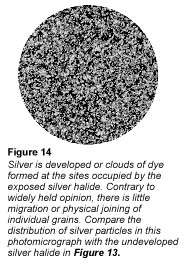
Notice the developed silver grains vary in size, but are generally all black (not shades of gray).
It may take more than one photon to produce a latent image, but once the silver halide grain has a latent image, it will develop into silver. If you overdevelop the film, even some grains without a latent image will develop into silver, usually the larger (faster) grains first. This caused "fog", or an increase in the minimum density of the image. Eventually, all the silver halide will be turned to silver by the developer.
Posted by Martin Brooks (Member # 1269) on 11-13-2004, 10:41 AM:
quote: Daniel Alt
I have a M.S. in astrophysics from Yale. (No kidding) It has not helped me one little bit in keeping the fershluggener projectors working. Which is not to say physics isn't cool. Just that the theory isn't always relevant to the practice
That's because you're trying to get the projectors working on Earth. But your theoretical techniques would work perfectly in outer space (except for the audio, I guess.)
Posted by David Graham Rose (Member # 1450) on 11-13-2004, 12:13 PM:
Greetings All
I have a chair here in Cambridge in Cinema Technology, and still don't understand how everything works! Although I must admit, my first degree is in Physics, my second in Chemistry, my third in Philosophy and my Ph.D allthose years ago in Cinema Technology. My chair was actually awarded back in 1969 when I discovered a sound proofing method for Odeon and ABC Cinemas who wished to twin/triple single auditoria using minimal materials (at the time plasterboard and woading)
With regards to all academics on this site
Good Evening
David
Posted by Dominic Case (Member # 1830) on 11-15-2004, 12:00 AM:
quote:
Each silver halide grain in a film is either exposed or unexposed (1 or 0 state). So at the molecular level, film IS digital,
I'm going to argue with John on this one.
What you are actually saying, John, is that film is binary. Not necessarily digital.
As I understand it, digital and analogue are two diferent ways of representing a variable). In an analogue representation, the quantity is represented by another quantity: in the case of digital, the quantity is represented by a number. (in the case of a film image, it's the brightness of a part of the image, which can either be represented by something that is greater or lesser as the brightness varies (analogue) or by a number (digital) that isn't, ITSELF, greater or lesser (the actual number 9 is no bigger than the number 6, nor is 1001 greater than 0110 - they only denote something else that's bigger).
So a conventional clock is analogue, because the amount of time elapsed is represented by the amount of angle the hands have turned through: whereas a digital clock represents the time elapsed by displaying a number (on the display, it's digital but not binary!). You need to understand the code (numbers 1,2,3,etc) to know how much time has passed.
A SR soundtrack is analogue because the level of the sound is represented by the width of the waveform in the track itself. An SRD track represents the level by a decodable number (in this case it is a binary number).
In a film image, the darkness of the original subject is not represented by a number that needs to be decoded, but by the darkness of the dyes in the film (or, if you like, the size and number of grains or dye clouds). To be digital, the image has to be represented by an encoded representation of the darkness: that is by an actual number, not a quantity of something.
That's my view of it, anyway.
Posted by Steve Kraus (Member # 476) on 11-15-2004, 12:05 AM:
I don't know how you can be binary but not digital. I see the point you are making but I don't think digital requires there to be a coding system where some...well in this case molecules...are given higher weight than others (like powers of two steps in base two digits). A number can be represented simply by having that actual number of something. Thus, digital.
Posted by Dominic Case (Member # 1830) on 11-15-2004, 05:18 AM:
quote: Steve Kraus
I don't think digital requires there to be a coding system
But that's exactly what it does require. Digital systems are representations that consist of pure numbers. Analogue systems are representations or scales that consist of quantities.
If a system uses pure numbers, you need a code to show the number. So, white is 1024, light grey is 456, dark is 37 for example. Or white is 1000000000, dark is 00000100101 etc. Both digital. if you don't know the code, you have no idea.
If it uses quantities, we can have white is ############, grey is #####, black is #. If I could do font sizes, or shades of grey, or thicker strokes, those could also be a scale representing brightness.
Posted by John Pytlak (Member # 331) on 11-15-2004, 05:50 AM:
Simplisticly, if each silver halide grain is considered a "pixel", once a latent image is formed by sufficient photons, after development it either forms silver (dye) or it doesn't. I agree calling it "digital" may be a stretch, but there is an analogy. Of course, for some, "digital" is a bad word. ![[Wink]](wink.gif) So "binary" is fine too.
So "binary" is fine too.
Posted by Steve Kraus (Member # 476) on 11-15-2004, 02:30 PM:
Since we're already way off topic:
CD's and DVD's are analog media. No, really.
Discuss.
Posted by Mark Gulbrandsen (Member # 72) on 11-15-2004, 02:41 PM:
Yes, because the signal you get back off the disk is an FM signal from which the data must be extracted. All digital formats work thihs way and this s the step at which much digital jitter is introduced. I think you'll be seeing less of this sort of system in the future though. The Blue Ray(no relation to Ray Charles) is straight digital read back like a hard drive. Some Blue Ray recorders are already available overseas and they all are using hard drives so far as the exact specs for the CD part are nailed down. Sony has also sucessfully used paper CD's in the laboratory.......
Mark
Posted by Ron Yost (Member # 1850) on 11-15-2004, 05:00 PM:
Speaking of optical disk developments, I read this this morning:
"Pioneer develops a 500GB optical disc
Japanese consumer electronics company Pioneer has, according to Nikkei Business Daily, managed to develop an optical disc that holds 500GB of data each side, making it 20 times bigger than the basic single-layer versions of "next generation" optical discs that are based on blue laser (including Blu-Ray and HD-DVD).
The new technology is apparently based on ultraviolet laser, which has shorter wavelength than the blue laser does, thus making it possible to store data much more efficiently on the disc."
Neat, huh?
Ron Yost
Posted by Dominic Case (Member # 1830) on 11-15-2004, 08:39 PM:
quote:
after development it either forms silver (dye) or it doesn't. I agree calling it "digital" may be a stretch,
John - if you've just convinced anyone that film is digital, you've also convinced them that it has a bit depth of ONE. Which, to people who are turned on by anything digital, is a big turn-off (since arguments usually rage over 8-bit, 10-bit or up to 16-bit!)
I think you should quit while you aren't too far behind on this one;-)
Posted by John Pytlak (Member # 331) on 11-16-2004, 07:41 AM:
Fortunately, the tremendous tonal range of film exceeds that of any of the current digital camera or projection systems. Pretty good for a century-old "binary" imaging system based on chemistry.
Posted by John Hawkinson (Member # 1135) on 11-16-2004, 09:34 AM:
Isn't it true that film does have a bit depth of one? It's like
a very fine halftone screen, no?
--jhawk
Posted by Daniel Alt (Member # 2303) on 11-16-2004, 09:38 AM:
My brain hurts.
Posted by Steve Kraus (Member # 476) on 11-16-2004, 10:51 AM:
Not exactly because the grains (or dye clouds) are not only randomly laid out (which you could do with a randomized halftone screen) but also may be in front of or behind one another which I presume would mean there are density differences going across the image whereas a halftone as you go across it it's either (assuming B&W) white or black with no in betweens.
Mark: Wouldn't it be cool to use that FM carrier to carry high quality wideband analog audio signals for a truly analog CD?
Posted by John Pytlak (Member # 331) on 11-16-2004, 11:27 AM:
quote: Steve Kraus
Not exactly because the grains (or dye clouds) are not only randomly laid out (which you could do with a randomized halftone screen) but also may be in front of or behind one another which I presume would mean there are density differences going across the image whereas a halftone as you go across it it's either (assuming B&W) white or black with no in betweens.
Right on!
http://www.kodak.com/US/en/motion/support/h1/exposureP.shtml#graininess
quote:
Figure 15
(a) A 2.5X enlargement of a negative shows no apparent graininess. (b) At 20X, some graininess shows. (c) When a segment of the negative is inspected at 60X, the individual silver grains start to become distinguishable. (d) With 400X magnification, the discrete grains are easily seen. Note that surface grains are in focus while grains deeper in the emulsion are out of focus. The apparent "clumping" of silver grains is actually caused by the overlap of grains at different depths when viewed in two-dimensional projection. (e) The makeup of individual grains takes different forms. This filamentary silver enlarged by an electron microscope, appears as a single opaque grain at low magnification.
quote:
Figure 19
The above illustrations are 1200X photomicrographs of a special cyan color film layer with incorporated coupler made very thin to permit showing the structure. The upper left picture is the film after color development and shows the metallic silver grains surrounded by dye clouds. The upper right picture shows another area of the same film after bleaching and fixing with the grain removed. The lower two pictures show the same type of film developed with a color developer containing a completing coupler which reduces the size of the dye clouds; hence, reducing the graininess.
Posted by John Hawkinson (Member # 1135) on 11-16-2004, 02:32 PM:
OK, sounds like a 3-dimensional halftone.
--jhawk
Powered by Infopop Corporation
UBB.classicTM
6.3.1.2