This is topic Maximum acceptable FtLb value for ambient light at Screen? in forum Film Handlers' Forum at Film-Tech Forum ARCHIVE.
To visit this topic, use this URL:
https://ft-forum.com/ft/cgi-bin/ubb/ultimatebb.cgi?ubb=get_topic;f=1;t=006727
Posted by Frank Angel (Member # 248) on 11-18-2004, 04:56 PM:
In our newly renovated theatre, the incandescent 15w bulbs that were use in the original step light fixtures were replaced with compact fluorescence in an attempt to use a technology that would significantly reduce the replacement frequency of the bulbs. Problem is, the genius designers simply replaced the incandescents with the same wattage CF replacements as the original bulbs, i.e., 15w, which in fluorescent years is equal to something like 60w incandescent bulbs. This is WAY too bright. To make matters worse, the slots of the fixtures that house the bulbs (in the stair steps) do not mask the bulbs completely, letting some of the bulb's light shine unobstructed to the screen, i.e., line-of-sight. And there are a few dozen steps lit with CF bulbs. Oh, and Compact Flourescents cannot be dimmed.
We are obviously going to have to swap them out to something with a lot less light output, but the problem got me thinking -- is there a standard, possibly SMPTE or THX, which specifies the acceptable maximum amount of ambient light that can hit the screen....a maximum foot lambert value beyond which is unacceptable and which will ruin contrast ratio?
Before these brilliant architects and designers decide on what they are going to replace the bright CFs with, I want to be able to tell them that whatever they do, there is an aggregate amount of light that can't exceed X FtLb at the screen surface. I want to give them something to shoot for.
Posted by Dominic Case (Member # 1830) on 11-18-2004, 08:50 PM:
SMPTE standard 196 refers to two factors:-
1. No stray light or illuminated area with luminance greater than 1.0 fL shall be visible from the normal observing area.
2. Screeen luminance due to stray light shall be less than 0.16% for review rooms and primary theatres and <paraphrasing> less than 0.25% for all other theatres.
Point 1 refers to the brightness of step lights, exit lights etc themselves, if they are directly visible.
Point 2 refers to the brightness of the screen where there is no image light projected on it. Mainly that will come from spill light from safety lights in the theatre (as Frank describes). But it's also about the reflectivity of the walls, floor, empty seats and even audience faces, that causes light from bright parts of the image to reflect back onto the screen and lighten up the dark areas.
Posted by Frank Angel (Member # 248) on 11-19-2004, 01:56 AM:
Thanks Dominic; I hadn't ever come across that SMPTE Standard. And I am assuming that the 1fL can be read off the screen the same way you measure projected/reflected light, correct?
Hmmmm, me thinks they are going to have a very rough time reducing those step lights way down to 1fL. And now that you mentioned Exit lights, I just realized that they put new Exit light fixtures up as well -- 10 of them, 5 per side and they also are MUCH brighter than the original fixtures. They are the new superbright LED type. I'll bet they too are spilling plenty of red light on the screen. Man, this is going to be one mean dragon to slay. Luckily I am sure the house Lighting Director will be fighting along side me because I know he goes ballistic if he calls for a black out and you can still see anything on the stage. The way it is now, you will barely notice the lights went out. ![[Eek!]](eek.gif)
Posted by John Pytlak (Member # 331) on 11-19-2004, 06:05 AM:
If you can cast a distinct shadow on the unlit screen when the lights are set to the levels used during a show, you need to eliminate or shield the source of the stray light:
Conquering Contrast Killers
quote:
Contrast Killer 1: Auditorium Lighting
The first step in conquering contrast killers is to simply look at the "dark"
screen. Exit signs, aisle lighting, ceiling lights, wall lighting, and booth lights
should be set to normal show levels. The projector lamp should be on, but the
dowser closed. After taking about five minutes to let your eyes get used to the
low light level in the auditorium, look at the screen. Is it truly "black"? If not,
get on a stepladder or use a long pole to cast a shadow on the screen to
identify the source of stray light.
Exit signs are a necessary source of light that must sometimes be located near
the screen. Their brightness and color are strictly regulated by fire code. Their
purpose is to guide patrons to the exits in case of emergency. But nothing says they need to shine ON the screen. Usually, only a simple shield is needed
to keep their light from hitting the screen, without compromising their function
of clearly identifying the exits. The newer light emitting diode (LED) exit signs
offer the possibility of more directionality to the light, with less stray light on
the screen.
Aisle and step lights need to be bright enough to safely guide theatre patrons
to and from their seats in a darkened theatre. They DO NOT need to be bright
enough to guide a jet plane to a landing on a foggy runway. Adjust these
guide lights to the minimum brightness that ensures safety, without shining on
the screen or being a distraction in the darkened theatre.
Many theatres use a low level of ceiling illumination during the show for the
safety and security of their patrons. Care should be taken to shield the screen
from direct illumination from these overhead lights. Decorative lighting that
doesn't contribute to safety should not be used during the show.
Don't forget other sources of stray light that may shine on the screen,
including those that aren't constant. Does light from the lobby shine on the
screen every time someone walks into the theatre during a show? If this
design flaw was missed when the theatre was built, correct it now. Can work
lights in the booth ever shine on the screen? Make sure they don't. Are kids
with laser pointers a problem? Enforce a strict policy banning laser pointers,
and reward patrons that report perpetrators.
Consider the use of efficient long-lived LED cluster lamps rather than compact fluorescents:
http://www.theledlight.com/index.html
http://www.theledlight.com/120-VAC-LEDbulbs.html
quote:
3 and 6 LED bulb; 240 degree light spread; Medium Base low profile light, accent lighting, area night light. Both consume only 3.32watt/30mA at 120vac. Available in white LED only.
Posted by Steve Guttag (Member # 268) on 11-19-2004, 08:53 PM:
Frank,
Think about your contrast ratio if you have as much as 1-fL of ambient light hitting your screen presumming you have 16-fL with white light. Your contrast ratio is (at most)?
Steve
Posted by Dominic Case (Member # 1830) on 11-20-2004, 12:32 AM:
quote: Steve Guttag
if you have as much as 1-fL of ambient light hitting your screen
There's a bit of confusion here.. Certainly if you got as much as 1 ftL on the screen from ambient sources, then you would have, at best, a contrast ratio of 16:1 (assuming you have correct brightness from the projector;-) . . )
But the 1 ftL spec refers to the brightness of the exit lights or step lights themselves, if I read the standard correctly. In other words, that is light from those sources that is hitting the viewers' eyes, not what is spilling onto the screen itself.
(If it's an exit light right next to the screen, then it could appear at 1/16th as bright as screen white - but if masked properly as John describes, it needn't cause any spill light on the screen itself. )
The other part of the standard is the part that gives the clue about acceptable contrast ratio - and that is where it talks about 0.16% or 0.25% - in other words, a contrast ratio of 600:1 or 400:1.
Posted by Steve Guttag (Member # 268) on 11-20-2004, 02:07 AM:
1-fL has to mean reflected light...if it is directly measured (i.e. not off the screen) then foot-Labert is the wrong measurement. Output of light is in Lumens, light falling on an object is in foot-candles and only when you get to reflected light is it foot-laberts.
However, Dominic, I believe your interpretation is correct. The only way this can make sense is if one were to observe from the seating area any object or area should not read above 1fL if a light meter was pointed at it. That is, the object or lighted area should not be a distraction, even if it does not cast a significant amount of light on the screen.
I was recently at the Academy theatre in Beverly Hills...it is one of THE reference theatres for contrast ratio. It gets very dark in that theatre when the lights go down. The ceiling is black, the walls are grey (for the most part) and when the lights go out, your attention is very much drawn to the screen. The sound pretty much kicks butt too. Any way...I was somewhat surprised about these three columns on each side wall of the theatre. There were reflective and as action happened on the screen my eyes were constantly drawn to the columns as they flickered with reflected light from the screen...they were most annoying. I wouldn't be surprised that when white light was projected on that screen that one could easily measure 1fL off of those columns.
FWIW...I've also never seen a show where the picture was that sharp (and steady) from beginning to end...the joys of an EK print and a system that is tweeked up to look right with a very competent projectionist....and amazingly, no ads on the head of the show...another pleasent thing. I think the worst movie of all time would be enoyable in that theatre.
Back to contrast ratio...
Here is something people should know about the Digital projectors with their "contrast ratio" measurements
A typical theatre, according to standard should have a least a contrast ratio (maximum) of 400:1 with review rooms 600:1. Let me tell you those are some pretty dark rooms. Some of darkest rooms measured in this industry only yield a contrast ratio of 1000:1 (stray light can be measured to just .016fL.
Now how many of you have seen the specs of digital projectors that have 1000:1 and greater? How many of them have rather high blacks? As in, can you tell when you are outputting a black picture just by looking at the screen...even with the lights up? Even with cheap LCD projectors, according to the specs, you should be able to get away with projector with a 450:1 contrast ratio in a typical theatre....ever seen one of those? There are not any blacks.
How can this be? Because they lie about those contrast ratio specs as video has always deceived with their specifications. For contrast ratio, they use an "all pixels on, all pixels off" test to determine contrast ratio. It has no basis in reality. Some day soon, I hope the SMPTE publishes the contrast ratio measurement method and these digital projection systems will get a true measurement...the numbers will not be as rosey as their current figures would have you believe. Both the P-3 (projection technology) and DC-28 (Digital Cinema) committees are working on just such a uniform contrast measurement method.
Steve
Posted by Leo Enticknap (Member # 534) on 11-20-2004, 05:30 AM:
quote: Dominic Case
But it's also about the reflectivity of the walls, floor, empty seats and even audience faces, that causes light from bright parts of the image to reflect back onto the screen and lighten up the dark areas.
Couldn't agree more. I was once asked to look at a lamp problem (rectifier diodes turned out to be knackered) in a theatre which had been converted from council offices. Incredibly, the walls of the auditorium were painted a light turquoise-green colour and the ceiling was standard council issue yellowish white! You could virtually watch the film on any of these surfaces, and I did politely suggest on my way out that several gallons of blackboard paint would do wonders for their presentation.
Posted by John Pytlak (Member # 331) on 11-20-2004, 07:08 PM:
Footlamberts or candelas per square meter are the correct measurement. You are measuring the luminance of the sign or light, not the light that is falling on something. Likewise, the luminance of a CRT display would be measured in footlamberts (or candelas per square meter). Yes, the 1 footlambert figures means that the luminance of any object in the direct field of view should be less than 1 footlambert.
Posted by Dominic Case (Member # 1830) on 11-21-2004, 04:20 PM:
quote:
only when you get to reflected light is it foot-lamberts.
Certainly, if you are talking about the light from a projector and a screen. But FtL are a measure of luminance, as John says - the same type of unit, as he also points out, as candelas per square meter, (and several other units). A reflective screen can be measured in the same units as a TV monitor (which is obviously a prime source, not a reflector).
But yes, Steve, I agree, that the point of this part of the spec is that lighted areas in the field of the audience's view should not be a distraction, and should not be brighter than a darkish grey (ie 1/16th, or 4 stops down)compared with screen white.
Posted by Frank Angel (Member # 248) on 11-23-2004, 02:23 PM:
Yes, that nonsense about contrast ratio as touted by the lying video projector manufacturers -- that really needs to be whacked down. DLP projectors are routinely claimed to have contrast ratios of an amazing 2000:1! Imagine that -- more that four times the contrast ratio of film in a theatre! So Mr. Videophile trots on home with is $900 In-Focus DLP projector happily thinking his little unit is going to put film to shame, so golly-gee, there's no need to go to the cinema to see movies any more.
But then again, did we really ever expect manufacturers to actually tell the truth when there was an opportunity to do some serious hype?
But back to the theatre -- so 1ftL is for stuff that the patron can see from any sourch OTHER than what's going on on the screen. I got that. But my original question was, is there a spec for the actual screen. In other words, where when the theatre lighting is set as it would be for the film, and then you go up to the screen and take a measurement -- what is the max that reading should be? The you can say, yes the ambient light striking the screen is below an established acceptable level or no it's not.
I understand the hand/shadow test -- done it many times myself --but that doesn't help me much if I need to go to the archetect to say that his lighting fixture placement needs to be corrected. Much easier if I can go in and say, your lighting fixture placement produces xxftL light on the screen which is above spec. If I tell him, it makes a shadow on my hand, he will just laugh and say, so what.
Posted by Steve Guttag (Member # 268) on 11-23-2004, 07:19 PM:
Frank, in effect, yes there is a maximum light allowable on the screen.
Dominic gave it to you in percentage form. So for standard theatres it is .25%. Thus if you are at 16fL, you are allowed 0.04fL. If you only have say 12fL (the minimum to still be in standard)...that drops to 0.03fL
If you are feeling haughty...go with the review room spec of .16%
So for 16fL you can have a whopping 0.0256fL and at the bottom end of the scale...14fL you can have 0.0224fL. Since most photometers read down to only 0.1fL (including the beloved USL PSA meter)...it is a tough one to read. Suffice to say, if your meter reads even 0.1, it is too bright.
Steve
[ 11-23-2004, 11:00 PM: Message edited by: Steve Guttag ]
Posted by Frank Angel (Member # 248) on 11-25-2004, 08:42 PM:
Great guys; thanks. The archetech has made so many mistakes in this renovation, I strongly doubt he's ever heard of a ftL. If I get a shadow on the screen, all I need do is go in and tell him there is too much light on the screen to meet SMPTE spec and he has to get it down to 0.03FtL. That should keep him busy long enough for our guys in the trenches to deal with it.
Posted by William Hooper (Member # 71) on 11-26-2004, 01:08 AM:
Frank:
As you know, architects hired to remodel theatres by non-profits or universities are almost never theatre architects, for a variety of reasons. What you wind up with is an architect who thinks a theatre is just a big room with seats in it, in which they feel they can express themselves & impress others with carpeting & lights.
You have to tell them that a theatre is a machine.
A machine is made of many essentil, independent mechanisms which must work together, & each of which must work itself. When you start arbitrarily tossing pieces out, it stops working.
I've seen a few that freak out & get defensive when things they've done don't work, make things worse, or suddenly become obvioulsy dumb.
At the next opportunity, I'd get them a copy of SMPTE's EG-18 - now that it's been withdrawn for sort of extraneous reasons, you may need to negotiate with someone nice like Steve Guttag to see if you can get a copy. Also, when you tell them about SMPTE Standard 196, direct them to SMPTE & have them BUY their copy of the standard. Sometimes, some folks don't think any information has any value until they must pay for it from some other established entity.
Architects have to get engineering studies & follow guidelines on structural designs, they farm out electrical & HVAC to consulting engineers, etc., but somehow everyone, even & sometimes especially architects, just go all euphoric & desirous only of self-expression through decoration when the project is a theatre. Somehow you've got to tell them to get over it; a theatre is a machine. There's a way it works, & it's got to work. Making it purty is only a small, although essential part of making it work. And that part goes on last. It hangs off the side, & is driven by the other mechanisms in the machine.
Posted by Thomas Procyk (Member # 1170) on 11-29-2004, 12:53 AM:
Speaking of Ambient Light and Home Theaters, has anyone seen these stupid new plasma TVs with "AmbiLight" technology? There's lights in the back of the TV that shine on the wall based on the colors on screen, or can be set at a stationary color by the user.
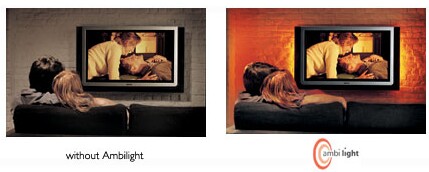
Annoying, if you ask me. How many ftL is that? ![[Smile]](smile.gif)
=TMP=
Posted by Monte L Fullmer (Member # 2797) on 11-29-2004, 03:29 AM:
Yea..bad reason why "floating screens" were just not it to be had in a theatre. Granted, cheap to put up and to maintain, but without adjustable maskings, and esp with running a feature lensed for flat on a screen sized for 2.35/1 anamorphic features, the presentation definitely looks cheap and unprofessional due to fuzzy edges of the flat presentation being not covered with masking.
People come out and wonder and ask "why the picture isn't filling the screen all they way." And then some patrons feel that with the screen isn't filled all the way, they feel cheated and want their money back.
Then, there were some theatre companies that would put "moonglow" lighting behind those "floating screens" and definitely annoying, esp. when they wouldn't dim down enough during the presentation.
-Monte
Posted by John Pytlak (Member # 331) on 11-29-2004, 08:52 AM:
The old GCC "shadowbox" screen theatres often had poor screen contrast due to the white "surround". AFAIK, many had the white walls later painted black to alleviate the problem:
GCC Shadow Box Screens
Anyone remember the old Sylvania "HaloLight" televisions of the 1950's? Same concept:
Sylvania HaloLight Brochure
Sylvania HaloLight Advertisement
Posted by William Hooper (Member # 71) on 11-30-2004, 01:54 AM:
I never had the pleasure of seeing a GCC shadow box theatre. I'm assuming that even with the light-colored surround, there was black adjustable masking betweent the picture & surround. There was an article in the SMPTE Journal a couple of years ago about contrast & increased *perceived* contrast when the same picture is inside a light-colored (white) "frame" as opposed to a black "frame". Shortly after this, TV showrooms lost all TV's with black surrounds around the picture & instead had only TV's with distracting, fatiguing silver or light gray surrounds to bump up *perceived* contrast for comparison shoppers.
Not much makes me more tired, critical, & depressed than looking at TV's in an electronics showroom.
Posted by John Pytlak (Member # 331) on 11-30-2004, 07:25 AM:
quote: William Hooper
I'm assuming that even with the light-colored surround, there was black adjustable masking betweent the picture & surround.
The ones that I've seen did NOT have screen masking, so the edges of the image were fuzzy, unless the projectionist set up some sort of frame to mask the image on the "projectionist's balcony" that was often part of this theatre design.
Powered by Infopop Corporation
UBB.classicTM
6.3.1.2