This is topic The right Neumade splicer model in forum Film Handlers' Forum at Film-Tech Forum ARCHIVE.
To visit this topic, use this URL:
https://ft-forum.com/ft/cgi-bin/ubb/ultimatebb.cgi?ubb=get_topic;f=1;t=006731
Posted by Christian Appelt (Member # 1067) on 11-19-2004, 05:56 PM:
I have to buy a new 16mm splicer to replace a CIR model that was damaged today. Now I recall that most of you preferred the Neumade splicers, but I am not sure from this website
Neumade splicers
which splicer model is correct for splicing standard 1-perf 16mm with optical sound (mag diagonal splice is not needed). I'd appreciate your help.
Posted by Steve Guttag (Member # 268) on 11-19-2004, 09:04 PM:
Some will tell you to get the 16SS...but don't listen to them...the best 16mm tape splicer is the 16SW.
Steve
Posted by Steve Kraus (Member # 476) on 11-19-2004, 11:03 PM:
What is the difference?
Posted by Carl Martin (Member # 1146) on 11-20-2004, 06:04 AM:
obviously they got rid of one of the redundant s's and replaced it with a w.
Posted by Jon Miller (Member # 163) on 11-20-2004, 08:53 AM:
No, the SW model has nothing to do with redundant letters ![[Wink]](wink.gif)
Instead of making a plain single-sided splice (hence the 16SS designation), it makes a so-called "wrap" splice. The splicer creates a perforated tape flap extending about 13mm beyond the edge of the sprocket side of the film. Just carefully fold that flap over onto the other side of the film et voila, completed splice. No need to awkwardly unreel extra film to splice both sides.
The 16SW, showing the punch die and splice method...
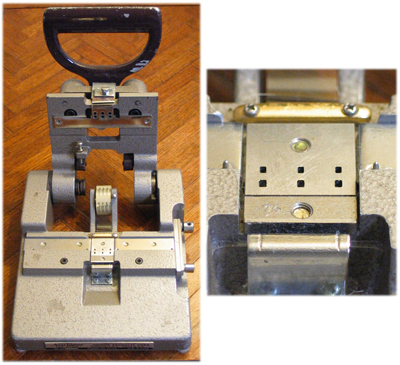

On the left, the tape cut by the splicer (outlined in red). On the right, the back side of the film after completing the splice (again outlined in red) by folding the flap over.
I think the reason for the short flap is so the splice is less likely to interfere with a magnetic soundtrack.
Once you master the trick of folding over the tape flap, splicing will go a lot quicker than with a single-sided splicer.
[ 11-20-2004, 10:08 AM: Message edited by: Jon Miller ]
Posted by Steve Guttag (Member # 268) on 11-21-2004, 02:39 AM:
You are correct, the SW is designed to have the tape stop before covering the magnetic track, if one is present.
Steve
Posted by Frank Angel (Member # 248) on 11-21-2004, 08:59 AM:
So you wind up with the corner of the joint being covered by on one side. It's the corner of the splice that is most vulnerable to separation. Then there is the wrap. Seems that at is a potential weakness of this method in that, no matter how tight you are able to make that overlap, it is still an additional thickness OUTSIDE the width of the film. That wider area at the splice has got to impact the stability of the image on the screen. I mean, the additional thickness of the tape at the splice causes movement; the additional tape on the edge of the film (and on only one side at that) is certainly more of the same -- movement of that frame in the gate.
I've been using the 16SS for years and that little bit of an inconvenience of spinning the splicer around (rather than turning the film strip itself) is no big deal. 16mm is not being used in a mulitplex situation like 35mm where speed is a major factor in every procedure; you are not making up prints by the dozen so that extra 2 seconds it takes to spin the splicer is no big deal, at least for me.
Posted by Steve Guttag (Member # 268) on 11-21-2004, 09:30 AM:
This is actually a rather strong splice (16SW) and damn near impossible to pull apart with good tape.
Frank, once you try the 16SW...you'll never go back baby
Steve
Posted by Steve Kraus (Member # 476) on 11-21-2004, 09:47 AM:
Ew...I hate wrap-around anything (splices, cues, splice marking tape for f---ing lazy operators) but especially on 16mm.
Posted by Paul Mayer (Member # 355) on 11-21-2004, 01:20 PM:
I'm glad I have both an SS and a Rivas then. The sideways image jump on every SW-made splice would annoy me, at least until I could trim off the one-sided wrap. But by the time I do that I can make a complete splice on the SS.
Posted by Jon Miller (Member # 163) on 11-21-2004, 03:08 PM:
Point taken on the sideways jump, Frank, Steve K., and Paul. But since I use this splicer mainly to assemble shorts programs for film festivals, the splices would be in the black film between titles and thus would have no visible impact on the screen.
Besides which, I try my best to keep the fold as small as possible.
Posted by Steve Guttag (Member # 268) on 11-21-2004, 03:22 PM:
Have you all ever seen a 16mm tape splice? 16SS or otherwise...they are nasty...the focus point is very shallow...the image is going to hop on an intermittent machine and the focus is going to go out on any machine (typical 16mm lenses are in in the 35mm -50mm focal length. Never noticed the sideways jump on my Kinotons...perhaps since they spring load both sides of the lateral guide and I'm almost positive that the folded over side gets the sprung side on current FP38s and hence no sideways shift.
If you really want the best splice, go ultrasonic or cement (film stock determining).
16SW...it is the way to fly in 16mm.
Steve
Posted by Scott Norwood (Member # 30) on 11-21-2004, 07:55 PM:
I just used a 16SW for the first time ever last week. It took a few tries to get a good splice, but after that I like it much better than the CIR that I have owned for years. I didn't notice any side-to-side image shift on either my home Elmo 16CLs (portables with claw movements) or an Eiki EX-6120 (theatre machine with intermittent movement). Two thumbs up for Neumade splicers (16, 35, and 70mm)
Posted by Steve Guttag (Member # 268) on 11-21-2004, 09:59 PM:
CIR used to make a 16mm wrap around splicer...called the 16FR. I think it was designated for lab and station use. It was discontinued a few years ago...or so I was told when I tried to order one.
Steve
Posted by Christian Appelt (Member # 1067) on 11-22-2004, 04:40 PM:
Thanks for all that advice! ![[Cool]](cool.gif) I'll recommend buying a model SS because we get many archival prints for which a non-wraparound splice seems safer IMHO. (16mm mag prints are rare these days, and while the mag tracks often sound extremely good, on most older prints color has totally faded.)
I'll recommend buying a model SS because we get many archival prints for which a non-wraparound splice seems safer IMHO. (16mm mag prints are rare these days, and while the mag tracks often sound extremely good, on most older prints color has totally faded.)
Posted by Mark Gulbrandsen (Member # 72) on 11-22-2004, 06:45 PM:
In rebuilding a Neiumade 35SS today it brought back just how crappily built these splicers really are, pot metal really and cheap soft metric screws,rubber feet that are just stick on and eventually fall off. From a machinists viewpoint its very cheaply made.
Isn't there a Hollywood splicer that will work. Sure they take the more expensive pre-perforated tape but they also last far longer and the parts when needed are far less expensive. Thay are also very well made! Once one learns how to use it properly it seems like a far better route to go for either gauge than any Neumade splicer.
Mark @ CLACO
Posted by Michael Schaffer (Member # 1204) on 11-23-2004, 04:09 AM:
I'll second that, Mr G. We spent tons of money rebuilding our Neumade splicers this year, and ordered parts by the ton too. That is why I just ordered Ciro for our new location.
Christian - don't buy that stuff! It might seem like an interesting exotic alternative to you, but it is just as exotic as vehement diarrhoe on a vacation on faraway shores.
Posted by Michael Schaffer (Member # 1204) on 11-23-2004, 04:09 AM:
oops
Posted by Mark Gulbrandsen (Member # 72) on 11-23-2004, 08:16 AM:
Michael,
You will definately have less breakage proglems with the Ciro splicers but the U shaped tape cutter blade gets dull way to fast. Be sure to keep those in stock... but the rest of the CIRO is much better than any Neumade splicer. I'm still leaning towards the Hallywood type splicer amnd a number of our customers have already gone this route. The only part on one that CAN go bad is the $2.50 cutter blade.
Mark
Posted by Frank Angel (Member # 248) on 11-23-2004, 01:57 PM:
Mark, I am always open to new approaches. Tell me about this Hollywood splicer. (do you have a picture of it?) I take it you need prepunched tape. It that still easy to get? I used to use it years ago, some on rolls and also the Hudson QuickTabs (they were quite expensive tho).
I am back doing some restoration work on a mag print now-a-days and find that I am going to eventually need a splicer with foxholes. Does CIRO make such a beast?
Posted by Gordon McLeod (Member # 33) on 11-23-2004, 03:54 PM:
I usually find the CIR blades don't go dull but get coated with gum and that is what makes them not cut well
Posted by Steve Guttag (Member # 268) on 11-23-2004, 07:27 PM:
Pre-perfed tape is certainly available. In fact, some prefer it for the simple reason of no chads sticking to the film.
Studio suppliers like FPC, Hollywood Film Company, J&R film Co. and such supply it. Also Hudson Photo has their pre-perfed splice tabs that one of our customers swears by (T35-DP). 3M seems to be the big maker of the pre-perf stuff on a roll. It is tough stuff too.
For permanent work, no splicing tape is good...I much prefer ultrasonic or cement.
As to the Somar, aka Neumade, splicer...while it is indeed easily damaged...generally I only find it damaged in places where it can only be described as abused. In places where it is treated like a precision piece...they last indefinately.
If the operators are going to abuse the splicer, I am now going with Strong's splicer...sure it has a couple of issues but it has yet to break on me in one of those abusive theatres.
I don't mind the CIR splicer like some here do either.
Both CIR and Somar have CS splicers (or did)...Neumade supplied me with a 35CS just last year.
Steve
Posted by Paul Mayer (Member # 355) on 11-23-2004, 09:17 PM:
Frank, look for the name "Rivas" amongst the others Steve mentioned when searching for one of those perf-tape splicers. There always seems to be one or two listed on ebay.
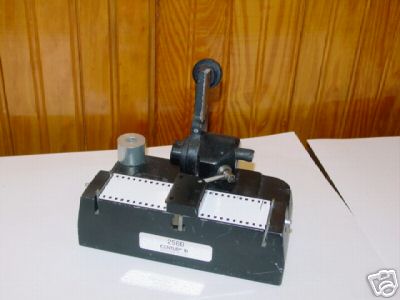
I have both 16 and 35mm Rivas splicers. Learned to use the 35mm one when I ran dailies and got pressed into service pre-making daily- and Kem-reel heads and tails. It is pretty much the standard splicer that film editors use. It takes a little practice to get both fast and good using one--I like it.
I also have the Tokyo Seiki (i.e. Neumade in the US) 8-perf 35mm splicer. I don't get to use it anymore but it makes great splices. I've never damaged any of mine so I don't know how well they hold up after such an event.
Posted by Michael Schaffer (Member # 1204) on 11-24-2004, 03:22 AM:
quote: Steve Guttag
If the operators are going to abuse the splicer, I am now going with Strong's splicer...sure it has a couple of issues but it has yet to break on me in one of those abusive theatres.
Actually the Strong splicer did look really rugged when they showed it at the recent factory training. They said it would survive a fall from the platter deck easily. But they didn't want to let us try it...
Posted by Jonathan Worthing (Member # 803) on 11-24-2004, 04:19 AM:
quote: Christian Appelt
most of you preferred the Neumade splicers
Who says
The CIR 16mm Is a good Little Splicer Less of a tank more of a piece of equipment.
Posted by Steve Guttag (Member # 268) on 11-24-2004, 07:44 AM:
Michael, Zero, and I mean zero Strong splicers have come back to us for repair. They are in theatres were Neumades wouldn't last 2-weeks (literally). It isn't the most precise splicer out there but it does the job well enough for these theatres.
Steve
Posted by Mark Gulbrandsen (Member # 72) on 11-24-2004, 09:52 AM:
I'm leaning towards selling the Rivas type splicers more and more. While the Strong may be heavier and hold up against a fall or two it is a pain in the ass to use and also does not cut tape very well. I sold one or two, got to use two at different locations and never sold any more of them... a big dissapointment and a very good example that shows the lack of precision in its products which company cranks out.
There is also some very, very good tape available for the Rivas type units that allow you to make about a 16mm wide splice that will not fall apart. Quite a few of our customers are doing this.
As for the Ciro splicer I disagree with Gord, somewhat....yes the blades do get full of goo and can be cleaned but only once or twice and after that the blade has typically gone south and will need replacement. The blades last at least a couple of years on average. IMHO the Ciro splicers are built much better than the Neumade(no pot metal castings!) and parts are also a bit less expensive but not by much and typically they do not fall apart.
Mark @ CLACO
Posted by Monte L Fullmer (Member # 2797) on 11-29-2004, 02:50 PM:
Yea Marko... I had a Strong "doorstop" splicer at Nampa, and sent that "doorstop" to Overland for a trade for their Marble that was busted pretty bad, which was the results of being left on platter decks too much. Luckilly,I found some old Neumades all parted out, and with these parted ones, I manage to rebuild a Neumade for Nampa and can do better splicing with than with that "doorstop".
Any more blurb on those Marble splicers that we got a hold of also?
(Yep, I miss my Ciros that I had at EDW's, just couldn't get over the 5-hole splice configurations though-tough to use "zebra" tape with..)
thx-Monte
Powered by Infopop Corporation
UBB.classicTM
6.3.1.2