This is topic Projector Light "Splatter" in forum Film Handlers' Forum at Film-Tech Forum ARCHIVE.
To visit this topic, use this URL:
https://ft-forum.com/ft/cgi-bin/ubb/ultimatebb.cgi?ubb=get_topic;f=1;t=006756
Posted by Robert E. Allen (Member # 1351) on 11-30-2004, 03:36 PM:
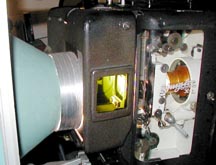
Most of today's modern projectors are doorless and seem to have been designed with little or no thought being given to controlling light "splatter". In the ten-plex where I work we have Simplex (Strong) equipment and the booth is kept dark most of the time. As I approach a machine that is running I need a flashlight to see the controls on the console as the light spilling out between the lamphouse and shutter and the gate and lens pretty much blinds me from seeing the printing on the console. Have any of you modified similar machines to control the light spill? Any ideas why there is no longer a lens barrel or a "spotsight box" on the newer machines? I can see some problems on machines that have swinging and rotating lens mounts with installing a lens barrel but I would think the geniuses that design these things would be able to figure it out.
Posted by Dominic Espinosa (Member # 2122) on 11-30-2004, 03:55 PM:
I used to work in a booth with Strong lamphouses and Simplex projectors with the same problem.
I can't remember but I thought there was some sort of shim or something on a few of them.
The most common fix I've noticed is duct taping the gap if it's not too big. Not the best solution but a solution none the less.
But don't they make a shield or something for this?
Posted by Steve Scott (Member # 630) on 11-30-2004, 05:43 PM:
Check out turrets, too, if you have them. A lot of our SA-TM's have separation issues between the frame of the turret and the circular lens plate. I've been using cardboard duct taped onto the hinge to mask the small beam of light that escapes through the gap. A technician told me to use foam rubber.
Posted by Steve Guttag (Member # 268) on 11-30-2004, 06:23 PM:
Light leakage eh?

I'll give you light leakage!
Steve
Posted by Mark Gulbrandsen (Member # 72) on 11-30-2004, 07:29 PM:
quote: Robert E. Allen
Light "Splatter"
You'll have to call the screen cleaning guy in!!
Mark
Posted by Monte L Fullmer (Member # 2797) on 12-01-2004, 01:44 AM:
Have to ask a question once again: I noticed that the reel feed on this FP-30 is like the 16mm - both reels in clockwise direction, or emulsion in during play. Is there a reason why of this reel feed is like this instead of the classic "figure-8",or emulsion out feed that projectors of old used to run, outside maybe this Kinoton's roller configuration doesn't allow the "figure-8" reel feed. -thx Monte
Posted by Brad Miller (Member # 2) on 12-01-2004, 01:49 AM:
You can tell the Kinoton to spin each reel whichever way you want. Steve is just a crazy fellow. ![[Razz]](tongue.gif)
Posted by Steve Guttag (Member # 268) on 12-01-2004, 05:40 AM:
Monte, On the Kinoton E series of projectors, one can run either reel in either direction, as Brad pointed out.
The classic "S" wind as you put it is only classic for the USA...other parts of the world have normally wound the film emulsion-in at all times. Both the SMPTE and my own findings have shown that the S-wind results in poorer focus stability over the emlusion-in only wind. In fact, there is an SMPTE RP on this very subject. I have checked this on both acetate and polyester film.
If you search the forum, you will find the other beliefs on emulsion-in versus emulsion-out. While you will find some, Brad Miller in particular, are quite vocal about their emulsion-out only, and there are those of us that still find emulsion-in to be the wind of choice for focus stability...only those that are tied to tradition think the S-wind makes any sense. What is the benefit of winding the film in opposite directions?
BTW...the picture above was from the German Cultrual Institute of Washington DC (Goethe Institut)...as such emulsion-in would be in keeping with their traditions too.
Steve
Posted by Steve Kraus (Member # 476) on 12-01-2004, 07:18 AM:
So what did you do about the light spill?
Posted by John Pytlak (Member # 331) on 12-01-2004, 07:20 AM:
SMPTE Recommended Practice RP39 specifies maintaining an emulsion-in winding orientation for 35mm prints. The Kodak technical paper "Effect of Winding on the Projection Performance of 35mm Motion-Picture Film" (SMPTE Journal, June 1965) clearly showed the advantages of maintaining an emulsion-in winding orientation for optimum focus stability (reduced focus flutter). The Kodak testing was done with triacetate base prints:
http://www.film-tech.com/manuals/SMPTEWIND.pdf
Polyester base prints have different curl characteristics than triacetate base prints. Unfortunately, information about which winding orientation is preferred for polyester prints is anecdotal, and opinions vary (the Guttag-Miller debate). It is likely preferred winding orientation will vary with relative humidity, which affects film curl. Fortunately, the winding orientation is less of a factor when film is wound on large hubs, such as platter systems.
Posted by Stephen Furley (Member # 1277) on 12-01-2004, 07:55 AM:
I find that with the vast majority of prints either it makes no difference, or emulsion in feed is better. Just occasionally I see a print which is happier feeding emulsion out, and if that happens, I'll run it that way, Kinotons will feed either way quite happily. I don't try every print both ways, but if I get a problem print, and I've got time, then I'll try it emulsion out.
With so many variables, type of film stock, model of projector, sizes of spools and cores, temperature and humidity of projection room, lamp wattage and past storage conditions of the print all come to mind, I'm quite happy to believe that one answer will not fit every situation; run the print whichever way you find is best, assuming that your equipment can run it either way.
Does anyone know how the American practice of feeding E.O, but taking up E.I., came about? It doesn't seem to be widely used elsewhere in the World, and with the smaller gauges the feed spool on the Kodak (American) designed ones tend to turn clockwise, whereas the Pathé (French) designed ones it tends to turn anti-clockwise, the opposite practice to 35mm. If they felt E.O. was better, why not design the take-up the same way? I've seen old projectors which need the film to feed E.O. due to the design of the fire traps, but they could easily have been designed differently, so it seems that the fire traps were designed to suit the way they wanted to feed, rather than the feed being chosen to suit the fire traps.
Posted by Steve Guttag (Member # 268) on 12-01-2004, 10:41 AM:
We tend to avoid large projection ports and complain to Kinoton. As stop gaps, some use cardboard to block the light if they have
"A/V" ports which tend to run the length of the booth.
What I would like is to have a flap attached to the shutter cover that can be opened for threading but closed for projection...kinda like a mini-door.
Steve
Posted by Brad Miller (Member # 2) on 12-01-2004, 01:45 PM:
The Kinoton turrets do solve that problem of light spill, however that restricts you to a maximum of 3 lenses on the machine. I agree, it's insane for there to not be some form of light baffle on the single lens machines though.
Posted by John Hawkinson (Member # 1135) on 12-01-2004, 01:57 PM:
Speaking of winding, I coincidently found myself wondering this morning -- what are the conventions for cameras? Are they at all consistent?
--jhawk
Posted by Stephen Furley (Member # 1277) on 12-01-2004, 02:23 PM:
The ones that I've seen feed emulsion in, and take up either way, depending on the model. I think E.I. take-up is more common.
Negs seem to be returned from the lab emulsion out; does this mean that printers expect them to be this way?
Posted by Scott Norwood (Member # 30) on 12-01-2004, 02:34 PM:
At least with 16mm, camera stock is shipped emulsion-in and the cameras that I have worked with in the past (Bolex, Beaulieu, Arriflex 16BL) are designed to take up emulsion-in.
Of course, camera stock is on acetate base (with exceptions for high-speed cameras) and is usually stored under something resembling controlled temperature and humidity conditions.
Hopefully John P. can comment on whether or not 35mm camera stock follows the same convention.
Posted by Monte L Fullmer (Member # 2797) on 12-01-2004, 03:32 PM:
When movie cameras came into being back in the Edison silent days, wasn't the film path in the camera, the "S" configuration to begin with and it was just carried on from there?
Yes, I remember now, back when I was in a carbon arc,changeover house, of this discussion of the focus thing with various Union house operators if film is wound a certain direction on either the 4inch, or 5inch house reels. I've tried both, and yet couldn't tell any difference.
Had no problems changing the taps on the Goldberg rewinder motor to reverse direction, but didn't want to change the settings on the reel-end alarm being the spindle mounted variety, instead of the simple drop-ding. The firetrap roller assembly accepted either direction of payout from the supply reel. Everything was all Simplex, with XL's and Magnarcs up in the booth
Yet, there was a difference in film handling with platters on if the film was soundtrack up, or soundtrack down. I used to work at a 4screener that we had to wind soundtrack down (the film would then wind on the ring as if it was being wound on a takeup reel), for if we would wind soundtrack up, scratches would emit for some odd reason, and I would check every roller and path on where the scratching, which was flake scratching down the middle of the print, emulsion side, thus we make sure of the soundtrack down film winds soundtrack down - and this was with the old Drive-IN (Speco) LP-270's. Nice platters, but trickey problems with that plug-in diode in the switchbox, magnetic reed switch mechanisms and an occasional case of "hiccups" with the trombone's reostat. thx-Monte
Posted by Gerard S. Cohen (Member # 994) on 12-01-2004, 03:54 PM:
The most common material for constructing a cone to prevent light leakage, in my experience, has been aluminum foil. It's easily available from the projectionist's lunchbag, is readily
shaped and easily removed.
I've heard such a cone called a "snood", "snoot" or "snout."
Posted by John Pytlak (Member # 331) on 12-01-2004, 04:00 PM:
quote: Scott Norwood
Hopefully John P. can comment on whether or not 35mm camera stock follows the same convention.
Most raw stock is wound emulsion-in. I recall the film for the Aaton A-Minima is emulsion-out.
Winding orientation is more critical for projection, to reduce "focus flutter" from high levels of radiant energy.
Posted by Dominic Case (Member # 1830) on 12-01-2004, 08:28 PM:
quote: Stephen Furley
Negs seem to be returned from the lab emulsion out; does this mean that printers expect them to be this way?
Yes. Negs are universally stored and printed emulsion out.
Posted by Sally Strasser (Member # 211) on 12-01-2004, 10:06 PM:
Blackfoil. Get it in the lighting tech's store.
It's the best thing invented for the annoying little places you get light spill. You can also use it to contain booth lighting. Great stuff! Like tin foil only matte black and a little thicker.
Posted by Dan Lyons (Member # 1454) on 12-02-2004, 12:49 AM:
Oh hell.. back to the same old argument again. ![[puke]](graemlins/puke.gif)
Fact is that storing old films emulsion in leads to warp and base curl.
Example: Just handled a 1960's IBTech feature last week. Half the reels were emulsion in, half out. It had been stored this way for years. The emulsion out wind has good focus and the film has no warp. The "in" reels have warping and a HEAVY base curl with makes the focus flutter in and out.
I've handled several other older features like the above. Fortunately after some Film Guard and being stored tight on a core for over a year, prints tend to relax enough to play well, but still show some base curl.
Vinegar is not involved, all reels were tested with AD strips. ![[thumbsup]](graemlins/thumbsup.gif)
Now then, let's get back to the topic of light spill.
[ 12-02-2004, 04:13 AM: Message edited by: Dan Lyons ]
Posted by Monte L Fullmer (Member # 2797) on 12-02-2004, 01:14 AM:
Yea..remember in the old days when one would use a coffee can, split it on the seam all the way down, take tin snips to angle the edges, pop-rivet this tin back together in a cone fashion to be the "snood" of your early setups?
Posted by Frank Angel (Member # 248) on 12-02-2004, 04:01 AM:
quote: Sally Strasser
Blackfoil. Get it in the lighting tech's store.
....and unfortunately you'll pay thru the nose. Get regular household heavy duty aluminum foil instead and save some money. Or, better yet, they make a really heavy gauge foil in 6in rolls that is much heavier than the consumer heavy duty aluminum foil, but not as heavy as tin can material. It is used to cover air duct joints and (I think) they also use it to repair muffler pipes. It is backed by a strong adhesive too. None of these have a matte black finish, but in reality, if you are covering up a space where light is spilling, it really doesn't need to have that expensive black finish.....shiny aluminum works fine.
We use it all the time between lamphouses and heads in our portable system...wrap the stuff like a scarf around the shutter mouth and the lamphouse opening.
Posted by Kenneth Wuepper (Member # 1174) on 02-23-2005, 07:58 PM:
A neat way to shield the connection between lamphouse and projector case is shown here.
This is the same expanding metal tubing used for stack venting of the lamphouse. It can be carefully sawed to the proper length and inserted between the lamp and projector. It can also be expanded slightly to fit as seen in the photo.
KEN
Posted by Darren Briggs (Member # 1071) on 02-25-2005, 07:32 AM:
I have found that 'Sound up' or Emulsion out is the best way to run on platters, helps against wraps, and helps prevent scratching of the last roller that feed the film onto the plate is miss-adjusted.
THe natural curve of the film been 'soundtrack up' means if the print is wanting to curve in, the natural curve of the film acts against the static, and minimises wraps a great deal. Not had a wrap at a site doing this for years.
Otherwise spools it s emulsion in.
Light spill is a problem and if you use Jax lights where the cell is super sensitive, it can cause all sorts of crackels and interference on the sound. Ive seen all sorts used to shield the lens-gate to prevent this.
Darren
Posted by John Pytlak (Member # 331) on 02-25-2005, 08:32 AM:
quote: Darren Briggs
I have found that 'Sound up' or Emulsion out is the best way to run on platters, helps against wraps, and helps prevent scratching of the last roller that feed the film onto the plate is miss-adjusted.
THe natural curve of the film been 'soundtrack up' means if the print is wanting to curve in, the natural curve of the film acts against the static, and minimises wraps a great deal. Not had a wrap at a site doing this for years.
Remember, the "natural curl of the film" depends on the relative humidity. So the preferred winding orientation could change if the humidity is high enough to produce "negative" curl. But I do agree, that winding orientation is a factor in reducing "static cling".
Powered by Infopop Corporation
UBB.classicTM
6.3.1.2