This is topic Anyone have a RCA soundhead thread pattern? in forum Film Handlers' Forum at Film-Tech Forum ARCHIVE.
To visit this topic, use this URL:
https://ft-forum.com/ft/cgi-bin/ubb/ultimatebb.cgi?ubb=get_topic;f=1;t=006758
Posted by Richard Greco (Member # 2032) on 12-01-2004, 10:31 PM:
At my new booths, we are running ShittyPECO platters, strong lamphouses, Century SA projectors, and RCA soundheads..
I can thread everything up(I haven't yet because I havent worked a shift yet) by memory since I used this equipment @ Carmike, but I never threaded a RCA soundhead before. Does anyone have a schematic that shows the thread pattern?
Thanks
Richard
Posted by Brad Miller (Member # 2) on 12-01-2004, 10:34 PM:
I call those things "boat anchors"...and there are 5 RCA soundhead manuals in the manual section available for you to download and peruse. ![[Wink]](wink.gif)
Posted by Richard Greco (Member # 2032) on 12-01-2004, 10:36 PM:
Thanks Brad, Cruising the manuals section now ![[Smile]](smile.gif)
Posted by Dan Lyons (Member # 1454) on 12-02-2004, 12:55 AM:
I call them "oil pissers".
Such a shame that people put nice Century's on top of them.
Posted by Pete Lawrence (Member # 130) on 12-02-2004, 11:46 AM:
Such prejudice against older equipment. ![[Razz]](tongue.gif)
I have a pair of RCA MI-1040's (from 1936) and a pair of MI- 9030's (from around 1942) that I've rebuilt for home use. They don't leak. Just replace the gaskets and bearings every 20 years or so and be very careful how much oil you pour into them. The other trick is to use seal screws in any threaded hole that goes into the gear box. Like any other piece of hardware, a lot depends on how you treat it. ![[Big Grin]](biggrin.gif)
Posted by Brad Miller (Member # 2) on 12-02-2004, 11:55 AM:
quote: Pete Lawrence
Like any other piece of hardware, a lot depends on how you treat it.
True, but no matter how perfect of condition your soundhead is, those models still have the "dirt embedder roller", which damages film. Hence the term "boat anchor", because that's what they are good for.
Posted by Chris Trainor (Member # 9) on 12-02-2004, 12:16 PM:
Brad,
Can't those rollers be replaced? I know they are similar on the SH1000 which I have at home and after I replaced it I had no more issues with picture area getting worn from it. Also, a filmcleaner with FilmGuard helps quite a bit from keeping the dust off the film which would eventually get embedded in that thing.
Tho granted, if I had my choice, I would use a soundhead that didn't have that 'pinch'roller.
--Chris
Posted by Steve Kraus (Member # 476) on 12-02-2004, 12:34 PM:
I agree that it was a questionable idea to begin with but how bad are they really? I've never had any problems with this design whether RCA, old Simplex, or new Simplex, but then I'm not running prints endlessly. Are you saying every such theatre (and there must have been and are many thousands of them) ended up with marred prints after a long run? Maybe nowadays few would notice but I'd bet in the days of single screeners and fulltime professional projectionists with little to do over the course of each reel they would notice every difference from run to run.
Posted by Brad Miller (Member # 2) on 12-02-2004, 01:31 PM:
It's not an immediately seen thing. It does take some passes, but in theaters where there are projectors with and without that pinch roller, the prints ran on the ones that had it always had nice embedded dirt patterns. Some people claim this isn't so, but clearly they aren't very picky, or maybe their screen illumination levels aren't all that great (so the image is bright enough to see), but film damage IS happening.
Yes running the film cleaner with FG will make it such that the roller doesn't matter, but honestly how many people diligently do this? The complaint here is the design.
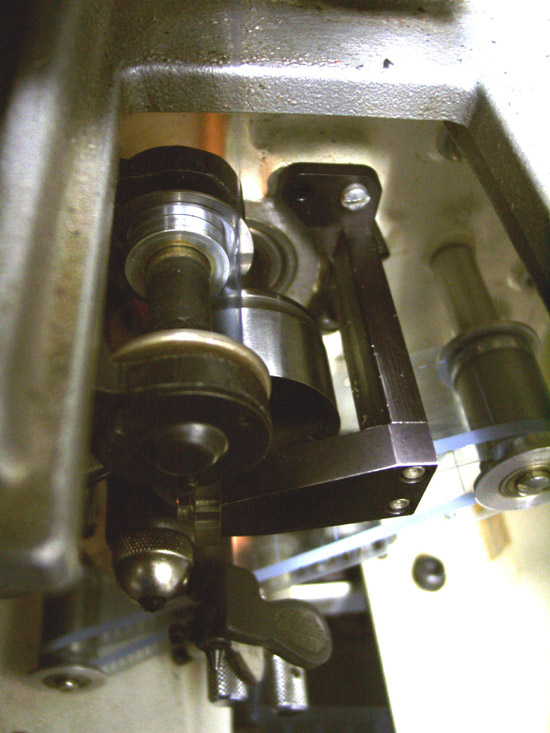
I have modified many 5 Star soundheads to eliminate this roller. I actually got around to taking some pictures of the modification earlier this year. Not sure if I posted them or not, but I'm sure I have them on my office computer. I'll upload a couple. Besides the obvious benefit to the film, the other nice thing is once modified, it's a done deal forever. There are no parts to wear. You can't do it on those old RCA/SH-1000 type of soundheads though.
Posted by Steve Kraus (Member # 476) on 12-02-2004, 04:38 PM:
I've never really understood the 5-Star design (and I own two). Tension and pressure roller? Is that like belt and suspenders? What's the logic? The Simplex 10XX and RCA designs divided the function of pulling film through the soundhead and take-up holdback between two sprockets but other than that the major difference is the solid flywheel on the 5-Star instead of the old fluid-damped one. Not sure if that account for the need to combine both techniques.
Posted by Dan Lyons (Member # 1454) on 12-02-2004, 05:13 PM:
My theatre has Century C's on top of RCA 1040 with the nasty rollers, they are segmented foam/rubber, not just one flat roller. On the rare occasion we recieve a new print, after only a week, or 14 shows, during breakdown the "track marks" on the emulsion from that roller can be clearly seen. I haven't seen any damage show up on screen, but it's obviously abrading the film.
Hopefully the RCAs will die soon and they'll get me some used Century soundheads. ![[thumbsup]](graemlins/thumbsup.gif) Damn things have been running since 1947! I'll take a photo of the threading pattern on it tonight at work.
Damn things have been running since 1947! I'll take a photo of the threading pattern on it tonight at work.
Below is the pic of the 5-Star modification.
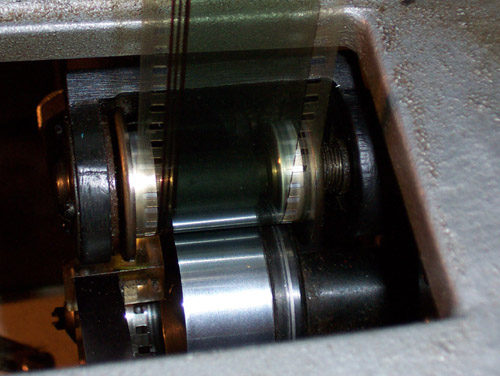
As promised, pics of the RCA 1040 threading pattern and roller. For use with a Century, close the pinch roller on the film, then pull it taught to the first soundhead sprocket, then back off two perfs. This gives the you the slack lower constant feed to the sound drum.
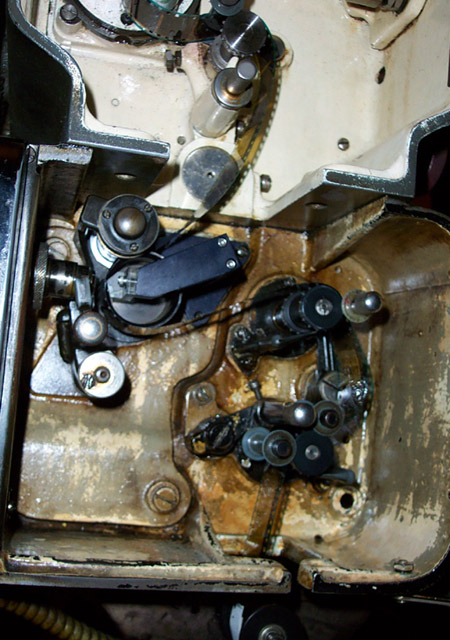
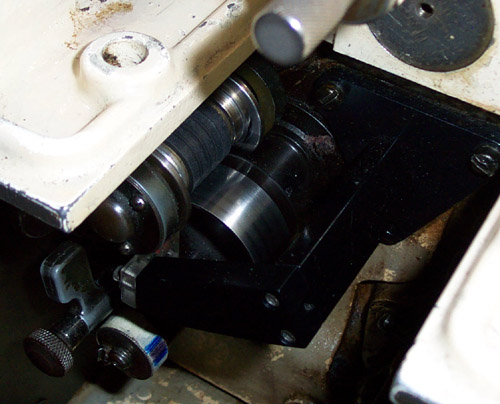
As you can see, these can't be modified. If you took out the rubber bit, the flanges would cup the film over the edge of the sounddrum, yuck! On the Simplex 5-star, see above, the inboard flange rests against the inner part of the drum.
Below are the "track marks" these icky things make.
[ 12-03-2004, 01:19 AM: Message edited by: Dan Lyons ]
Posted by Ian Joseph Parfrey (Member # 2682) on 12-03-2004, 03:59 PM:
Here's a few points to consider when "dissing" the RCA soundheads of old.
Many of you are bitching about the roller that is in contact with the film and the resulting "track marks" let by that dirt embedded roller and the fact that it is in contact with the film's picture area. Judging by the disgusting interior condition of that soundhead I'm not surprised that oil and shit is ending up on the film! Oil attracts dirt like the plague. Now, whether or not there is a full contact roller, that oil will eventually find it's way through the roll (platter or spool) and there is where you'll find oil mottling.... and THAT is going embed more dirt and cause more film damage than any roller.
And as oil attracts dirt, air-borne or otherwise, when the flm travels to and from the projector head, dirt is gunna stick like glue.
So you're complaining about those soundheads running since the 1940's????
This has got to be the first time of heard anyone complaining about a reliable bit of gear!!!AND you want the thing to shit itself so you can get a Century s/head. WOW.... and I do mean WOW is what you're gona get if you junk the RCA's for Century's.
Century make BRILLIANT projectors but the s/heads SUCK...SUCK...SUCK
RCA's with the double loose loop and mag-coupled flywheel have the lowest wow/flutter ratio in existance, why else would sound camera designs use similar methods????? And I'll bet 60 years after their manufacture they'll STILL have great specs.
I'm not one for waving the flag for all things American, but DAMN, those RCA guys nailed that design on the head, they knew their stuff and credit must be given where credit is due.
I'd be proud to have a bit of gear like the RCA's. (Incedently, I do have a pair of 1018-F's that do leave a bit to be desired)
So don't knock a bit of gear just because it's old and projectionists are too damn lazy to keep things CLEAN.
![[Mad]](mad.gif)
Posted by Brad Miller (Member # 2) on 12-03-2004, 04:31 PM:
I didn't know there was an I-30 in Australia! ![[Eek!]](eek.gif)
Posted by Justin West (Member # 920) on 12-03-2004, 05:28 PM:
So, a Century projector head was mentioned...and I am working on one and need some input: I have a Century C and I am missing one of the thumbscrews that hold the exterior plate over the gear-side base or the projector head. The steel plate is mostly cosmetic but I want to replace the missing thumbscrew. I tried to find something acceptable (like a hex head screw) at the hardware store and have found that neither of the threads they offer (coarse-20 or fine-28) will work on what essentially is a 1/4" diam. screw. Darned if the mfr (Century) hadn't made up their own thread count. It must lie somewhere between 20 and 28... can anyone advise (short of contacting a dealer for a replacement part)?
Posted by Dan Lyons (Member # 1454) on 12-03-2004, 06:31 PM:
quote: Ian Joseph Parfrey
So don't knock a bit of gear just because it's old and projectionists are too damn lazy to keep things CLEAN.
Watch your mouth sweetie, no need to insult me like that.
I keep those machines clean. The film path is spotless. What you're seeing is 50 years of oil stains and worn off paint.
I never said anything about oil on the film; none gets on my film , ever.
Posted by Scott Norwood (Member # 30) on 12-03-2004, 06:52 PM:
I've run lots of film on those RCA soundheads (and SH-1000s and 5-stars) and I've never seen "track marks" like the ones pictured above. I don't doubt that the "dirt embedder" roller is a bad idea, but I honestly can't say that I've seen any film damage that was directly attributable to it, as long as the rubber roller itself is clean and not caked in years of dirt from sitting idle.
As for Century soundheads, what's so wrong with them? They don't have any parts that touch the image area of the film, nor do they have the flaws of the Cinemeccanica V5 or Kinoton designs. (I'm not commenting on sound quality here...just potential for film damage and convenience to the operator.)
Posted by Tim Reed (Member # 137) on 12-03-2004, 07:07 PM:
That's right, Scott. And let's remember, guys, these were originally felt rollers. The track marks are from the rubberized "improved" version.
A Century on an RCA was a popular, and fair combination... especially from the reproducer's standpoint. It was a lot easier than driving a Brenkert on top!
Justin, I could've sworn a 1/4-20 screw was right for that cover.
Posted by Ian Joseph Parfrey (Member # 2682) on 12-03-2004, 09:14 PM:
My main gripe with the Century S/heads, the TR4 in particular, is the propensity to wow due to the one sprocket being used for hold back and take-up at the one time. My beloved RCA's always used two sprockets in the place of Century's one, one after the sound drum for hold back and one for takeup. This seemed to prevent any fluctuation in linear speed due to warped spools or eccentric platter rings. And it's harder to break down on the fly because film piles in the soundhead casting ![[evil]](graemlins/evil.gif)
I have never had an RCA wow on me under any circumstance and just reckon that they are the best bar none. Solid, Dependable, Gentle on film, Reliable. Isn't that what all gear should be?
How can the Christie "Ultamittant" get an oscar when those pieces of shit don't deserve it and the RCA gear doesn't has got me stuffed!
Posted by Brad Miller (Member # 2) on 12-03-2004, 10:42 PM:
That extra sprocket doesn't have anything to do with wow. You probably ran some Centurys with bad bearings.
Also, RCA heads are NOT "gentle on film". Geez, do you really not understand?
Posted by Will Kutler (Member # 770) on 12-04-2004, 02:10 AM:
Dan, those machines look filthy!
2 suggestions for you:
What kind of shape are the sound-drum casting isolators/insulators in?
Have your replaced the sound drum bearings with sealed type so that you do not have to fill the sound drum casting up with oil?
There are some excellent gasket material out today that will help prevent gear-box leakage. Another thing, is the gear-box cover warped? If it is, a machine shop can straighten that out, but you may also need to make up the difference with gasket material thickness...such as is done on auto-engines (different thickness of head gasket).
Also, make sure that you correctly tighten the gear box down in a correct criss-cross pattern, and dont over torque the screws!
And don't over fill them with oil!
Properly cleaned and maintained, those ole RCA's should run like a dream.
And if you are so inclined, a motor shop can clean up the motors and replace the greaseable bearings with sealed ones!
Cheers
K.
Posted by Brad Miller (Member # 2) on 12-04-2004, 02:32 AM:
Will, I've been to Danny's theater and the film path IS spotless. You are making your comments based upon the cosmetic issues of many decade's time. Besides, why in the world would someone want to take a lousy soundhead and restore it when there are BETTER soundheads, like the Century, available on the used market for much less than that boat anchor could be "prettied up" for?
Posted by Mark Gulbrandsen (Member # 72) on 12-04-2004, 08:38 AM:
quote:
RCA's with the double loose loop and mag-coupled flywheel have the lowest wow/flutter ratio in existance,
I'm not sure what planet this guy is from but he's wrong on both statements above.... its got to be that I-30 stuff!
The flywheels on RCA cinema soundheads are not magnetically coupled they are oil coupled... if the oil has not leaked out over the years which many do. And secondly the sound reproducer with the lowest flutter specs that I have actually measured is the Kalee 21 @ .07-.09%. The RCA and Simplex SH-1000 flutter specs are typically the same at .15-.25%... depending on what projector head is mounted on them, Brenkert heads on an RCA increase that spec to a bit over .3% and thats why RCA came out with the 9050 and the projector drive arrangement off the lower sound reproducer sprocket shaft. I have never measured a 9050.
The only magnetically coupled cinema soundhead stabilizers I am aware of are the Cinemecanica V-10(not all of them were), and the Century R-2. There may have been other European machines with that feature but definately NOT RCA. Many R-2 flywheels have also become somewhat de-magnetized over the years!!
Ian, when was the last time you ACTUALLY MEASURED W&F of any sound reproducer? I don't think you ever have.... You also need to cut open an RCA flywheel and learn how the thing works ![[Roll Eyes]](rolleyes.gif) . Weather the RCA cameras ever had magnetic coupling is also debatable and may depend on when the camera was actually manufactured. The RCA cameras I've seen fo not and use the idential oil damped flywheel. I have books on many of the various sound cameras if you'd like me to look it up and see.
. Weather the RCA cameras ever had magnetic coupling is also debatable and may depend on when the camera was actually manufactured. The RCA cameras I've seen fo not and use the idential oil damped flywheel. I have books on many of the various sound cameras if you'd like me to look it up and see.
quote:
How can the Christie "Ultamittant" get an oscar when those pieces of shit don't deserve it and the RCA gear doesn't has got me stuffed!
Why shouldn't it deserve a technical oscar? It is the first and only totally sealed movement that doesn't ever leak in 99% of its installations. Of the many thousands sold very few movements actually ever fail thanks to its special synthetic oil. The Christie projector when properly maintained on just a yearly basis is not at all bad and the latest version with the new belt drive scheme which has eliminated the double sided timming belt is a very efficient mechanism indeed. Its soundhead W&F specs are actually far better than the RCA or Simplex.
Danny,
Those RCA's interiors speak for themselves of the years of service they've given!! They have a nice patina to them. Century reproducers are ok and have fewer moving parts, expect the stabilizer performance to give you W&F specs somewhere around .25%. Just be sure that any Century that gets installed has all ball bearing dancer arm rollers and that the output roller at the bottom is also ball bearing. The R series reproducers that have bushings on the sprocket shaft actually have a tad bit better W&F spec than the later ball bearing variety do... but they need oiling once a month.
Justin,
Try Wolk for that thumbscrew, or run a 1/4-20 tap in both of those dang holes and change the thread. There is enough metal there to do it because the 1/4-20 threads are taller than the fine thread. I've done that on several occasions and it works juat fine, just use a two flute tap and tapping fluid when you do and back the tap back out to clean off the chihps about every turn or two of the tap. The latter two might cost more to buy that the correct thumbscrew though. The original is an odd thread for what ever reason..... Probably the only really dumb aspect of the Century head.
Mark @ CLACO
Posted by Steve Kraus (Member # 476) on 12-04-2004, 09:07 AM:
Not gentle for any reasons besides the roller?
With both RCA and Simplex going to a fair amount of trouble to have two sprockets to divide functions I think it's safe to presume that it does provide a certain amount of isolation from takeup anomolies. With a platter the tree or arm should keep things fairly smooth but with reels if a funky reel is causing some glitches in take up tension every turn it's hard to see how that wouldn't have at least some effect on smoothness of film motion by the scanning drum.
Posted by Mark Gulbrandsen (Member # 72) on 12-04-2004, 09:17 AM:
Steve,
You're absolutely correct. Bad reels, a bad or improperly adjusted or maintained take up can actually be heard and quite easily. Ditto for the 5 star and the el crapo 35/70 X-L free wheeling penthouse!! During a screening of L.O.A. at McClurg court that wow was very definately audible near the end of a reel on just one projector when it was spinning its fastest.
Mark @ CLACO
Posted by Will Kutler (Member # 770) on 12-04-2004, 01:46 PM:
"Restoring" that RCA is not really that expensive or time consuming.
Actually, some bleach, household cleanser or paint cleaner will easily remove all those stains!
On the other hand, dissassembly/reassembly of the unit (outside of projector alignment) is not really that time consuming.
Take all the castings to the powder coater and either have them powder coated or epoxy painted. Now, some powder coaters may have a minimum charge regardless of the job. Or some might due a quality job at next to no cost...if a "standard color" like black or machine grey is used, and your job can be ganged to other orders. For example, I had a non-cinema related project I was working on. One powder coater had a min $100.00 charge, period. Another quality powder coater was only going to charge me $15.00, as the standard color was to be ganged with other simialr color orders.
The rubber isolators/insulators and pad roller costs are peanuts. THe expensive part is the slit lens (if you need to replace it due to oil penetration), the bearings and sprockets if need be.
As for projector motors, they basically have the same specs as household motors that yopu can purchase at Ace Hardware, Home Depot or the like. And these motors run $50.00 or so, whereas projector motors are ungodly expensive!
Why are projector motors so expensive? We have had this discussion in other threads, but the projector manufacturers attempted to bullywink customers by putting "special" specs on the data plates, while at the same time incorporating specially tapered winding shafts that connect to the soundhead.
Notice that these new store bought motors will also fit in the origonal motor cradles. In fact, the same cradles are avaiable at the local home-improvement stores, they are just stamped from a lighter gage metal.
Who knows, maybe with some ingenuity, new store bought motors might be adaptable to those older Simplex/RCA soundheads?
Cheers
K
Posted by Mark Gulbrandsen (Member # 72) on 12-04-2004, 03:29 PM:
Will,
Lemon scented oven cleaner works the fastest and is the safest on yourself. Use of bleach or other chemicals might land you in the emergency room.
Als, no one is using slit lenses any more...... Store bought motors..... might on xome Centurys but then there is the flywheel thing to deal with.
Mark
Posted by Tim Reed (Member # 137) on 12-04-2004, 04:55 PM:
quote:
RCA's with the... mag-coupled flywheel
Century R-6's had magnetic damping, too. But Mark's right, RCA's didn't.
Posted by Will Kutler (Member # 770) on 12-04-2004, 05:55 PM:
Hi Mark...
I need to look at the situation a little closer, but maybe there is the possibility of a machinist being able to design a simple motor-soundhead coupling so that a standard motor could be used?
Cheers
K.
Posted by Paul Trimboli (Member # 1509) on 12-04-2004, 08:21 PM:
Will was talking about getting the soundhead powdercoated and have read others talking about it before. How do you deal with covering up parts of the castings like where bearings would be installed? The reason I say this is becuase if you masked the holes up they would then chemically strip it. So do you strip it yourself or do you just got back and mask the holes before its powedercoated? Has anyone powdercoated a Simplex Standard before? Again similiar questions to masking it.
Posted by Luciano Brigite (Member # 1104) on 12-04-2004, 08:24 PM:
I worked with Simplex projectors for about 5 years with both SH1XXX and 5 Star soundheads and never had any problem with markings on the film because of their rubber or felt roller. Even on prints that ran for over a month (Ie Titanic) in the same machine then switched to another theatre ,ran for more 3 weeks then back, nothing was detected on the image area.The wear on the film edges was the only noticeably thing on them.
To add some insult to it, I got to see a few Simplex and RCA reproducers with the rubber roller and side guides replaced by a one piece,entirely metal roller, yes the part that should be felt or rubber was metal and even that way, did not see damage on the print.
Also during all that time never had a gearbox leaking oil in any of them.even on the pair of RCAs I ran recently nor in the 9030 SH I'm rebuilding ATM.
Regarding off-the-shelf motors , the 9030 I'm rebuilding, along with everything else (lamp,projection head,pedestal) is driven by a motor of that kind. I just had the motor's shaft redone in a machine shop to get rid of a rudely done job on it. the damaged part of it was cut and a new, longer shaft soldered in place then machined to diameters required to fit the flyweel,some tap'd length for the flyweel retainer and the coupler "star". The coupler is not the original one often found in those heads, the one I have is made of two gear-like machined parts that matchs the same pattern made inside a round nylon block. one part goes on the motor's shaft and the other on the gear box's. once the motor is loose from it's base, pulling it away is all that's needed. the nylon block also comes out and the entire gear box can be removed then .
Posted by Will Kutler (Member # 770) on 12-04-2004, 08:41 PM:
Hi Paul
Usually the powder coater will do the stripping for you, and is included as part of the service charge. It is usually done by media blasting. Clean media is usually used to prevent surface prep contimination, and media blasting will also help with coating adherence. Media blasting is technical, and correct media and technique must be done so that the part is not actually ruined.
You need to specify what surfaces are to be masked. Besides taping, there are various types and sizes of plastic plugs and caps specifically made for masking machined surfaces on industrial equipment as preparation for paint finishing. The powder coater should have these. And if not, then auto body/paint masking tape (that wont leave unwanted residue like regular masking tape) can be used.
Cheers
K.
Posted by Pete Lawrence (Member # 130) on 12-04-2004, 09:32 PM:
Did I start something I shouldn't have? Maybe those of us that like RCA sound heads should line up on one side of the street and everyone else on the other side. Then we could throw old trailers at one another.
Seriously, I do agree with Brad that the rubber roller is a real weak spot in the design, but I'm not ready to toss them in the bay yet. Even though the bay is only a block away. I do use Film Guard and haven't seen any roller marks.
As to Will's comments about the motor and slit lens...
The original slit lens can be easily disassembled and cleaned if it's full of oil. I've done several of them. Would I use them in an operating theater? No, of course not. There would have been reverse scan readers in there, but for a home screening room allowences can be made. I have replaced the originals with narrow slit ones. The budget hasn't allowed for reverse scan, yet.
The motors on RCA heads are another matter. Flywheels, special shafts, and couplings aside, the book says they must be 1765 R.P.M., not the readly available 1725 R.P.M. ones. Only about 2.3% difference in speed, but enough to be wrong.
One mans "patina" is another mans "gunk". That's easily cleaned off and there's really no excuse for it being there.
Posted by Michael Wilkinson (Member # 2389) on 12-04-2004, 10:01 PM:
With almost all prints in digital anyways. How big of a deal is .3%?
As for the rubber roller-Yes I do see some marking on the film at tear down. However in running a print 4 shows per day for 7 weeks I did not notice anything which detracted from the presentation.
If anyone has a workable pad roller replacement, please let me know.
I look at the 9030 as a great workhorse. They have run for nearly 60 YEARS and could probably go another 60! They start smooth which I believe is also a plus.
Once again with the optical sound now basically a back up, why would I want to change them out??? Oh yes, I just drove 250 miles to save three orphaned 9030's from going to the scrapyard!
PS Brad-If you have a boat-I could send you a couple of castings so you could live out your little fantasy.
Posted by Steve Kraus (Member # 476) on 12-04-2004, 10:13 PM:
Here's an interesting question: Is there really a difference in the gear ratio from input shaft to sprockets between the RCA's and the Simplex 10XX?
BTW, what's the difference between the motor that does 1765 vs. 1725? Same basic type of motor, isn't it? You have so many poles on the rotor and so many poles on the stator and 60 Hz. power, yes? It chases sync but unlike a sync motor doesn't catch it. So it lags and isn't the amount of lag largely due to loading? Are these really different motors or is there a difference in someone's interpretation of nominal speed?
Posted by Will Kutler (Member # 770) on 12-04-2004, 11:07 PM:
Some time ago, I asked a few very experienced (older and wiser ) FT members about the 1725 vs 1765 rpm differences in motors.
The answer I received was that the projector motors are actually the standard 1725 rpm, and that the 1765 rpm info was used to encourage customers to purchase the more expensive motors from the projector/soundhead manufacturers.
However, if there is any doubt, a small motor repair shoppe can run the motors on a test stand with a tachometer to see what is true !
Cheers
K.
Posted by Pete Lawrence (Member # 130) on 12-04-2004, 11:16 PM:
quote:
How big of a deal is .3%?
Well, it's 2.3%, not .3%. I know musicians that would go ballistic if their recordings were played back with that much error. With regard to digital sound, the error has to be made up somewhere, probably by a pause or skip periodically. As to traveling that far to save a couple RCA heads, I'd do the same thing. Way to go Michael. I drove from NY to FL and back one weekend to save a pair of 1040's.
As to Steve's question. The amount of lag or slip is controlled by design. Motor speed is usually quoted at full load, whatever that may be. Four pole sychronous speed is of course 1800 R.P.M. Non-synchronous four pole induction motor speed is always less and a balance between running torque, starting torque, starting current, rotor resistance, and assorted other characteristics. Instead of my posting a bunch of links, do a Google search on "ac motor slip" and you will find many detailed articles discussing it.
Edited to add the following about Will's comment...
Based on the RCA books for 60 Hz the bronze sprocket gear is 49 tooth, the drive shaft pinion is 10 tooth and the film sprocket is 4 frames per revolution. So 24 frames per second equals 360 R.P.M. for the sprocket. The motor shaft should rotate at 360 X (49/10)R.P.M which is 1764 R.P.M. That seems pretty straight forward to me. Does a 1/3 HP, 1725 R.P.M motor run close to that when driving a projector and sound head load? I can't answer that.
Posted by John Hawkinson (Member # 1135) on 12-05-2004, 02:02 AM:
With regard to digital sound, the error has to be made up somewhere, probably by a pause or skip periodically.
Nope. All 3 digital formats speed up or slow down their rate to match the film rate. No skips, jumps, pauses, or double dutch.
--jhawk
(Though if there was to be double dutch, obviously SDDS would be the one to do it.)
Posted by Ian Joseph Parfrey (Member # 2682) on 12-05-2004, 04:36 AM:
Pete.
Good to see you've started this RCA thing. It's a passionate thing when it comes to what someone likes and dislikes. That's probably why we don't have just one make and model of projector/soundhead/lens &tc. Mind you, if I had my choice........
Mike.
I'm getting a boat!!!!!!!!!!!!!!
Posted by Mark Gulbrandsen (Member # 72) on 12-05-2004, 08:34 AM:
quote: Paul Trimboli
Will was talking about getting the soundhead powdercoated and have read others talking about it before. How do you deal with covering up parts of the castings like where bearings would be installed? The reason I say this is becuase if you masked the holes up they would then chemically strip it. So do you strip it yourself or do you just got back and mask the holes before its powedercoated? Has anyone powdercoated a Simplex Standard before? Again similiar questions to masking it.
Chemically stripping any projector part with critical tolerances is the only way to preserve those tolerances. There are others that will tell you that certain types of abrasives are ok to use but by experience in refinishing hundreds of pieces of projection equipment I have found that to be very false. Abrasive blasting not only removes the machined finish but it also does this in a very uneven fashion because its all done by hand. The only other method that might work that I have yet to try is extremely high pressure water blasting. There are only a few p[laces in the U.S. that do that sort of operation.
As for powder coating.... environmentally its a great thing and from a quiality standpoint its excellent if applied peoperlym has to be just the right thickness. Masking is done with a special high temperature green colored plastic like tape that is available in alot of different sizes, use it just as you would macking tape. Holes are plugged with high temp cork like plugs that come in a myrad of sizes. Several things to be aware of if you powder coat is that any casting that has been subjected to lots of oil must be properly cleaned before coating. If its not properly cleaned it will bleed oil and ruin the finish at that spot leaving a big splotch with no paint adhering. Castings cannot be preperly re-powder coated once that have been coated. Since the coating is so tough it pretty much has to be machined off before that could happen... so you pretty much have one chance to make it come out looking good! You can also have problems with air bleeding out of castings that will leave you pin holes in the finish..... Very large castings cannot be powder coated because the casting has to evenly heat up for the paint to fuse properly... even preheating it wown't work on something the size of a DP-70 main casting.
Hope this helps.... and don't sand blast anyting with machined surfaces!!!
Mark
Posted by Steve Kraus (Member # 476) on 12-05-2004, 08:36 AM:
So then how many teeth on gears & pinion in the Simplex gearbox?
Posted by Mark Gulbrandsen (Member # 72) on 12-05-2004, 10:27 AM:
RCA and Simplex are the same... just different hubs on them.
MArk
Posted by Will Kutler (Member # 770) on 12-05-2004, 12:05 PM:
Yes Mark
Any part with machined surfaces needs to be given extra attention when media blasting. As I previously stated, there are proper ways of masking off those machined surfaces when preparing to media blast.
Furthermore, care should also be taken when chemical stripping. Damage can also be done with these methods, if the correct chemicals and procedures are not followed...namely immediate corrosion caused by water and water based chemicals, and possible material removal caused by surface-prep etchants.
Cheers
K.
Posted by Bob Koch (Member # 1062) on 12-05-2004, 02:25 PM:
About 1947 RCA supplied a metal roller to replace the felt one used prior on all RCA stabilizer soundheads similar to some Western Electric reproducers. I changed to this on all reproducers on my run. Then came the "rubber tired" roller[#51961]. Some of the first were eccentric, making the pressure roller move rapidly up and down on the film. Some damage was reported{the rubber tire mark] to film but in those days [changeover remember] it was usually traced to one machine only which was usually found to be bad stabilizer or pressure roller bearings or improper assembly of pressure roller shaft and split ring. All in all I liked the soundhead although when you had a Brenkert on top of it you were putting on overalls and doing a gearbox rebuild every year or so. If you had an XL that was the end of doing the rebuilds.
Posted by Mark Gulbrandsen (Member # 72) on 12-05-2004, 02:28 PM:
We use a local place called "The Stripper" ![[Cool]](cool.gif) and they use an industrial grade paint remover on our stuff. When you get the castings back they look like new... they are also reasonable. I've also used Redi-Strip as well for really huge batches of castings and they always did a really nice job on them as well. Unfortunately most of the Redi-Strip locations are no longer because they used Sodium Cyanide(in hot tanks)as the stripping agent. They are still in operation in a few states and in Canada though.
and they use an industrial grade paint remover on our stuff. When you get the castings back they look like new... they are also reasonable. I've also used Redi-Strip as well for really huge batches of castings and they always did a really nice job on them as well. Unfortunately most of the Redi-Strip locations are no longer because they used Sodium Cyanide(in hot tanks)as the stripping agent. They are still in operation in a few states and in Canada though.
Mark
Posted by Will Kutler (Member # 770) on 12-05-2004, 02:51 PM:
Hi Mark
Thank you for mentioning Red-Strip. They have a location in the Phoenix, AZ area...Mesa or Tempe, I believe.
Anyhow, I am interested in your feed-back regarding this company, as they have recieved much publicity in automotive restoration circles.
What I understand, this is one of the few companys that will do a full emersion tank strip of an entire car body, as their process can get to areas not accessable to dry media blasting...especially in unitized construction car bodies.
From what I understand, they use a two-tank process, the first strips everything, and the second kills corrosion.
They state that their process is non caustic, so metal thinning via caustic etchant chemicals is not a problem.
Cheers
K
Posted by Michael Wilkinson (Member # 2389) on 12-05-2004, 03:53 PM:
Well Bob,
I guess you would know.
I'm glad to know of an RCA tech....10 miles from here. How come you've never come by and said howdy?
Assuming that you must have serviced this booth once upon a time...I bet you didn't know I still have the original Photophone, Amp, Speaker, attached to the #2 machine...and even the EN-ARC with a new metal mirror! Not to mention the VOM record player or the stereopticon with color wheel! Yes-I keep it all going just for me. I wish I had the space for the matched pair in the booth.
RCA RCA RCA RCA. I think I'll try to bring the 9030 back into production just for those of you who like them (in spite of their shortcomings). Anybody know where the original mold and tooling is? ![[beer]](graemlins/beer.gif)
Bob,
You'll have to come over and play sometime.
Posted by Richard Fowler (Member # 893) on 12-05-2004, 05:19 PM:
The 9030 is still in production in India using the original tools and molds. In 1959 the tools and molds where sold to Toshiba Japan under the Photophone label and later sold to an Indian manufacturer....still built in cast iron. It is usually sold with a Photophone P35 projection head.....
Posted by Michael Wilkinson (Member # 2389) on 12-05-2004, 09:47 PM:
I'm not sure if that's good thing or not considering where Cine ![[bs]](graemlins/bs.gif) a and Monee come from.
a and Monee come from.
Anybody have a picture???
Oh joy-brand new boat anchors. And to think all of this time that they were long out of production.
Posted by Richard Fowler (Member # 893) on 12-06-2004, 08:15 AM:
They run much better than you think When I get the time I will send Brad their parts manuals
Powered by Infopop Corporation
UBB.classicTM
6.3.1.2